





Skywatchers heading outdoors in November 2026 can view two separate meteor showers, an orbital pairing of bright planets, and a lunar display that opens a series of three full supermoons. NASA skywatching tips outline several key events during the month, beginning with Taurid fireballs and concluding with a bright lunar disk rising against evening horizons. The schedule also features a notable distance threshold as the Voyager 1 probe continues outbound travel through deep space [1].
Viewing Taurid and Leonid Meteors
NASA Science writers Amanda Barnett and Raquel Villanueva note that the month presents two separate streams from the Southern Taurids and Northern Taurids, both radiating from paths linked to the constellation Taurus. Southern Taurid activity crests near November 5, while Northern Taurids peak around November 12. Under clear skies, each stream generates only about five meteors per hour. But both streams are known for producing occasional fireballs that burn brightly over long paths, making patience at night worthwhile for skywatchers. These meteors move at modest speeds, creating slow visual tracks that stand out clearly against background stars [1].
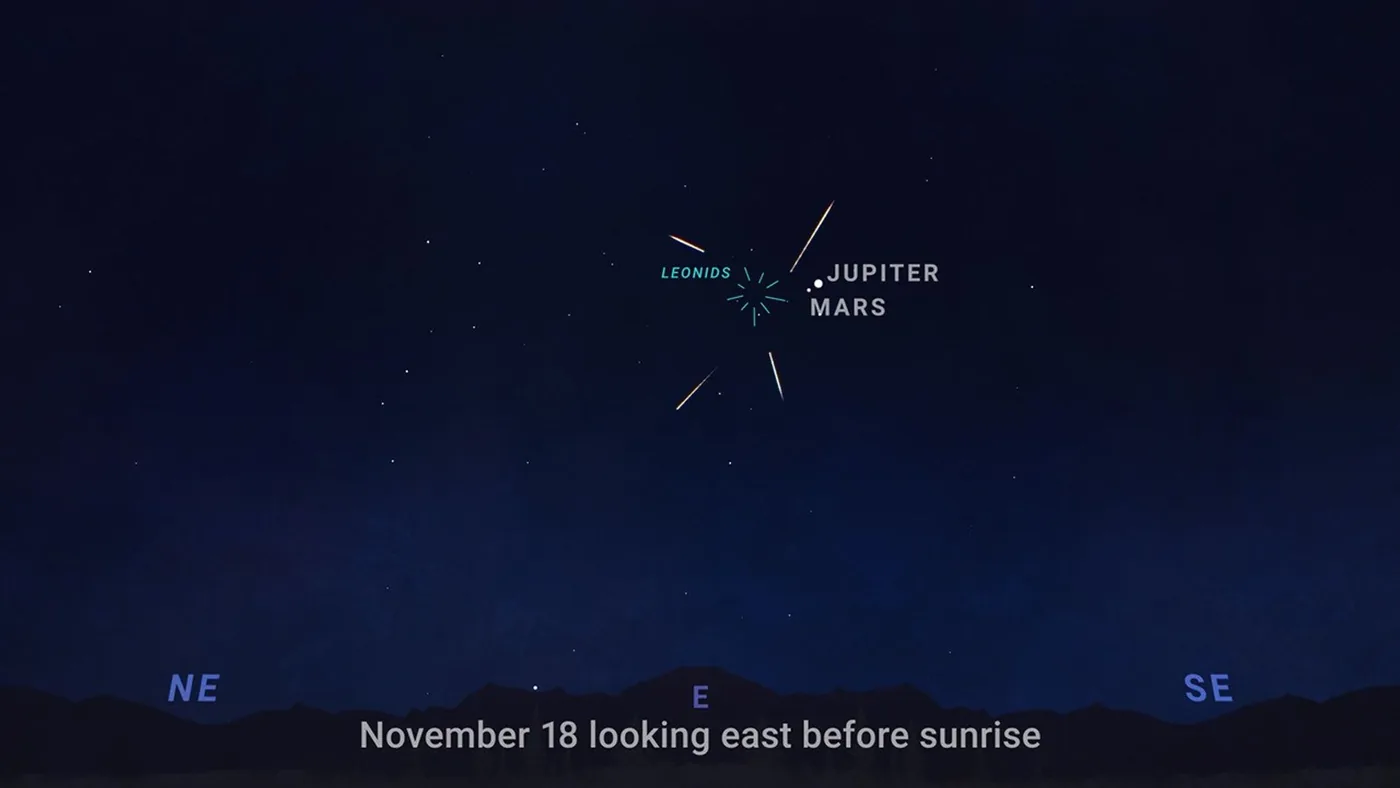
Activity picks up mid-month when the Leonid shower peaks before dawn on November 17 and 18. Observers watching after the Moon sets can expect up to 15 meteors each hour under clear dark skies, though most locations see fewer [1]. The friends of NASA report notes the video guidance runs 3 minutes and 34 seconds, giving observers sky maps that plot the Leonid radiant near Mars and Jupiter [3].
Mars and Jupiter Conjunction
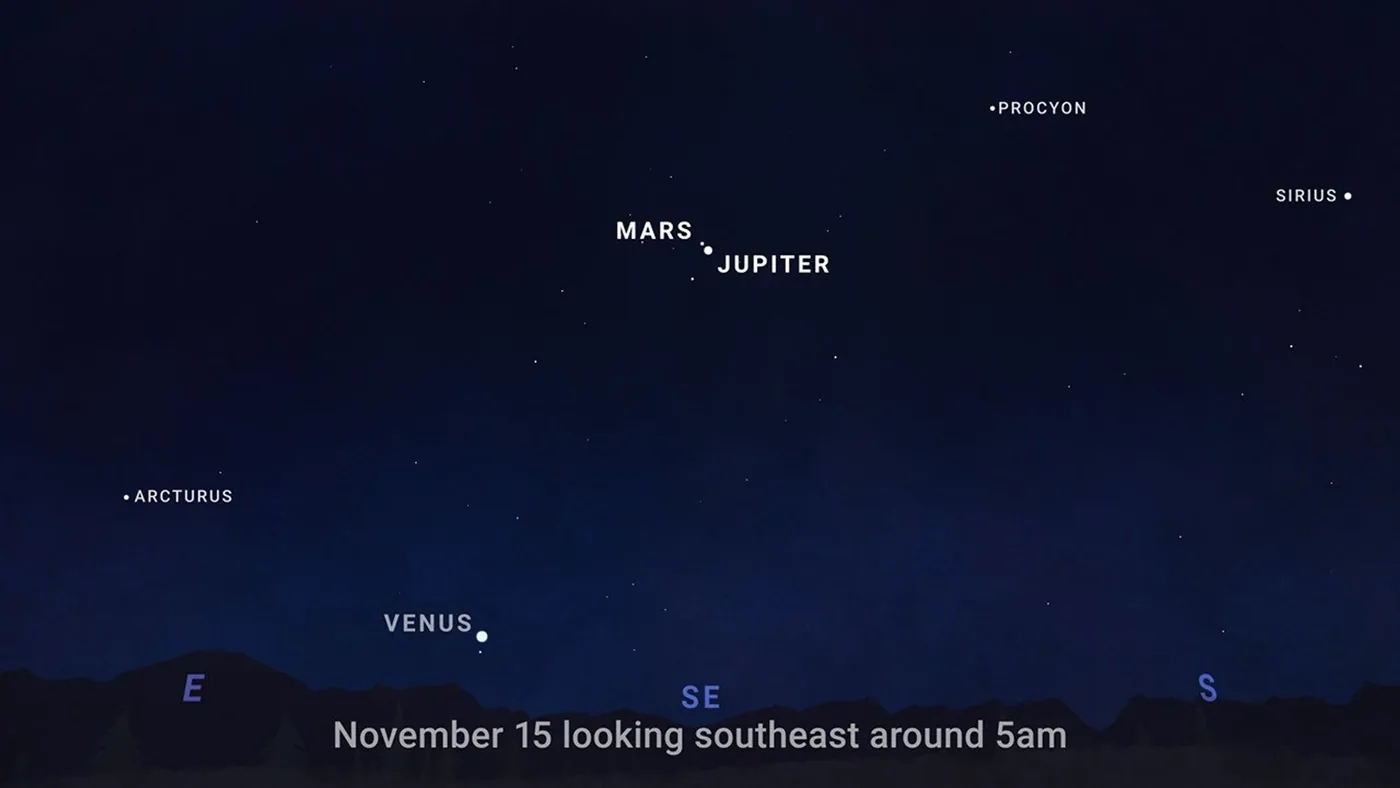
Early risers can spot an alignment on November 15 and 16. Looking toward the southeast before dawn, watchers will see Mars and Jupiter appear just 1.2 degrees apart in the morning sky, a visual gap only slightly wider than two full Moons placed side by side. Jupiter is brighter. Mars displays its reddish glow beside it, and both planets remain visible to the unaided eye without telescopes or binoculars. While both worlds sit separated by hundreds of millions of miles in deep space, Earth’s orbital line of sight places them into this tight visual arrangement [1].
Watching over several successive mornings lets observers track dynamic orbital motion across the sky. The two planets drift closer together through mid-November, reach their closest visual spacing, and then begin separating along their independent paths. Brilliant Venus also sits low between east and southeast near the horizon, completing a bright morning planet display before dawn twilight washes out faint stars [1].
Voyager 1 Light-Day Marker
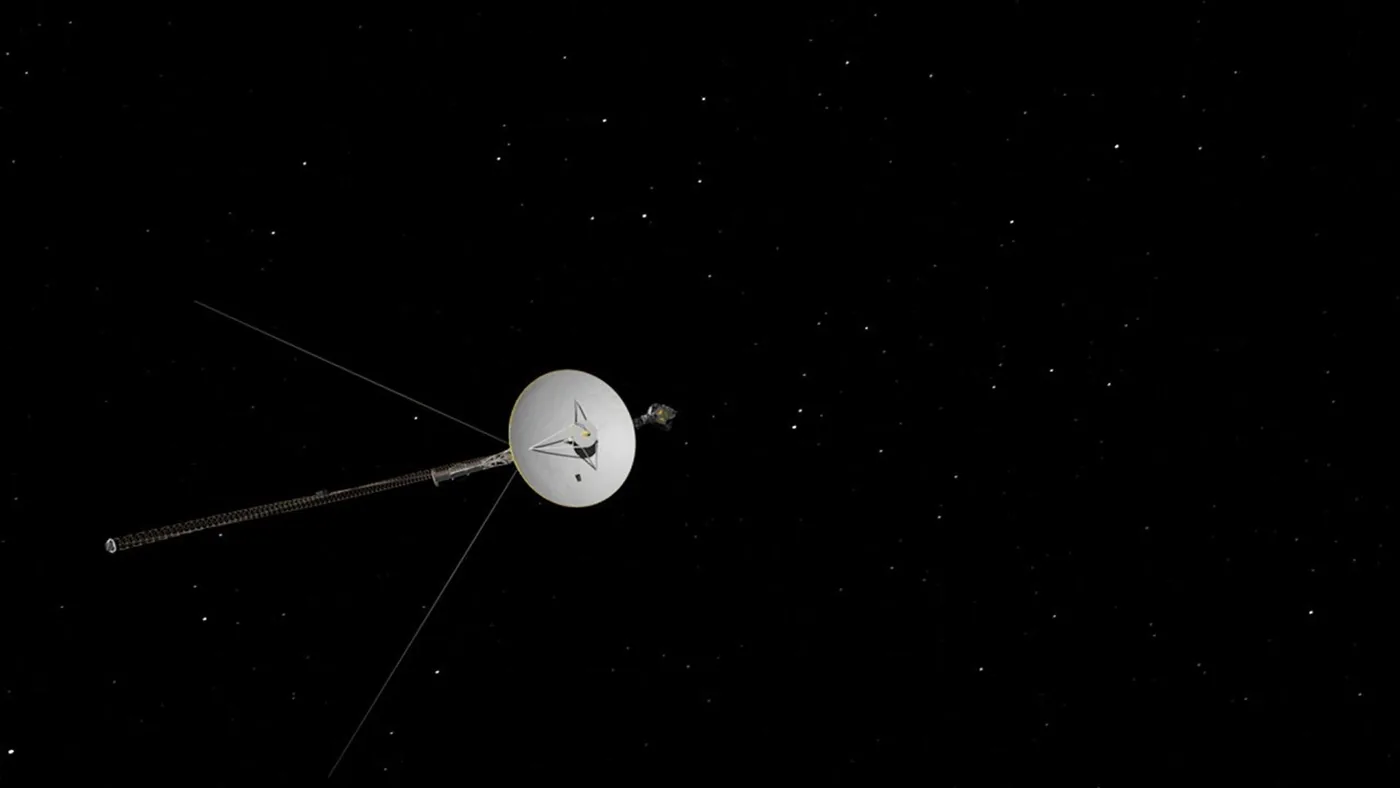
Deep space tracking marks a notable distance threshold on November 17, when the Voyager 1 spacecraft reaches one light-day from Earth. That distance means radio signals traveling at the speed of light need 24 hours to reach the robotic explorer, and another 24 hours pass before ground stations receive a reply. Launched decades ago, it is the first human-built craft to travel this far from our home planet. Skywatchers who want to picture where the probe travels can look toward the constellation Ophiuchus (the Serpent Bearer) during evening hours. NASA invites the public to mark this event on November 17 through the Shine Bright for Voyager’s Light-Day activation at its project portal [1, 3].
Data collection from distant craft continues to inform deep space communication strategies across scientific institutions. Long-range telemetry links provide practical engineering lessons, connecting early robotic exploration with ongoing research into NASA Cosmic Origins mission planning for next-generation astronomical observatories. Following the path of distant probes helps the public connect visible night constellations with real exploratory journeys in deep space [1].
November Supermoon
The full Moon on November 24 will shine as a bright supermoon, rising in the east around sunset. Lunar orbits are slightly oval. Because that elliptical orbit causes Earth-Moon distances to change over time, full Moons near perigee look slightly larger and brighter than usual. As host Raquel Villanueva said, “When it’s closer, the full Moon appears larger and brighter than average – though the difference can be subtle”. Observers watching the Moon rise near the horizon also experience the Moon illusion, an optical perception that makes the low disk look remarkably prominent against silhouettes of buildings and trees [1].
This event opens an unbroken series of three consecutive supermoons spanning November, December, and January [1, 3]. Lunar observers can follow shifting illumination across the calendar all month. November starts with a Third Quarter Moon on November 1, followed by a New Moon on November 8. The Moon reaches First Quarter on November 17, peaks as a Full Moon on November 24, and finishes with another Third Quarter phase [1].
Using NASA Skywatching Tips for Best Visibility
Dark skies matter. Heading away from streetlights into rural parks gives observers the best opportunity to spot faint meteors streaking across cold November air. Eyes need about thirty minutes to adapt to darkness, making it important to keep smartphone screens tucked away in pockets during observing sessions. Because binoculars or telescopes restrict vision to a tiny slice of the heavens, lying back in a reclining lawn chair and scanning as much open sky as possible produces the highest meteor counts. Warm clothing helps [1].
Moonlight directly affects meteor watching during early morning hours. For the Leonids, waiting until after moonset in the predawn hours keeps moonlight from washing out faint shooting stars. In contrast, bright targets like Mars, Jupiter, and the November supermoon do not need dark sky parks. Following NASA skywatching tips helps observers recognize that these brighter bodies shine clearly even through moderate suburban lighting [1].
Behind the NASA Skywatching Tips Video Series
Behind the monthly video summaries sits a creative team that has documented night skies for nearly two decades, as detailed by Lindsey Tran. “What’s Up” is NASA’s longest-running web video series, premiering in April 2007 with original host Jane Houston Jones. The show was later guided by host-producers Preston Dyches and Chelsea Gohd before transition to its current staff. Today, Raquel Villanueva produces and hosts the episodes at the Jet Propulsion Laboratory in Southern California, collaborating closely with video editor Christopher Harris and animator Lisa Poje. Astronomy specialists at JPL, including Bill Dunford, supply ongoing subject-matter guidance with support from social media team members, while the team honors the lasting legacy of Gary Spiers. Earlier installments covered events including Saturn at opposition, Orionid meteors, the Harvest Moon, Neptune, Venus near Antares and the Teapot, and lunar paths drifting beside the Pleiades cluster [2].
The video series helps translate orbital mechanics into accessible guidance for amateur observers around the world. Educational programming from the laboratory coordinates with wider public science efforts, such as the NASA Space Apps challenge, encouraging people everywhere to engage directly with real space data. Through straightforward celestial maps and viewing suggestions, these monthly guides help observers of all skill levels step outside and understand the motion of the planets overhead [1, 2].
- WEBSITE Barnett, A., & Villanueva, R. (2026). What’s Up: November 2026 Skywatching Tips from NASA. NASA Science. [Article Link]
- WEBSITE Tran, L., & NASA Science Editorial Team. (2023). What’s Up: Skywatching Tips from NASA. NASA Science. [Article Link]
- WEBSITE Friends of NASA. (2026). What’s Up for November 2026? Skywatching Tips from NASA | JPL. Friends of NASA. [Article Link]
APA 7: PerEXP Teamworks. (2026, November 3). NASA Skywatching Tips Guide November 2026 Observers. PerEXP Teamworks. https://perexpteamworks.com/en/nasa-skywatching-tips-november-2026/


