






Where oceanic plates slide beneath continents, volcanic chains called continental arcs rise along plate boundaries. These belts do not erupt at a steady pace. Instead, they undergo episodic pulses known as flare-ups, during which magma enters the crust at rates up to 20 times above background levels. A study in Tectonics by Sourav Karmakar and colleagues shows how North Cascades geology recorded one of these surges between 79 million and 60 million years ago [3].
Magma Surges in Continental Arcs
Continental volcanic arcs form Earth’s largest sites of intermediate magmatism, stretching for thousands of kilometers along active subduction margins where oceanic slabs sink beneath overriding continental lithosphere. Magmatic output within these mountain belts varies over tens of millions of years. Long intervals of quiet volcanic lulls alternate with episodic flare-ups that add huge volumes of plutonic rock to the crust. Plutonic and volcanic rocks in these arcs straddle the compositional boundary between andesite and dacite. About half of that material comes from newly added mafic melt from the mantle, while the rest differentiates from residual materials deeper than 40 kilometers [8]. As ascending melt cools, large magma bodies crystallize at depth to build granitic batholiths that anchor continental mountain systems.
Did horizontal tectonic compression squeeze the crust first, forcing melt-fertile rock to depths where high temperatures triggered the surge? Or did mantle melt inject into the crust first, heating the lithosphere and causing it to thicken? In the North Cascades of Washington, deep sections of an ancient arc active between 150 million and 50 million years ago provide direct access to crystallized magma chambers that cooled deep within the Cretaceous crust [2].
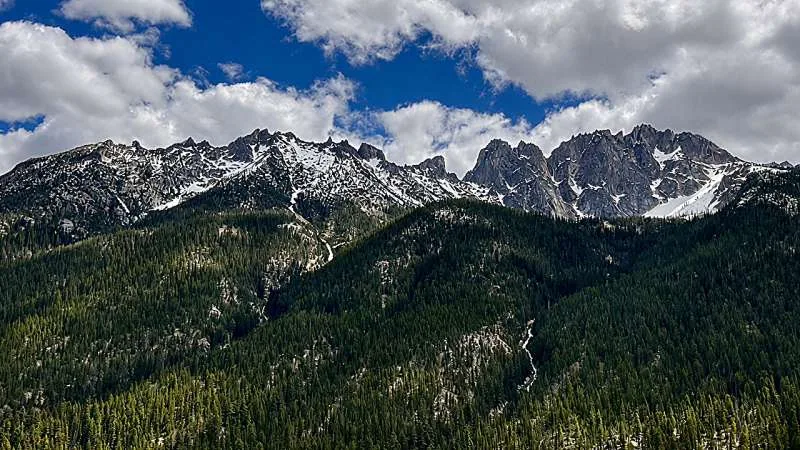
North Cascades Geology and Terrane History
The bedrock of the North Cascades is an intricate collage of accreted terranes rather than a single continuous landmass. Studies of rock magnetism and marine fossils indicate that these crustal blocks formed thousands of miles to the south in the Pacific Ocean. They drifted northward on oceanic plates. Merging about 90 million years ago, they collided with the North American continent, thrusting rock packages upward along faults and slicing them into fault-bounded structural belts that remain visible across the range today [4]. Erosion later reduced this collision zone to a nearly level plain before younger volcanic cycles began. During the past 40 million years, heavier oceanic rocks plunged beneath the margin and melted, sending magma toward the surface to build volcanic peaks.
National Park Service geologists point out that “North Cascades geology comprises some of the most complex and least understood geology in North America.” The province preserves rocks that endured repeated bouts of metamorphism and melting. As Sourav Karmakar and colleagues wrote in Tectonics, this deep crustal exposure lets scientists test whether flare-ups stem from regional compression or from thermal feedbacks within individual magmatic conduits [3].
High-Precision Zircon Dating Methods
Testing whether crustal thickening preceded or followed magma surges needs igneous rocks dated with exceptional accuracy. Standard dating methods often carry age uncertainties of several million years, which is too broad to separate cause from effect during an episodic surge. To overcome this limitation, Karmakar and his team gathered rock samples of crystallized flare-up magma from the North Cascades mountains. They extracted microscopic zircon crystals from granodiorites and tonalities to reconstruct the timing of melt emplacement across the arc. The team targeted zircon because the mineral locks in uranium and excludes initial lead when it crystallizes from cooling magma, preserving an isotopic clock that resists subsequent thermal disturbances [1].
The team applied chemical abrasion–isotope dilution–thermal ionization mass spectrometry, a uranium-lead technique known as CA-ID-TIMS. This method removes damaged crystal zones to minimize lead loss, yielding age uncertainties as low as 0.05% and resolving incremental pluton growth down to tens of thousands of years. In tandem with geochronology, the researchers measured whole-rock lanthanum-to-ytterbium ratios, written as (La/Yb)n, which serve as a proxy for crustal thickness. Because garnet concentrates heavy rare earth elements at high pressures deep in the lithosphere, elevated ratios indicate melt differentiation within an unusually thick crustal column [3].



Timeline of the Cretaceous Flare-Up
The resulting timeline clarifies the evolution of the Late Cretaceous-Paleocene flare-up that swept the arc from 79 million to 60 million years ago [2]. Karmakar and his colleagues found that crustal thickening did not begin before the surge in magmatic activity. Instead, the data show that magma flow jumped first, with localized crustal thickening developing only after large volumes of ascending melt had accumulated within the crust [1]. Magma flux and crustal thickening were correlated in both space and time across the magmatic belt. This observation indicates that thermal weakening and mass addition from ascending melt drove structural deformation within the arc rather than responding passively to pre-existing crustal roots.
The geochemical data revealed another key detail about arc evolution. Crustal thickness did not show measurable change between this event and an older flare-up that had occurred between 96 million and 86 million years ago [2]. Individual plutons also recorded independent geochemical trajectories, showing that crustal thickening was localized around distinct magma centers rather than uniform across the entire arc. Local melt inputs governed structural thickening [3].
Magma Evolution and Crustal Thickening
Understanding how magma diapirs ascend and stall helps explain why crustal thickening followed melt intrusion. In subduction zones, oceanic slabs carry water into the mantle wedge, triggering flux melting that generates mafic magmas. In the Cascadia subduction zone, the Juan de Fuca plate begins at spreading ridges like the Gorda ridge 250 kilometers offshore, where hydrothermal reactions hydrate the young basaltic crust. As the slab plunges beneath the continental slope 60 kilometers offshore and sinks to depths exceeding 100 kilometers, metamorphic reactions expel these fluids into the overlying peridotite mantle, lowering its melting temperature and inducing partial melting [6]. That buoyant melt rises upward through the lithosphere. As liquid magma ascends, it collects in crustal chambers where physical and chemical changes take place during cooling.
As mafic melts rise, they stall in magma chambers and undergo fractional crystallization. Minerals with high melting temperatures, such as olivine, crystallize first and settle to the chamber floor, removing iron and magnesium while concentrating silica in the remaining liquid [6]. Repeated magma pulses pumped heat into the crust, driving localized vertical thickening across North Cascades geology. In the Central Andes, geologic records document related vertical growth, where a devastating volcanic eruption preserved clues to Andes uplift.
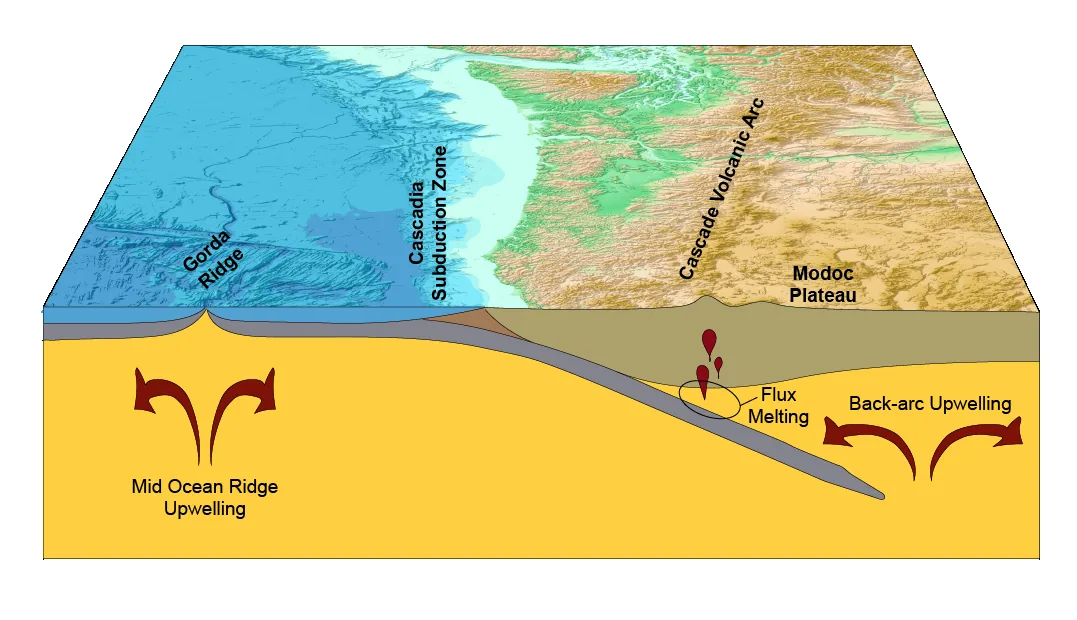
Modern Cascades crust averages 42 kilometers in thickness after enduring multiple episodes of terrane collision and arc magmatism [7]. Contemporary volcanic monitoring tracks shallow melt bodies directly, showing how Kīlauea magma reservoirs revealed by dense seismic imaging maintain interconnected storage zones. In ancient arcs, those molten reservoirs eventually froze into granitic batholiths that now anchor the continental core, preserving a permanent record of past thermal pulses [5].
What North Cascades Geology Reveals
The Cretaceous flare-up waned around 60 million years ago, but the Pacific Northwest remained geologically active. At about 50 million years ago, the accretion of the Siletzia oceanic plateau against North America ended flat-slab subduction and reorganized plate boundaries [7]. Siletzia was an offshore basaltic plateau up to 30 kilometers thick that sutured between Vancouver Island and the Klamath terrane. This collision established dipping subduction west of Siletzia and built the ancestral Cascade Arc by 35 million years ago. Plutons from that younger magmatic era formed the Chilliwack batholith between 35 million and 2.5 million years ago, baking surrounding rocks through contact metamorphism to sculpt peaks like Mount Shuksan and Mount Challenger [5]. These baked contact zones made the peaks far more resistant to glacial erosion over millions of years.
Present-day Cascade stratovolcanoes like Mount Baker and Mount Rainier grew only within the last several hundred thousand years, representing the latest phase of subduction volcanism [5]. By linking high-precision geochronology with whole-rock geochemistry, the investigation by Karmakar and colleagues shows that flare-ups do not require prior tectonic crustal shortening. In this way, North Cascades geology continues to reshape our understanding of continental growth, proving that the thermal power of ascending magma builds mountain roots from within [3].
- ONLINE NEWS Stanley, S. (2026). High-precision timeline helps clarify an ancient magma surge in the North Cascades. Phys.org. [Article Link]
- ONLINE NEWS Stanley, S. (2026). What triggered an ancient magma surge in the North Cascades? Eos, 107. [Article Link]
- ACADEMIC JOURNAL Karmakar, S., Bakshi, S., Eddy, M. P., Miller, R., & Gordon, S. M. (2026). High Temporal Resolution Record of Flare‐Up Magmatism Reveals Tectonic and Local Controls on Crustal Thickening in the Cretaceous Continental Arc of the North Cascades. Tectonics, 45(10). [Article Link]
- WEBSITE National Park Service. (2023). Geologic Formations – North Cascades National Park. U.S. Department of the Interior. [Article Link]
- WEBSITE Wikipedia contributors. (2007). Cascade Volcanoes. In Wikipedia, The Free Encyclopedia. [Article Link]
- WEBSITE Halpern, J. (2023). The Cascadia Subduction Zone and the Cascade Continental Volcanic Arc. Geosciences LibreTexts. [Article Link]
- ACADEMIC JOURNAL Humphreys, E. D., & Grunder, A. L. (2022). Tectonic controls on the origin and segmentation of the Cascade Arc, USA. Bulletin of Volcanology, 84(12). [Article Link]
- ACADEMIC JOURNAL Ducea, M. N., Saleeby, J. B., & Bergantz, G. (2015). The Architecture, Chemistry, and Evolution of Continental Magmatic Arcs. Annual Review of Earth and Planetary Sciences, 43(1), 299-331. [Article Link]
APA 7: PerEXP Teamworks. (2026, November 7). Ancient Magma Surge Clarified by North Cascades Geology. PerEXP Teamworks. https://perexpteamworks.com/en/north-cascades-geology-magma-surge/


