





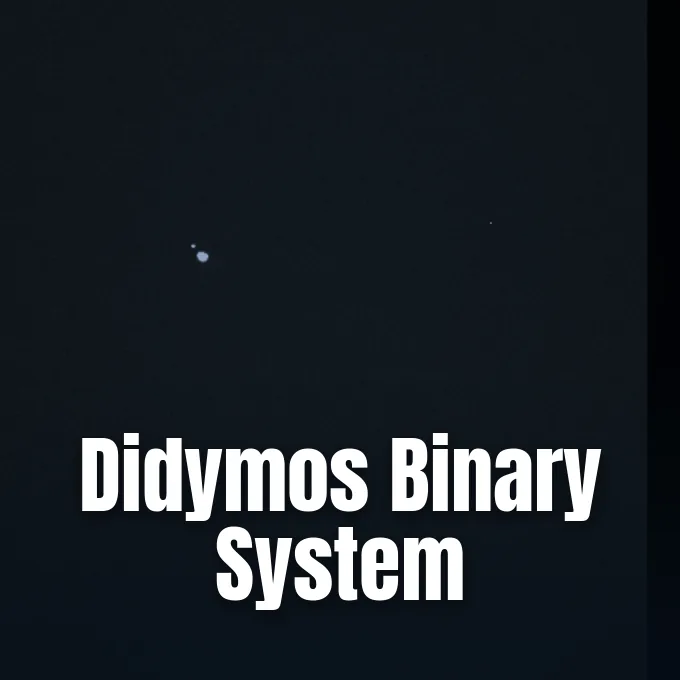
The European Space Agency confirmed that the Hera spacecraft has resolved the Didymos binary asteroid system into two distinct objects for the first time, separating the main asteroid from its small moon Dimorphos at an observation distance of 1,280 km [2]. The imaging run occurred on the evening of October 18, 2026, while the pair traveled roughly 197 million km from Earth following two braking maneuvers that slowed the probe to 20 m/s relative to the target [1]. This visual confirmation prepares the mission team for close-range navigation and detailed mapping of the kinetic deflection site created by NASA’s DART probe in 2022 [4].
Resolving the Didymos Binary System
The European Space Agency confirmed that the probe captured the asteroid pair using its monochromatic Asteroid Framing Camera during an approach run on Friday, October 18, 2026 [2]. At the time of exposure, the probe was flying approximately 1,280 km from the binary pair, which sits roughly 197 million km from Earth. Dimorphos covers only one camera pixel [1].
Ground controllers had previously tracked the Didymos system as a single bright dot on camera sensors, without sufficient angular separation to discern individual outlines of the binary components [2]. The new frame isolates Dimorphos as an individual point of light about one pixel wide, separated cleanly from the larger primary asteroid [1]. Mission scientist Michael Kueppers explained that Dimorphos had finally become visible as an independent body after weeks of long-range navigation [2].

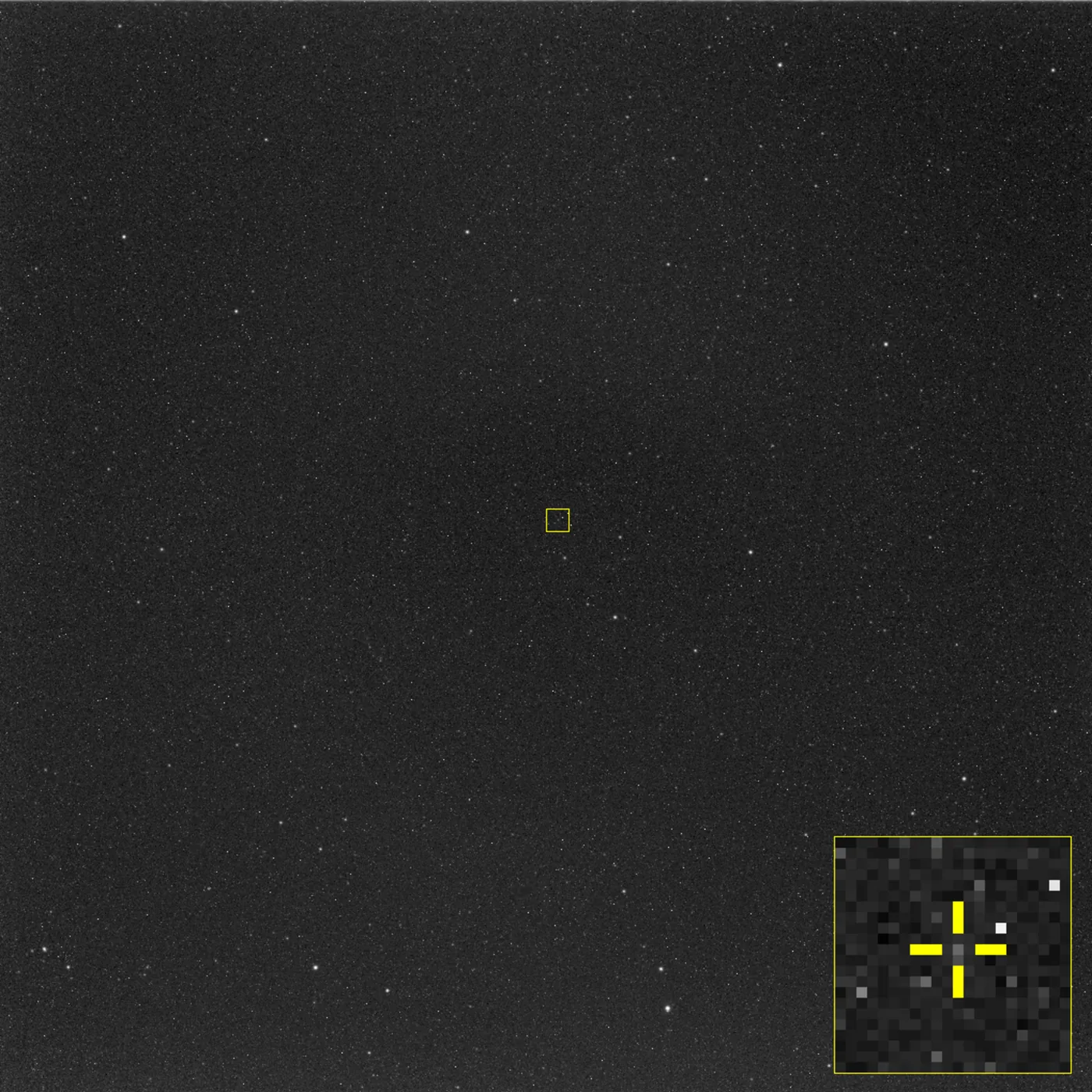
Long-range detection started earlier in the month, when cameras first caught Didymos from a distance of roughly 236,500 km on October 7, 2026. That early sighting relied on stacking multiple exposures and applying photometric algorithms to extract faint light against dense background star fields [3]. Calibration runs using background star fields remain standard practice for space observatories, including earlier campaigns where the eROSITA telescope mapped cosmic structures across wide multi-wavelength survey fields. The recent October 18 frame provided optical proof that the Hera spacecraft could track both bodies independently using onboard guidance algorithms [2].
How the Hera Spacecraft Slowed Down
Reaching this close vantage point required precise orbital adjustments after the cruise through deep space. Flight teams at the European Space Operations Centre executed two thruster firings separated by one week in early October 2026, which together reduced the relative velocity of the Hera spacecraft to 20 m/s relative to Didymos. Dimorphos orbits at 18 cm/s [1].
Earlier in the voyage, deep-space maneuvers consumed 123 kg of hydrazine propellant to modify spacecraft velocity by 367 m/s, altering the heliocentric path toward its rendezvous corridor. That burn altered the heliocentric path and ensured an arrival window that keeps relative motion gentle enough for close optical tracking [5].
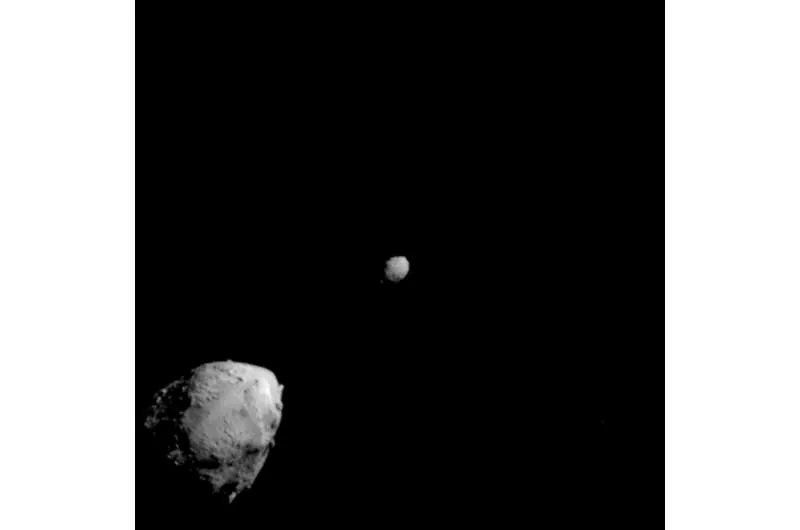
The physical scales of the two asteroids present an intriguing target for planetary defense researchers. Didymos measures about 780 m across, roughly comparable to the Burj Khalifa skyscraper in Dubai, while Dimorphos spans approximately 151 m across, matching the scale of the Great Pyramid of Giza. Dimorphos circles its parent body at a mean distance of 1.15 km with an orbital speed of roughly 18 cm/s. Mission manager Ian Carnelli said, “For the first time we are seeing through Hera’s own eyes the double asteroid system that the mission was designed and built for” [1]. Detailed images will arrive on November 25. He added that the views will grow sharper as the probe draws nearer, with detailed close-up images scheduled for release on November 25, 2026 [2].
Investigating the DART Impact
The main objective of the mission centers on assessing the physical outcome of the Double Asteroid Redirection Test conducted by NASA on September 26, 2022 [4]. During that demonstration, the DART impactor slammed into Dimorphos at 6.1 km/s to evaluate whether an artificial projectile could alter the trajectory of a near-Earth asteroid. The collision created no hazard for Earth prior to the arrival of the Hera spacecraft [1].
Ground observatories recorded a debris plume stretching across 10,000 km of space and confirmed that the collision shortened the orbital period of Dimorphos around Didymos by roughly 33 minutes. Yet fundamental questions about the collision remain unresolved [1]. Did the kinetic impact punch out a localized crater, or did it reshape the entire rubble pile structure of the moonlet? Scientists also seek to determine the exact mass, internal porosity, and composition of Dimorphos to understand why momentum transfer exceeded initial predictions derived from numerical impact simulations [2].

Earlier mission studies published in The Planetary Science Journal by Patrick Michel and colleagues outlined how measuring the deflection efficiency provides critical ground truth for planetary defense models. The collision proved that human intervention could alter celestial trajectories, but planetary defense planners need precise mass and volume metrics before they can reliably replicate the technique against future hazards [8]. Close surveys will map Dimorphos with ten-centimeter resolution around the impact area to determine whether the body underwent global deformation [4].


Scientific Instruments on the Hera Spacecraft
The main Hera spacecraft, built by a consortium led by OHB SE under a 129.4 million euro contract with the European Space Agency, carries a compact dry mass of 350 kg and a launch mass of 1,128 kg within a 1.6 by 1.6 by 1.7 meter chassis. Its core payload includes the Asteroid Framing Camera for visual navigation, the Thermal Infra Red Imager for measuring surface heat retention, and the Planetary Altimeter for laser distance measurements. It also features the HyperScout-H imaging spectrometer and radio science hardware to measure tiny gravitational perturbations caused by the asteroid pair [4].
In a study published in Space Science Reviews, Ernesto Palomba and co-authors described the VISTA thermogravimeter sensor, designed to monitor volatile release and dust particles smaller than five micrometers around Didymos. Ground teams will correlate these readings with optical tracking data as the spacecraft closes distance [8].
Hera also transports two shoe-box CubeSats designed to operate in close proximity to the binary asteroids before attempting surface landings. The Juventas CubeSat carries a low-frequency radar to probe internal structures beneath the asteroid crust and will record mechanical surface reactions upon touching down on Dimorphos. Juventas will land directly on Dimorphos. Meanwhile, the Milani CubeSat carries hyperspectral imagers to examine surface mineralogy and characterize the surrounding dust environment. Deep space tracking networks will monitor both secondary craft during independent orbital phases, gathering data that single-satellite missions cannot obtain [4].
Cruise Observations and Belt Encounters
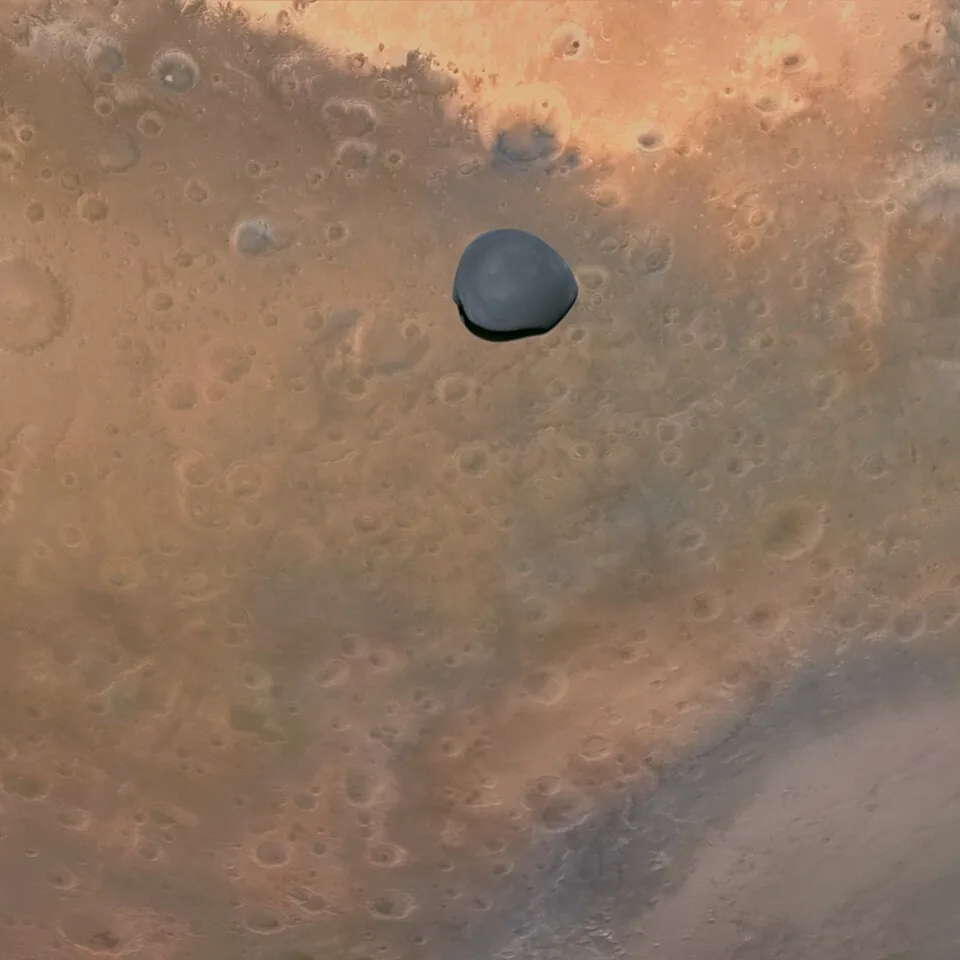
Hera launched on October 7, 2024 from Space Launch Complex 40 at Cape Canaveral Space Force Station aboard a SpaceX Falcon 9 Block 5 rocket into a heliocentric transfer trajectory. The booster previously flew 22 missions. Flight controllers conducted three test burns soon after launch and initiated deep-space maneuvers later in October and November 2024 to refine the flight path toward Mars. The Hera spacecraft completed a gravity assist at Mars on March 12, 2025, passing 5,000 km from the Martian surface and sweeping within 300 km of the small moon Deimos. During that flyby, onboard cameras tracked ancient crater features beneath Deimos dust layers while testing autonomous optical navigation systems [4].
During its journey through the main asteroid belt, the mission tested tracking routines on distant targets at short notice, observing asteroid (1126) Otero from about three million kilometers. On July 19, 2025, the probe observed asteroid (18805) Kellyday from six million kilometers away to test instrument tracking agility [4]. Flight controllers also evaluated opportunities to inspect fast-moving bodies like asteroid 2024 YR4 [6].
Astronomers frequently track newly spotted icy bodies across the inner solar system, an effort that parallels how the Euclid space telescope detected a new comet during its wide survey. In a preprint study, S. R. Grant and G. H. Jones calculated that the probe might cross the ion tail of interstellar comet 3I/ATLAS in late October 2025. That study remains an unrefereed preprint that has not undergone peer review [7].
Origins of Planetary Defense Architecture
The roots of the Hera mission trace back to European planetary defense planning in 2002, when space safety working groups began exploring asteroid deflection concepts. The Near-Earth Object Mission Advisory Panel recommended the Don Quijote architecture, which envisioned two separate spacecraft to test kinetic deflection and record the physical outcome. European industrial consortia refined this concept through 2007, laying the technical foundation for the Asteroid Impact and Deflection Assessment collaboration between ESA and NASA [5]. While ESA cancelled an earlier orbiter concept called AIM in late 2016 due to budget limitations, member states approved the Hera mission in November 2019 to fulfill the measurement goals [4].
Looking beyond the primary investigation at Didymos, the European Space Agency plans to repurpose the probe into a long-duration technology testbed in mid-2027. Operating roughly 150 million km from Earth, the Hera spacecraft will host third-party software experiments using an isolated sandbox on its dual-core LEON3 computer processor after mid-2027. European researchers and commercial developers will test autonomous navigation routines and machine learning image processing submitted through the Open Space Innovation Platform. OSIP will review proposals in October 2026. This extended phase will validate onboard decision software for future deep-space operations [5].
- ONLINE NEWS Phys.org. (2026, October 27). First light: Hera resolves two asteroids instead of one. [Article Link]
- PRESS RELEASE European Space Agency. (2026, October 7). First light: Hera resolves two asteroids instead of one. [Article Link]
- PRESS RELEASE European Space Agency. (2026, October 7). Destination sighted: Hera’s first glimpse of Didymos. [Article Link]
- WEBSITE Wikipedia contributors. (2026). Hera (space mission). In Wikipedia, The Free Encyclopedia. [Article Link]
- WEBSITE Hera Mission Team. (2026, October 1). Hera Mission: European Space Agency Asteroid Mission. [Article Link]
- WEBSITE ESA’s Hera Mission. (2025, August 6). Hera observations of asteroid targets [Post]. X. [Article Link]
- PREPRINT Grant, S. R., & Jones, G. H. (2025). Prospects for the Crossing of Comet 3I/ATLAS’s Ion Tail. arXiv. [Article Link]
- ACADEMIC JOURNAL Michel, P., Küppers, M., Bagatin, A. C., Carry, B., Charnoz, S., Leon, J. d., Fitzsimmons, A., Gordo, P., Green, S. F., Hérique, A., Juzi, M., Karatekin, Ö., Kohout, T., Lazzarin, M., Murdoch, N., Okada, T., Palomba, E., Pravec, P., Snodgrass, C., & Zhang, Y. (2022). The ESA Hera Mission: Detailed Characterization of the DART Impact Outcome and of the Binary Asteroid (65803) Didymos. The Planetary Science Journal, 3(7), 160. [Article Link]
APA 7: PerEXP Teamworks. (2026, October 28). Hera Spacecraft Separates Didymos and Dimorphos in New Image. PerEXP Teamworks. https://perexpteamworks.com/en/hera-spacecraft-resolves-didymos-dimorphos/


