





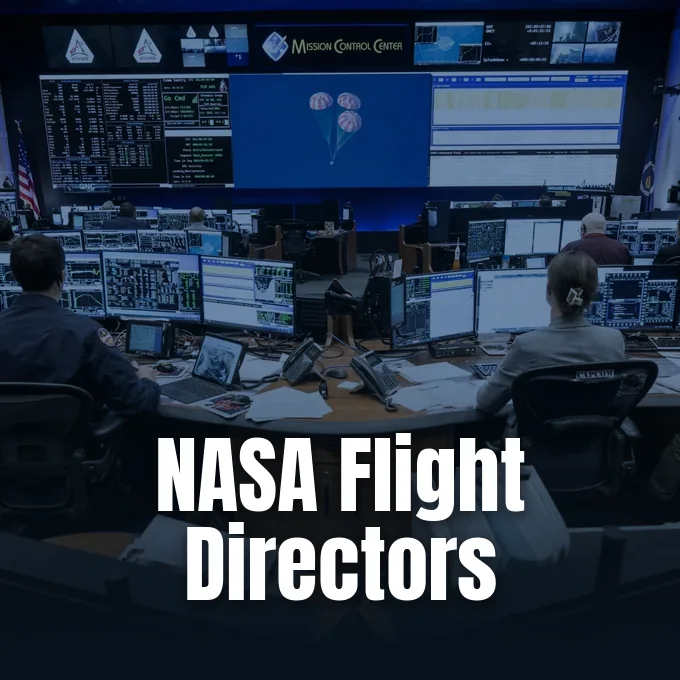
Human spaceflight demands rapid operational judgments that determine whether astronauts survive hazardous orbital regimes and return safely to Earth. To steer these monumental missions, NASA flight directors lead console teams from Mission Control at the Johnson Space Center in Houston as the agency builds towards a permanent presence on the Moon [1]. Officials confirmed this week that applications have formally opened for the next class of flight directors, establishing an open application window that extends through Monday, October 12, 2026.
- How NASA Flight Directors Direct Human Spaceflight
- What Qualifications Must Candidates Present?
- Johnson Space Center Flight Directors Across Deep Space
- Why Operational Leadership Matters in High-Risk Environments
- What Does La NASA Mean in Mission Announcements?
- How Will NASA Flight Directors Complete Specialized Training?
How NASA Flight Directors Direct Human Spaceflight
NASA Flight Directors hold ultimate operational authority for crewed aerospace missions operating from the Mission Control Center environment at Johnson Space Center in Houston [1]. Once a spacecraft lifts off from the launchpad, the Flight Director orchestrates real-time mission execution and immediate risk management across every technical discipline. These leaders direct specialized teams of flight controllers, communicate with orbiting astronauts, and synchronize technical actions with international and commercial partners. Every command transmitted to a vehicle reflects their integrated judgment under dynamic flight conditions. Console teams operate from Houston.
Operational leadership extends far beyond active console shifts during spaceflight maneuvers [1]. During months of intensive pre-mission preparation, NASA Flight Directors collaborate directly with engineering directorates, safety panels, and program offices to guarantee that operational flight rules match spacecraft structural and avionics capabilities. If an unexpected anomaly emerges during translunar injection or orbital rendezvous, Flight Directors reconcile competing engineering recommendations into a single operational directive. Their responsibility spans ongoing expeditions to the International Space Station, upcoming Artemis lunar surface missions, and future human expeditions to Mars.
Maintaining dependable telecommunications remains vital throughout every mission phase. Flight directors work closely with tracking stations around the planet, including lunar ground stations routing NASA Artemis data across deep space networks during translunar coast and orbital maneuvers [1]. Without uninterrupted telemetry, mission controllers cannot certify trajectories. NASA coordinates deep space tracking worldwide.
What Qualifications Must Candidates Present?
To qualify for selection as a Flight Director, candidates must hold American citizenship and possess a bachelor’s degree from an accredited institution in an applicable technical discipline [1]. The agency recognizes qualifying degrees in engineering, biological sciences, physical sciences, computer science, and mathematics. Beyond academic credentials, applicants must demonstrate substantial professional experience of increasing responsibility that includes critical decision-making under acute operational pressure. Candidates need a proven ability to analyze complex, high-risk situations where technical failures jeopardize mission success.
Although many former NASA Flight Directors began their careers as flight controllers inside Mission Control, the agency explicitly noted that prior console experience is not mandatory to submit an application [1]. NASA opened the formal recruitment notice on the federal employment platform under USAJOBS posting number 886788000, inviting applications from qualified professionals across civilian industry, research laboratories, and military flight programs. This broad recruitment model reflects the reality that modern space exploration requires cross-disciplinary problem solvers capable of integrating complex software, orbital mechanics, and human factors. Technical review panels will evaluate candidate dossiers once the application portal closes on Monday, October 12, aiming to announce final selections before the end of the year.
Evaluating candidates outside traditional mission operations allows NASA to incorporate fresh perspectives on risk management and team leadership. Candidates with backgrounds in commercial aerospace engineering, clinical medicine, high-performance computing, or maritime navigation frequently possess equivalent competencies in high-stakes problem resolution. Prior console experience is not mandatory [1].
Johnson Space Center Flight Directors Across Deep Space
The strategic urgency of this selection round reflects a historic expansion in human spaceflight architecture [1]. Emily Nelson, Chief Flight Director at Johnson Space Center, explained that the agency stands at an unprecedented operational crossroads: “We are at an exciting and pivotal moment as we continue supporting operations on the International Space Station while building the next phase of human spaceflight with Artemis and Lunar Base missions, preparing to go farther than ever.” Balancing ongoing station expeditions with lunar exploration demands continuous console vigilance across overlapping flight profiles.
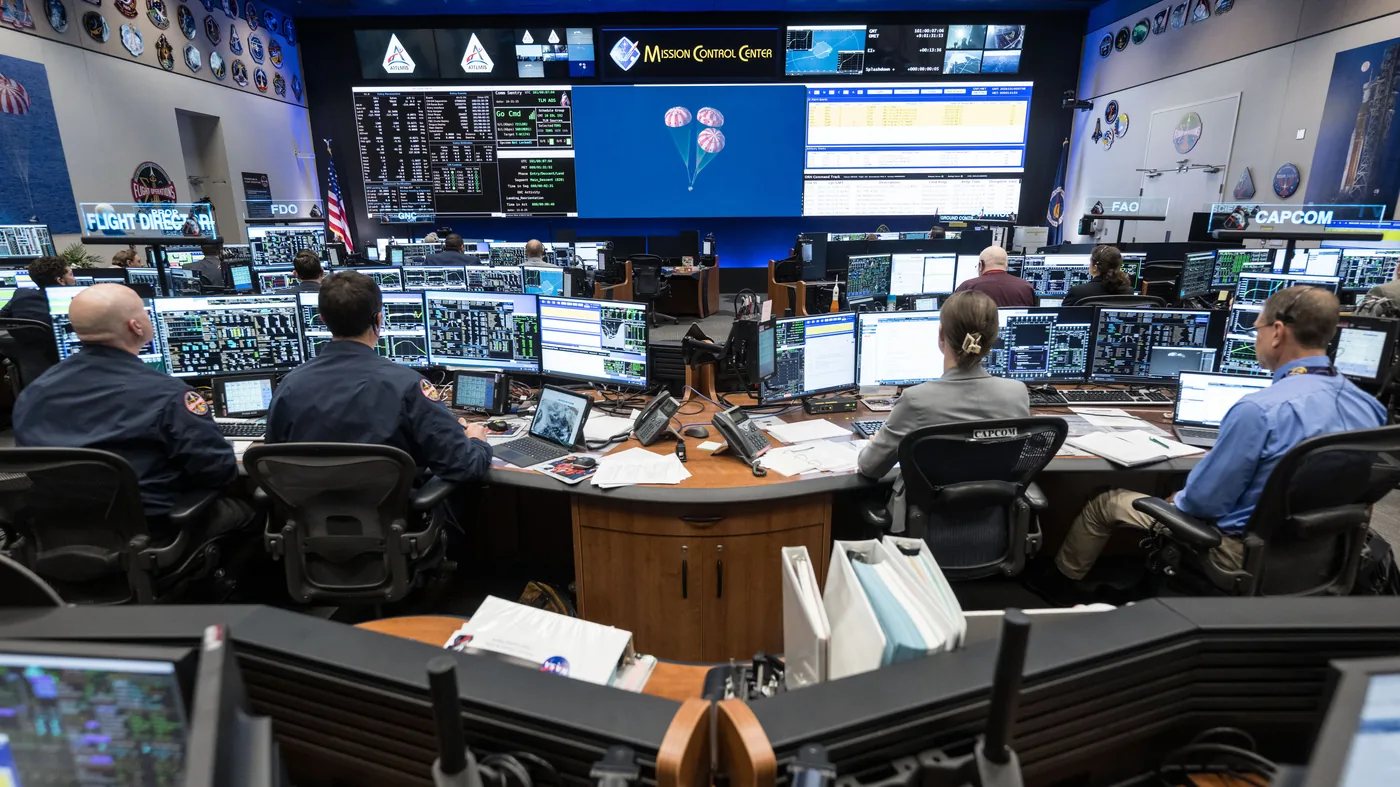
Nelson stressed that meeting these exploration goals requires Johnson Space Center Flight Directors who excel as system integrators [1]. In her assessment, the position demands leaders who are “capable of bringing together a wide variety of teams and disciplines into a clear and unified mission effort.” This leadership culture was recently visible inside the White Flight Control Room (Sala Blanca de Control de Vuelo), where controllers coordinated recovery assets for lunar flight testing [2].
Flight controllers directed recovery operations during the Artemis II splashdown on April 10, 2026 [2]. Photographer Robert Markowitz documented the recovery team.
The Artemis program transforms Mission Control into a multi-destination dispatch hub. While orbiting laboratory consoles focus on microgravity science and station maintenance, lunar flight teams monitor trans-Earth return trajectories and landing radar data. Future shifts will simultaneously oversee surface habitats at the Lunar Base. Managing simultaneous flight paths requires seamless handoffs between rotating flight control shifts.

Why Operational Leadership Matters in High-Risk Environments
For NASA Flight Directors, managing crewed spaceflight missions involves navigating unexpected hardware anomalies where checklists provide incomplete answers [1]. In high-pressure orbital regimes, a Flight Director carries exclusive authority to initiate an emergency abort, alter an orbital trajectory, or override automated software guidance. This immense responsibility requires emotional discipline, rapid synthesis of contradictory sensor streams, and clear communication across every operational console. Directing spaceflights demands individuals who empower their controllers while independently evaluating ambiguous data before ordering irreversible maneuvers.
Commercial partnerships add unprecedented layers of coordination to modern console operations [2]. As commercial aerospace developers build heavy launch architecture—including orbital tests of the SpaceX Starship super heavy rocket—Flight Directors must coordinate joint trajectories, standardized docking interfaces, and shared telemetry streams. Managing these diverse orbital systems mirrors distributed satellite tracking programs, such as the Tropics constellation monitoring tropical storm systems, where multiple spacecraft demand synchronized flight management. Flight directors integrate these disparate industrial methodologies into a rigorous, unified safety framework.
How do leaders maintain focus when lives are on the line? Console discipline relies on transparent communication and rehearsed decision trees that eliminate hesitation during sudden decompression or propulsion anomalies [1]. Flight directors train to suppress personal panic, isolate root causes, and delegate tactical investigations to specialized console positions. Their decisive calls ensure crew survival.
What Does La NASA Mean in Mission Announcements?
In official communications released across international channels, the Spanish designation la NASA refers directly to the agency as it conducts public outreach for critical spaceflight positions [1]. NASA Headquarters published NASA RELEASE 26-082 in Spanish to ensure that prospective applicants understand the strategic significance of the recruitment. Media representatives can contact Rachel Kraft and María José Viñas in Washington at 202-358-1100, or Anna Schneider and Mary Pfister at Johnson Space Center (Centro Espacial Johnson) in Houston at 281-483-5111. Public inquiries reach Mary Pfister in Houston.
International reporting highlighted the broader geopolitical context of American human spaceflight administration [3]. In Madrid, journalist Óscar López reported for ESPACIO DIARIO (directed by Roberto Espacios) that opening Flight Director applications reinforces American leadership (Estados Unidos) in aerospace exploration. Broad recruitment strategies mirror other federal research solicitations, such as the NASA ROSES hydrosphere opportunity that funds competitive global scientific research. By maintaining rigorous, open application standards across USAJOBS under vacancy 886788000, the agency attracts high-caliber leaders capable of guiding complex expeditions beyond low Earth orbit.
Public engagement remains essential for sustaining long-term space exploration funding. When citizens follow recruitment drives and mission operations, public investment translates into tangible technological innovation. Does widespread public visibility strengthen agency morale during complex missions? Experienced controllers affirm that public backing reinforces operational dedication across Houston.
How Will NASA Flight Directors Complete Specialized Training?
Newly selected candidates will undergo an intensive multi-year training syllabus focused on flight control procedures, spacecraft systems engineering, operational leadership, and dynamic risk management [1]. NASA plans to finalize its selection process before the end of 2026, promptly immersing the chosen cohort into rigorous mission simulation environments. Trainees spend hundreds of hours inside high-fidelity mockups of the Mission Control Center, confronting simulated computer crashes, communication dropouts, and life-support anomalies. Through iterative simulations, prospective NASA Flight Directors develop the cognitive resilience required to command under acute stress.
Beyond textbook flight dynamics, mentorship from veteran directors forms the cornerstone of the certification pipeline. Senior leaders evaluate how candidates handle escalating failures, test their willingness to make unpopular safety calls, and instill the operational ethos articulated by legendary Flight Directors of the Apollo era. Candidates must learn to speak concisely over voice loops, manage fatigue during prolonged orbital emergencies, and preserve emotional stability among console specialists.
Graduation from candidate status to certified Flight Director authorizes an individual to hold tactical command over humanity’s most complex space exploration missions [1]. Once certified, these leaders will oversee continuous orbital expeditions on the International Space Station, direct lunar surface and orbital activities supporting the Lunar Base, and formulate operational frameworks for the first human expedition to Mars. Decisions formulated at Johnson Space Center will ultimately safeguard astronaut crews while unlocking long-term human habitation across the solar system.
- PRESS RELEASE Viñas, M. J. (2026, October 2). La NASA abre solicitudes para próxima promoción de directores de vuelo. NASA. [Article Link]
- ONLINE NEWS La Primera en Línea. (2026, October 2). La NASA abre solicitudes para próxima promoción de directores de vuelo. [Article Link]
- ONLINE NEWS López, Ó. (2026, October 2). NASA abre solicitudes para nuevos directores de vuelo en misión espacial. ESPACIO DIARIO. [Article Link]
APA 7: PerEXP Teamworks. (2026, October 3). How NASA Flight Directors Will Lead Artemis Moon Missions.


