






AMD published new enterprise performance disclosures for its upcoming 6th Gen server processors on Friday, directly challenging Nvidia’s expanding data center silicon footprint. The detailed white paper expands on initial disclosures from July by positioning the flagship AMD EPYC Venice architecture against rival server processors in emerging agentic artificial intelligence workloads. While server deployments historically relegated x86 processors to supporting roles behind massive graphics accelerators, modern multi-agent systems place heavy demands on host CPUs for orchestration, database querying, and tool execution [1].
EPYC Venice Architecture and Zen 6 Throughput
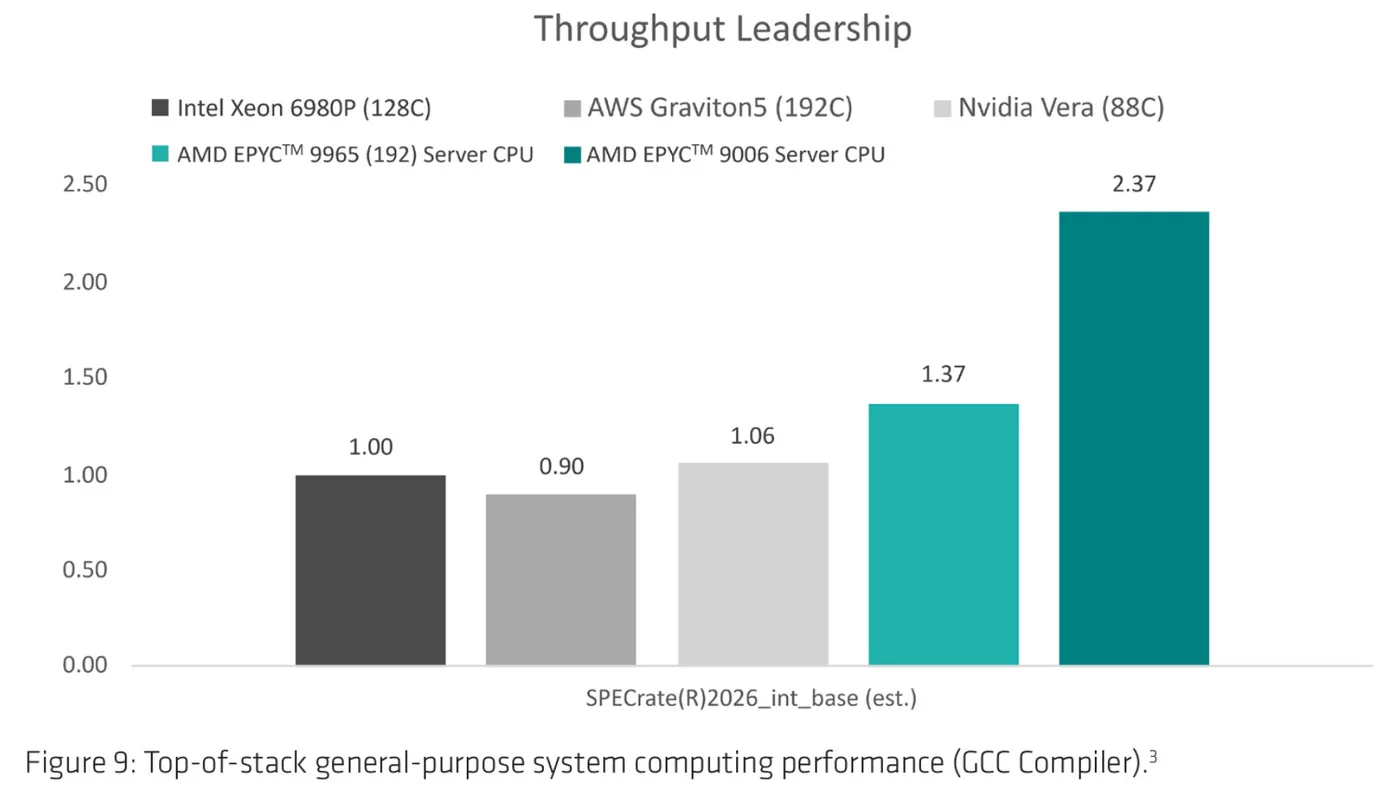
The centerpiece of the company’s enterprise rollout is the EPYC 9996, a top-tier server CPU packing 256 Zen 6 cores built to maximize aggregate workload throughput across dense server clusters. According to AMD’s updated disclosures from the Advancing AI 2026 event, the flagship AMD EPYC Venice processor delivers 2.37 times the overall throughput of an Intel Xeon 6980P system and 2.24 times the platform performance of Nvidia’s Vera processor [2]. Generational scaling appears equally substantial, with the 256-core Venice model demonstrating an estimated 78% throughput uplift over the previous-generation 192-core EPYC 9965 [1].
Server architectures prioritize sustained multithreaded capacity over the compact power budgets found in consumer desktop platforms. Scale dictates design. While client environments emphasize thermal convenience as highlighted in AMD’s budget desktop Ryzen processor strategy, Venice targets hyper-dense server racks where total socket capacity governs operational costs. By pushing socket capability up to 256 physical cores (employing high-density Zen 6 execution units), AMD aims to replace dual-socket server configurations with single-socket deployments that reduce peripheral footprint across hyperscale facilities [1].
Can dense clusters sustain efficiency? Early data suggests strong virtualization scaling. Across high-performance computing suites, 6th Gen EPYC silicon drives platform advantages between 1.8 times and 3.13 times over Intel Xeon 6980P hardware in molecular dynamics, materials modeling, and weather forecasting simulations [2].
AMD EPYC Venice Benchmarks Target Nvidia Vera
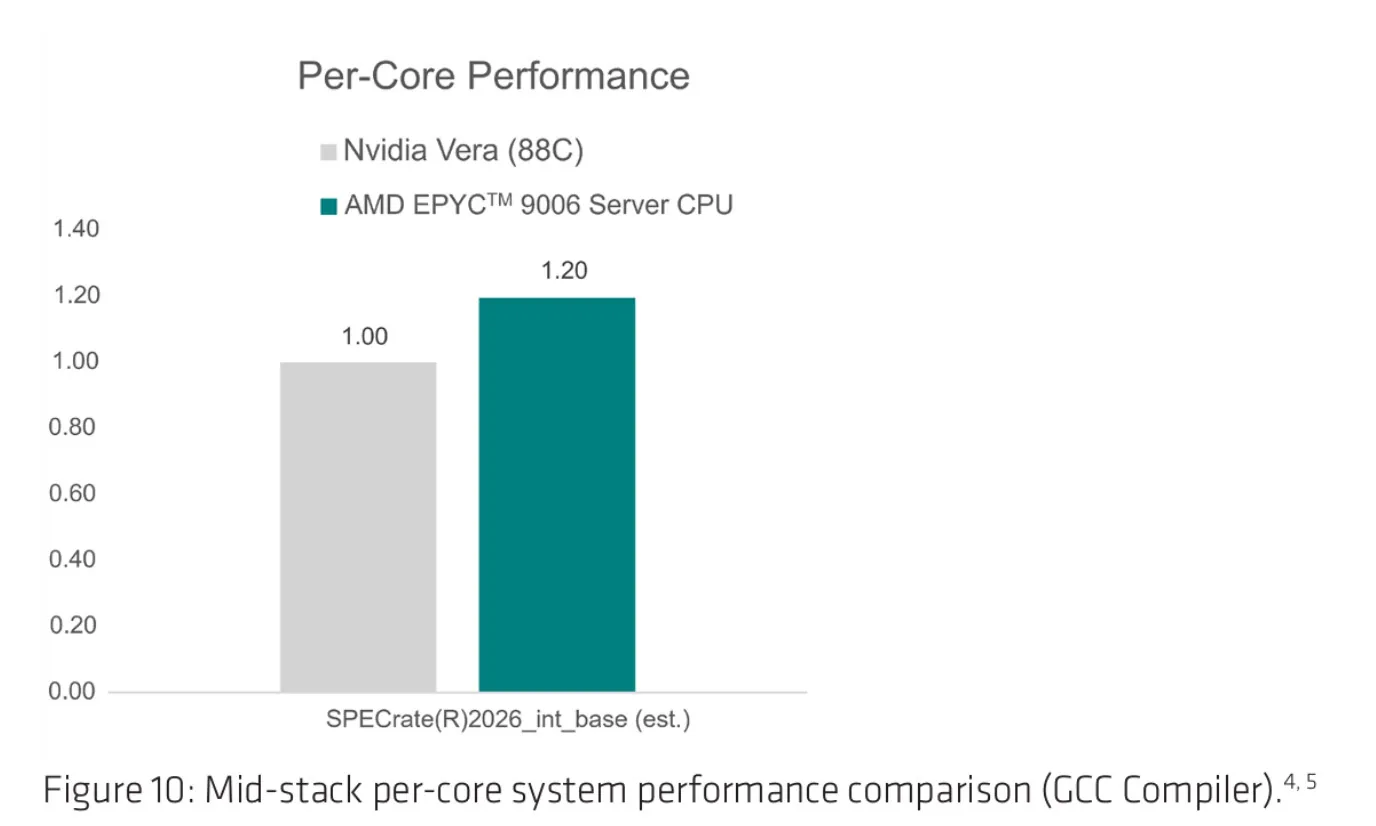
While aggregate throughput showcases raw core scaling, AMD’s revised white paper focuses squarely on head-to-head comparisons against Nvidia’s Vera processor. In SPEC CPU 2026 Integer Rate assessments, AMD pits a 96-core Venice configuration directly against Nvidia’s 88-core Vera CPU [1]. Testing indicates that the AMD EPYC Venice architecture delivers approximately 20% higher per-core performance, posting a 1.20 score against Vera’s 1.00 baseline in normalized integer throughput [2].
Per-core throughput gains carry major ramifications for latency-sensitive cloud microservices, interactive retrieval pipelines, and conversational agent inference steps. Within specific agentic AI subtests evaluated by AMD, the 96-core Venice processor achieves an average 12% to 20% performance lead over the 88-core Vera platform. Individual subtests widen that gap significantly, with Venice registering a 2.01-times throughput advantage in 706.stockfish_r and sustaining leads above 30% across multiple integer execution benchmarks [2].
Modern inference pipelines depend heavily on host CPU coordination. Compute nodes rarely run isolated accelerators. In enterprise clusters where host CPUs manage continuous model offloading, such as emerging Apple AI server deployments paired with Nvidia hardware, orchestration overhead directly influences end-to-end token latency [1]. AMD argues that robust integer performance on host processors prevents communication bottlenecks from idling downstream accelerator clusters during multi-step reasoning tasks [3].


Memory Bandwidth Advantages Across Enterprise Workloads
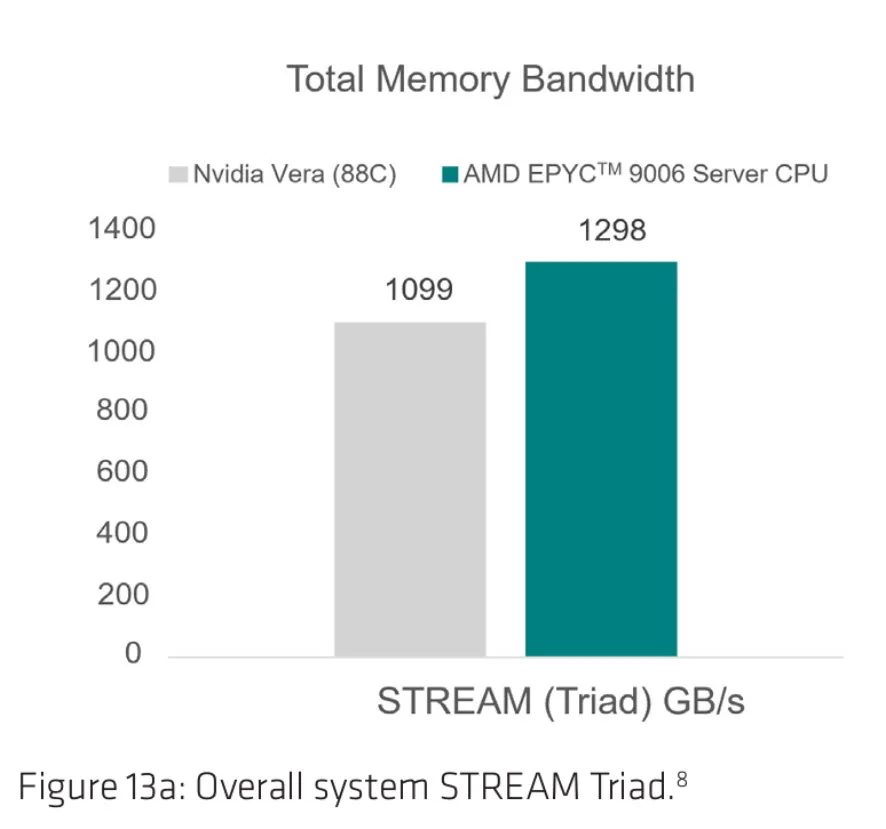
Memory subsystem architecture forms another critical battleground between AMD and Nvidia server platforms. To support 256 high-throughput Zen 6 cores without starving computational execution units, the AMD EPYC Venice platform integrates a 16-channel memory controller capable of driving RDIMM modules at speeds reaching up to 12,800 MT/s. In sustained throughput measurements utilizing the industry-standard STREAM Triad benchmark, Venice delivers 1.6 TB/s of aggregate memory bandwidth compared to 1.2 TB/s for Nvidia Vera systems reliant on LPDDR5x memory channels. Despite provisioning a larger core allocation (96 active cores on Venice versus 88 on Vera), AMD’s platform sustains approximately 8% higher memory bandwidth per individual core, ensuring balanced execution during dense matrix transformations [2].
High sustained memory throughput directly accelerates standard data center enterprise infrastructure. In cloud-native and transactional application testing normalized against an Intel Xeon 6980P system, AMD projects massive throughput gains for its 256-core flagship. The EPYC 9996 delivers 2.4 times the performance in server-side Java, 2.5 times in OpenSSL cryptography, and 2.6 times in TPC-C transaction processing. Web serving and in-memory caching demonstrate even higher leaps, reaching 2.9 times in Redis Benchmark, 3.5 times in MongoDB paired with YCSB, and 3.7 times in NGINX utilizing WRK [3].
Does raw memory bandwidth guarantee linear speedups across distributed pipelines? Memory access latency and software thread scheduling impose unavoidable constraints on theoretical scaling [1]. When processing graph analytics, vector indexing, and relational queries, high aggregate bandwidth ensures that execution pipelines avoid starvation during concurrent retrieval sweeps [2]. AMD frames these enterprise metrics as representative components of an agentic software stack where caching and database querying consume expanding proportions of server clock cycles [3].
Compiler Discrepancies and Power Budget Variables
Technical claims warrant scrutiny. Disclosed benchmark comparisons frequently introduce subtle methodological asymmetries that alter perceived performance gaps between competing architectures [1].
As detailed by Tom’s Hardware senior CPU analyst Jake Roach, AMD’s white paper introduces notable configuration discrepancies between AMD EPYC Venice and Vera hardware runs. Most consequential is the compiler environment. AMD compiled its Venice benchmarks using GCC 16.1, whereas the comparative Vera figures originate from Nvidia’s earlier white paper compiled under GCC 15.2. As compiler testing documented by Michael Larabel at Phoronix demonstrates, GCC 16 implements Zen 6 optimizations that yield measurably faster binary execution at the expense of compilation duration [1].
Power budgets present an additional layer of technical nuance. When evaluating the 96-core Venice model against Vera, AMD utilized a down-cored EPYC 9996 running with access to the full 600W thermal ceiling of the 256-core flagship (operating at reduced core configurations for thermal headroom). In commercial production, AMD’s dedicated 96-core high-frequency Venice SKU tops out at a 500W specification. Testing a 96-core chip with 600W headroom grants frequency margins that production servers operating within strict 500W constraints may struggle to sustain under sustained thermal loads [1].
Workload definitions also diverge from standard industry certifications. The agentic AI tests presented in AMD’s charts rely on custom derivatives of TPC-H and TPC-C benchmarks and internal multi-persona agent replays. AMD explicitly notes in documentation footnotes that these derived tests cannot be directly equated with official, audited benchmark publications [1]. While preliminary data highlights architectural strength, independent evaluations across physical hardware clusters remain essential to verify how these silicon designs perform under production enterprise constraints [3].
Modeled Rack Efficiency Versus Hardware Deployment
Beyond individual processor metrics, AMD’s most provocative claims center on facility-level density within fixed power constraints. The company published a refreshed 100-kW rack-capacity simulation estimating aggregate throughput per data center rack footprint. Under this revised model, the 256-core AMD EPYC Venice platform delivers an estimated 3.4 times the rack-level throughput of an equivalent Nvidia Vera baseline. That projection expands significantly on AMD’s June modeling, which estimated the 5th Gen EPYC 9965 at 2.37 times Vera rack performance [3].
Benchmark composition changes account for a substantial portion of that rack-level shift rather than silicon evolution alone. The previous June model calculated a six-workload geometric mean anchored by SPECrate 2017 Integer testing. AMD’s updated study replaces that suite with SPECrate 2026 Integer, server-side Java, NGINX, Redis, Memcached, and TPROC-C transaction modeling. Rerunning the calculations also adjusted the older EPYC 9965 baseline from 2.37 times down to 2.3 times Vera throughput, reflecting methodological revisions across the entire testing framework [3].
Facility operators must treat these projections with measured skepticism until independent testing validates silicon under real deployment thermals. Rack figures represent mathematical modeling rather than physical measurements gathered from fully populated 100-kW hardware cabinets. Both AMD and Nvidia approach AI infrastructure from fundamentally contrasting platform philosophies (general-purpose x86 density versus custom accelerated host fabric) [3]. Whether the AMD EPYC Venice architecture maintains its modeled efficiency edge will be decided when hyperscalers begin deploying production silicon into live data center environments [1].
- ONLINE NEWS Roach, J. (2026, September 18). AMD targets Nvidia with first official benchmarks for EPYC ‘Venice’ CPUs — company claims 256-core chip is more than twice as fast as Nvidia Vera, 96-core model 20% faster per-core. Tom’s Hardware. [Article Link]
- ONLINE NEWS Mujtaba, H. (2026, September 19). AMD Targets NVIDIA Vera In Latest EPYC Venice “Agentic AI” Benchmarks, Zen 6 Leads With 20% Higher Per-Core & Over 2x Gains In Platform-Level Performance. Wccftech. [Article Link]
- ONLINE NEWS Killian, Z. (2026, September 19). AMD Report Says Zen 6 EPYC Venice Smokes NVIDIA Vera In Revised Agentic AI Benchmarks. HotHardware. [Article Link]


