






Security researcher Mark Blaszczyk published a proof-of-concept exploit for an Android flaw that lets remote attackers knock phones offline. The bug, tracked as CVE-2026-58882 and dubbed the SMS of Death, abuses how system services parse incoming data messages before they reach the user inbox. Android Authority reported the issue at 6:33 AM ET after Blaszczyk shared test details. Victims receive no visible alert or message preview on their screens before the calling service crashes, abruptly cutting off voice calls placed to 911 emergency services. Because Android keeps trying to parse saved messages whenever the radio resets, attackers can leave hardware unusable [2].
How the SMS of Death Works
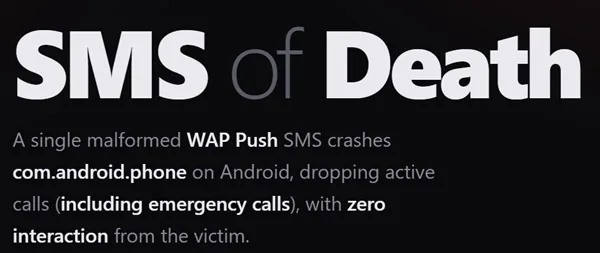
The SMS of Death targets core wireless messaging in Android rather than standard chat apps. When a carrier delivers an incoming data packet, system code handles the payload through an internal function called WapPushOverSms.decodeWapPdu before user apps ever get involved. It runs in the background [1]. Because the attack bypasses the normal inbox, users can’t see the sender or delete the bad text [2].
The bug directly hits com.android.phone, which is the system process tasked with handling cell signals, phone calls, and mobile network handshakes on Android devices [1]. That single service manages the cellular radio. When an incoming payload forces this background process to die, the phone loses carrier signal within seconds. Call audio drops mid-sentence, mobile data cuts out, and Android must restart its whole calling subsystem to restore reception. If another bad text arrives while the telephony service tries to recover, the crash repeats right away without giving the device sufficient time to reconnect to the network. Blaszczyk confirmed that test attacks succeeded against both Google Pixel and Samsung Galaxy phones [2].
Google previously rolled out AI defenses against messaging scams to catch fraudulent texts, but those consumer tools operate strictly inside chat apps rather than low-level telephony code. At the lower protocol layer, unchecked carrier data triggers errors that bring down phone services before security filters can run [1].
Flawed Integer Handling in Telephony Code
The root cause stems from missing bounds checks inside Android’s WAP Push parser, which fails to verify integer values before passing them to internal memory allocation routines. Attackers can trigger the crash by sending a bad eight-byte WAP Push payload formatted as 01 06 88 80 80 80 00 BE to port 2948 as a data SMS. This raw byte string targets how the system decodes variable-length header fields during packet parsing. The exploit needs no user interaction [1].
When Android parses this byte sequence, internal code translates the length field into a signed 32-bit integer without checking if the resulting number fits valid buffer boundaries. The number becomes -2147483648. That is the lowest possible 32-bit signed integer. When the decoding routine tries to allocate a memory buffer using this negative number, Java throws a NegativeArraySizeException. Because Android code fails to catch this error, the phone process dies on the spot [1].
This flawed code has lived in Android since Android 12 [2]. While Google engineers added modern memory safety fixes across newer Android releases, this legacy WAP Push decoding function remained completely untouched throughout years of platform updates [1]. That bug left millions of phones open to remote attacks from any sender with a cell connection [2]. Attackers just need the target phone number [1].


Reboot Loops and Recovery Challenges
A single bad text message demonstrating the SMS of Death causes a quick cell drop, but repeated hits cause far worse harm. Blaszczyk found that sending about 20 malicious messages in quick succession can trap an unpatched smartphone in an endless bootloop that prevents the operating system from loading [2]. The phone keeps crashing as soon as it powers on [1].
When an affected phone boots up, Android spots unprocessed messages in local flash storage and tries to decode them again. This automated step retriggers the array error right away. During tests on an Android 12 phone, the handset entered a crash loop that rebooted into recovery mode roughly every 90 seconds. The loop repeats endlessly. Normal fixes fail because the phone restarts before an owner can open settings, toggle airplane mode, or delete the bad text. A GitHub contributor named Sakis showed that users can clear the messages using Android Debug Bridge, but that fix needs a personal computer and developer tools [1].
For everyday users without access to developer tools, recovering from the loop often needs a full factory reset that wipes personal photos, local files, and saved device settings [1]. Even that drastic step might not fix the issue if mobile carriers keep undelivered messages queued on their networks. When the wiped phone reconnects to mobile towers, the carrier can resend the bad texts and trigger the crash loop all over again [2].
Patch Timeline for CVE-2026-58882
The bug disclosure timeline reveals clear tension between independent security researchers and Google staff. Blaszczyk submitted his technical bug report to Google on May 5, but company review teams repeatedly dismissed the submission after deciding the crash was not a security issue. Google said it was not a security issue. Frustrated by the lack of action, Blaszczyk went public and released a proof-of-concept exploit on October 29 [2].
While rejecting the researcher’s ticket in public, Google had already resolved the bug in private code branches. Android source code records show that Google engineers built a working fix on June 15 under the title “Fix remote DoS in decodeWapPdu” to catch unhandled array size errors. The patch catches decoding errors safely and deletes corrupt texts from the SMS database to stop recurring reboots [1].
GrapheneOS clarified on X that Google actually distributed the underlying fix to phone partners in July security previews, months ahead of public disclosure. The bug carries a Critical severity rating and is slated for the November Android Security Bulletin [2]. BleepingComputer reported that Google did not list the flaw in its October security bulletin even though patch code had already begun merging into public software repositories [1].

An internal communication mix-up or a duplicate ticket could explain why Google turned away the researcher. Google hasn’t explained the mismatch, but patches have begun reaching consumer phones [2]. Unpatched phones still face real risks [1].
Protection Steps for Android Users
Google included the patch in its October 2026 security updates for supported releases spanning Android 14 through Android 17. Phone owners can check their status by opening Android settings and viewing their current patch level. Because Google Pixel, Samsung Galaxy, and other phone brands issue firmware builds on separate schedules, patch delivery dates vary widely depending on carrier approval and geographic region [1].
The picture is far bleaker for older devices. Phones on Android 12 or Android 13 did not get the October update and stay open to remote attacks [1]. While independent teams behind GrapheneOS merged the fix in July, older carrier phones that have reached end-of-life status will never see an official security patch. Owners of these older handsets can’t easily block data SMS payloads without carrier help [2].
Now that working proof-of-concept SMS of Death exploit code is circulating online, installing the newest available system update represents the single most effective defense for Android device owners. Supported Google Pixel and Samsung Galaxy phones should apply available patches right away and restart to load the fix. Until carriers block port 2948 data SMS, unpatched phones stay exposed [1].
- ONLINE NEWS Abrams, L. (2026, October 31). New Android SMS of Death exploit can remotely crash unpatched phones. BleepingComputer. [Article Link]
- ONLINE NEWS Keverenge, H. (2026, October 30). Android’s SMS of Death bug can knock out your phone, but a fix is coming soon. Android Authority. [Article Link]


