





The history of collage did not begin with modern European painters pasting newspapers onto canvas, but with medieval scribes decorating intricate poetic manuscripts across East Asia. Why did pasting scraps of paper and fabric become one of humanity’s most enduring artistic practices? In twelfth-century Japan, calligraphers layered torn sheets and textiles to accentuate the visual impact of their brushwork. Alexandra Crosby traces this evolutionary trajectory across eight centuries, showing how an ancient craft evolved into an instrument of political subversion and communal healing [1].
Calligraphy and the Ancient Roots of Paper
Collage is ancient, drawing its lineage directly from the invention and spread of paper across East Asia. In twelfth-century Japan, craftspeople began incorporating pasted elements into the presentation of written poetry. Calligraphers adhered contrasting sheets of paper, fine dyed fabrics, and deliberately torn fragments beside their brushwork to amplify the visual presence and aesthetic resonance of their poetic texts. Rather than treating the page as a passive surface, these early practitioners discovered that textured backgrounds could accentuate poetic meaning through graphic contrast. The material prerequisites of collage depended upon the historical transmission and craft of papermaking, which originated in East Asia before reaching medieval European scriptoriums [1].
Japanese scribes carefully selected diverse paper textures and layered textiles to produce subtle visual rhythms that echoed the shifting emotional cadence of their classical poetry scrolls. Torn paper edges created subtle transitions, while woven fabrics introduced tactile variation to flat scrolls. Pasting disparate surfaces allowed Japanese artisans to guide the reader’s eye across the page. Their compositional experiments demonstrated that graphic arrangements could alter how an audience experienced written language [1].
Early artisans saw paper as an expressive medium. Texture enhanced the word [1].
Print Culture and the History of Collage
Paper entered Europe during the late Middle Ages, where monastic scribes painstakingly transcribed manuscripts by hand. That manual labor changed permanently around 1440. Johannes Gutenberg revolutionized European print culture around 1440 by inventing movable metal type for letterpress machinery, an innovation that generated an unprecedented continent-wide demand for inexpensive rag paper. Over the next few centuries, print workshops multiplied rapidly throughout European cities, turning printed sheets into familiar household goods. Mass reproduction replaced solitary transcription [1].
By 1702, London witnessed the publication of the world’s first daily newspaper, the Daily Courant. This publication was so inexpensive that readers routinely discarded it at the end of the day. Yet discarded paper also invited unintended uses. Disposable newsprint provided artists with an abundant, accessible material for creative experimentation. The widespread proliferation of cheap daily print laid the essential material groundwork for the modern history of collage, transforming disposable municipal ephemera into an accessible and democratic artistic medium [1].
The terminology itself reflects mechanical assembly. The word collage derives from coller (the French verb meaning to glue or to stick together). European practitioners adopted the term to describe the physical act of binding everyday materials directly onto a two-dimensional support. By affixing mundane print onto board or canvas, makers elevated humble waste into deliberate art [1].
Modern Art and War Resistance
European artists popularized collage during the early twentieth century as a direct aesthetic response to the catastrophic devastation of war. Pioneering figures such as George Braque, Hannah Höch, and Pablo Picasso recognized that traditional academic painting techniques could no longer convey the catastrophic shock and fractured condition of modern wartime society. When these avant-garde innovators encountered mass-market commercial newspapers, aggressive wartime propaganda posters, and street flyers, they recognized vital creative materials rather than disposable municipal waste. Rearranged across a canvas, commercial fragments could subvert fascism and critique authoritarian regimes. Pasting actual artifacts of conflict exposed the machinery of political indoctrination [1].
Because collage was relatively inexpensive, fast to assemble, and technically accessible, the method migrated fluidly across several defining twentieth-century Modern Art movements, including Cubism, Dada, Surrealism, and Feminist Art. Why did these diverse movements adopt the exact same mechanical process? Cutting dismantled the illusion of seamless representation. Artists abandoned the unachievable perfection of naturalism and realism, choosing instead to manipulate the potent symbols, printed slogans, and photographic images already saturating their daily environment [1].
Confronting reality required artists to dismantle its material representations. By recombining severed images, avant-garde creators generated striking new meanings from disjointed societal fragments. The technique gave marginalized voices a direct channel to interrogate institutional power without requiring expensive academic training. Just as material culture studies document humanity’s earliest physical assembly methods in archaeological findings on the earliest known wooden constructions, early twentieth-century collage challenged the physical boundaries between flat imagery and three-dimensional objects [1].


Collaborative Circles and Cultural Fragments
While individual creators frequently completed distinct studio compositions, collage functioned fundamentally as a collective medium that was socialized through collaborative circles of progressive thinkers, writers, and visual innovators. In Germany, playwright Bertolt Brecht established close creative partnerships with visual artists such as George Grosz and John Heartfield. These collaborators pooled graphic resources, combining provocative photomontage with satirical text to assault rising militarism. Collaborative collage transformed private artistic labor into an organized public protest. Shared studio tables became political workshops [1].
Other European and American practitioners utilized photographic cutouts to interrogate the psychological dislocations of the interwar era. Artists such as Man Ray and Elemérné Marsovszky juxtaposed severed photographs to bring an increasingly fractured cultural landscape into sharp focus. In the United States, assemblage artist Joseph Cornell constructed evocative three-dimensional shadow boxes that translated widespread psychological experiences of anxiety and dislocation into haunting physical dioramas. By merging found objects with paper illustrations, Cornell challenged the rigid historical boundary separating two-dimensional painting from three-dimensional sculpture [1].
The modern world has grown no less chaotic since these early avant-garde pioneers began reinterpreting the visual detritus around them. Today, the history of collage continues to evolve as contemporary practitioners employ scissors and glue to navigate ongoing societal upheavals. The underlying logic of the medium remains unchanged: dismantling existing imagery provides the tools to articulate new perspectives [1].
Community Activism in Contemporary Australia
Australian collage artists remain deeply committed to interrogating contemporary reality by cutting and pasting what they uncover within modern culture. Contemporary Australian artist Deborah Kelly has earned wide acclaim for her colorful, eclectic, and activist body of work. Kelly incorporates collage across diverse creative formats, designing posters, postcards, banners, billboards, public installations, videos, and live performances. Kelly employs collage to challenge entrenched power hierarchies and rigid cultural assumptions. Her projects demonstrate that assembled imagery can function as a dynamic vehicle for grassroots political advocacy [1].
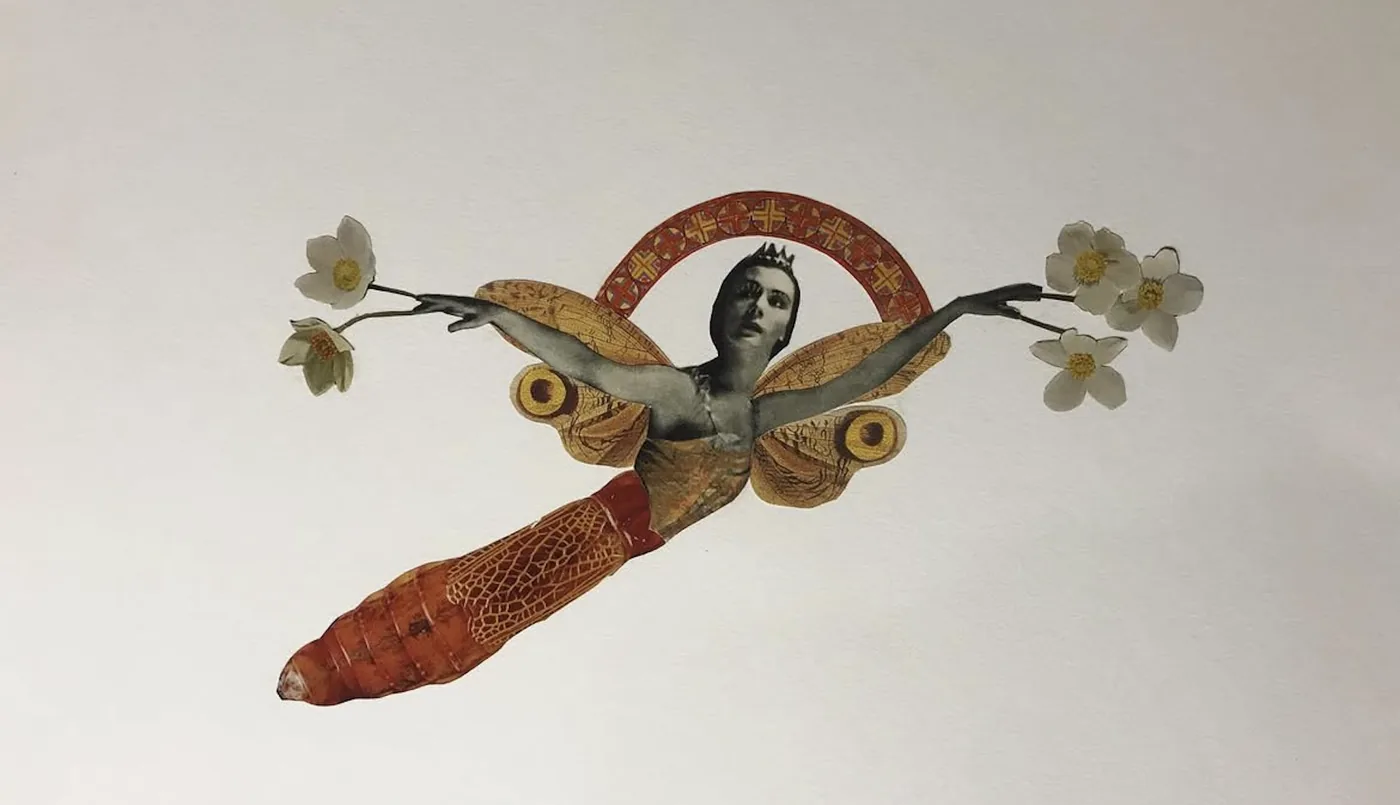
In her recent community project, C.U.L.T (Collaging Using Library Things), Kelly investigated how discarded library volumes, academic journals, and vintage ephemera could be transformed into meaningful cultural commentary. Through structured workshops, she invites participants to reimagine discarded printed materials. One workshop participant playfully accentuated the muscular contours of a physique athlete by grafting on delicate butterfly wings, while another excised and recomposed the painted lips from commercial fashion magazines. Another maker constructed a provocative piece entitled Dog Women with Alligator Fetus. This playful recombination actively disrupts traditional gender norms and historical authority [1].
Kelly encourages workshop participants to compose their own personal histories rather than accepting inherited narratives. Makers write their own histories. Instead of facing the intimidating expanse of a blank sheet, makers begin with the tangible printed artifacts surrounding them. They gravitate toward clippings that provoke discomfort, evoke whimsical humor, or feel pleasantly strange. This tactile methodology demystifies artistic creation, turning everyday paper recycling into an accessible act of personal reclamation [1].
Communal Tables and Kitchen Assemblage
Communal collage practice finds a vibrant home in collectives like the Social Glue of Sydney, an informal group dedicated to eliminating barriers to serious art production. The collective removes obstacles surrounding time, physical space, and financial resources by gathering members around a communal table to assemble work without leaders or institutional constraints. Social Glue recently staged a major survey exhibition at the Chrissie Cotter Gallery, presenting works categorized by themes such as ‘skulls, bones and anatomy’, ‘hands’, and ‘tourist albums, pianola, etc.’ Collective member Mia Ardianto merges transnational family archives with vintage magazines from years of experimentation across Australia and Indonesia, while Kathryn Baird contributes work as a self-described ‘devotee of medieval weirdness’ [1].
Collage provides an accessible therapeutic outlet for personal expression, particularly for individuals who feel marginalized by contemporary injustices. Anyone can establish a creative practice at a kitchen table using minimal equipment: a sturdy backing of cardboard or paper, discarded print media, scissors, and adhesive. Can intuitive cutting foster meaningful connection? Participants simply excise words or pictures that provoke genuine emotional resonance, whether curiosity, anger, love, or humor. There is no incorrect method for composing a collage. Intuition directs the scissors [1].
Alexandra Crosby’s historical documentation of these Australian collectives and international movements is archived as a DOI-linked preprint, and the manuscript has not undergone formal academic peer review [2]. Nonetheless, her survey demonstrates how the history of collage bridges ancient Japanese calligraphy and modern community activism. By repurposing the mass-produced fragments of their era, everyday makers continue to challenge dominant narratives from their own kitchen tables [1].
- ONLINE NEWS Crosby, A. (2026, September 13). A brief history of collage from 12th century Japan to Sydney today – and your own kitchen table. The Conversation. [Article Link]
- PREPRINT Crosby, A. (2026). A brief history of collage from 12th century Japan to Sydney today – and your own kitchen table [Preprint – not peer reviewed]. [Article Link]
- WEBSITE The Conversation. (2026, August 31). Artwork accompanying A brief history of collage from 12th century Japan to Sydney today – and your own kitchen table [Illustration]. The Conversation. [Article Link]
APA 7: PerEXP Teamworks. (2026, September 14). The history of collage: From ancient scrolls to modern art. https://perexpteamworks.com/en/history-of-collage-paper-to-modern/


1 comment