





In the desert cliffs of the Pisco Formation in southern Peru, paleontologists have identified a fossil whale with the most asymmetrical skull known among mammals. The newly described extinct dwarf sperm whale, Scaphokogia huachafo, lived six million years ago during the Late Miocene period. While modern toothed whales show slight skull skewness for echolocation, this creature possessed a face bent so far to the left that researchers initially suspected the fossil had been crushed by sediment. Geological tests confirmed the distortion was genuine biological anatomy [1].
Discovery of Scaphokogia Huachafo in Peru
The fossil skull emerged from desert sandstone layers known for preserving ancient marine life. Paleontologists Aldo Benites-Palomino and Gabriel Aguirre-Fernández examined the specimen from the arid Pisco Formation in southern Peru, working alongside co-authors M. R. Sánchez-Villagra, F. Paolucci, J. Vélez-Juarbe, and A. Collareta. Team researchers A. Alfsen, A. Dooley, D. Omura, M. Urbina, and R. Salas-Gismondi assisted in analyzing the Late Miocene layers. When researchers first uncovered the specimen, how had ancient forces preserved such an asymmetrical skull? Physical inspections showed zero evidence of fractures, cracks, or mechanical breaks along the cranial plates. The skull had entered the rock record in pristine condition, showing that the animal grew and swam with a visibly lopsided head. It survived six million years intact [2].
Such asymmetry had never turned up in fossil cetaceans. Skeletal symmetry forms the typical foundation of vertebrate anatomy, even among marine mammals that hunt in deep oceanic waters. Field teams confirmed that the peculiar shape reflected true biology instead of sedimentary compression or tectonic distortion. The discovery showed that unusual skull architecture evolved in South American coastal waters far earlier than once assumed [1].
The fossil belongs to an unknown member of the pygmy sperm whale family, known scientifically as Kogiidae. Although living relatives inhabit open tropical and temperate seas, this Late Miocene ancestor patrolled shallow nearshore environments. Its skull looked completely crooked. The sheer degree of lateral displacement surprised every anatomist on the team. Understanding how such a shape functioned in Scaphokogia huachafo pushed researchers to examine living marine mammals that hunt near the ocean floor [2].
The Lopsided Skull
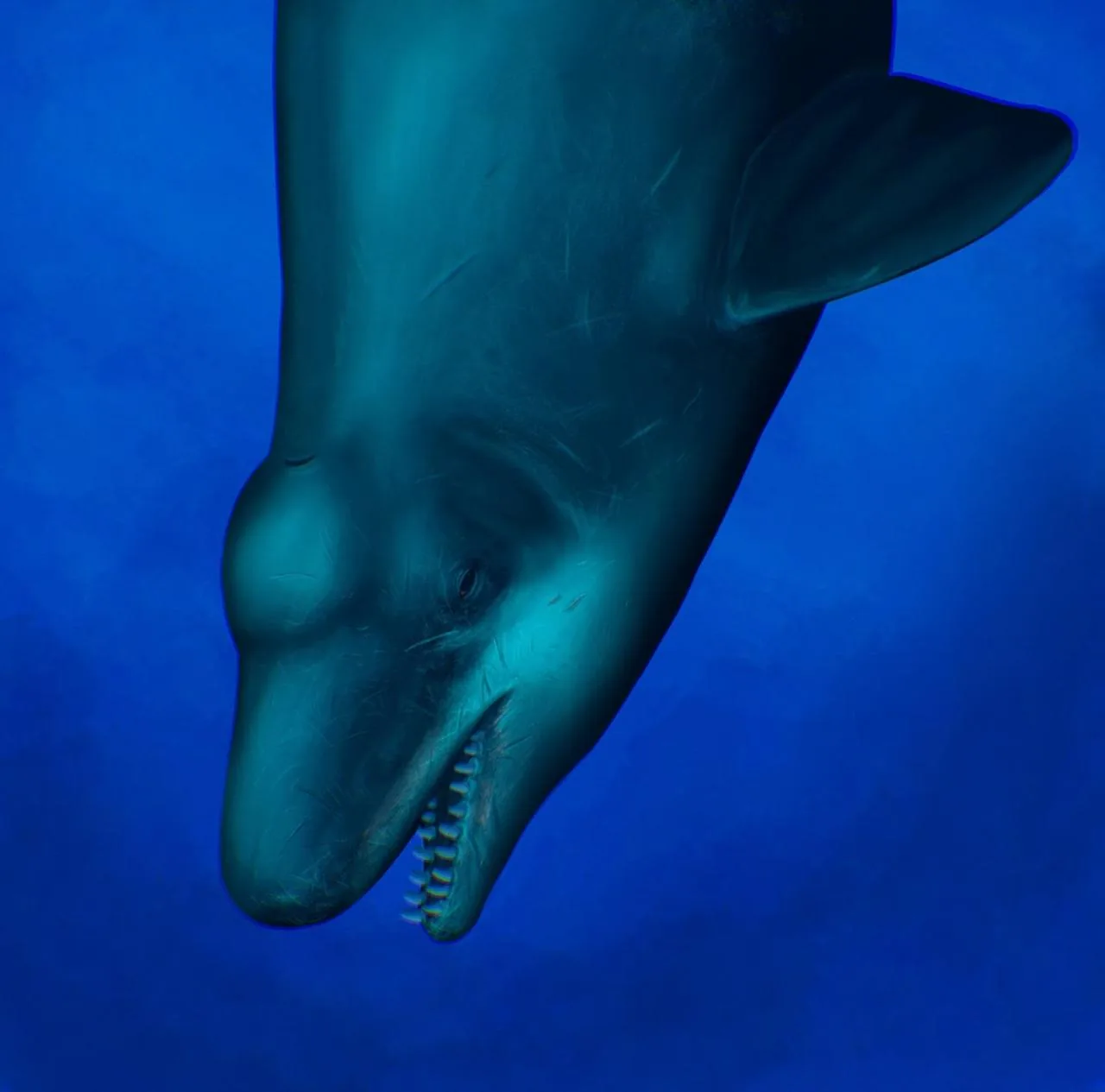
The anatomical hallmark of the skull lies in its lateral displacement. Both nostrils, known to anatomists as the external bony nares, sit far over to the left side of the face instead of along the midline. In modern toothed cetaceans, including oceanic dolphins and living sperm whales, cranial asymmetry remains mild because it links to fatty sound-producing melon tissues in the forehead that generate acoustic clicks for echolocation. In this fossil whale, however, the skewness extends far beyond the soft tissues into solid bone. The upper jaw, facial plates, and external bony nares bend steeply toward the left, giving the cranium a permanently warped posture that departs completely from standard vertebrate symmetry found in living mammals. Nothing looked symmetrical [1].
Researchers used geometric morphometric analyses to map the coordinates of the fossil bones against other cetaceans. Detailed geometric measurements confirmed that the species displays the most extreme cranial asymmetry recorded in any mammal, living or extinct, extending far beyond the bony nostrils to involve the surrounding cheekbones and rostrum [1].
The snout forms a robust, tubular structure made of pachyostotic bone, which is dense and thickened. Ossified cartilage further reinforces this bony tube, giving the front of the head exceptional weight and structural durability. The entire snout curves downward at a steep angle, creating a downward-hooked profile suited for plowing through coastal sediment beds. Marine paleontologists investigating ancient ocean ecosystems have documented how prehistoric species developed bizarre adaptations to survive, such as when a chunky belemnite fossil reveals a Jurassic survivor adapting to ancient predators in shallow seas. For the Peruvian whale, the crooked skull provided useful mechanical advantages in shallow waters instead of acoustic enhancements for open-ocean echolocation. The skull was built for bottom work [2].
Why the Name Huachafo Fits
The bizarre look of the fossil inspired the research team when choosing its scientific designation. In Peruvian Spanish, the everyday slang word huachafo describes something tacky, extravagant, odd, or thoroughly over-the-top. The researchers felt the word captured the strange geometry of the animal far better than conventional academic terminology. Reporting in Nautilus, science journalist David Nield noted that artist Jaime Bran Sarmiento provided anatomical reconstructions illustrating the unusual skull posture [2].
“It broke every rule of symmetry and elegance seen in living cetaceans,” study author Aldo Benites-Palomino said. “Its anatomy is so extravagant and odd that huachafo seemed the perfect name for it.” Taxonomic names often honor famous naturalists or geographical landmarks, but naming this species after local Peruvian street slang captures the striking visual shock delivered to anyone who inspects the crooked skull. Benites-Palomino, Aguirre-Fernández, and their research colleagues formalized the designation in scientific literature. The study published in Communications Biology shows how regional culture and paleontology converge to describe unusual prehistoric life [1].


Benthic Feeding on the Ancient Seafloor
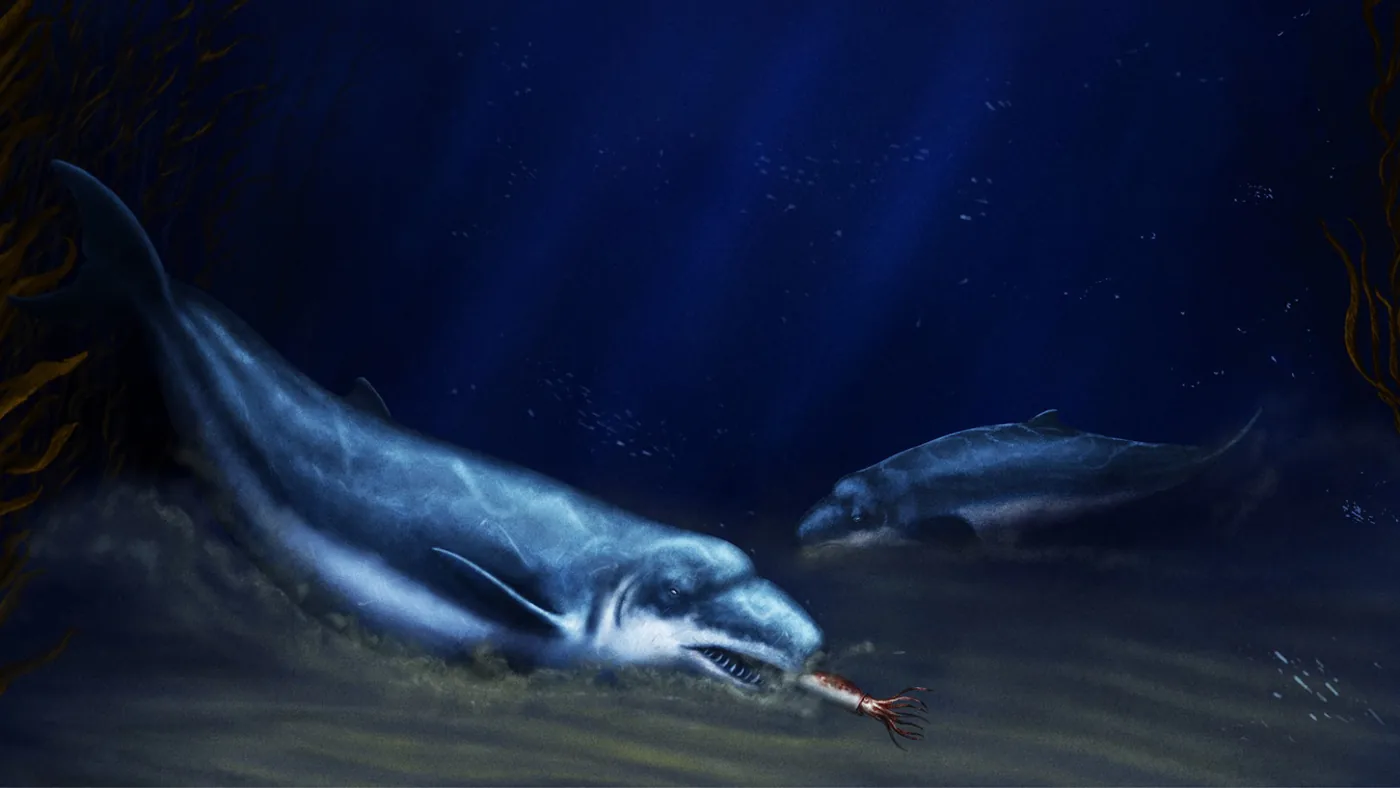
Why did this whale evolve such an asymmetrical, downward-pointing head? The answer stems from its dietary habits along the prehistoric seafloor. While living relatives feed on squid in open pelagic waters, the Peruvian species was built to gather food from marine sediments [1].
Its heavy snout served as an effective digging tool. Dense pachyostotic bone reinforced by ossified cartilage provided ballast, helping the animal stay submerged near the bottom without constantly fighting buoyant upward forces as it rooted through sediment for burrowing invertebrates. The animal’s leftward facial skew assisted in suction feeding or prey detection close to the bottom. In modern oceans, bottom-feeding cetaceans rely on specialized head postures to hoover prey from sandbanks. The crooked anatomy of this fossil dwarf sperm whale allowed it to position its mouth and sensory systems at an optimal angle against the seafloor. Having nasal and facial structures oriented toward one side helped the creature monitor the substrate while skimming just inches above the muddy sediment [2].
Coastal ecosystems often nurture unusual animal behaviors, creating intricate relationships between marine organisms that share shallow waters. Biologists tracking unusual wildlife behaviors in shallow coastal environments have noted surprising ecological relationships, such as when tiny crabs on sea snakes hitch rides across ocean currents to disperse through marine ecosystems. For ancient whales, shallow coastal bays offered rich feeding grounds packed with shellfish, worms, and bottom fish. The crooked head turned a difficult feeding zone into an accessible bounty [1].
How Scaphokogia Huachafo Flexed Its Neck
A downward-curving skull alone was not enough to scour the seabed; the animal also required exceptional neck mobility. When researchers examined the atlanto-occipital joint, which connects the base of the cranium to the first cervical vertebra, they discovered structural signs of enhanced ventral neck flexibility. Fossil reconstructions of the cranium and cervical vertebrae revealed that Scaphokogia huachafo could bend its head downward by 55 degrees relative to its torso, allowing it to cruise horizontally while aiming at the sediment. This posture gave the animal direct sensory access to the marine floor [1].
This anatomical setup gave the animal a major advantage when feeding along coastal shelves. “The combination of dense bone, the downward-curving snout and the flexible neck articulation allowed the animal to move directly above the seabed and feed close to the sediment,” study author Gabriel Aguirre-Fernández said. Morphological analysis of the atlanto-occipital joint in closely related fossil congeners indicates enhanced ventral neck flexibility, which allowed Scaphokogia huachafo to forage directly above the seabed without pitching its whole body down [2].
The whale grew nine feet long. At nearly nine feet in length, it was relatively small compared to modern sperm whales, which can exceed fifty feet. Its compact body size allowed it to navigate shallow waters and make tight maneuvers around submerged sandbars. The combination of small body dimensions, heavy cranial bone, and neck flexion formed an integrated suite of adaptations for benthic life. It lived as a dedicated bottom feeder [1].
Miocene Ecosystem Shifts
Despite its successful adaptations, the specialized lifestyle of the whale made it vulnerable to climatic change. As the Late Miocene transitioned into the Pliocene epoch, global oceanic circulation patterns shifted, cooling coastal waters and restructuring marine ecosystems until the specialized bottom prey communities that supported the species disappeared. The very traits that made the animal an effective bottom feeder—its heavy, dense snout and feeding posture—became liabilities when coastal prey disappeared. The lineage died out [2].
The demise of the species reveals an enduring lesson in evolutionary biology: functional success matters more than cosmetic balance. While symmetrical skulls dominate living marine mammals, ancient seas supported radical experiments in skeletal architecture. Scaphokogia huachafo proved that a crooked face could serve as an effective tool for millions of years. As paleontologists Aldo Benites-Palomino, Gabriel Aguirre-Fernández, and their international colleagues unearth more specimens from the Pisco Formation of Peru, this bizarre fossil illustrates how peculiar adaptations flourish when shallow seas provide rich feeding grounds [1].
- ACADEMIC JOURNAL Benites-Palomino, A., Sánchez-Villagra, M. R., Paolucci, F., Vélez-Juarbe, J., Collareta, A., Alfsen, A., Dooley, A., Omura, D., Urbina, M., Salas-Gismondi, R., & Aguirre-Fernández, G. (2026). Extreme cranial asymmetry in extinct benthic feeding sperm whales. Communications Biology, 9(1). [Article Link]
- ONLINE NEWS David Nield. (2026). This Newly Discovered Whale Species Had a Lopsided Skull. Nautilus. [Article Link]
APA 7: PerEXP Teamworks. (2026, November 27). Extinct Whale Scaphokogia Huachafo Had Completely Crooked Skull. PerEXP Teamworks. https://perexpteamworks.com/en/scaphokogia-huachafo-crooked-skull/


