



Spatial audio is an audio playback method that creates a three-dimensional sound field, placing sounds in front, behind, above, and below the listener. Standard stereo sound splits music and movie audio into fixed left and right channels, but spatial audio treats individual sound sources as free-moving objects positioned within an open room. This method mimics how human ears hear in real life by adding height and depth to the audio experience. Today, object-based code and binaural filters let regular headphones and home speakers reproduce realistic acoustic spaces [10].
- Fundamentals of Spatial Audio
- Psychoacoustics Behind Binaural Filtering
- Object-Based Mixing Versus Channel Audio
- How 3D Audio Recreates Elevation
- Headphone Processing with Dynamic Sensor Tracking
- Spatial Audio Hardware Requirements for Home Theaters
- Streaming Platform Catalogs and Industry Adoption
- Why Stereo Mixing Still Dominates Everyday Listening
Fundamentals of Spatial Audio
Spatial audio includes several proprietary and open systems made to build immersive soundscapes for listeners. Common formats include Dolby Atmos, DTS:X, Sony 360 Reality Audio, MPEG-H 3D Audio, THX Spatial Audio, and Dirac Virtuo [7]. Instead of locking recorded instruments or dialogue into fixed speaker channels, these systems attach three-dimensional coordinates that describe exactly where every sound belongs in an open virtual room. The decoder reads these spatial positions and maps each element to the playback hardware in real time.
Older surround sound formats like 5.1 and 7.1 placed audio on a single flat horizontal plane. In contrast, new spatial formats introduce vertical height, letting sounds like falling rainfall, passing helicopters, or cathedral room echoes come from overhead with convincing physical realism [7]. Dolby Atmos adds height. Sound designers can steer individual audio cues smoothly from one wall to another without jarring jumps between speaker cones. Tech companies build these decoding tools into Apple AirPods, Sonos soundbars, smart TVs, and mobile phones to enhance movies, tracks, and games [10]. Closed-back headphones build an even tighter acoustic field by isolating the ears [7].
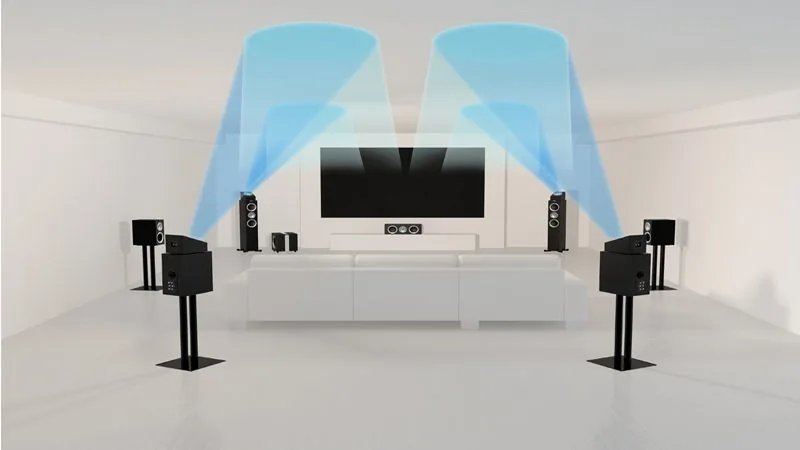
This dynamic mapping adapts to each setup. When someone plays an Atmos track, the software checks the speaker count before sending audio feeds. A compact soundbar bounces sound off the ceiling, while full home theater setups feed discrete ceiling speakers to place acoustic elements directly above the seated listener [13].
Psychoacoustics Behind Binaural Filtering
Human ears find sound locations by judging tiny gaps between what each ear hears. Sound travels fast. When a noise comes from the left side of a listener, it reaches the left ear slightly earlier than the right ear, producing an interaural time difference. The human head also blocks incoming sound waves, creating an interaural level difference that the human brain uses to pinpoint the exact directional location of the source [2].
Beyond horizontal cues, human hearing relies on spectral cues shaped by the torso, head, and outer ear, known as the pinna. Sound waves bounce off these body contours before entering the ear canal, altering frequency curves depending on whether a sound is high, low, or behind [12]. Researchers model these directional modifications with mathematical filters called Head-Related Transfer Functions (HRTF). By filtering an audio stem with HRTF data, software tricks the human brain into hearing sounds above or behind, even when listening through basic stereo earbuds [1]. A study by Hong and Gan examined how binaural recording and playback capture soundscapes accurately for virtual environments [6].
Binaural playback uses these filters with cross-talk cancellation to prevent audio bleed between ears. Direct sound hits first. Zhang and fellow researchers reviewed how two-ear binaural rendering mimics natural acoustic paths so well that listeners can point to virtual objects in space without extra speakers [1].
Object-Based Mixing Versus Channel Audio
Standard audio production relies on channel-based tracks, where sound engineers route recorded instruments and vocal takes to fixed speaker outputs like stereo left, center, or surround channels. If a playback system lacks a specific speaker, the mix folds down and loses separation. In an object-based workflow, each sound element exists as an independent stem with positional metadata that marks its exact coordinates and movement in a three-dimensional listening field [3].
Modern digital audio workstations like Apple Logic Pro, Steinberg Nuendo, Cockos Reaper, and Avid Pro Tools now include spatial panning tools to position sounds onto a three-dimensional virtual sphere. Stems remain discrete. Mixers place vocals, drums, and guitars onto a virtual sphere to set distance and height. Dolby provides a standalone Dolby Atmos Renderer to preview how objects sound on headphones and speaker arrays. The final project is exported as an ADM BWF file containing multitrack stems and positional metadata [9].
Global standards also support open distribution across different platforms. The MPEG-H 3D Audio standard from the ISO/MPEG group carries channels, audio objects, and Higher Order Ambisonics. This flexible standard renders immersive sound for setups ranging from large 22.2 speaker arrays down to standard stereo headphones without requiring separate audio files for each environment [4].
How 3D Audio Recreates Elevation
Faking height and depth is harder than left-right panning. In a room, ears tell distance by comparing direct sound with reverberant room reflections. Ears detect distance. As a sound source moves further away from the listener, high tones drop off naturally in air and room reflections grow louder relative to the direct acoustic wave [3]. Synthetic spatial algorithms must calculate early reflections and decay times instantly to keep sound realistic [2].
Researchers have built parametric tools to model 3D reverberation cleanly. A research team led by P. J. C. Coleman and A. Franck published the RSAO framework in the Journal of the Audio Engineering Society, generating reverberation directly inside an audio object renderer [3]. Listening evaluations showed that adjusting RSAO settings successfully alters perceived room size and source distance while preserving listener envelopment across diverse playback speaker systems. To measure these perceptual traits, A. Lindau and S. Weinzierl established the Spatial Audio Quality Inventory, offering 48 standardized verbal descriptors to grade localization accuracy, coloration, and authenticity [5].
Directional audio also serves flight safety. The US Air Force hired Danish defense contractor Terma A/S in November 2024, paying $9 million to install 3D audio systems in F-16 Fighting Falcon fighter aircraft. The system separates radio chatter and points audio cues toward flight threats to help pilots react quickly [12].


Headphone Processing with Dynamic Sensor Tracking
Earbuds offer simple access. Because apps like Apple Music, Tidal, and Amazon Music decode object streams into binaural signals using built-in software engines, standard wired or wireless headphones deliver multi-directional sound without extra hardware [10]. Apple introduced spatial audio in iOS 15, letting mobile users experience 3D audio directly through handheld devices. The app shifts timing and frequency response to place sounds outside the head [8].
Static binaural sound feels spacious, but the illusion slips when the listener turns their head. In a real room, speakers stay put. With basic headphones, turning the head turns the whole soundstage along with the body. Dynamic head tracking solves this limitation by embedding gyroscopes and motion sensors inside wireless listening gear like Apple AirPods Pro, AirPods Max, and Sonos Ace headphones [7]. Paired with an iPhone, iPad, or Apple TV 4K, the sensors read head movements instantly. If an actor speaks on screen and the listener looks to the left, dialogue stays pinned to the screen, shifting naturally to the right ear [10].
Custom ear scans sharpen this effect. Apple and Sony let users scan their ears with phone cameras to build tailored HRTF files. Apple uses the TrueDepth camera on iPhone X and newer models to measure ears and head shape, tuning binaural filters to individual anatomy for sharper directional clarity [10].

Spatial Audio Hardware Requirements for Home Theaters
Home theaters build immersion with physical speakers placed across a room. Standard five or seven-speaker surround setups gain height channels, designated by a third digit in modern system ratings like 5.1.2 or 7.1.4 to indicate overhead speakers [10]. Dedicated audiovisual receivers like the Sony TA-AN1000 7.2-channel amplifier or Marantz Cinema 70s decode Atmos bitstreams, routing independent audio objects to in-ceiling or upward-firing drivers [11].
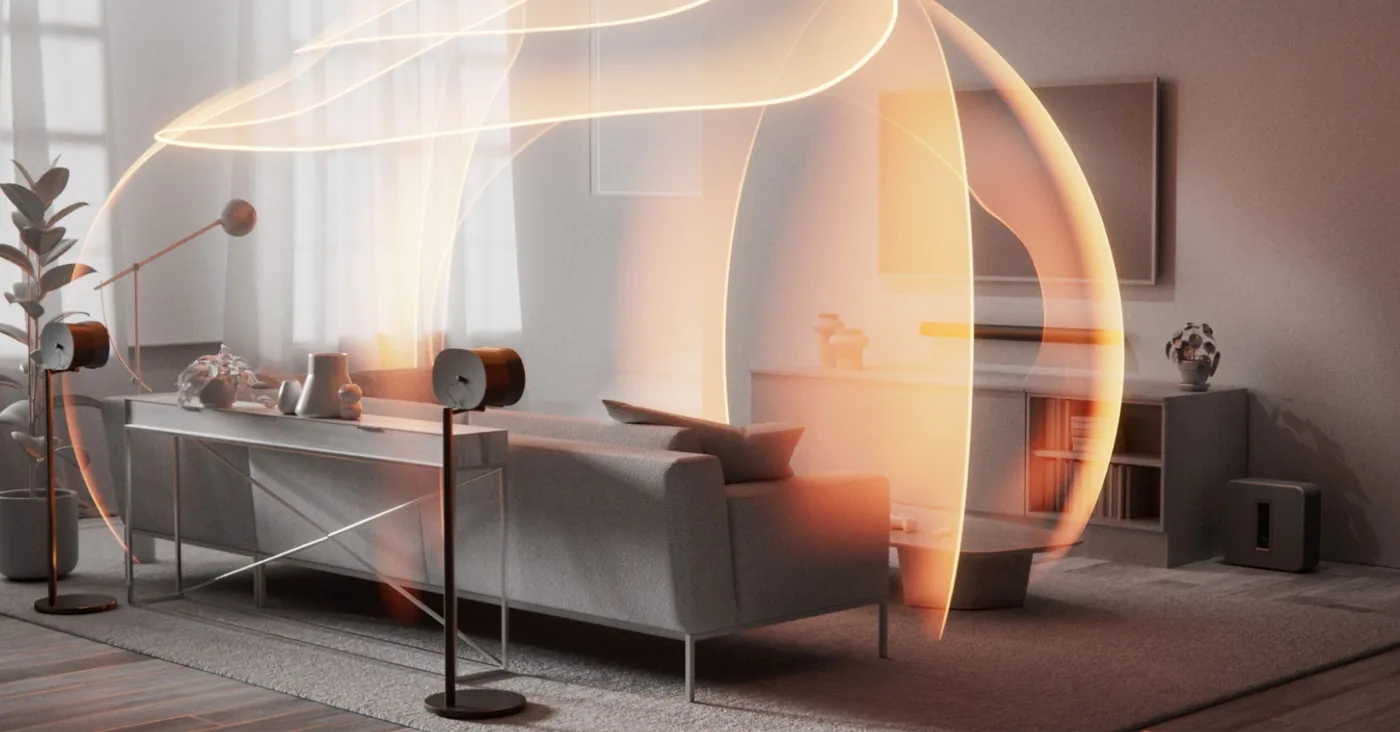
Soundbars and smart speakers offer simpler setups. Advanced soundbars like the Sonos Arc Ultra and smart speakers like the Sonos Era 300 use upward-firing and side-firing drivers to bounce acoustic waves off ceilings and walls toward the listener [13]. Other standalone units include the Apple HomePod, JBL Authentics 500, and Amazon Echo Studio [10]. Standard stereo gear cannot decode these spatial streams. For example, Mordaunt Short Mezzo 2 bookshelf speakers powered by a standard Marantz PM6005 amplifier cannot decode object metadata and simply fold spatial audio down into regular two-channel stereo [11].
Processors also include upmixing tools that expand stereo or 5.1 tracks into height channels. Technologies like Dolby Surround, DTS Virtual:X, Sony Immersive AE, and Sennheiser Ambeo analyze frequency cues to distribute ambient sound across height channels in existing speaker arrays. These tools widen legacy sound, though they cannot match true object mixes [10].
Streaming Platform Catalogs and Industry Adoption
Video platforms have adopted spatial sound steadily over the last decade. Services like Netflix, Disney+, Apple TV+, Amazon Prime Video, Paramount+, and Max host broad libraries of movies mixed in Dolby Atmos. However, several services restrict spatial playback to top-tier subscription plans, such as the Netflix Premium plan, Max Ultimate tier, and the Paramount+ with Showtime bundle [7]. Streaming boxes and TVs must support Atmos passthrough to output the signal properly [10].
Music platforms show a split market. Apple Music, Tidal, and Amazon Music Unlimited offer deep catalogs of Dolby Atmos Music and Sony 360 Reality Audio [7]. In contrast, Spotify has not added spatial audio, keeping its listener base on standard stereo [9]. Gamers can use Windows Sonic, Dolby Atmos for Headphones, or DTS Headphone: X on PC and Xbox consoles. Popular gaming titles like Doom Eternal, Apex Legends, Call of Duty, and Destiny utilize spatial audio cues to help competitive players pinpoint footsteps and gunfire from enemies moving nearby [8].

Public shows introduced spatial sound years ago. The Sounds Dangerous! attraction at Disney’s Hollywood Studios in the Walt Disney World Resort used binaural headphones to immerse park visitors in a dark room starring actor Drew Carey. Tony Colman performed the first Dolby Atmos club set at Ministry of Sound in London for Hospital Records [12].
Why Stereo Mixing Still Dominates Everyday Listening
Stereo still leads distribution. While producing an Atmos mix requires separate stems, monitoring tools, and careful acoustic balance, Apple Music encourages adoption by paying approximately a 10 percent royalty premium for immersive releases. That payout pushed major record labels to adopt the format. In 2025, 85 of the top 100 Billboard artists released music in Dolby Atmos, but 15 artists skipped it [9].
Submission rules set high technical bars for independent acts. Apple Music submission guidelines strictly ban automated stereo-to-Atmos upmixing, demanding genuine multitrack stems that comply with rigid loudness targets of minus 18 LKFS and minus 1 dBTP. Consumer playback habits also favor stereo, as most listeners use Bluetooth speakers, car stereos, and basic phone speakers that cannot play 3D audio tracks. An engineer who tunes a mix solely for binaural headphones risks weak vocals or thin bass when audio folds down to stereo [9].
Because everyday audio gear relies on two channels, mixers finish a solid stereo master before attempting 3D formats, ensuring tracks sound clear on cheap earbuds and car stereos. Digital aggregators like DistroKid and TuneCore now distribute Atmos files alongside stereo masters [9]. Immersive audio enriches big movie soundtracks, but stereo is still the format that reaches most listeners [10].
- ACADEMIC JOURNAL Zhang, W., Samarasinghe, P. N., Chen, H., & Abhayapala, T. D. (2017). Surround by Sound: A Review of Spatial Audio Recording and Reproduction. Applied Sciences, 7(5), 532. [Article Link]
- ACADEMIC JOURNAL Hacıhabiboğlu, H., De Sena, E., Cvetković, Z., Johnston, J. D., & Smith, J. O. (2017). Perceptual Spatial Audio Recording, Simulation, and Rendering: An overview of spatial-audio techniques based on psychoacoustics. IEEE Signal Processing Magazine, 34(3), 36-54. [Article Link]
- ACADEMIC JOURNAL Coleman, P. J. C., Franck, A., Jackson, P. J. B., Hughes, R. J., Remaggi, L., & Melchior, F. (2017). Object-Based Reverberation for Spatial Audio. Journal of the Audio Engineering Society, 65(1/2), 66-77. [Article Link]
- ACADEMIC JOURNAL Herre, J., Hilpert, J., Kuntz, A., & Plogsties, J. (2015). MPEG-H 3D Audio—The New Standard for Coding of Immersive Spatial Audio. IEEE Journal of Selected Topics in Signal Processing, 9(5), 770-779. [Article Link]
- ACADEMIC JOURNAL Lindau, A., Erbes, V., Lepa, S., Maempel, H., Brinkmann, F., & Weinzierl, S. (2014). A Spatial Audio Quality Inventory (SAQI). Acta Acustica united with Acustica, 100(5), 984-994. [Article Link]
- ACADEMIC JOURNAL Hong, J. Y., He, J., Lam, B., Gupta, R., & Gan, W. (2017). Spatial Audio for Soundscape Design: Recording and Reproduction. Applied Sciences, 7(6), 627. [Article Link]
- ONLINE NEWS Bedford, T. (2024, August 3). What is spatial audio? 3D audio effects explained – and why you want them. TechRadar. [Article Link]
- ONLINE NEWS Vicente, V. (2021, November 9). What Is Spatial Audio, and How Does It Work? How-To Geek. [Article Link]
- ONLINE NEWS Rahul, R. (2026, August 10). Spatial Audio Explained: What It Is, What It Isn’t, and Where Stereo Still Wins. Remasterify. [Article Link]
- ONLINE NEWS Cohen, S. (2021, June 9). What is spatial audio? The 3D sound experience fully explained. Digital Trends. [Article Link]
- ONLINE NEWS Ben. (2025, September 14). What Is Spatial Audio? How It Works, Why It Matters, and How to Use It. Gadgets N Tech. [Article Link]
- WEBSITE Wikipedia. (n.d.). 3D audio effect. Wikipedia. [Article Link]
- WEBSITE Sonos. (2023, July 24). The Beginner’s Guide to Spatial Audio. Sonos. [Article Link]


