





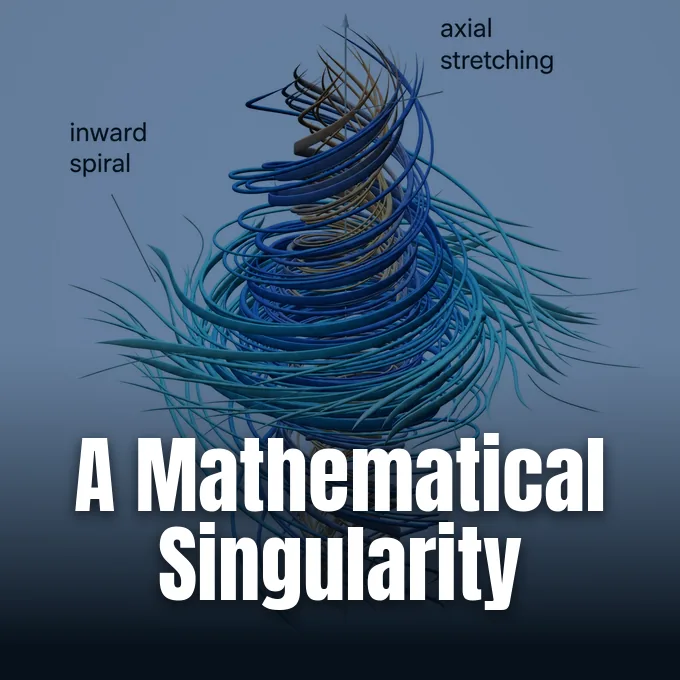
A vortex stretches like spaghetti in the Navier-Stokes proof that OpenAI says its AI agents produced, spiraling inward as the mathematical fluid approaches a breakdown in finite time. The company announced the claimed solution on September 8. Independent verification remains unestablished in the available reporting. OpenAI says it found a singularity (a breakdown in the mathematical description). What would this proposed Navier-Stokes solution actually establish? [1, 2]
Navier-Stokes Proof Targets Fluid Breakdown
OpenAI describes a fluid that begins smoothly, then spirals inward and becomes increasingly elongated until the equations assign it infinite speed within a finite interval, according to its researchers. Real fluids cannot do that. Ven Chandrasekaran, an OpenAI computer scientist, described the outcome at a press briefing reported by Nature. He said it would expose circumstances in which the equations cease to mirror physical reality. [1, 2]
Mathematicians have struggled with the underlying question for roughly 90 years, according to OpenAI, asking whether smooth three-dimensional motion can eventually break down under the Navier-Stokes equations. The stakes reach beyond one calculation. The Clay Mathematics Institute included the question among its Millennium Problems, whose solutions carry a $1 million prize. OpenAI says its proposed example takes the breakdown route. The available reports do not establish independent verification of the company’s claimed solution. [1, 2]
Engineers already use these equations to model fluids, from airflow around aircraft wings to blood moving through arteries. The applications are familiar. PerEXP Teamworks previously covered methods for tackling partial differential equations; OpenAI’s announcement concerns whether one particular model can preserve smooth motion under the conditions of a famous mathematical problem. The company says it pushed thousands of agents toward that question. [1, 3]
Ten Thousand Agents, One Problem
OpenAI says its internal model group reached the Navier-Stokes proof in 88 hours, using around 10,000 coordinating AI agents and a next-generation model it describes as significantly more capable than GPT-6 Astra. Training continues, the company says. OpenAI also claims improvements across benchmarks. Those performance descriptions come from the company itself. The available material supplies no independent benchmark assessment of that comparison. [1]
OpenAI mathematician Sebastian Bubeck told Nature that researchers initially tested their prototype on all six unsolved Millennium Problems before concentrating on fluid motion on September 1, after hearing reports about Levent Alpöge and Tristan Buckmaster. Another team had caught their attention. Bubeck said 1,000 agents first answered a simplified version in 50 hours. OpenAI then increased the effort to 10,000 agents for the full Navier-Stokes problem. Nature reports those figures as the researchers’ account. It does not provide a separate audit of the run. Nor does its account explain how the 50-hour stage relates to the 88 hours in OpenAI’s public post. Both timings come from the company. [1, 2]
The agents’ output, OpenAI says, includes an analytical argument and a Lean formalization. Can a computer-checkable proof settle the claim? [1]


What Lean Adds to Checking
Mathematicians use Lean to express mathematical arguments in code that computers can check for logical errors, a process New Scientist explains in its coverage of Alpöge and Buckmaster’s work. OpenAI says it supplied that component too. The company claims a Lean formalization alongside its analytical proof. The accessible reporting does not document an independent examination of that formalization. Checking the actual argument remains essential to evaluating whether the announced result settles the stated problem. [1, 3]
OpenAI lists its announcement under On the Navier–Stokes Millennium Prize Problem, and the research package also identifies a Hacker News discussion linking to that page. The full announcement was unavailable. Only feed metadata accompanied these two records, so neither supplies evidence here about the proof’s assumptions, successful verification or outside mathematicians’ conclusions. The source list includes both as announcement and discussion pointers, with their access limits marked explicitly. The mathematical account comes from OpenAI’s accessible X post and the reporting by Nature and New Scientist. [1–5]
Clay Mathematics Institute president Martin Bridson welcomed the prospect of major advances when speaking to Nature, but the report records no prize award or completed independent review of OpenAI’s argument. Peer-reviewed publication also remains unestablished. OpenAI’s Navier-Stokes proof therefore enters the story as a company claim, while other researchers have released results for nearby equations that help explain why the full problem remains such a difficult target. [2]
Human Teams Reach Nearby Equations
Tristan Buckmaster of New York University and Levent Alpöge announced three results involving the Boussinesq approximation and Euler equations, which New Scientist describes as close relatives of Navier-Stokes. Two came with Lean formalizations. The pair held back another while completing its formalization. They built on work by Diego Córdoba and Luis Martínez-Zoroa with a ‘great deal of help from LLMs’ (large language models). New Scientist describes steps toward the full problem, rather than a published general Navier-Stokes solution. [3]
Nature reports that the pair released a paper on September 7 concerning fluids with zero viscosity (resistance to flowing), using Anthropic’s Claude and OpenAI’s Codex and Astra models. A more general result would follow, they said. Separately, Anima Anandkumar of the California Institute of Technology and collaborators released a zero-viscosity result using a physics-informed neural network. Nature describes a different AI method from the language models used by the other teams. These results do not independently confirm OpenAI’s claim. [2]
Terence Tao, at the University of California, Los Angeles, expressed optimism about extending Alpöge and Buckmaster’s methods, according to New Scientist. Camilla Nobili shared that optimism. The University of Surrey mathematician nevertheless expected Navier-Stokes to demand more than repeating the same technique, because friction and dissipation introduce effects that tend to smooth fluid motion. How would a proposed singularity survive? Those smoothing effects complicate the route from the related equations to the full problem. [3]
What the Claim Leaves Open
David Silvester of the University of Manchester called the related results ‘stepping stones’ in New Scientist, while cautioning that a mathematical resolution might offer little immediate benefit for existing engineering applications. Fluid models already work well, he said. Aircraft design and other established uses need not change because mathematicians settle the underlying question. His comments concern the research discussed in that report. They provide practical context without evaluating OpenAI’s Navier-Stokes proof. [3]
OpenAI emphasizes the resources it committed and the capabilities it attributes to its developing model, while Buckmaster’s account in New Scientist stresses AI’s growing ability to amplify human mathematical effort. People remain part of both accounts. OpenAI describes an internal model group directing thousands of agents; Buckmaster and Alpöge describe building on Diego Córdoba and Luis Martínez-Zoroa’s work with assistance from several models. The reporting establishes neither an independently verified winner nor a prize recipient. [1, 2, 3]
OpenAI’s public announcement of its proposed proof gives mathematicians a specific claim to investigate: a fluid that starts smoothly and develops a singularity in finite time under Navier-Stokes dynamics. The argument still needs independent scrutiny. For the Navier-Stokes proof, the unresolved question in these reports is whether the analytical reasoning and Lean formalization establish exactly the result required by the Millennium Problem. [1, 2]
- WEBSITE OpenAI [@OpenAI]. (2026, September 8). We’re sharing a solution to the Navier-Stokes Millennium Prize Problem [Post]. X. [Article Link]
- ONLINE NEWS Castelvecchi, D. (2026, September 8). OpenAI claims huge maths breakthrough on a famed ‘Millennium Problem’. Nature. [Article Link]
- ONLINE NEWS Sparkes, M. (2026, September 8). Major breakthrough made on famous Millennium maths problem. New Scientist. [Article Link]
- PRESS RELEASE OpenAI. (n.d.). On the Navier–Stokes Millennium Prize Problem. [Article Link]
- WEBSITE On the Navier–Stokes Millennium Prize Problem. (n.d.). Hacker News. [Article Link]


