





In modern software teams, ci/cd pipelines run as automated workflows that compile, test, and package code before pushing it to live servers [13]. Older release habits often created friction because developers kept branches on local machines for weeks before facing a chaotic merge day full of defects [5]. By combining ongoing code integration with automated delivery, teams break large updates into small batches [12]. Every commit undergoes immediate automated checks, turning software delivery into a daily habit that keeps systems stable while shipping new features [1].
Why Teams Use CI/CD Pipelines
A delivery pipeline acts like a conveyor belt moving raw code into tested releases [6]. When a programmer pushes code to a Git repository on GitHub or GitLab, webhooks wake up the pipeline [1, 12]. Cloud runners pull code within seconds [1]. Cisco documentation notes that running regression tests at this initial step catches errors on small code diffs [10].
Before teams built automated pipelines, developers wrote code in prolonged isolation while operations staff handled separate, infrequent release windows that routinely failed due to uncoordinated changes [9]. Merge conflicts took days to resolve. Modern ci/cd pipelines eliminate these merge delays by prompting engineers to integrate small code changes daily, allowing compilation errors and unit test failures to surface within minutes of a push [3, 4]. According to State of DevOps research tracked by GitHub, engineering teams adopting mature automated workflows achieve 208 times higher deployment frequency and accelerate lead times by a factor of 106 compared to peers relying on manual release steps [3]. Technology leaders like Netflix and Spotify rely on these delivery flows to ship regular software updates to millions of active users [12, 19].
Continuous Integration Basics
Continuous integration establishes trunk-based development by requiring software engineers to merge their code changes into a shared central branch early and often throughout the working day, which prevents long-lived branches from diverging [4, 5]. When engineers work on separate branches without regular syncing, conflicting edits accumulate rapidly, turning final integration into an unpredictable task that consumes days of debugging time [5, 7]. Teams adopting this practice commit small updates to version control repositories like Git every day [7].
Build scripts assemble web assets, server binaries, and database scripts with a single command [4, 7]. Compilers like Maven or Gradle package applications into deployable artifacts. When code fails to compile or breaks existing tests, the build server stops the run and alerts the author right away [12].
A major research study examined how developers configure these automated builds in open-source mobile projects. In an article published in ACM Transactions on Software Engineering and Methodology, Ghaleb and colleagues examined 2,557 Android repositories utilizing GitHub Actions, CircleCI, Travis CI, and GitLab CI/CD. The authors found that most project files focused primarily on basic compilation tasks, while only 9 percent configured automated security scans. The study also pointed out that varying YAML syntax across different CI platforms forces developers to spend hours rewriting build rules when migrating between services [16].
Continuous Delivery Pipelines Versus Deployment
While both concepts share the CD abbreviation, continuous delivery and continuous deployment represent fundamentally different automation boundaries when shipping software to end users [11]. Continuous delivery keeps code release-ready. Every build that passes automated testing advances to staging, where it waits for an explicit manual approval decision before an engineer triggers the final release [1, 8].
Continuous deployment removes this human approval step to create a fully automatic flow [1]. When changes pass every unit test, integration test, and security check, the software deploys to live servers without human intervention [8]. This setup lets teams roll out bug fixes and new features within minutes of committing code [11]. With modern ci/cd pipelines, automatic deployment demands rigorous test suites, automated system telemetry, and dependable rollback plans so flaws never linger in production environments [6].
The choice between these two approaches depends on business risk tolerance, compliance rules, and product architecture [5]. Stephen Bigelow explains in TechTarget that financial institutions and healthcare firms often prefer continuous delivery because strict regulatory standards demand signed audit trails before software reaches users [2]. In contrast, software-as-a-service companies and web platforms lean toward continuous deployment to ship features rapidly [9]. At automated testing firm mabl, developers push updates to production about 80 times each week using GitHub Actions and automated CLI test runners [3]. Cloud providers like Amazon Web Services with AWS CodeCommit and Microsoft with Azure DevOps Pipelines offer built-in compliance gates to support both manual approvals and automated deployments [1, 9].
Five Core Pipeline Stages
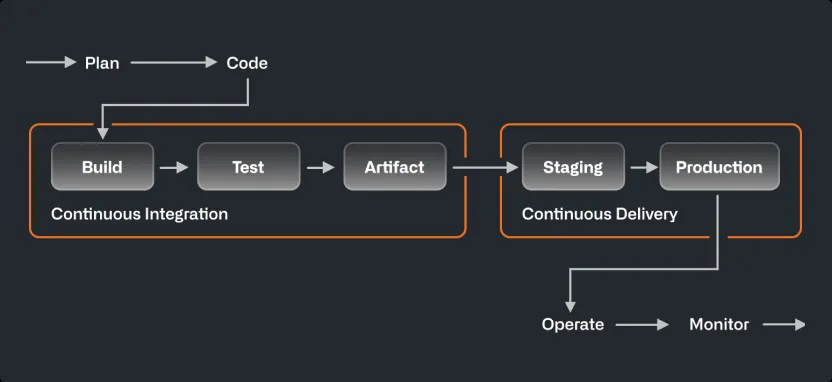
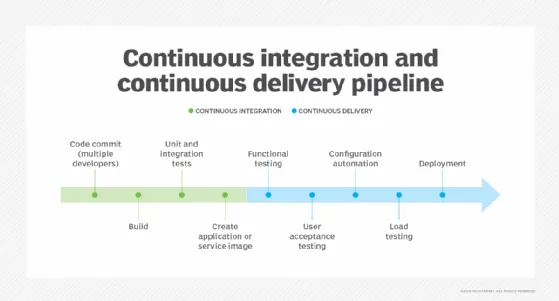
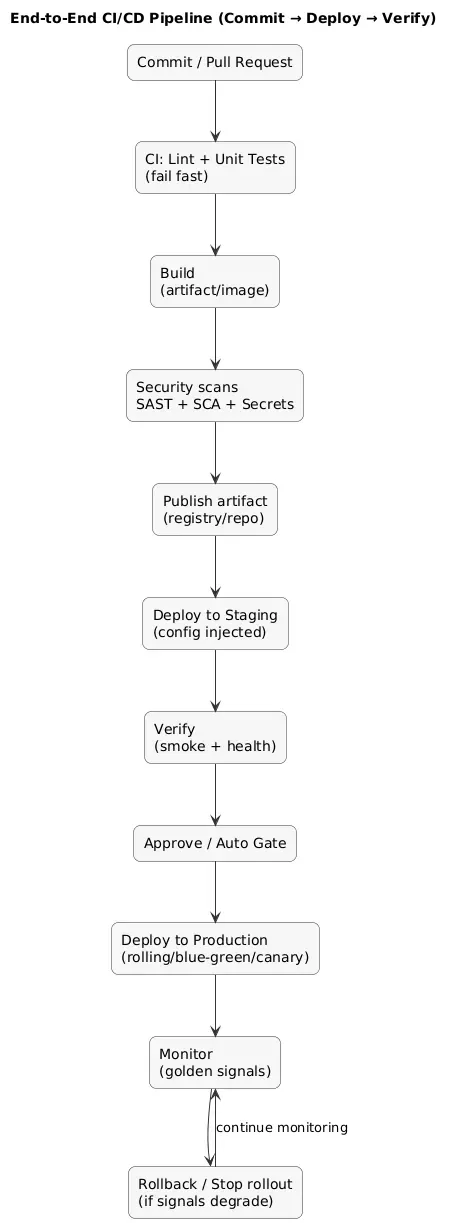
Five connected stages form standard ci/cd pipelines. The process begins when an engineer pushes new commits to a version control repository like Git, triggering automated webhooks that pull the updated source files into isolated build environments within seconds [1, 12]. Next, runners compile source files, resolve external library dependencies, and generate immutable artifacts [1, 6].
Passing builds advance to staging servers that mirror live infrastructure, where teams run smoke tests against external APIs and databases [6, 9]. Staging catches configuration drift. Norbert Sowinski at All Days Tech advocates for an immutable artifact model where engineers build a container once and promote that identical package from dev to staging and production rather than recompiling per server [6].
Integrating database migrations into these stages requires careful design to prevent breaking live queries. In an empirical evaluation published in the Journal of Software Evolution and Process, Fluri and colleagues evaluated automated database pipelines across three industrial software environments. The findings proved that automating database schema migrations and validation scripts cut deployment errors, increased release volume, and lowered cognitive fatigue among developers. Teams avoided schema mismatches between backend code and database tables by letting pipeline workers test migration scripts in isolated staging databases before applying changes to live clusters running Docker containers or Apache Mesos instances [2, 17].


Automated Testing Strategy
Automated testing serves as the central safety net in software pipelines by confirming that new commits do not break existing features [1]. Pipelines rely on layered testing with frameworks like JUnit, pytest, and Selenium, running fast unit tests first before moving to integration tests that check database interactions and web APIs [6, 12]. Microsoft developer guides advise teams to aim for 70 to 80 percent test coverage to protect functionality without creating excessive test maintenance [1].
To keep feedback loops fast, modern build systems run tests in parallel across multiple cloud agents. Running tests sequentially can add hours to build times, tempting developers to skip checks [1, 6]. When intermittent flaky tests fail at random without actual code defects, engineers lose faith in pipeline alerts [6].
In March 2022, CircleCI acquired Paris startup Ponicode, a firm founded in 2019 by Patrick Joubert that had previously raised $4.6 million in funding to generate automated unit tests. CircleCI engineering vice president Jean-Philippe Leblanc explained that embedding test generation into the developer IDE catches software regressions before code ever reaches remote build queues. Under chief executive Jim Rose and technology chief Rob Zuber, CircleCI provides up to 6,000 build minutes monthly on its free tier across Linux, Windows, and Docker environments [18, 14]. Klara quality assurance lead Valentin Ranshakov noted that cloud pipelines provide the testing reliability needed to deploy healthcare software at scale, joining enterprise customers such as Peloton and Samsung [18].
Security Controls and Access Rules
Modern ci/cd pipelines embed security tools early in the software lifecycle, a shift known as DevSecOps [5, 9]. Pipelines scan source code with static analysis tools like SonarQube or GitHub CodeQL to find coding bugs before merge. They also run software composition analysis to check open-source libraries against known Common Vulnerabilities and Exposures [1].
Cloud infrastructure also brings specific security threats that teams must manage actively. In a systematic review evaluating 66 academic papers on cloud CI/CD security, Saleh, Madhavji, and Steinbacher documented major vulnerabilities in automated pipelines. The authors found that container image tampering, unauthorized repository access, and weak authentication credentials pose frequent security hazards. Their study stressed that development teams need clear security standards when assembling pipelines from open-source tools such as Harbor, Jenkins, and GitHub Actions to prevent attackers from injecting malicious code into production images [15].
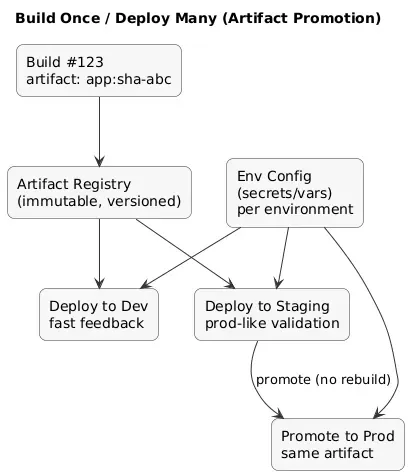
Protecting build pipelines requires disciplined secrets management and strict adherence to the principle of least privilege, ensuring that automation credentials remain completely isolated from application source repositories [6, 12]. Hardcoded passwords must never enter Git commits [6]. Instead, pipeline runners dynamically fetch short-lived credentials from secure vaults like HashiCorp Vault, AWS Secrets Manager, or Azure Key Vault at runtime to prevent long-term credential leakage [12]. Environment boundaries keep staging tokens from touching live database clusters [6].
Rollout and Verification Methods
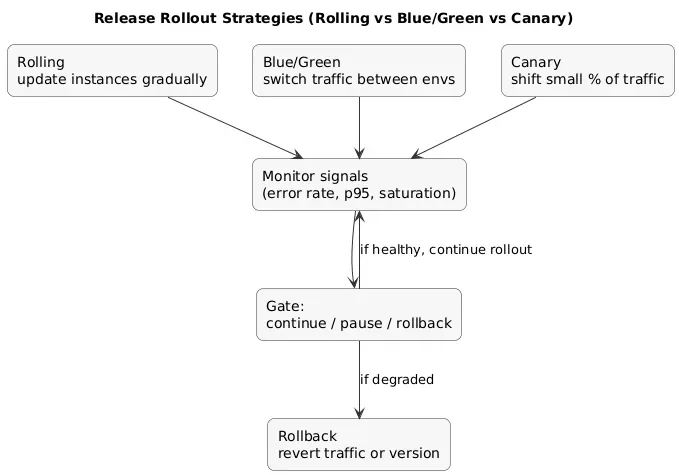
After software passes staging checks, automated deployment methods release the update while avoiding user downtime. In a rolling deployment, the pipeline updates server instances one by one until the entire cluster runs the new release [6, 12]. In blue-green deployments, teams maintain two identical server environments, switching router traffic instantly from blue to green once tests pass [9].
Canary releases offer even tighter risk control by directing a small slice of live user traffic, like five percent, to the new version before rolling it out broadly across the remaining production fleet [6, 12]. Norbert Sowinski notes that mature pipelines pair canary rollouts with automated stop triggers based on telemetry data. For instance, if error rates climb above 1 percent for five minutes, or p95 response latency jumps 30 percent above baseline, the pipeline halts the rollout and reverts traffic to the prior stable release. Automated rollbacks protect end users from encountering buggy updates during high-traffic hours [6].
Teams can also untangle deployment from release by adopting feature flags in application code [7, 9]. By wrapping new features in conditional code blocks, developers push code to live servers while keeping the feature invisible until it is ready. Isaac Sacolick reported in InfoWorld that engineering teams using feature flags like LaunchDarkly, CloudBees, or Optimizely Rollouts saw a ninefold increase in release frequency, showing that separating code deployment from feature activation reduces delivery risk [7].
Measuring CI/CD Pipelines with DORA
Measuring software delivery performance relies on objective indicators rather than guesswork [1, 6]. The DevOps Research and Assessment team defined four key benchmarks to measure engineering velocity and stability [1, 3]. These DORA indicators evaluate the frequency of code releases, the time required for commits to reach production, the proportion of deployments causing incidents, and the average time needed to restore service [1].
Data collected across thousands of engineering organizations reveals dramatic differences between high-performing groups and teams using manual release processes. Elite teams sustain change failure rates under 15 percent and resolve production incidents in under an hour. By contrast, low-performing organizations report change failure rates exceeding 46 percent and spend more than 24 hours recovering from outages [1]. Adopting automated ci/cd pipelines provides the consistent operational foundation needed to eliminate these bottlenecks, shifting teams away from emergency triage toward predictable software delivery [3].
Beyond DORA benchmarks, engineering leads track secondary signals such as build runtimes, queue delays, and flaky test rates [1, 6]. When build durations climb above fifteen minutes, developers delay code check-ins, slowing down feedback loops. Open-source automation servers like Jenkins, with over 1,800 community plugins, alongside enterprise platforms like Azure DevOps and GitLab Auto DevOps, offer detailed metrics dashboards [1, 7]. Tracking these health indicators helps teams keep ci/cd pipelines fast, reliable, and trusted across the entire organization [6, 11].
- WEBSITE Microsoft. (2026). CI/CD Pipeline Guide for Developers. [Article Link]
- WEBSITE Bigelow, S. (2024). CI/CD pipelines explained: Everything you need to know. TechTarget. [Article Link]
- WEBSITE GitHub. (2025). What is CI/CD? Building automated workflows for faster releases. [Article Link]
- WEBSITE GitLab. (2026). What is CI/CD? Continuous integration and delivery explained. [Article Link]
- WEBSITE Red Hat. (2025). What is CI/CD? Overview of continuous integration and continuous deployment. [Article Link]
- WEBSITE Sowinski, N. (2025). CI/CD Pipeline Explained: Stages, Secrets, Environments, Rollouts & Metrics. All Days Tech. [Article Link]
- ONLINE NEWS Sacolick, I. (2024). What is CI/CD? Continuous integration and continuous delivery explained. InfoWorld. [Article Link]
- WEBSITE China, C. R. (2025). What Is CI/CD? IBM Think Topics. [Article Link]
- WEBSITE Susnjara, S., & Smalley, I. (2024). What Are CI/CD And The CI/CD Pipeline? IBM Think Topics. [Article Link]
- WEBSITE Cisco. (2000). What is CI/CD? Continuous Integration and Continuous Delivery. [Article Link]
- WEBSITE Schmitt, J. (2026). What is CI/CD? The complete guide. CircleCI. [Article Link]
- WEBSITE GeeksforGeeks. (2024). CI/CD Pipeline – System Design. [Article Link]
- WEBSITE Wikipedia. (2026). CI/CD. [Article Link]
- ONLINE NEWS Lardinois, F. (2022). CircleCI acquires Ponicode. TechCrunch. [Article Link]
- ACADEMIC JOURNAL Saleh, S. M., Madhavji, N. H., & Steinbacher, J. (2024). A Systematic Literature Review on Continuous Integration and Deployment (CI/CD) for Secure Cloud Computing. International Conference on Web Information Systems and Technologies, 331-341. [Article Link]
- ACADEMIC JOURNAL Ghaleb, T. A., Abduljalil, O. A. I., & Hassan, S. (2025). CI/CD Configuration Practices in Open Source Android Apps: An Empirical Study. ACM Transactions on Software Engineering and Methodology, 35(2), 1-40. [Article Link]
- ACADEMIC JOURNAL Fluri, J., Fornari, F., & B, E. H. (2024). On the importance of CI/CD practices for database applications. Journal of Software Evolution and Process, 36(12). [Article Link]
- ONLINE NEWS Dotson, K. (2022). CircleCI is offering a new free CI/CD plan for DevOps teams with more features. SiliconANGLE. [Article Link]
- WEBSITE GeeksforGeeks. (2021). Introduction to CI/CD. [Article Link]


