






MSI released the Pro Max Edge AI+ on October 1, 2026, putting AMD Strix Halo silicon and 128GB of unified memory into the MSI Pro Max Edge compact workstation desktop. The computer starts at $5,499 in the United States and £5,999 in Britain, aiming at professionals who run local machine learning models without relying on cloud services. While server operators use cluster silicon, desktop users get a self-contained box that doesn’t need cloud links to process confidential code or images [1].
AMD Strix Halo Silicon Powers the MSI Pro Max Edge
Under the hood, the MSI Pro Max Edge runs on the AMD Ryzen AI Max+ 395 processor. The silicon uses TSMC 4nm lithography. AMD chose 16 full Zen 5 cores and 32 threads rather than mixing smaller compact cores on the main compute die [2].
AMD split the compute silicon into two Core Complexes with 8 cores apiece, giving each CCX 32 MB of L3 cache for a combined 64 MB of L3 cache and 16 MB of L2 cache. Base clock sits at 3.0 GHz. It hits 5.1 GHz boost clocks. Graphics processing comes from an integrated AMD Radeon 8060S core, which packs 40 compute units based on RDNA 3.5 architecture. The graphics engine clocks up to 2900 MHz. The silicon also carries an XDNA 2 neural processing unit delivering 50 TOPS, surpassing the 48 TOPS found in Lunar Lake chips and lifting overall compute to 126 TOPS [1, 2].
Reviewer Hassan Mujtaba pointed out how this architecture leaps past earlier mobile processors. Standard mobile chips like the Ryzen AI 9 HX 370 and Ryzen AI 9 HX PRO 375 topped out at 12 cores, 36 MB of total cache, Radeon 890M graphics with 16 CUs, and 85 AI TOPS. The smaller Ryzen AI 7 365 capped at 10 cores, Radeon 880M graphics, and 80 AI TOPS. In contrast, Strix Halo brings modular chiplets to desktop users. While large cloud facilities rely on server parts like those seen in AMD EPYC Venice benchmarks challenging Nvidia Vera in data centers, this BGA design on the FP11 platform targets compact desks. Firmware allows scaling power between 54W and 140W [2].

Unified Memory Allocation for Offline Language Models
Memory bandwidth often determines how the MSI Pro Max Edge handles large language models during token generation passes. The desktop solders 128GB of LPDDR5X-8000 memory straight to the motherboard. Micron supplies the 8000 MT/s modules. These memory chips run across a wide 256-bit bus, supplying up to 256 GB/s of bandwidth to feed processor threads without creating bottlenecks [2].
The biggest software advantage of this memory design is how system resources divide between jobs. Users can dedicate up to 96GB of memory to the Radeon 8060S graphics core through Unified Memory Architecture (UMA) options in BIOS. That setup turns the integrated GPU into a graphics accelerator with 96GB of usable video memory, bypassing standard hardware limits [1, 2]. Most consumer graphics cards stop at 16GB or 24GB of video memory, so having 96GB available lets researchers load massive quantized parameter models without buying server racks [1]. The graphics core holds 32 MB onboard cache. It relies heavily on fast system memory to shuttle weights back and forth during generation passes [2].
There’s one clear trade-off with this memory layout: the soldered modules can’t be upgraded after purchase. TechRadar reviewer Alastair Jennings pointed out that buyers must commit to the installed memory configuration from day one, though 128GB covers most offline workloads. Crucial storage parts arrive as a 2TB NVMe PCIe Gen 4 x4 SSD. The board carries two M.2 slots capable of handling larger drives when project archives expand [1, 2].
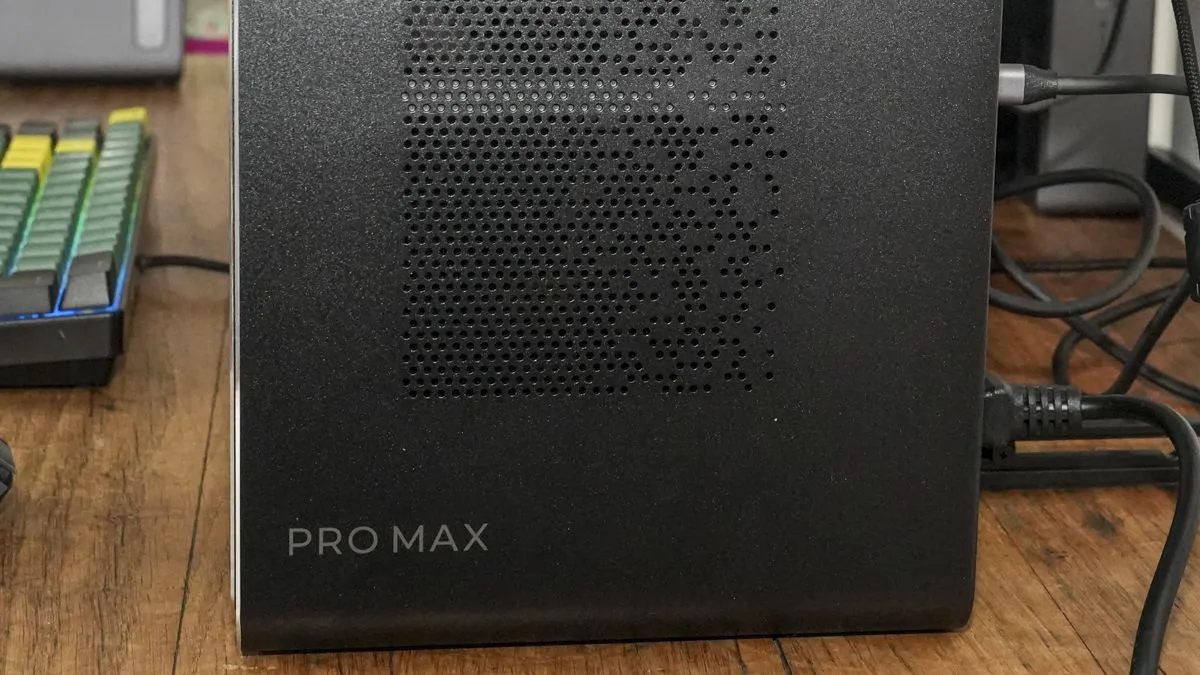


How the MSI Pro Max Edge Handles Creative Workloads
Real tests showed how the MSI Pro Max Edge functions when processing practical machine learning pipelines. Testing by TechRadar centered on the open-source Lemonade model manager to download, set up, and run models without internet access. The hardware sorted more than 2,600 images quickly and handled generative rendering through Flux without crashing [1].
Testing ran inside Visual Studio Code. It handled coding models including Qwen3 Coder and Qwen 2.5 to write software scripts. Creative media tasks showed similar responsiveness when handling heavy uncompressed production files. During photo editing sessions, the machine processed batches of Sony RAW files in Adobe Photoshop and Lightroom without stuttering. Video editing in Premiere Pro proved equally smooth when scrubbing through 4K Canon EOS R5 C footage, using hardware decoding blocks to keep timelines responsive. The computer even built a ten-page website through iterative prompting, though Jennings said the process needed plenty of detailed instructions to finish cleanly [1].
Jennings wrote that the combination of high unified memory and Strix Halo processing delivers “raw power to comfortably run local AI”. He added that everyday desktop responsiveness feels “workstation-level, perfect for high-end creative and business use”. It isn’t a completely effortless experience, because configuring offline models still needs experimentation and manual setup. But once configured, the hardware gives creative studios a secure environment where private source code and unreleased media never leave local storage [1].

Benchmark Numbers Reveal Mixed Hardware Strengths
Synthetic benchmarks illustrate where the MSI Pro Max Edge stands against conventional desktop hardware. In Geekbench 7 testing, the system earned a multi-core CPU score of 21,905 and a single-core score of 2,672, with an OpenCL GPU score of 96,251. Cinebench 2026 recorded 6,932 multi-core points. Single-core Cinebench 2026 reached 457 points [1].
General business productivity was tested in PC Mark, where the desktop earned an overall score of 9,990, while Procyon returned 1,125 points. Gaming and graphics benchmarks also reflected the scale of the 40-compute-unit Radeon 8060S core. In 3DMark Fire Strike, the system produced an overall score of 25,009, driven by 28,653 points in graphics and 29,422 points in physics testing, with a combined result of 11,480. Time Spy yielded 10,777 overall, backed by 10,972 graphics points and 9,792 CPU points. Wild Life reached 65,611 points. Steel Nomad logged 2,158 points. Windows Experience rated overall responsiveness at 8.8 [1].
Storage benchmarks confirmed fast disk transfers for local data sets. Crystal Disk Mark recorded sequential read speeds of 6,122.48 MB/s and write speeds of 5,827.92 MB/s on the 2TB drive. That read throughput helps load multi-gigabyte neural network weights into memory in seconds rather than minutes. The Strix Halo silicon may be over a year old now, but its memory bandwidth keeps it competitive against bulkier desktop towers [1].

Chassis Connectivity and Rival Desktop Options
For desktop workspace setups, the MSI Pro Max Edge measures 197.5 x 188.4 x 94.5mm and weighs 2.9kg, placing it between a traditional mini PC and a compact tower. One welcome engineering detail is the built-in 300W internal power supply, which lets users plug a standard power cable into the back without carrying an external power brick. Internal power supplies cut cable clutter. The front panel carries two 10Gbps USB Type-A ports, a 40Gbps USB4 Type-C port supporting DisplayPort 2.0 and 15W Power Delivery, an SD 4.0 UHS-II card reader, and a performance toggle switch. Around the rear, users get two USB 2.0 ports, a 10Gbps USB Type-A port, a second USB4 40Gbps port, HDMI 2.1, DisplayPort 1.4a, and a 2.5GbE LAN port [1].
Despite those strengths, the port selection drew criticism from TechRadar. On a workstation priced at $5,499, the single 2.5GbE network jack feels slow when studio networks run 5GbE or 10GbE speeds. MSI also omitted an OCuLink expansion port, meaning owners can’t attach external graphics enclosures through PCIe cabling [1]. In contrast, the competing GMKtec EVO X3 mini PC from Shenzhen, China, includes an OCuLink port and retails for $3,799.99 with an external 230.1W Huntkey power adapter. It targets enthusiast mini workstations. The GMKtec design uses three internal fans with green accents to sustain 140W TDP modes [2].
Support for the platform is widening as developers work on newer drivers, and builders can track how AMD Gorgon Halo chips receive Linux NPU support for open-source AI frameworks [2]. MSI sells the MSI Pro Max Edge directly through its website and online retailers at €5,299 in Europe and £5,999 in Britain. For engineers needing a quiet desktop capable of running heavy offline neural networks, the hardware delivers workstation capability inside a portable shell [1].
- ONLINE NEWS Jennings, A. (2026, October 9). I tested MSI’s Pro Max Edge AI+ mini PC and its offline AI is off the charts. TechRadar. [Article Link]
- ONLINE NEWS Mujtaba, H. (2026, October 10). GMKtec EVO-X3 “AMD Ryzen AI MAX+ 395” Mini PC Review: Enhanced Cooling In A Local AI Powerhouse. Wccftech. [Article Link]


