




Networked server clusters depend on shared agreement to keep state machines in sync when individual computers fail or network links break. The Raft consensus algorithm solves this coordination challenge by managing a replicated log across independent servers, providing an understandable alternative to the Paxos family of protocols. Designed by Diego Ongaro and John Ousterhout at Stanford University, the protocol divides distributed agreement into distinct operational steps rather than treating consensus as a single tangled mechanism [8]. Each cluster machine steps through clear role shifts, feeding applied log records into a local state machine so that every server arrives at matching states. Raft stands for Reliable, Replicated, Redundant, And Fault-Tolerant [13].
- How the Raft Consensus Protocol Operates
- Server Roles and Node States
- Leader Election Driven by Random Timers
- How Replicated Logs Achieve Consistency
- Raft Consensus Algorithm Invariants and Safety
- Cluster Membership Transitions
- Log Compaction Through Snapshotting
- Raft Consensus Algorithm in Production Systems
How the Raft Consensus Protocol Operates
Building fault-tolerant software clusters requires multiple servers to agree on values even when hardware crashes interrupt processing. How do nodes reach agreement when a server crashes? Consensus ensures that once a majority of nodes decides on an entry, that decision remains permanent for the entire cluster. Diego Ongaro and John Ousterhout presented the foundational paper, In Search of an Understandable Consensus Algorithm, receiving a Best Paper Award at the 2014 USENIX Annual Technical Conference. The core design decomposes consensus into leader election, log replication, and safety guarantees. Educational visualizers like RaftScope and The Secret Lives of Data illustrate how five servers maintain state when two nodes drop offline [8].
In practical deployments, consensus algorithms typically operate in the context of replicated state machines where each node maintains an identical log of commands, such as operations on a hash table [8]. The protocol assumes crash fault tolerance, meaning all participants are trustworthy and fail by stopping rather than by broadcasting corrupt data [13]. Because base Raft does not handle Byzantine faults where rogue actors inject counterfeit packets, researchers have investigated cryptographic signatures and message freshness verification to protect clusters against message forgery and replay attacks [6]. Formal verification by Doug Woos, James R. Wilcox, Steve Anton, Zachary Tatlock, Michael D. Ernst, and Thomas Anderson proved 90 system invariants to verify state machine safety in OCaml [1]. Later studies by Heidi Howard, Malte Schwarzkopf, Anil Madhavapeddy, and Jon Crowcroft at the University of Cambridge evaluated quorum trade-offs. Hugues Evrard and Frédéric Lang explored automated code generation, while James R. Wilcox, Pavel Panchekha, and Xi Wang built the Verdi verification framework [8].
Server Roles and Node States
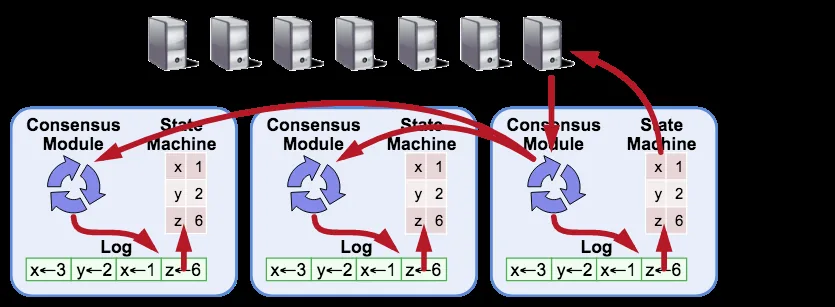
Every node in a Raft cluster exists in one of three distinct roles: leader, follower, or candidate. Follower nodes remain passive, responding to incoming RPC messages from leaders and candidates but issuing no independent requests. When a follower receives no communication during an election timeout, it assumes the leader is unavailable and transitions into a candidate. Candidates solicit votes from peers to establish a new leader term. Only one elected leader directs cluster operations during an active term [13].
Logical time in Raft advances in arbitrary numerical periods known as terms, which act as logical clocks to help servers detect obsolete information. Each term begins with an election; if votes split and no server secures a majority, the term ends without a leader and a new term begins immediately. Servers exchange term numbers in every RPC message, and any server observing a higher term updates its local counter and immediately reverts to follower status. If a leader discovers that its term number lags behind a peer, it steps down without delay. Terms allow distributed nodes to resolve leadership transitions without global synchronized hardware clocks [13]. The cluster maintains progress as long as any majority of servers remains operational. For example, a five-server cluster continues normal processing when two servers experience crashes [8].
Leader Election Driven by Random Timers
When a follower detects that its election timer has expired without receiving heartbeats, it increments its term counter, votes for itself, and broadcasts RequestVote RPC messages to all peers in the cluster. A peer grants its vote on a first-come, first-served basis, provided the candidate’s log is at least as up-to-date as its own. If the candidate receives affirmative votes from a majority of servers, it assumes the leadership role and starts broadcasting periodic heartbeat signals. Should another server declare leadership with an equal or higher term, the candidate yields [13].
To prevent split votes where multiple candidates divide the cluster evenly and stall progress, Raft uses randomized election timeouts chosen from a fixed interval. In standard implementations, election timeouts range between 150 and 300 milliseconds. Randomization spreads candidate election attempts across time so a single node times out first, gathers majority support, and establishes leadership before competing peers can trigger new elections [13]. Researchers such as Z. Du, Z. Qu, Y. Fu, M. Huang, and L. Liu proposed multi-strategy priority mechanisms to replace random selection when leaders encounter performance degradation [3]. Timing stability depends on maintaining broadcast delays well below election timeouts. Typical broadcast times span 0.5 to 20 milliseconds [13].
How Replicated Logs Achieve Consistency
The cluster leader serves as the sole entry point for client write operations, accepting commands and appending them as entries to its local log. The leader then issues AppendEntries RPC messages to duplicate these records on follower disks [13]. Each log entry stores an integer index, a term number, and the state machine command [8]. Entries remain uncommitted until a cluster majority stores them [13].
Once a majority of nodes safely persists an entry, the leader marks that index as committed and applies the payload to its local state machine. The leader informs followers of the latest committed index in subsequent heartbeat messages, prompting followers to apply those entries in matching order. If a leader crashes before replicating entries, follower logs may contain conflicting uncommitted data from previous terms. The new leader resolves discrepancies by locating the last agreed entry, deleting all conflicting follower entries after that point, and overwriting them with entries from its authoritative log. Log matching guarantees that identical index and term pairings produce matching histories on all machines [13]. D. Huang, X. Ma, and S. Zhang analyzed packet loss impacts on cluster split probabilities in private blockchain networks, validating theoretical split models through custom simulation tests [4].
Raft Consensus Algorithm Invariants and Safety
The Raft Consensus Algorithm guarantees system correctness through five fundamental safety rules: Election Safety, Leader Append-Only, Log Matching, Leader Completeness, and State Machine Safety. Election Safety ensures that voters never choose more than a single cluster leader per term. Under Leader Append-Only, an elected leader never overwrites or truncates its own log entries, but only appends new records. Log Matching dictates that if two server logs share an entry with identical index and term, they store identical entries across all prior indices. Leader Completeness guarantees that any entry committed in a term is present in the logs of all subsequent leaders [13].
State Machine Safety prevents two nodes from executing divergent instructions for the same log position. Raft enforces this guarantee through an election restriction: voters reject candidates whose logs are less up-to-date than their own. Voters compare log records by examining the term of the last entry; if terms differ, the log ending in a higher term is considered more complete. If last terms match, the candidate with the longer log wins the vote. Because committed entries reside on a majority of cluster nodes and an election requires majority approval, every winning candidate contains all previously committed records from earlier terms [13]. Heidi Howard analyzed these quorum intersections in formal studies of consensus guarantees [8].
Cluster Membership Transitions
Modifying cluster membership, such as replacing failed hardware or expanding server capacity, poses risks because independent nodes cannot change configurations simultaneously without risking split-brain conditions. To prevent disjoint majorities from electing two conflicting leaders, Raft specifies joint consensus as a transitional two-phase configuration. Under joint consensus, configurations transition from an old server set (Cold) to a new configuration (Cnew). Log entries and election approvals require separate majorities from both Cold and Cnew groupings before the transition completes. Once the Cnew configuration entry commits, the cluster sheds the old configuration safely [13].
In production libraries, membership modifications often follow single-node change mechanisms to avoid the complexity of joint consensus [9]. Diego Ongaro detailed single-server membership changes in his doctoral dissertation, which also included a formal specification of Raft written in TLA+ [8]. Because single-node adjustments ensure that any two consecutive majority quorums overlap, clusters can commit configuration updates directly without dual-quorum voting. The Go implementation in etcd applies membership changes when the corresponding entry commits, actively disallowing subsequent changes while uncommitted proposals remain in the local pipeline. Two-node clusters cannot remove a member if one node dies [9].
Log Compaction Through Snapshotting
Unbounded logs consume excessive disk space and lengthen recovery times when restarted servers replay historical entries. Raft resolves memory pressure through log compaction, allowing each server to take snapshots of its state machine and discard applied records. A snapshot preserves the final state of the machine along with metadata recording the last included index and term. By persisting this state to stable storage, nodes free substantial memory and storage resources. The leader sends snapshots to slow or newly joined followers that lag behind the compacted log boundary [13].
Snapshot transmissions use an InstallSnapshot RPC message to bring lagging nodes up to speed without streaming thousands of individual records. When a follower receives a snapshot, it verifies metadata, resets its state machine to the snapshot image, and purges all preceding log entries [13]. In production systems like ClickHouse Keeper, built with the NuRaft library in C++, backpressure commands can delay leader commit advancement so trailing voting replicas catch up before falling beyond log boundaries. The clickhouse-keeper-converter tool enables migrating ZooKeeper data directly into ClickHouse Keeper snapshots while preserving Access Control Lists [11].
Raft Consensus Algorithm in Production Systems
The clarity of the Raft Consensus Algorithm has driven broad adoption in enterprise infrastructure software. CoreOS created the etcd key-value store, which powers Kubernetes, Docker Swarm, and Cloud Foundry Diego. The library also powers CockroachDB, TiDB, Project Calico, Flannel, and Dgraph [9]. In storage engines, TiDB uses the Rust-based raft-rs library inside TiKV for distributed consistency across 200 companies. Siddon Tang said that raft-rs separates the core consensus logic from transport and storage, giving database architects control over disk writes and custom network message protocols [12]. The library sets MaxSizePerMsg to 4096 bytes and MaxInflightMsgs to 256 messages [9].
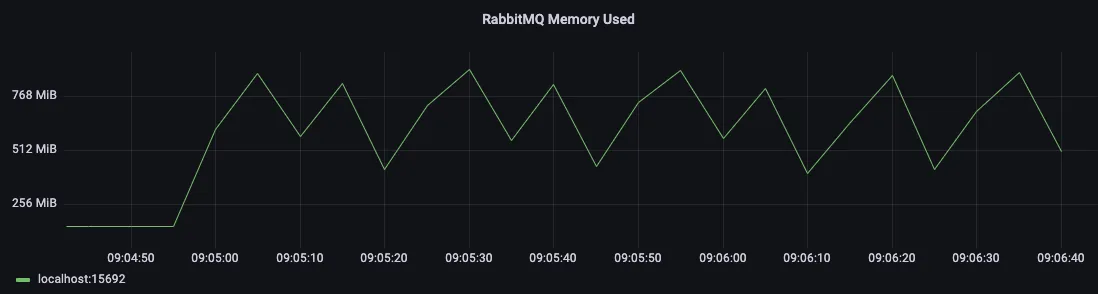
Message brokers also leverage Raft for fault tolerance. RabbitMQ introduced quorum queues based on the Raft algorithm, making them the default replicated queue type for reliable messaging. A quorum queue requires agreement from a majority ((N/2) + 1) of participating members, protecting orders and voting systems from message loss. RabbitMQ dropped classic queue mirroring in release 4.0 to make quorum structures the standard. The documentation advises reviewing topology when deployments exceed ~5000 quorum queues. Setting per-message expiration adds 16 bytes of memory overhead per message [10].

Academic studies continue to extend Raft into novel domains. In a 2025 study, A. Nyzhnyk, A. Partyka, and M. Podpora used a specialized Rust implementation of Raft to coordinate interceptor drones in an unmanned aerial vehicle detection and neutralization defense system [5]. In data markets, D. Yang, I. Doh, and K. Chae designed a cell-based Raft architecture to reduce leader transaction burdens [2]. In IoT big data processing, L. He and L. Wu combined Raft with homomorphic encryption to shift computational workloads to edge devices [7]. These deployments show how the Raft consensus algorithm coordinates clusters in production clouds and private blockchains [4].
- CONFERENCE PAPER Woos, D., Wilcox, J. R., Anton, S., Tatlock, Z., Ernst, M. D., & Anderson, T. (2016). Planning for change in a formal verification of the raft consensus protocol. Proceedings of the 5th ACM SIGPLAN Conference on Certified Programs and Proofs, 154–165. [Article Link]
- ACADEMIC JOURNAL Yang, D., Doh, I., & Chae, K. (2022). Cell based Raft algorithm for optimized consensus process on blockchain in smart data market. IEEE Access, 10, 85199–85212. [Article Link]
- ACADEMIC JOURNAL Du, Z., Qu, Z., Fu, Y., Huang, M., & Liu, L. (2023). Multi-strategy-based leader election mechanism for the Raft algorithm. Concurrency and Computation: Practice and Experience, 35(22). [Article Link]
- ACADEMIC JOURNAL Huang, D., Ma, X., & Zhang, S. (2019). Performance analysis of the Raft consensus algorithm for private blockchains. IEEE Transactions on Systems, Man, and Cybernetics: Systems, 50(1), 172–181. [Article Link]
- ACADEMIC JOURNAL Nyzhnyk, A., Partyka, A., & Podpora, M. (2025). Using the Raft algorithm to coordinate interceptor drones in a UAV detection and neutralization system. Advances in Cyber-Physical Systems, 10(1), 105–110. [Article Link]
- ACADEMIC JOURNAL Afifi, T., Hegazy, A. A., & Abousaif, E. K. (2025). From consensus to chaos: A vulnerability assessment of the RAFT algorithm. International Journal of Advanced Computer Science and Applications, 16(12). [Article Link]
- ACADEMIC JOURNAL He, L., & Wu, L. (2025). Study on asynchronous processing of IoT big data-based homomorphic encryption transmission using Raft algorithm. AIP Advances, 15(10). [Article Link]
- WEBSITE Ongaro, D., & Ousterhout, J. (2014). In search of an understandable consensus algorithm (extended version). USENIX Annual Technical Conference. [Article Link]
- WEBSITE etcd-io. (2022). Raft library implementation in Go. GitHub. [Article Link]
- WEBSITE RabbitMQ. (2026). Quorum queues overview and operational guide. [Article Link]
- WEBSITE ClickHouse. (2022). ClickHouse Keeper documentation. [Article Link]
- WEBSITE Tang, S. (2018). Implement Raft in Rust. PingCAP. [Article Link]
- WEBSITE Wikipedia. (2026). Raft (algorithm). [Article Link]


