






Researchers led by Christopher Walsh at Boston Children’s Hospital and the Howard Hughes Medical Institute have identified a shared cell process connecting hundreds of separate autism risk mutations in human brain pathways. Lead authors Rebecca Andersen and Maya Talukdar mapped this pattern, termed transcriptomic convergence, in human brain cell models to explain how unrelated genetic faults yield comparable traits [2]. Their findings published in Nature reveal that silencing single risk genes prompts steady drops in wider gene networks in developing neural tissue. The team also discovered that an X-linked gene called ZFX escapes chromosome shutdown in females, giving women a natural biological buffer against severe autism symptoms [1].
Shared Patterns in Neural Cells
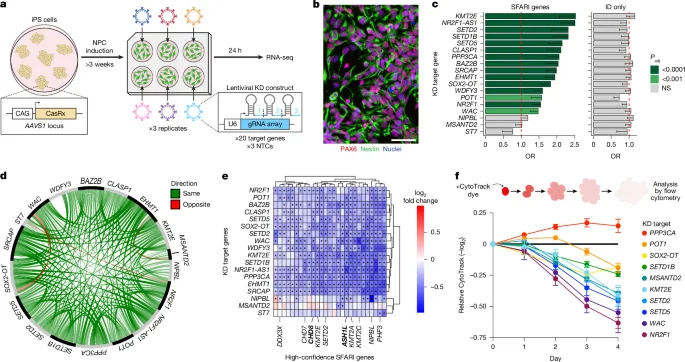
Rebecca Andersen and Maya Talukdar examined how separate autism gene variants alter early brain growth in human neural stem cells derived from an induced pluripotent stem cell line. The Boston Children’s Hospital team used the RNA-cutting enzyme CasRx to knock down 20 candidate genes cataloged in the Simons Foundation Autism Research Initiative database, known as SFARI Gene. Because high CasRx concentrations can cause unintended RNA breakdown, investigators integrated the enzyme into a single AAVS1 safe-harbor genomic site to limit cellular enzyme levels while sustaining effective gene silencing. RNA sequencing completed 24 hours after perturbation revealed that 18 of the 20 knockdowns produced clear cellular responses, generating a median of 920 differentially expressed genes per targeted trial. Targets ARHGAP5 and ARID2 altered fewer than 20 genes and were excluded from further study. The remaining 18 gene tests each changed between 287 and 1,485 genes in cellular RNA [1].
Geneticists Tyler Sakamoto and Seungil Lee at Boston Children’s Hospital observed that these expression changes singled out autism risk pathways rather than general brain development genes cataloged in Molecular Autism. Fifteen of the 18 successful knockdowns showed significant enrichment for high-confidence SFARI Gene database members. In contrast, the gene tests caused zero enrichment among genes tied only to intellectual disability without autism, proving that the cascade is selective for autism spectrum disorder. Neural cells kept 1,062 intellectual disability genes active throughout testing, yet those sequences avoided the widespread downregulation seen in SFARI autism genes. Non-coding RNAs NR2F1-AS1 and SOX2-OT also triggered this targeted downstream suppression in cell tests [1].
How Transcriptomic Convergence Unfolds
When Christopher Walsh and Rebecca Andersen analyzed the perturbed cells, they uncovered coordinated downward shifts in cellular networks [1]. Loss of single risk genes routinely lowered the activity of other autism genes within the same functional network [2]. Andersen described the outcome: “The point is, if you down-regulate one autism gene, you down-regulate a whole bunch of them.” She said: “This ‘transcriptomic convergence,’ as we call it, gives us a way to understand how hundreds of different genes can cause similar phenotypes, a similar condition.” The major risk gene CHD8 dropped in 11 of the 18 knockdown models. A core group of 27 high-confidence SFARI genes dropped in at least 10 separate knockdowns [1].
Exome sequencing data published in Cell by Satterstrom confirmed that these downregulated targets represent top-tier neurodevelopmental genes linked to synaptic function [3]. To confirm that CasRx was not causing non-specific RNA degradation, the Boston Children’s Hospital team engineered neural cells expressing three distinct fluorescent reporter proteins: mKO2, mScarlet, and iRFP670. Flow cytometry tests confirmed zero loss of signal in non-targeted markers during targeted CasRx runs. Parallel tests with short hairpin RNAs also verified this shared downward regulatory pattern [1].
Effects on Brain Cell Growth
Laboratory growth tests with CytoTrack dye proved that molecular suppression impairs cell division in early brain development. Cell tracking showed that nine of the 18 perturbations caused a statistically significant drop in neural progenitor cell proliferation. Stem cells lacking SETD1B, SETD2, SETD5, KMT2E, or WAC divided much slower than control cells, matching clinical reports that link loss-of-function variants in these chromatin regulators to pediatric microcephaly. Only one tested knockdown accelerated progenitor cell multiplication. Slower progenitor cell division forms a convergent cellular outcome shared by separate mutational origins. Re-analysis of published Cas9 knockout data in human excitatory neurons by the Walsh group confirmed that convergent downregulation also restricts neuronal growth [1].
Clinical geneticists often document abnormal head circumference in autistic children, observing both microcephaly and macrocephaly depending on the exact location of mutations in SETD2 or KMT2E. These cellular growth patterns clarify underlying mechanisms, contrasting with inquiries into whether autism overlaps with extremism through social isolation in wider human environments where behavioral rather than genetic variables drive outcomes. Slower progenitor multiplication shifts the precise timing of human neocortical layer formation in developing tissue [1].



Organoid Models and Network Hubs
To examine how transcriptomic convergence influences three-dimensional tissue development, researchers Janet Song and Xuyu Qian developed an inducible platform for human cerebral organoids at Boston Children’s Hospital. They built the FLEx-based inducible CRISPR knockdown construct (FLICK), which uses doxycycline administration to drive permanent CasRx and EGFP reporter expression without disrupting earlier stem cell pluripotency. Each FLICK vector contained molecular barcodes captured during single-cell RNA sequencing, allowing Ryan N. Delgado and Sijing Zhao to evaluate mosaic organoids containing multiple distinct genetic perturbations. Cells were isolated by fluorescence-activated cell sorting using TagBFP markers before growing into mature cortical structures [1].
Network maps reconstructed by computational biologists Nila Murugan and Julia Harms pinpointed master transcriptional regulators that coordinate downstream transcriptomic convergence in target genes. The analysis revealed that chromatin remodeler CHD8 and transcriptional repressor REST serve as key hub genes sustaining baseline autism network expression. By screening for genes that showed consistent downregulation in knockdowns and held high genic constraint scores, the authors prioritized 397 candidate autism risk genes. This screen captured 113 known SFARI genes and nominated novel risk candidates including AKT3, KIF11, KIF2A, and SOS1 [1].
Why Transcriptomic Convergence Involves ZFX
Epidemiological surveys compiled by David M. Werling in Biology of Sex Differences show that autism is diagnosed three to four times more often in boys than girls. Autistic females consistently carry a significantly higher burden of rare autosomal mutations before reaching comparable clinical diagnostic thresholds [4]. Geneticists refer to this disparity as the female protective effect, but identifying its biological mechanism has remained an open challenge [2]. Mutations on the X chromosome cannot explain this pronounced sex difference on their own [1].
Mammalian female cells inactivate one X chromosome to equalize gene dosage with males, yet more than 60 genes escape this transcriptional shutdown [2]. David C. Page, Gwenyth Eichfeld, and Christopher Walsh discovered that transcription factor ZFX escapes X inactivation, generating substantially higher baseline expression in female neural progenitor cells than in male cells. Because ZFX serves as a transcriptional activator for numerous autism risk genes, its elevated expression provides ongoing support for genes susceptible to transcriptomic convergence. The authors confirmed that ZFX directly drives baseline expression in these vulnerable networks in female brain cells [1].

This heightened ZFX expression operates as a cellular buffer, protecting female neural networks when a damaging mutation disrupts a single autosomal risk gene. Female brain cells maintain adequate downstream network transcription where male cells suffer widespread secondary gene drops [1]. Walsh said: “The most important take-home messages are the idea of this transcriptomic convergence in autism and our identification of the ZFX gene as a potential driver of autism’s male bias.” The finding provides a genetic explanation for the longstanding female protective effect in autism.
Therapeutic Implications for Autism
Developing separate gene therapies for each of the hundreds of individually rare mutations implicated in autism spectrum disorder poses immense logistical challenges for biotechnology researchers [2]. Because diverse genetic lesions funnel into a shared molecular cascade, targeting central regulatory hubs like ZFX or CHD8 could restore balanced transcription in co-regulated networks. Targeted upregulation of master transcription factors could stabilize dozens of suppressed autism genes at once [1].
Christopher Walsh suggested that pharmacologically enhancing ZFX activity in males might confer protection comparable to that naturally observed in female carriers. Boosting ZFX expression could likewise assist females who carry an exceptionally heavy burden of autism risk variants. Walsh summarized this unified therapeutic approach by saying that “a rising tide lifts all boats,” indicating that activating master regulators elevates entire co-expressed gene networks [2]. Cross-species studies into how early-life stress and maladaptive behavior across different species shape neurobiology illustrate how shared biological pathways can inform translational therapy in developmental conditions. Mapping shared transcriptomic convergence offers a concrete roadmap for developing broad-spectrum molecular interventions in autism [1].
- ACADEMIC JOURNAL Andersen, R. E., Talukdar, M., Sakamoto, T., Exposito-Alonso, D., Song, J. H. T., Qian, X., Lee, S., Murugan, N., Delgado, R. N., Zhao, S., Eichfeld, G., Harms, J., Page, D. C., & Walsh, C. A. (2026). Transcriptomic convergence and the female protective effect in autism. Nature. [Article Link]
- ONLINE NEWS Medical Xpress. (2026). Researchers identify genetic ‘convergence’ in autism and a possible explanation for the female protective effect. [Article Link]
- ACADEMIC JOURNAL Satterstrom, F. K., Kosmicki, J. A., Wang, J., Breen, M. S., De Rubeis, S., An, J., Peng, M., Collins, R., Grove, J., Klei, L., Stevens, C., Reichert, J., Mulhern, M. S., Artomov, M., Gerges, S., Sheppard, B., Xu, X., Bhaduri, A., Norman, U.,. Aleksic, B. (2020). Large-scale exome sequencing study implicates both developmental and functional changes in the neurobiology of autism. Cell, 180(3), 568-584.e23. [Article Link]
- ACADEMIC JOURNAL Werling, D. M. (2016). The role of sex-differential biology in risk for autism spectrum disorder. Biology of Sex Differences, 7(1). [Article Link]
- ACADEMIC JOURNAL Abrahams, B. S., Arking, D. E., Campbell, D. B., Mefford, H. C., Morrow, E. M., Weiss, L. A., Menashe, I., Wadkins, T., Banerjee-Basu, S., & Packer, A. (2013). SFARI Gene 2.0: A community-driven knowledgebase for the autism spectrum disorders (ASDs). Molecular Autism, 4(1). [Article Link]
APA 7: PerEXP Teamworks. (2026, November 5). Boston Children’s Hospital Maps Transcriptomic Convergence. PerEXP Teamworks. https://perexpteamworks.com/en/transcriptomic-convergence-autism-genes/


