






Three American astronauts orbiting Earth cast their midterm ballots from aboard the International Space Station on November 3, 2026. NASA crew members Anil Menon, Luke Delaney, and Jessica Watkins took part in voting in space by completing digital forms inside their orbital living quarters. Their ballots traveled thousands of miles through satellite data networks to local election workers in Texas, proving that civic duties continue even hundreds of miles above the planet [1].
How Voting in Space Works
Anil Menon shared the voting news on social media on November 3. His 29-second clip on X presented his private quarters as a makeshift voting booth, with the astronaut wearing an “I voted” sticker on his flight suit while demonstrating how he submitted his ballot. He explained that a laptop inside his cabin served as his private voting station for the midterm election. “Inside of it is my computer, where I was able to fill out an electronic form and send it to Harris County so I could vote today,” he said [1].
The procedure resembles military absentee voting. Because orbiters cannot visit a polling precinct, space crews coordinate directly with municipal election boards through federal absentee pathways before departing the planet. When astronauts prepare for voting in space during an expedition, they submit a Federal Post Card Application to request an absentee ballot from their home district. “Just like any other American away from home, astronauts may fill out a Federal Post Card Application to request an absentee ballot,” NASA officials wrote in an agency explainer. “Yes, you can even vote from space! All three U.S. crew members had the privilege of voting from space station. We filled out an electronic ballot and sent it securely to the election officials,” Menon wrote. The county clerk prepares a password-protected ballot file and uploads it to NASA ground teams for relay upward [1].
Once the document arrives on the station, the astronaut uses personal credentials to open the file and record their choices. The ballot stays locked from other crew members during this step. After completing the form, the voter saves the encrypted document for ground transmission [1].
Texas Legislation and Early Orbital Ballots
Texas established orbital voting procedures in 1997. State lawmakers passed the measure after recognizing that astronauts spend months training and flying without physical access to home polling places. Because most American astronauts reside near Houston during flight training, they maintain formal voting registration in Texas’ Harris County. Johnson Space Center serves as NASA’s central base for human spaceflight, meaning the local county clerk handles ballots delivered from orbit. NASA astronaut David Wolf cast the first orbital ballot in 1997 while stationed aboard Russia’s Mir space station during a four-month mission [1].
Wolf proved that citizens off Earth could participate in elections back home without returning to the ground. Training in Houston keeps flight crews connected to local civic systems long before launch day. Flight operations and crew gatherings routinely take place at the Texas hub, where the NASA Artemis crew gathers in Houston to review mission records and flight readiness. Harris County election workers review voter files and coordinate with flight directors so every ballot cast from orbit meets standard state verification guidelines.
Secure Transmission Through Satellite Relays
The transmission path uses multiple tracking hubs. When an astronaut sends the file, it travels through NASA’s Tracking and Data Relay Satellite System (TDRSS) in high Earth orbit. These geosynchronous satellites relay the signal down to receiving dishes at NASA’s White Sands Test Facility near Las Cruces, New Mexico. Space communications networks must handle these encrypted election packets with high reliability to ensure that files arrive without corruption before local polls close [1].
NASA explainer documents describe how ground teams handle the file without compromising voter confidentiality. “After an astronaut fills out an electronic ballot aboard the orbiting laboratory, the document flows through NASA’s Tracking and Data Relay Satellite System to a ground antenna at the agency’s White Sands Test Facility in Las Cruces, New Mexico,” agency officials said. “From New Mexico, NASA transfers the ballot to the Mission Control Center at NASA Johnson and then on to the county clerk responsible for casting the ballot. To preserve the vote’s integrity, the ballot is encrypted and accessible only by the astronaut and the clerk,” they explained [1].
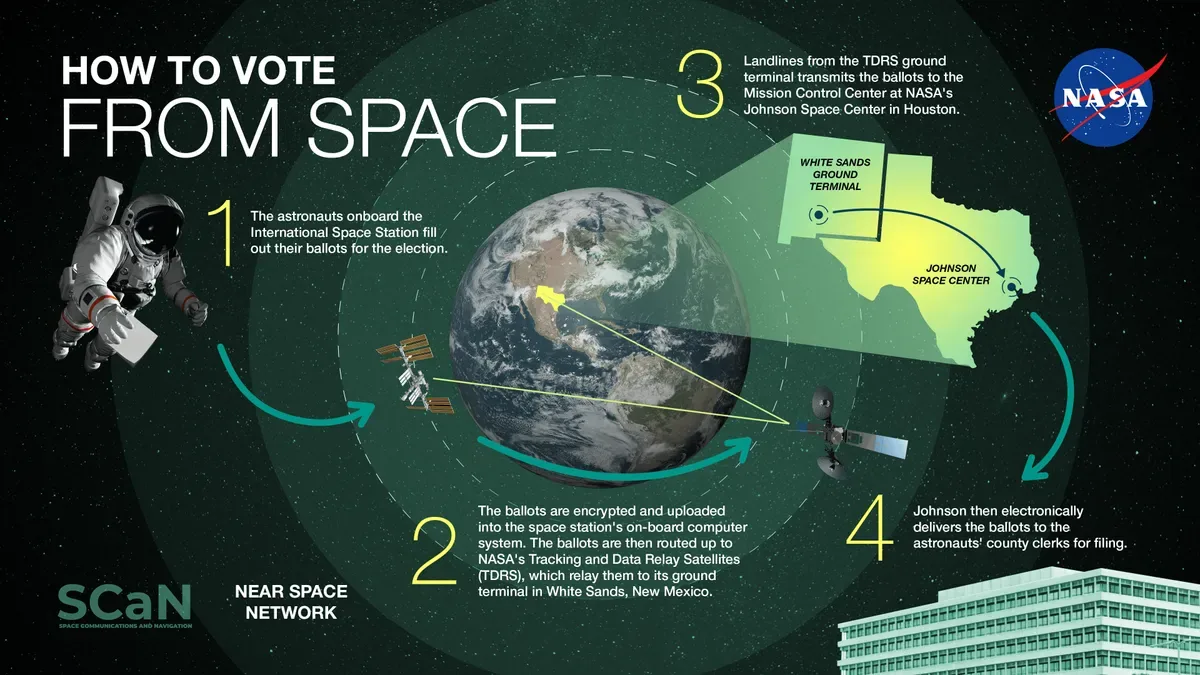
Strong encryption guards the file in transit. Neither ground technicians at White Sands nor flight controllers in Houston hold the code needed to read the ballot. Only the Harris County clerk possesses the decryption key to open the digital ballot and record the choices into the official county register [1].

Station Operations During Voting in Space
The voting crew represents overlapping station expeditions. NASA astronauts Luke Delaney and Jessica Watkins reached orbit on October 1 aboard a SpaceX Falcon 9 rocket during the Crew-13 mission. Watkins serves as mission commander, overseeing station science and maintenance while leading her flight group. Menon arrived earlier in the summer, docking with the station in mid-July aboard a Russian Soyuz spacecraft. The three Americans share the orbiting complex with four international crewmates, including Canadian Space Agency astronaut Joshua Kutryk and cosmonaut Sergey Teteryatnikov, who both flew on Crew-13. Cosmonauts Anna Kikina and Pyotr Dubrov traveled with Menon on the Soyuz, creating a seven-person crew working together during the midterm election period [1].
Participating in voting in space fits into a busy daily timetable filled with laboratory research, daily workouts, and systems monitoring. Although each astronaut maintains a demanding flight schedule, voting takes only minutes from their private sleep quarters. The crew logged their ballots ahead of standard deadlines, showing how orbital staff remain full participants in democratic processes while living off Earth [1].
Robotic Assistants in the Kibo Laboratory
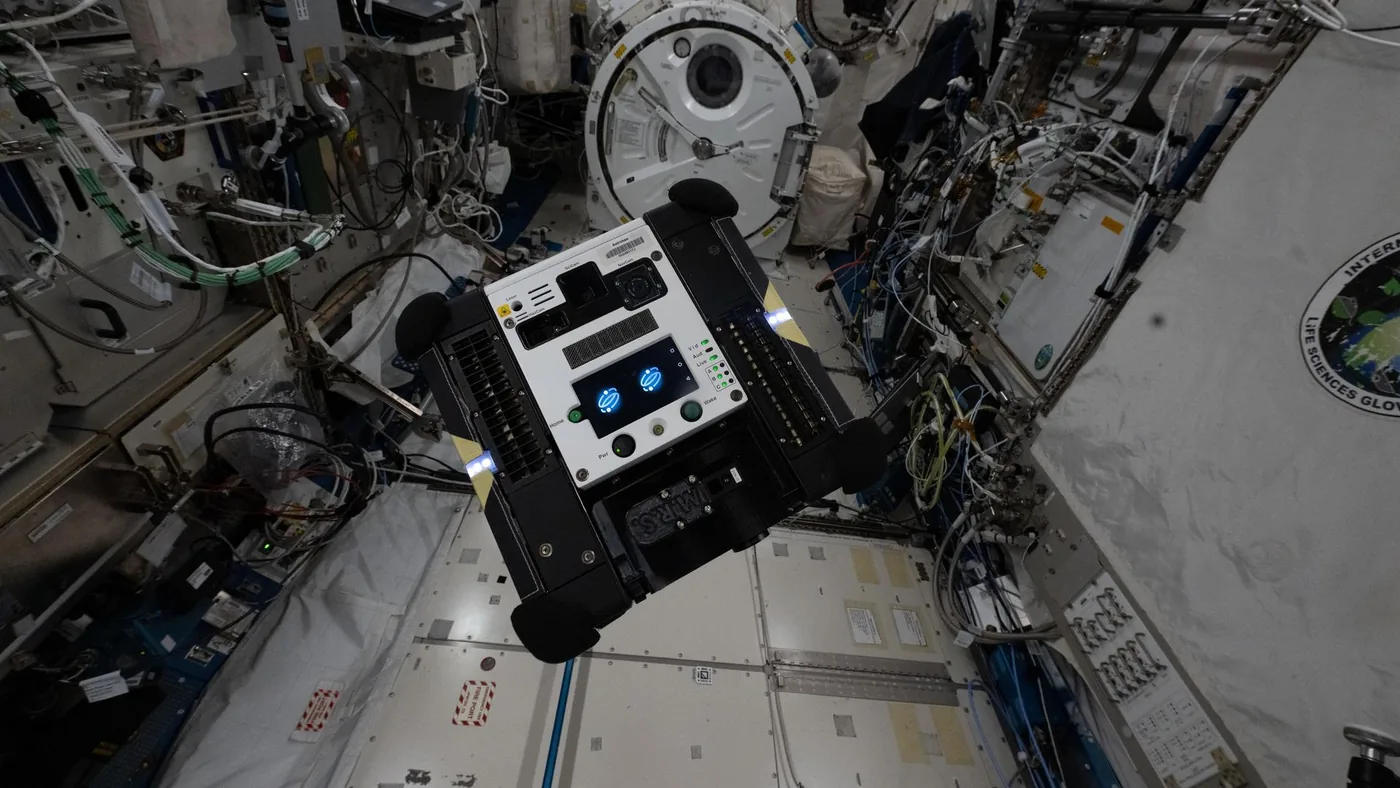
While crew members carry out civic duties and daily science, autonomous machines handle secondary chores inside the station modules. NASA developed the Astrobee robotic system to relieve astronauts from routine tasks in microgravity. These free-flying robotic helpers resemble compact metal cubes about the size of a household toaster. Equipped with small electric fans, they float through the Japanese Kibo laboratory to conduct air quality checks and survey equipment racks [2].
NASA sent Bumble and Honey to orbit in 2019. A third helper, Queen, arrived later that year. The machines conduct technology tests in microgravity and provide Earth controllers with direct video feeds of station compartments so researchers can monitor ongoing orbital experiments without taking away precious astronaut research hours. Commander Jessica Watkins recently photographed one Astrobee working beside equipment racks in the Kibo module [2].

Autonomous hardware tests in orbit generate flight data for future deep-space travel. The free-floating cubes recall Rocky helping Dr. Ryland Grace in the story Project Hail Mary, as Chelsea Gohd wrote for Space.com. Orbital technology evaluations also parallel independent satellite tests where Google receives first Project Suncatcher AI response from orbit to study autonomous system behaviors. The Astrobee program has run for seven years, showing how small robotic helpers support human expeditions living off Earth [2].
Long-Term Living Aboard the Space Station
The orbital complex began supporting permanent human habitation in early November 2000 under the Expedition 1 assignment. American astronaut Bill Shepherd and Russian cosmonauts Yuri Gidzenko and Sergei Krikalev docked aboard a Russian Soyuz vehicle on November 2, 2000, to open continuous station operations. Earlier construction required five short Space Shuttle flights to assemble early modules and deliver provisions. Shepherd, Gidzenko, and Krikalev spent four and a half months in orbit unpacking gear and installing the complex’s first solar arrays before returning home on the Space Shuttle Discovery [3].
Humans have inhabited the outpost without interruption for 26 years. Hundreds of crew members have rotated through the complex to conduct physics experiments, biology studies, and materials research. While NASA plans to decommission the aging station in coming years, its decades of continuous habitation built the operational framework that allows astronauts to live, research, and cast election ballots from orbit [3].
- ONLINE NEWS Wall, M. (2026, November 3). Voting in space: NASA astronauts cast ballots from International Space Station. Space.com. [Article Link]
- ONLINE NEWS Gohd, C. (2026, November 3). Robot cube explores the International Space Station. Space.com. [Article Link]
- ONLINE NEWS Weitering, H., & Gohd, C. (2026, November 2). On this day in space! Nov. 2, 2000: Expedition 1 Arrives at the International Space Station. Space.com. [Article Link]
APA 7: PerEXP Teamworks. (2026, November 4). NASA Astronauts Complete Voting in Space During ISS Mission. PerEXP Teamworks. https://perexpteamworks.com/en/voting-in-space-nasa-ballots/


