





Will Wright has revealed his next digital simulation project well over 15 years after stepping away from Electronic Arts. Wright’s Gallium Studios and partner Artificial Agency announced MyMems in a morning press release, introducing an inward experience that relies on generative AI. The new Will Wright simulation mines personal memories provided by the player to create digital companions who group into teams to solve puzzles within the game world. Slated for commercial release next year, the project represents Wright’s first formal return to digital simulation design since leaving Electronic Arts to run an entertainment think tank in 2009 [1, 2].
Announcement of MyMems
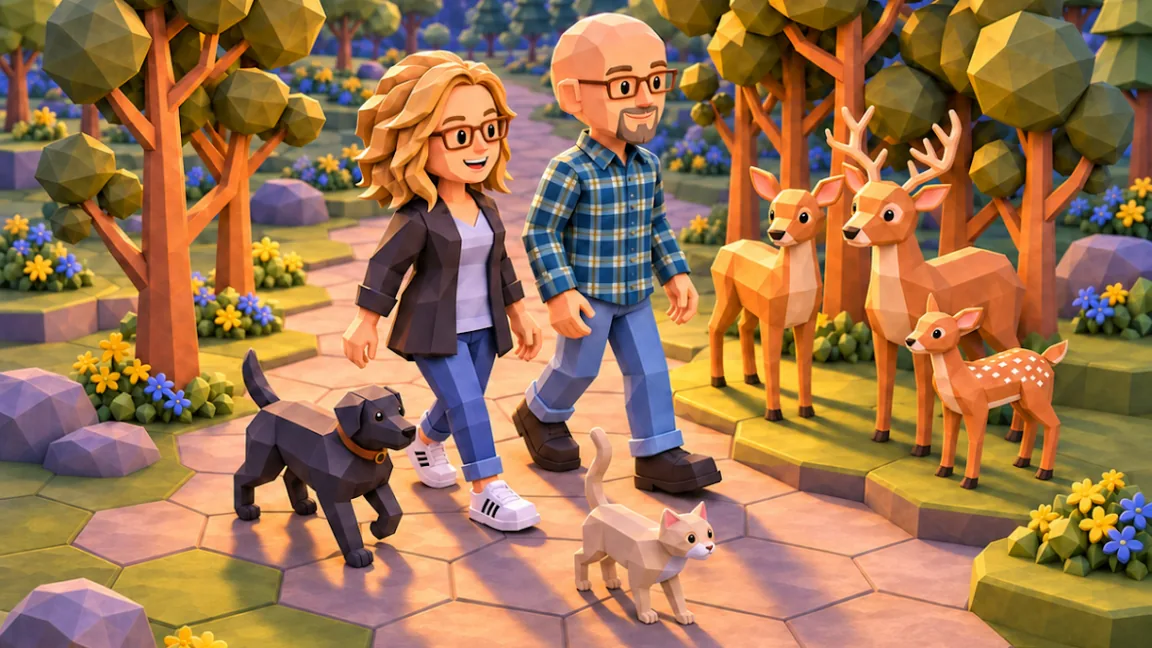
The core design of the game turns simulation rules toward personal memories rather than broad city grids or planetary orbits. In their joint morning release, Gallium Studios and partner Artificial Agency said the software builds digital people directly from recollections entered by the player. These virtual figures do not simply wander about inside an empty house. Instead, they form cooperative teams that work together to solve logic puzzles placed across the game world, creating unique problem-solving dynamics based on the specific people each player remembers [1].
Wright offered two examples to show how these memory figures might interact during play. “If my Grandmother ended up in a Grand Slam match against Serena Williams, who would win?” Wright said in the release. “If I had to build a bridge across a short chasm, which three people from my life would I choose to help me?” Both questions point to how players might draw on the skills, quirks, and habits of real people they know to overcome specific challenges inside the game [1].
The game does not rely on pre-written character scripts. By using generative AI tools, the software interprets player stories to define how each digital companion reasons, reacts, and collaborates when facing puzzles. The release remains slated for next year [1].
Turning the Will Wright Simulation Inward
The studio announcement notes that the title differentiates itself by “turn[ing] the simulation inward,” pointing away from the broad worlds Wright built in earlier decades. While his older hits simulated cities, ants, and planets, this inward approach focuses on how small digital groups think, react, and cooperate with each other [1].
That perspective aligns with ideas Wright explored long before generative AI entered consumer software. In an interview with The Times, Wright shared his belief that computers extend human imagination and posited the arrival of what he called the “metabrain,” where computer code helps expand human thought. His design path began with Raid on Bungeling Bay, released in 1984. While other designers such as Bill Budge and Nasir Gebelli made games for Apple systems, Wright decided to write for the Commodore 64. The game placed players in control of a helicopter flying over islands to bomb factories. While making it, Wright realized he spent more time enjoying his own level editor than flying the bombing runs, an insight that steered him away from action games toward simulation systems [2].
That simple discovery shifted his creative priorities for good. Rather than building tight challenges with fixed endings, he wanted to give players tools to shape their own outcomes. The experimental island editor laid the groundwork for his next project [2].


Origins of Maxis and SimCity
The level editor from that helicopter game soon evolved into a city simulation, but finding a company willing to publish it proved difficult. Mainstream game companies in the mid-1980s did not know what to make of software that lacked clear win or lose rules [2].
To structure the urban systems, Wright drew ideas from the writings of architect Christopher Alexander and urban theorist Jay Forrester. In 1986, Wright met Jeff Braun, an investor looking to enter computer games, at what Wright has described as “the world’s most important pizza party.” Braun saw the promise of the project, and together they co-founded Maxis the following year in 1987 in Orinda, California. When SimCity finally hit store shelves in 1989, it became a major hit and established software simulation as a respected form of entertainment. Wright stayed with the simulation concept through the next several years, creating related releases including SimEarth and SimAnt to model natural and animal systems with simple, interconnected rules [2].
Each new title pushed the boundaries of open-ended play. Instead of punishing mistakes with sudden restarts, the games let players observe how tiny changes rippled through entire virtual worlds. That design philosophy became the hallmark of Wright’s career [2].
The Sims and Spore Era
In 2000, Maxis released the first entry in The Sims series, marking Wright’s most visible commercial triumph. Rather than managing power plants or road budgets, players guided the daily habits and social ties of ordinary people. The game grew into a massive brand, leading to direct sequels including The Sims 2, The Sims 3, and The Sims 4 [2].
His next major design effort was Spore, which released in September 2008 with gameplay based on evolution and scientific progress. The release had strong early demand, and sold 406,000 copies within three weeks of its arrival in stores. Yet it drew mixed player reception, and in April 2009 Wright chose to leave Electronic Arts to run Stupid Fun Club Camp, an entertainment think tank in which Wright and EA were principal shareholders. That move took him away from mainstream game studios for well over 15 years. His new partnership on MyMems brings him back to simulation software with a focus on smaller, memory-based puzzles rather than galactic evolutions [1, 2].
Leaving EA allowed him to experiment with interactive media outside corporate deadlines. For over a decade, Wright kept a low profile while exploring fresh ideas in entertainment. The announcement of MyMems ends that extended hiatus [1, 2].
Design Roots of the Will Wright Simulation
The habits behind this new Will Wright simulation reflect lifelong interests that started during his childhood in the American South. Born on January 20, 1960, in Atlanta, Georgia, to a plastics engineer and an actress, Wright went to a Montessori school until he was nine years old. When his father died of leukemia that same year, Wright moved to Baton Rouge, Louisiana, with his mother and younger sister. He later graduated from Baton Rouge Episcopal High School at 16. During his youth, Wright grew fascinated with the board game Go, explaining that it had a “simple set of rules” while “the strategies in it are so complex,” adding that he was “fascinated with the idea that complexity can come out of such simplicity” [2].
As a teenager, Wright also played tactical board wargames like PanzerBlitz before beginning five years of university studies without taking a degree. He studied architecture at Louisiana State University for two years, then switched to Louisiana Tech to study mechanical engineering, robotics, space exploration, military history, and language arts. In the fall of 1980, he transferred to The New School in New York City. Living in an apartment in Greenwich Village, he spent his free time “searching for spare parts in local electronics surplus stores.” During that New York year, he bought an Apple II+ and taught himself Applesoft BASIC, Pascal, and assembly language so he could program John Conway’s Game of Life on his own screen [2].
Those early experiments showed him how simple rule sets could generate lifelike behavior. In 2007, he became the first video game designer to receive the BAFTA Fellowship, an honor that had previously gone only to creators working in film and television [2].
- ONLINE NEWS Ars Technica. (2026). Will Wright’s next simulation will use AI to mine content from your memories. [Article Link]
- WEBSITE Wikipedia contributors. (n.d.). Will Wright (game designer). Wikipedia. [Article Link]


