






Skywatchers tracking the 2026 full moons will encounter twelve distinct lunar events, marked by three perigee supermoons, two lunar eclipses, and an uncommon late-spring Blue Moon. A full moon occurs when our planet sits precisely between the Sun and the Moon, allowing sunlight to illuminate the entire Earth-facing lunar hemisphere. Although orbital geometry produces a mathematically exact alignment that lasts only an instant, the lunar disc appears completely illuminated to ground observers for approximately three consecutive nights. The recurring synodic cycle governing these phase transitions repeats roughly every twenty-nine to thirty days across the calendar year [1].
What Are the 2026 Full Moons?
Twelve full moons grace 2026. The 2026 full moons comprise twelve named astronomical events that trace seasonal cycles across Earth’s Northern Hemisphere. Algonquin folklore traditions and the historical Farmer’s Almanac assigned descriptive monikers to each monthly appearance to monitor agricultural schedules and wildlife movements. For example, January begins with the hungry howls of the Wolf Moon, February brings the freezing conditions of the Snow Moon, and March introduces the Worm Moon as thawing soils reveal emerging earthworms [1].
Tracking this annual progression differs substantially from single-evening public events such as the annual Observe the Moon Night celebrations, which unite communities on a solitary autumn night to inspect prominent craters along the terminator. In contrast, following the 2026 full moons requires charting orbital variations across all four seasons.
Spring and summer introduce seasonal transitions reflected in the names of successive lunar discs. April features the Pink Moon in honor of blooming wild ground flowers, followed by May’s Flower Moon celebrating regional flora, while June marks strawberry harvesting seasons with the Strawberry Moon. Midsummer brings July’s Buck Moon as male deer grow new antlers, followed by August’s Sturgeon Moon recognizing productive freshwater fishing periods [1].
Autumnal agriculture dictates the names of later lunar appearances. The September Corn Moon marks maize harvesting, yet this year it yields its title to the Harvest Moon because it occurs nearest to the autumn equinox. October introduces the Hunter’s Moon as communities historically prepared meat supplies for winter, November features the Beaver Moon when animals construct river dams, and December concludes the annual sequence with the Cold Moon [1].
What Is the 2026 Full Moon Schedule?
The 2026 full moon schedule spans twelve specific dates recorded across astronomical ephemeris calendars and global observing tables. The year opens on Jan. 3 with the Wolf Moon supermoon, followed by the Snow Moon on Feb. 1. March brings the Worm Moon on March 3, coinciding with a total lunar eclipse. April then welcomes the Pink Moon on April 1 [1].
May delivers two full moons. The month opens with the Flower Moon on May 1 and closes with an uncommon Blue Moon on May 31. A calendar Blue Moon represents the second full lunar phase within a single calendar month, an astronomical quirk recurring roughly once every two to three years. Summer continues with the Strawberry Moon on June 29, followed by the Buck Moon on July 29 [1].
Late summer and autumn round out the remaining timetable. Aug. 28 presents the Sturgeon Moon during a partial lunar eclipse, before September 26 delivers the Harvest Moon. October features the Hunter’s Moon on Oct. 25, leading into two concluding perigee supermoons: the Beaver Moon on Nov. 24 and the Cold Moon on Dec. 23 [1].

How Orbital Geometry Drives Lunar Cycles
Lunar phases arise from continuous shifts in the illumination angle of sunlight striking our orbiting companion relative to observers on Earth. Rather than fixed boundaries, terrestrial skywatchers witness a gradual evolution through eight recognized stages, starting from the unlit new disc, through waxing crescents, intermediate quarter stages, and bulging gibbous profiles before achieving complete illumination and receding through waning crescents. When Earth sits directly between the Sun and the Moon, the entire near side gleams under unbroken sunlight. The complete cycle constitutes the synodic month, which averages roughly twenty-nine to thirty days [1].
Earth aligns between Sun and Moon. Gravitational alignment during full and new phases also produces profound terrestrial effects on marine waters. When the Sun, Earth, and Moon align along an astronomical syzygy axis, their combined gravitational vectors generate spring tides, characterized by exceptionally high water levels and correspondingly deep low tides [1].

Perigee Alignments Define Astronomical Supermoons
Orbital distance fluctuates continuously because the lunar trajectory around Earth forms an ellipse rather than a circle. At perigee, the Moon achieves its closest orbital approach to our planet, in contrast to apogee, which designates its most distant point. When a full phase coincides with perigee, astronomers designate the event as a supermoon [1]. Physical proximity causes the lunar disc to appear noticeably larger and brighter in the evening sky.
Supermoons dominate late autumn skies. Ground observers frequently notice an amplified visual presence when the supermoon rises above terrestrial landmarks during evening twilight. Three official events meet these strict perigee criteria throughout 2026, commencing with January’s Wolf Moon and concluding with back-to-back spectacles during the Beaver Moon in November and the Cold Moon in December [1].

Tracking the 2026 Full Moon Calendar
Observing the 2026 full moon calendar provides amateur astronomers with structured opportunities to explore varied lunar topography. High magnification reveals fine details across ancient basaltic maria and impact craters, which scientists map with orbital probes like those in NASA lunar orbiter crater detections. Contrast diminishes during full phases because sunlight strikes the lunar terrain from directly overhead, casting virtually no shadows along crater walls [1].
Glaring moonlight overwhelms dark-adapted eyes. Observers reduce intense brightness by attaching neutral-density moon filters or wearing sunglasses before viewing through eyepieces [1].
Increasing magnification on telescopes also assists visual comfort by restricting the field of view to smaller swaths of bright lunar terrain. Looking toward the lunar limb at the onset of twilight allows skywatchers to bypass harsh glare while appreciating subtle color variations across highlands and volcanic plains [1].
September Harvest Moon Rises Near Saturn
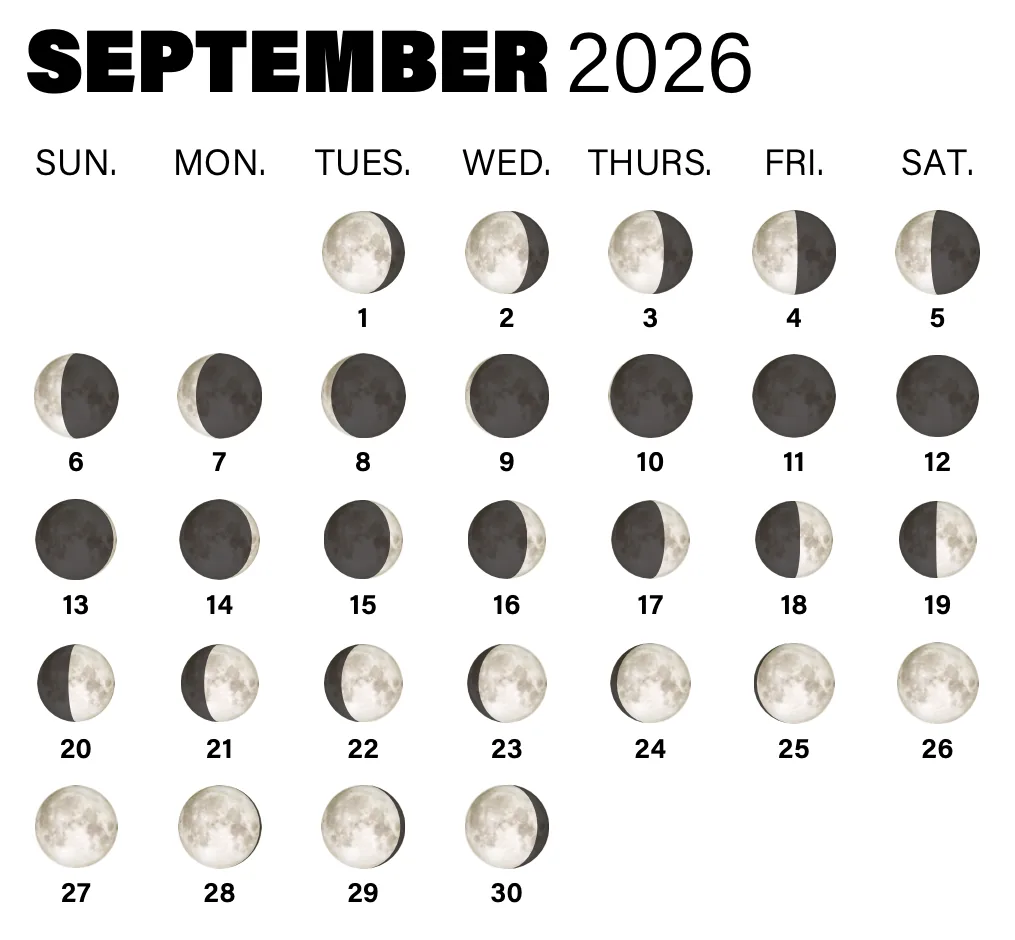
The arrival of the Harvest Moon on September 26 marks the most prominent skywatching spectacle of early autumn. Officially reaching full illumination in late September, the Moon emerges in the eastern sky within the constellation Pisces as twilight settles across North America [1, 2]. Observing reports highlight that this full moon coincides directly with traditional autumn celebrations centered on lunar folklore [2].
Planetary conjunctions enhance this observing window. During the evening of September 26, the Moon passes near distant Neptune [1]. That evening, bright Saturn shines prominently just beneath the glowing lunar disc, presenting a brilliant pairing visible without optical aid. Through a small backyard telescope, Saturn’s returning rings appear tilted at roughly 7.5 degrees, presenting a striking sight after being oriented edge-on during the previous observing year [2].

Unique orbital geometry creates the renowned Harvest Moon effect around the autumn equinox. Typically, moonrise occurs approximately 50 minutes later from one evening to the next. In late September, however, the ecliptic meets the eastern horizon at a shallow angle in the Northern Hemisphere, compressing the daily delay to roughly 25 minutes across North America [2]. The lunar disc remains more than 99 percent illuminated on both September 25 and 26, lingering at 97 percent on September 27 [1].
Observing Lunar Eclipses Across Seasons
Two striking eclipses mark 2026. On March 3, the Worm Moon passes directly into Earth’s umbral shadow, creating a dramatic total lunar eclipse cataloged under Saros 133. According to calculations in the Five Millennium Catalog of Lunar Eclipses by Espenak and Meeus, the penumbral stage begins at 08:44 UT, the partial eclipse begins at 09:50 UT, and totality commences at 11:04 UT before reaching greatest eclipse at 11:34 UT. The total phase concludes at 12:03 UT, with the moon completely exiting the umbra at 13:17 UT and leaving the penumbra at 14:23 UT under an umbral magnitude of 1.1507 [3].
Later in the summer, on Aug. 28, the Sturgeon Moon experiences a partial lunar eclipse as our satellite grazes Earth’s umbra under Saros 138. Penumbral contact begins at 01:24 UT, partial shadow immersion starts at 02:34 UT, and greatest eclipse arrives at 04:13 UT with an umbral magnitude of 0.9299 before concluding partial phases at 05:52 UT [3]. Unlike solar eclipses, no eye protection is required.
Preparation optimizes full moon viewing throughout all four seasons. Stargazers should select viewing sites with unobstructed eastern horizons, enabling early observations as the moon clears ground obstacles during twilight. Taking advantage of the successive 2026 full moons allows astronomers of all experience levels to document recurring orbital geometry, track accompanying planetary conjunctions, and witness the cyclical progression of our nearest celestial neighbor [1, 2].
- ONLINE NEWS Parks, J., & Klesman, A. (2026, September 26). 2026 Full Moon calendar: When to see the Full Moon and phases. Astronomy Magazine. [Article Link]
- ONLINE NEWS Carter, J. (2026, September 26). The full ‘Harvest Moon’ rises with Saturn this weekend — here’s how to get the best views. Live Science. [Article Link]
- ACADEMIC JOURNAL Espenak, F., & Meeus, J. (2009). Five Millennium Catalog of Lunar Eclipses: -1999 to +3000. NASA Goddard Space Flight Center. [Article Link]
APA 7: TWs Editor. (2026, September 27). Skywatchers Chart Dates and Eclipses for 2026 Full Moons. PerEXP Teamworks.


