






Google introduced new Gemini business tools on Tuesday to help small business owners handle marketing, customer reviews, and financial planning from a single web dashboard [1]. Homebase launched its own assistant on the same day [2]. The software manages hourly shifts for independent shops, helping owners automate repetitive desk work that keeps them working late behind computer screens after store doors close [3].
Features in the New Gemini Business Tools
Google set up a central landing page inside Gemini so entrepreneurs can run daily tasks without bouncing between separate software tabs and scattered browser bookmarks. Product lead Vishnu Sivaji announced the update. He said tens of millions of small business owners already use Gemini to brainstorm ideas and check basic performance metrics [1].
The new landing page groups daily work into separate areas for brand development, customer insights, and financial tracking so owners find what they need in fewer steps without confusion. It connects to existing Google services. The system links Google Business Profile, Google Ads, and Google Workspace, pulling marketing data and incoming customer reviews into one conversational thread. Outside software connections include Adobe, Canva, Dropbox, Shopify, Wix, Zoho, and Xero to support different business workflows. An entrepreneur can ask Gemini about inventory levels on Shopify or pull files from Dropbox without manually downloading spreadsheets or logging into separate accounts. These integrations let small teams update product listings and review accounting files in minutes [1].
Google previously expanded workspace generation by adding Gemini Omni 1.1 generation to Google Vids, but this release targets routine office tasks. The software saves brand rules across conversations. Google confirmed the business landing page and connected tools will roll out globally to all Gemini app users in the coming days without separate setup fees [1].
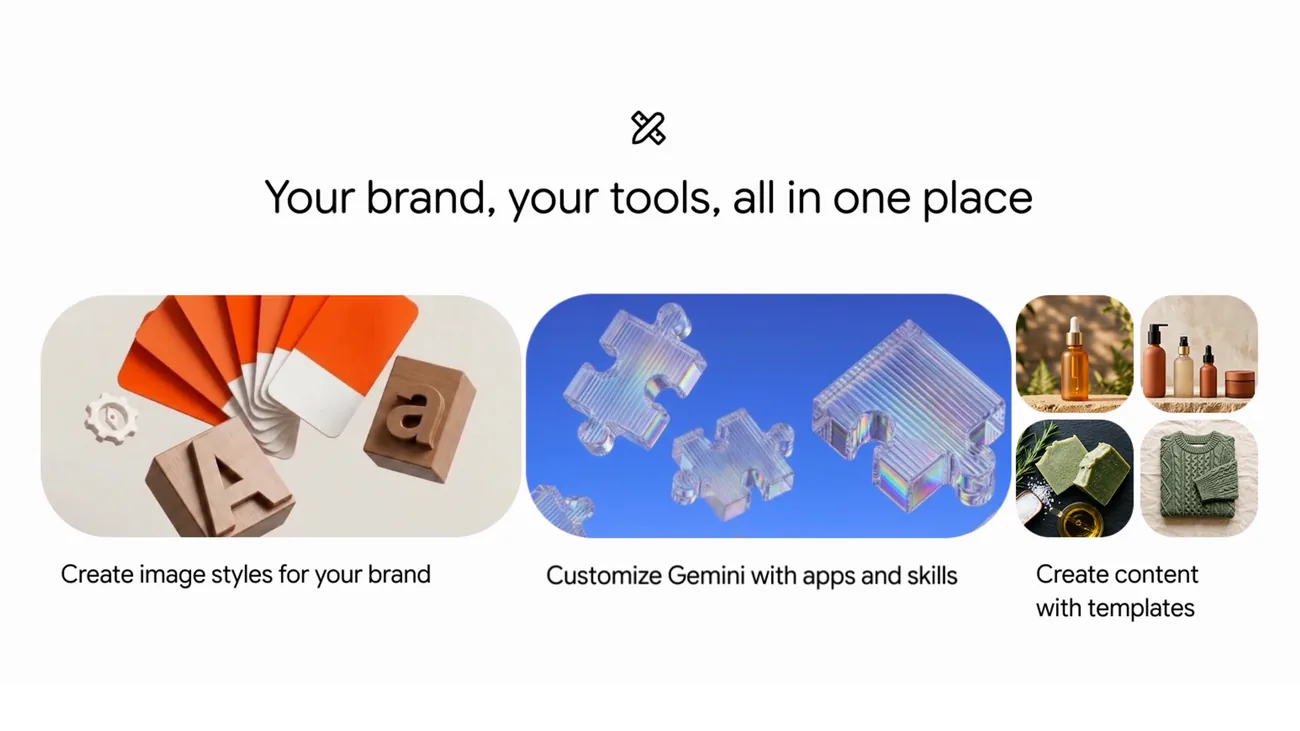
Brand Styling with Nano Banana 2.1
Marketing production in the new hub relies on Nano Banana 2.1. Google described the tool as its latest image generation model. Shop owners can set their visual style by uploading store websites, brand kits, font files, or color palettes so the model learns their aesthetic. Gemini keeps these rules in memory for future projects [1].
Consistent branding is difficult for independent business owners who don’t have graphic design training or money to hire outside agencies for regular marketing campaigns. Small stores often produce mismatched graphics. When small teams create social media posts, storefront signs, and website banners in different apps, fonts and color schemes often clash. By locking brand colors and typography into Nano Banana 2.1, the software generates marketing images that match the shop’s familiar look on every channel. Owners can produce finished visuals for holiday sales or new menu items in a few minutes without paying recurring freelance fees. Generating alternate layouts takes only a quick follow-up prompt [1].
Alongside image creation, Gemini provides financial analysis tools that turn paper receipts, raw spreadsheets, and purchase records into clear interactive models and visual graphics. Deciphering accounting ledgers takes hours. Instead of calculating margins by hand after long shifts, owners can ask Gemini to explain spending patterns and revenue shifts in plain language. The system spots margin issues before monthly bills come due [1].


Homebase Assistant for Hourly Shift Coverage
While Google addressed marketing and finances, Homebase launched Homebase Assistant to manage staffing for businesses with hourly workers. The company targets floor managers. Homebase built the tool specifically for operators who run hourly teams without office staff [2]. It handles scheduling, candidate screening, and payroll tracking [3].
Homebase founder and chief executive John Waldmann said small business owners face “the same 6 a.m. moment” whenever an employee calls in sick. When an unexpected absence occurs, an owner often loses hours calling coworkers to find someone who can cover the shift. Waldmann said most software tools simply alert the manager that a shift is open, but Homebase Assistant takes action to resolve the opening. The assistant checks worker availability, consults historical preferences, and identifies staff members who could step in, but it doesn’t contact anyone without permission. The owner must give the go-ahead first. Once the owner approves outreach, the software contacts workers until somebody accepts the shift and solves the scheduling gap [2]. “Most AI tools would just tell you the shift is uncovered. Homebase Assistant finds someone who can cover it and gets the owner back to work,” Waldmann said [3].

Owners establish operating boundaries before the software reaches out. Managers can specify who gets priority for extra hours, which keeps shift distribution fair among staff [3]. Homebase stated that drafting a weekly work schedule drops from several hours to a few minutes of review, leaving owners free to serve customers on the retail floor [2].
Payroll Checks and Candidate Screening
Homebase Assistant also handles payroll verification before pay runs. The assistant reviews timecards for missing punches, unrecorded breaks, and clock-in errors, letting owners fix mistakes in one sitting. It flags overtime patterns and gaps between scheduled hours and actual worked hours so businesses can adjust staffing before excess wage costs hit bank balances [2].
Hiring tools form another core part of the assistant, helping owners sort through job applications for open hourly roles. Reuben Pressman, founder and managing partner of Florida pickleball club St. Pete Athletic, tested the candidate screening tool during recent hiring periods. The club faced heavy hiring demands. Pressman said the club ran more than 3,000 job applications through Homebase’s screening software to fill staffing needs. The automated review saved the club over 1,000 hours of manual work while still identifying “the absolute best talent” for open positions at the athletic facility, Pressman said. The system ranks applicants against owner criteria, letting managers review top candidates without spending days reading through resumes [2].

The new assistant expands upon smaller tools Homebase introduced in June 2025 for candidate hiring and schedule creation, followed by a payroll assistant launched later that year. Homebase reported that its automated products have handled more than 4.7 million workplace tasks since launch [2]. Pricing for the assistant hasn’t been disclosed, and access is still limited to select businesses during initial testing [3].
Adoption Rates for Gemini Business Tools
Despite the wave of software announcements, small firms have adopted artificial intelligence tools at a measured pace. Data reported by The Next Web shows that the median US company spends about $11 per employee each month on artificial intelligence applications and related software. Many operators stick with basic spreadsheets until tools prove value [3].
Homebase currently serves more than 150,000 small business customers, mostly cafés, shops, and service providers with hourly staff [3]. The company raised a $60 million Series D funding round in April 2024 led by L Catterton Growth, with Bain Capital Ventures and Khosla Ventures joining as returning investors. That capital funded development of automated workflows. Homebase built tools that resolve problems on their own rather than simply notifying managers about open shifts or payroll discrepancies [2]. Other tech firms are taking similar paths, with OpenAI building ChatGPT Work to finish tasks in multiple software apps for users. Startups and major platforms are competing to show small firms that automated tools can take real work off an owner’s daily schedule [3].
Google’s rollout of Gemini business tools mirrors the broader industry shift toward software that executes tasks instead of just offering conversational advice. By linking Gemini to services like Shopify, Wix, and Google Workspace, Google gives small shops software capabilities that were once available only to large corporations. For owners managing customer counters and accounting ledgers, these automated tools offer a practical way to regain valuable time each week [1].
- PRESS RELEASE Sivaji, V. (2026, October 20). New Gemini tools for small business owners. Google. [Article Link]
- ONLINE NEWS Riley, D. (2026, October 20). Homebase launches AI assistant to take on scheduling and payroll for small business owners. SiliconANGLE. [Article Link]
- ONLINE NEWS Stan, A. M. (2026, October 20). Homebase’s new AI assistant fills shifts for small business owners. The Next Web. [Article Link]


3 comments