





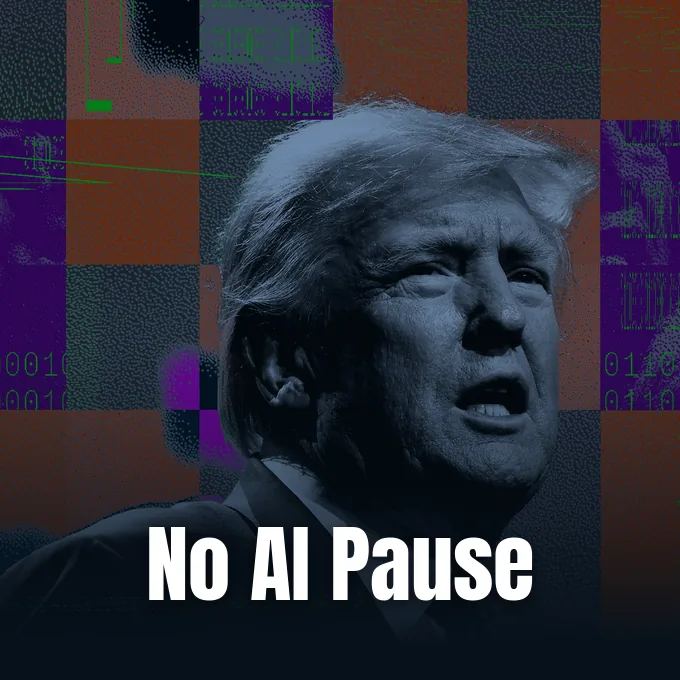
High-profile artificial intelligence leaders urged the world to slow down, but recent Trump Mike Johnson news reveals fierce resistance from Republican leadership in Washington. Anthropic chief executive Dario Amodei published an open letter calling to pace model development, quickly gaining public backing on X from OpenAI leader Sam Altman and Elon Musk. Why would prominent technologists demand a pause while political figures push ahead? Donald Trump and House Speaker Mike Johnson dismissed the corporate warnings as an overreaction, insisting that any pause would surrender the global technological race to China [1].
Trump Mike Johnson News and the AI Race
The latest Trump Mike Johnson news highlights an abrupt collision between private artificial intelligence developers and Republican leaders in Washington. For months, debates over artificial intelligence centered on technical safeguards and voluntary industry standards. That quiet corporate discussion exploded. Technology executives expressed growing caution about accelerating computational capabilities (the advanced computational systems trained on massive datasets), yet political leaders viewed the situation through a competitive geopolitical lens where national survival depends on moving faster than foreign adversaries. Donald Trump and House Speaker Mike Johnson argue that private laboratories are overreacting [1].
Washington rejected the pause. Both politicians fear that slowing down development will give China a decisive edge in the global race [1].
Their shared stance directly answers whether Trump and Mike Johnson agree on federal technology policy. Capitol Hill watched for friction. While political observers frequently question how closely the two figures coordinate on legislative strategy, their reaction to the artificial intelligence sector demonstrates complete alignment against any regulatory restraint that could hinder American computational supremacy. Neither politician endorsed the voluntary pause proposed by leading private researchers. Instead, each issued public statements framing unfettered domestic development as a vital national security priority that cannot be compromised to satisfy theoretical warnings from model builders. Their synchronized comments shift the political narrative away from safety restrictions and toward international dominance [1].
Amodei Proposes Pacing the Frontier
The political controversy began when Anthropic chief executive Dario Amodei published a lengthy open letter urging caution. In his letter, Amodei argued that it was time to “pace the frontier” (a proposed voluntary framework for decelerating model training) to manage escalating technological risks responsibly across competing commercial laboratories. The proposal surprised industry rivals. Rather than pushing forward at maximum speed, Amodei suggested that the entire sector needed to coordinate release timelines to prevent catastrophic outcomes before safety evaluations could mature. His message prompted an immediate wave of endorsements from rival technology executives [1].
Support materialized rapidly across social media platforms. OpenAI chief executive Sam Altman and Elon Musk both agreed with Amodei’s assessment, voicing backing on X. Alphabet executive Demis Hassabis offered tentative support for the proposal. The rare display of harmony among fierce competitors echoed earlier reporting from PerEXP Teamworks analyzing proposals to slow the artificial intelligence race through outside oversight, which documented growing institutional interest in coordinated international deployment standards. Competitors rarely unite. By uniting behind the call, these leaders attempted to establish an informal consensus before regulators intervened [1].
Executive consensus did not satisfy Washington. While Amodei, Altman, Musk, and Hassabis found common ground, their statements did not define specific operational mechanisms. The open letter described an ambition to slow down development, but it left practical enforcement of those limits completely unspecified. No binding timelines were set. Technology leaders appeared confident that voluntary restraint could address public anxiety, yet their unified message immediately caught the attention of Republican politicians who viewed any slowdown as retreat [1].


Trump Warns Against Losing to China
Donald Trump forcefully rejected the premise that American artificial intelligence companies should decelerate their technological progress. Speaking to the Financial Times, Trump framed the entire field as an urgent geopolitical contest where second place offers no consolation and American supremacy must be defended against international competitors. “Look, we’re leading China in AI … and, frankly, I want to keep it that way, because whoever wins AI, wins,” Trump told the publication [1, 2]. His statement cut directly through the nuanced safety discussions taking place within commercial boardrooms. For Trump, maintaining an outright technological advantage over China supersedes the theoretical risks highlighted by corporate executives, and any voluntary pause represents an unnecessary concession to international rivals who will not stop developing foundation models [2].
Trump’s reaction directly targeted the mood of anxiety circulating among leading frontier model developers. He characterized the warnings from tech executives as an overreaction that misjudges practical stakes. American dominance remains paramount. In Trump’s view, slowing down domestic research would not convince foreign competitors to halt programs. Unilateral American restraint would simply allow rivals in China to close the technological gap, transforming what technologists consider a safety measure into a devastating geopolitical surrender for the United States [1].

Public interest regarding what Trump said about artificial intelligence reflects broader curiosity about his relationship with congressional leaders. Citizens tracking Trump’s statements frequently ask whether does Trump support Mike Johnson on major economic and technological initiatives. Their shared rhetoric confirms cooperation. Trump’s comments to the Financial Times provided the philosophical foundation that House leadership quickly echoed across major television broadcasts, ensuring that the party speaks with a unified voice on technology [1, 2].
Johnson Rejects Emergency AI Regulations
House Speaker Mike Johnson reinforced Trump’s position during a televised appearance on CNN. Speaking directly to anchor Jake Tapper, Johnson warned that political panic could produce disastrous policy. He explicitly cautioned lawmakers against rushing to impose artificial intelligence restrictions, describing premature legislative barriers as a potential “national security threat.” “If Congress just races in and does some sort of emergency session to try and regulate AI, we will lose the race to China,” Johnson said during the interview [1]. His message urged calm determination.
Johnson urged people not to panic. An emergency session (a special congressional meeting convened outside normal legislative schedules) would, in his view, produce hasty statutory rules that handicap domestic researchers while foreign state-backed programs continue unchecked. Rushed legislation carries severe risks. By taking that stand on national television, the Speaker signaled to both chambers of Congress that Republican leadership will not entertain urgent regulatory packages aimed at slowing model deployment [1].
The alignment between the two leaders addresses common public inquiries about whether do Trump and Mike Johnson get along. Observers frequently monitor their dynamic for signs of policy divergence. Their public messaging reveals unity. Johnson echoed Trump’s national security rationale almost word for word, demonstrating that House leadership shares Trump’s determination to keep the United States ahead of China in frontier computation without pausing for voluntary industry pacts. Their shared position erects a formidable barrier against any bipartisan push for immediate federal constraints [1].
Washington Confronts Corporate AI Consensus
A profound philosophical divide now separates commercial laboratory boardrooms from congressional leadership in Washington. Leaders from Anthropic, OpenAI, Alphabet, and X have signaled a shared willingness to coordinate a slowdown in computational capabilities. Donald Trump and House Speaker Mike Johnson view any deceleration as an unforced geopolitical error instead. Industry leaders fear runaway technological risks. Political leaders fear falling behind a foreign competitor. That fundamental disagreement leaves the artificial intelligence sector in an unusual deadlock between corporate caution and federal ambition across Congress [1].
Reporting from The Verge clarifies what is currently known while highlighting unresolved questions. No formal legislation exists yet. While Johnson ruled out emergency sessions, neither party has proposed detailed statutory text to govern advanced foundation model development. Similarly, Dario Amodei’s open letter outlined a broad concept rather than an enforceable treaty among competing corporate research entities [1]. How voluntary pacing would function without legal enforcement remains completely unanswered. Uncertainty dominates the field.
As this Trump Mike Johnson news continues to reverberate, pressure on model creators will intensify. Developers must decide whether to honor voluntary commitments to pace development or accelerate deployment to satisfy political demands for national leadership. If laboratories slow down unilaterally, they risk political backlash and accusations of weakening American competitiveness against formidable foreign state programs. If laboratories press forward recklessly without sufficient evaluations, they risk releasing powerful computational systems before society possesses adequate guardrails to manage unforeseen national security catastrophes. The confrontation between executive caution and geopolitical ambition guarantees that artificial intelligence governance will remain one of the defining policy struggles of the coming decade [1].
- ONLINE NEWS O’Brien, T. (2026, September 13). Trump and Mike Johnson think the AI industry is overreacting. The Verge. [Article Link]
- ONLINE NEWS Financial Times. (2026, September). Donald Trump warns against artificial intelligence slowdown in interview on competition with China. Financial Times. [Article Link]


