




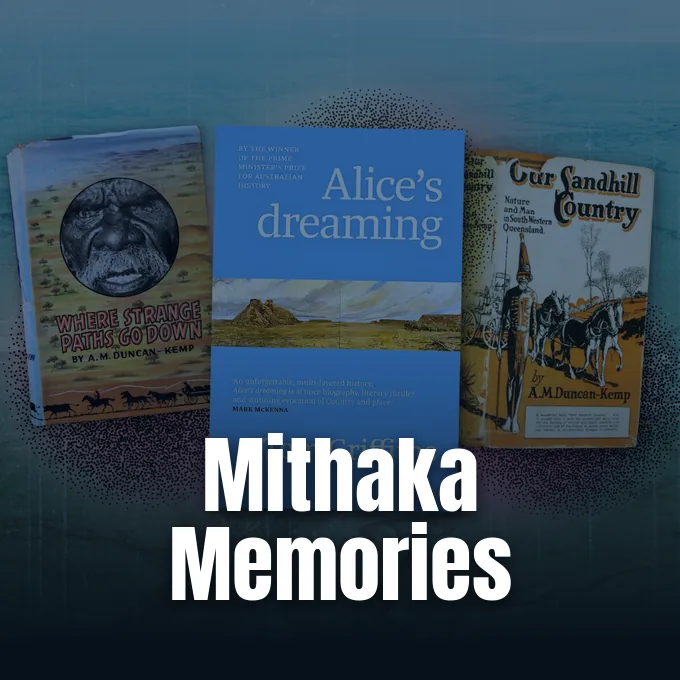
Can childhood memories recorded on an isolated cattle station reshape legal recognition a century later? Early pastoral memoirs often reflected colonial biases, but the writings of Alice Duncan-Kemp (born Alice Monkton Duncan-Kemp) captured an unusually intimate portrait of Mithaka life in south-western Queensland. Her extensive observations of Indigenous customs and geography subsequently formed part of the documentary foundation for the 2015 native title determination recognising Mithaka traditional ownership [1].
Alice Duncan-Kemp and Mooraberrie Station
Alice Duncan-Kemp (1901–1988) spent her formative childhood on Mooraberrie, an expansive sheep and cattle station situated within the Channel Country of inland south-western Queensland. Situated between the remote settlements of Birdsville and Windorah, the vast run encompassed complex alluvial floodplains where Mithaka families maintained deep ancestral connections while living and labouring under pastoral expansion. When Duncan-Kemp was two years old, she survived a dangerous buggy accident while crossing the flooded Bullo River. Although a flowering branch of a bauhinia tree nearly struck her, the child emerged completely unscathed. Mithaka elders interpreted this survival as establishing an enduring connection with Yammacoona, a maternal Dreaming figure associated with the bauhinia [1].
In his biographical study Alice’s dreaming, Australian National University historian Tom Griffiths draws upon her five volumes—four published during her life and one released posthumously—to reconstruct this frontier upbringing. Griffiths suggests that her detailed observations were shaped by the imaginative perspective of an enchanted child absorbed in the rhythms of her surroundings. Scientific investigations into how infant consciousness illuminates early perception indicate that formative sensory memories heavily shape later narrative recollections. Duncan-Kemp recorded plant names, animal behaviours, and ceremonial events in exhaustive prose that blurred the line between careful observation and reflective reverie [1].
Her childhood accounts preserved vital ethnographic details. Few pastoralists paid comparable attention [1].
Rethinking the Concept of Dreaming
The linguistic framing of Aboriginal cosmology underwent profound shifts across the twentieth century. Historian Patrick Wolfe demonstrated that the word ‘dreamtime’ entered the Australian lexicon through the early anthropological collaboration between Frank Gillen, the postmaster at Mparntwe (Alice Springs), and Baldwin Spencer, a biology professor at the University of Melbourne. Gillen translated the Arrernte term alcheringa as ‘dream-times’ to describe an ancient epoch of creation and moral law. However, Wolfe criticised how European writers generalised this concept into vague notions of ‘dreaminess’ that contrasted with Western scientific rationalism and reinforced paternalistic assumptions [1].
Later scholars sought more precise vocabulary to convey Indigenous worldviews. Mid-twentieth-century anthropologist W.E.H. Stanner advocated for the capitalised term ‘Dreaming’ to encompass an impalpable yet structured framework linking cosmogony, totemic affiliations, institutional rules, and reciprocal duties to ancestral lands. Contemporary linguists and Indigenous communities strongly favour local ancestral expressions. Modern Arrernte people use Altyerra rather than Gillen’s early translation, while Yawuru communities near Broome speak of Bugarrigarra [1]. A comprehensive historical study by Edgar and Silverstein in History Australia reinforces how deep kinship networks and reciprocal obligations to Country remain continuous across generations in Yawuru territory [2].
Griffiths acknowledges these critical distinctions while defending his book’s title as an exploration of Alice’s subjective dreaming. He argues that her early memoirs document both an imaginative white child’s fascination and an authentic absorption into Mithaka narratives. Her perspective was unique. By listening closely to Aboriginal stock workers and female domestic labourers at Mooraberrie, Duncan-Kemp recorded complex ancestral songlines that pastoral authorities routinely dismissed as folklore [1].
Frontier Massacres and Pastoral Survival
The apparent pastoral harmony portrayed in frontier memoirs masks an earlier era of systematic violence. Griffiths reconstructs the violent decades preceding Duncan-Kemp’s birth, noting that historical records document more than a dozen major massacres across the Channel Country. Most punitive expeditions were organised by colonial authorities to kill maximum numbers of Indigenous inhabitants and were carried out with brutal efficiency by the Native Mounted Police across regional waterholes. These calculated attacks frequently struck vital desert waterholes, which formed irreplaceable ecological refuges during harsh inland droughts. The Mithaka groups that Duncan-Kemp encountered did not represent an undisturbed society living in isolation, but a greatly reduced community persevering in the tragic aftermath of catastrophic demographic disruption [1].
Personal tragedies underscored this collective trauma. Bogie, one of Duncan-Kemp’s most influential childhood mentors and cultural teachers, had witnessed the murder of his mother and sister during a police massacre when he was an adolescent. His subsequent presence at Mooraberrie reflected pragmatic survival strategies under colonial domination. After the Queensland parliament passed a repressive 1897 Act enabling the forced removal and institutionalisation of Aboriginal populations onto state reserves, remaining on a working pastoral station became essential. Securing employment under a white leaseholder offered a rare passport to survival on ancestral land. Bogie and his kin chose station labour to maintain continuous contact with their traditional Country [1].
Griffiths frames Duncan-Kemp’s accounts as vital evidence of cultural dynamism under extreme pressure, rather than passive relics of the past. Mithaka families actively adapted their social practices to navigate pastoral disruptions. Surviving ceremonies and oral storytelling reflected continuous resilience rather than passive assimilation [1].


Mithaka Labour and Food Traditions
The pastoral economy of south-western Queensland rested entirely upon unwaged Aboriginal labour. Mithaka men provided expert horsemanship and livestock handling across vast unfenced pastures, while Mithaka women maintained the domestic operations of the homestead. In his prologue, Griffiths highlights that Duncan-Kemp’s father, station manager William Duncan, referred to his Indigenous workforce as the respected ‘landlords’ of Mooraberrie. Reviewer Eve Vincent observes that while this unusual phrasing reveals William Duncan’s personal regard, it did not confer legal title or rent-collecting authority upon Mithaka families, who remained dispossessed labourers [1].
Children on the pastoral frontier shouldered demanding adult responsibilities from early ages. Duncan-Kemp recalled station youths mastering difficult cattle musters on horseback when only six or eight years old. Yet station obligations did not extinguish cultural autonomy. Vincent notes that Mithaka labourers avoided what slavery theorist Orlando Patterson termed ‘social death’ by sustaining vital spiritual responsibilities. They regularly performed complex ceremonial rites, such as the goose corroboree, an elaborate ritual designed to summon magpie geese and migratory waterfowl to inland lagoons to guarantee seasonal sustenance [1].
Beyond ceremonial gatherings, Mithaka foodways integrated sophisticated land management and resource processing. Historical analyses of pre-colonial Aboriginal food practices beyond simple hunting and foraging show that Indigenous economies systematically cultivated native ecosystems. Duncan-Kemp documented how Mithaka women operated heavy stone grindstones to mill endemic grass seeds into nutritious flours. These specialised grinding implements formed the backbone of regional grain harvesting. Such accounts reveal an energetic subsistence economy functioning in tandem with station duties [1].
Archival Puzzles and Environmental History
Duncan-Kemp felt a lifelong compulsion to publish accounts of the Channel Country, producing four books during her lifetime and leaving a fifth manuscript that appeared posthumously. Later literary assessments uncovered significant editorial complications in her texts. Griffiths acknowledges that her published volumes contain substantial instances of unattributed borrowing and outright plagiarism alongside authentic field recollections. She frequently wove external readings into her childhood memories, creating a complex textual archive where firsthand Mithaka ethnography intertwined with romanticised frontier prose [1].
Griffiths mirrors this complexity by embedding extensive environmental history into his narrative. He explores the alluvial floodplains of Mithaka Country, charting subterranean aquifers, native desert truffles, and diverse bird species. He illustrates how seasonal inundations transform arid expanses into lush aquatic habitats. However, Vincent argues that Griffiths’ branching chapters occasionally lose focus, echoing the verbose narrative style of Duncan-Kemp herself. Readers navigate wide-ranging digressions on literary theory and regional ecology that dilute the core historical inquiry into frontier relationships [1].
Despite these archival contradictions, her records retain substantial scientific and legal value. Anthropologists and historians must carefully separate her secondary literary embellishments from authentic Mithaka vocabulary and territorial descriptions. Her meticulous documentation of camp locations and clan groupings proved indispensable decades later [1].
Modern Alliances Across Channel Country
The historical threads connecting Mooraberrie extend directly into modern Queensland politics. Griffiths traces the parallel life of Bill Gorringe, who was born around the same year as Duncan-Kemp to a Mithaka woman named Nuncaleer and pastoral stockman George Gorringe. Today, Nuncaleer’s descendants collaborate actively with pastoral station owners to defend Channel Country river systems against large-scale irrigation and extractive mining projects. Bill’s daughter, Rainy McKellar, works directly with Alice Duncan-Kemp’s grandson, Will Kemp. Together, they examine ancestral archives to revitalize Mithaka cultural heritage and reaffirm territorial connections [1].
This collaborative archival research bore decisive legal fruit in 2015. Federal native title determinations formally recognised Mithaka people as the traditional owners of their ancestral territories, relying in part upon Duncan-Kemp’s early writings as historical evidence. Her detailed accounts helped demonstrate unbroken continuity of connection to Country. Yet Eve Vincent cautions against viewing this outcome through an uncritical celebratory lens. Griffiths mentions pastoral exploitation without engaging deeper scholarship on stolen wages and unfree labour, while framing colonial diplomacy around the Queensland Path to Treaty initiative without acknowledging that the Crisafulli government repealed the Path to Treaty Act in 2024 [1].
Hopeful historical narratives cannot ignore contemporary political headwinds. Duncan-Kemp’s memoirs preserve invaluable cultural insights, but reconciling pastoral history requires addressing ongoing inequalities on the modern frontier [1].
- ONLINE NEWS Vincent, E. (2026, September 13). Alice Duncan-Kemp was an empathetic observer of Mithaka culture, but her legacy is complicated. The Conversation. [Article Link]
- ACADEMIC JOURNAL Edgar, J., & Silverstein, B. (2025). We are all connected to each other: deep history and relationship in Yawuru Country. History Australia, 22(1), 42–61. [Article Link]
- WEBSITE The Conversation. (2026, September 11). Archival photograph accompanying Alice Duncan-Kemp review [Photograph]. The Conversation. [Article Link]
APA 7: PerEXP Teamworks. (2026, September 14). How Alice Duncan-Kemp shaped our view of Mithaka history. https://perexpteamworks.com/en/alice-duncan-kemp-mithaka-history/


