






A $99 processor puts the aging AM4 socket back on the shopping list in the latest AMD Ryzen launch. AMD has introduced the Ryzen 5 5500F for AM4 and the $189 Ryzen 5 7500 for AM5, with Wccftech reporting that it confirmed both suggested prices directly with the company. The new AMD Ryzen releases give desktop builders two six-core options: one adds faster connectivity to a familiar budget tier, while the other can run a desktop without a separate graphics card. [1]
AMD Ryzen Launch Keeps AM4 Going
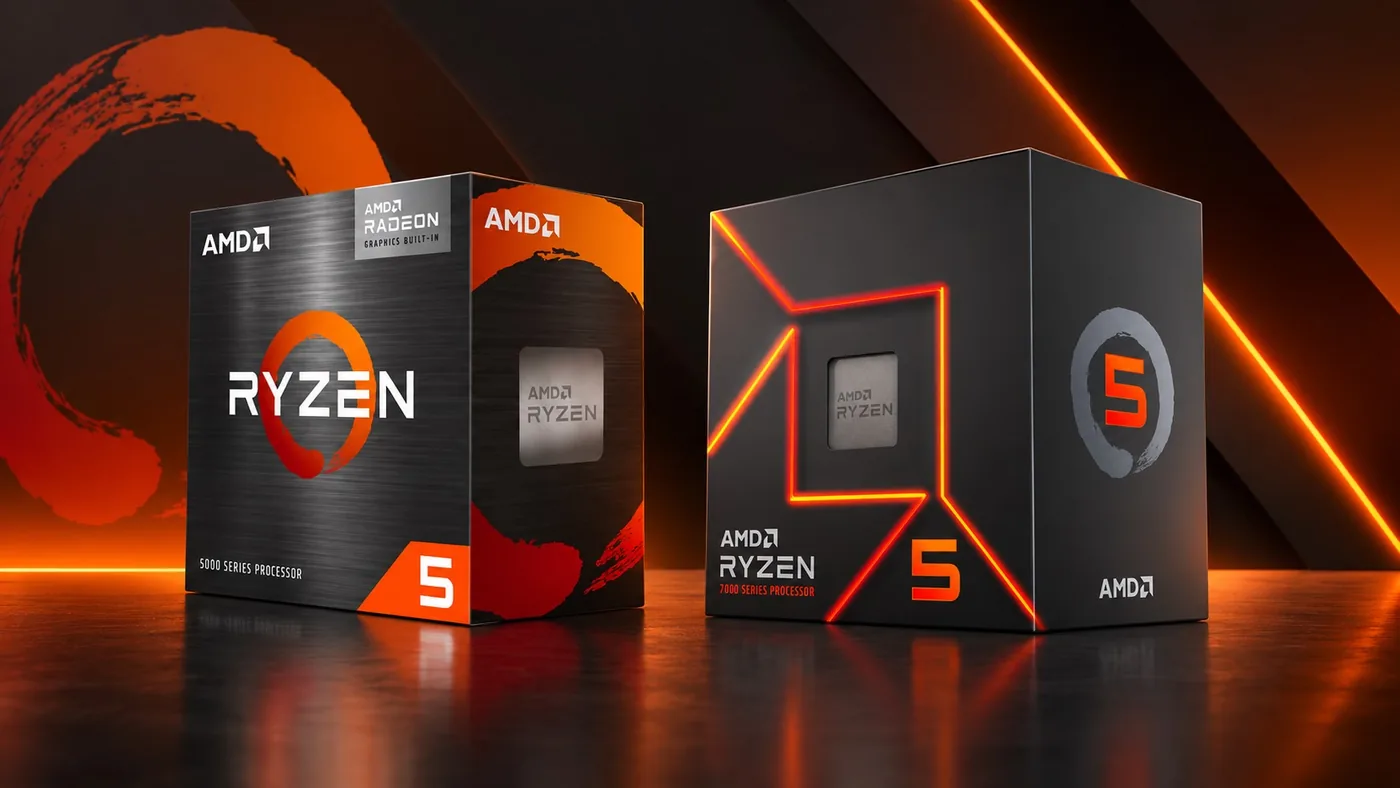
AMD makes the chips; Ryzen names the processor family. AM4 and AM5 identify the two desktop platforms involved in this launch, and that distinction matters more than the similar Ryzen 5 branding on the boxes. The Ryzen 5 5500F uses Zen 3 cores on AM4, while the Ryzen 5 7500 brings Zen 4 cores to AM5. Both have six cores and 12 threads. Both carry a 65-watt TDP (thermal design power). Their memory platforms and graphics capabilities separate them. [1, 3]
AM4 uses DDR4 memory. AM5 uses DDR5. For an existing AM4 owner, the 5500F offers another processor option within the same platform, whereas an AM5 build moves to a different motherboard and memory generation. Wccftech’s Hassan Mujtaba places the releases against rising memory prices, which make the cost of the surrounding parts especially relevant to a budget build and complicate comparisons based solely on processor prices. A cheaper CPU can leave more room for those components. [1]
AMD’s two prices also buy different routes to a working display: the $99 model requires a graphics card, while the $189 model includes its own graphics hardware. For a new desktop assembled without a dedicated GPU (graphics processing unit), the more expensive processor supplies a capability the cheaper one lacks, making this AMD Ryzen launch more complicated than its $90 price gap suggests. The surprise on AM4 sits elsewhere, beneath the 5500F name. [1, 2]
5500F Changes the Silicon Underneath
AMD built the Ryzen 5 5500F around Vermeer, the chiplet design used by its Ryzen 5000 desktop family, while the older Ryzen 5 5500 uses Cezanne, a single-die design associated with processors that include graphics hardware. The desktop 5500 disables those graphics. Adding an F to the name hides a change in the underlying silicon that a glance at the product box could easily miss. Neither budget AM4 processor provides integrated graphics. [2, 3]
PCIe 4.0 is the practical gain. The older 5500 supports PCIe 3.0, while HotHardware’s Zak Killian reports that the 5500F provides 24 usable PCI Express 4.0 lanes. PCI Express connects devices such as graphics cards and SSDs to the system. With a newer GPU or storage drive, that extra connectivity gives the 5500F a feature the older chip cannot supply, although the launch reports offer no measurements showing how much any particular application benefits. The processor also raises maximum boost frequency from the 5500’s 4.2 GHz to 4.4 GHz, a 200 MHz increase. AMD sets the new chip’s base frequency at 3.0 GHz. [1, 2]

AMD keeps the cache small. The 5500F combines 3 MB of L2 and 16 MB of L3 cache (memory held close to the processor cores), giving it 19 MB in total. HotHardware stresses that moving to Vermeer does not restore the larger L3 capacity associated with other Ryzen 5000 desktop chips. The Ryzen 5 5600 has twice as much L3. Buyers comparing those names still face a compromise: the 5500F gains connectivity over the 5500 while retaining the smaller cache allocation. [1–3]


7500 Adds a Working Display
AMD takes a simpler route with the Ryzen 5 7500: the existing Ryzen 5 7500F supplies the basic design, and the new version enables its integrated Radeon graphics. Its base frequency reaches 3.7 GHz. Boost tops out at 5.0 GHz. AMD pairs 6 MB of L2 cache with 32 MB of L3, totaling 38 MB. HotHardware also lists PCIe 5.0 support, placing the processor on the newer side of this AMD Ryzen launch. [1, 2]
The integrated GPU has a modest job. Its two RDNA 2 compute units run at up to 2.2 GHz, and HotHardware describes them as sufficient for ordinary desktop use. Wccftech gives a more immediate example: a builder waiting for a separate graphics card to arrive can still use the machine, while someone investigating a faulty card has another graphics option. Neither publication presents this small GPU as a substitute for a dedicated gaming card. [1, 2]
The 7500F disables that graphics hardware. A build already destined for a separate GPU may gain little from paying extra to enable it. How much extra? The launch coverage records different answers: TechSpot lists the 7500F around $157, while Wccftech reports roughly $130–$140 for boxed versions and $119–$129 for tray versions. Those are the publications’ retail observations, rather than a single AMD price shared by every seller. [1, 3]
Suggested Prices Meet Store Listings
Wccftech identifies $99 and $189 as AMD’s suggested e-tailer prices, or SEP, with Mujtaba reporting that AMD confirmed both figures after the initial introduction omitted pricing. HotHardware received no suggested prices in AMD’s email. Zak Killian instead found an Amazon listing for the Ryzen 5 7500 at $225, well above the $189 figure that Wccftech says AMD supplied for the chip. A suggested price cannot guarantee the checkout total. [1, 2]
HotHardware found no retail 5500F listing. Its September 12 report instead pointed to offers on existing Ryzen processors. [2]
Amazon’s competing listings make the $189 target harder to judge in isolation: Killian reported a Ryzen 5 7600X at $158.95, a Ryzen 5 9600X at $174 and a Ryzen 5 7600X3D at $229.99. Wccftech expected the new models to become cheaper after launch. AMD made no such promise in that report. Until stores settle on prices, the AMD Ryzen launch adds choices without establishing which listing delivers the strongest value. [1, 2]
The Rest of the Build Counts
AMD’s older 5500 remains part of the calculation. Wccftech found it listed at $99 with some stores offering a $25 promotion, while TechSpot reported OEM tray versions starting around $74. The 5500F’s faster PCIe connection and higher boost clock come up against those discounts, leaving buyers to weigh the extra features against an older processor that can cost substantially less. Benchmarks remain the missing piece. None of the three launch articles compares the new processors in measured gaming tests. [1–3]
HotHardware also found CPU-and-motherboard offers using the older 5500: $159.99 with an ASRock A520M-HDV, or $197.99 with a Gigabyte B550 Eagle WiFi6 that adds Wi-Fi 6, two M.2 SSD slots, two USB Type-C ports and Q-Flash Plus. Both bundles use DDR4 memory. For a build needing both parts, those offers put a standalone $99 chip in a different price comparison, because the motherboard still has to enter the total. [2]
September’s hardware launches include $399 Apple Watch preorders, but the advertised price of a desktop processor covers only one component of a working machine. An AM4 owner can weigh the 5500F against discounted 5500 options; an AM5 builder can compare the 7500’s integrated graphics with cheaper 7500F listings. For this AMD Ryzen launch, the next useful evidence will come from stocked retail listings and benchmarks showing what the new chips deliver at the prices stores charge.
- ONLINE NEWS Mujtaba, H. (2026, September 12). AMD Ryzen 5 7500 officially costs $189 while Ryzen 5 5500F brings fantastic value to AM4 platforms at $99. Wccftech. [Article Link]
- ONLINE NEWS Killian, Z. (2026, September 12). AMD launches Ryzen 5 7500 and 5500F CPUs for great value focused builds. HotHardware. [Article Link]
- ONLINE NEWS Jacobs, S. (2026, September 11). AMD launches $99 Ryzen 5 5500F for AM4 and new Ryzen 5 7500 for AM5. TechSpot. [Article Link]


2 comments