





Rigorous amorphophallus identification began when classical taxonomists realized that massive flowering structures could mislead field observers. Can human observers readily distinguish an enormous carrion-scented inflorescence from microscopic fungal structures? Plant systematists separate the genus Amorphophallus within Araceae (the family of herbaceous flowering plants known as arums) by recording precise subterranean and floral features. A systematic revision cataloging 239 recognized species established definitive morphological boundaries across the paleotropics [1].
Why Plant and Fungi Names Confuse Observers
Botanists and cultural theorists frequently examine how scientific nomenclature shapes human understanding of divergent biological kingdoms. Writing for The Harvard Gazette, Sy Boles outlined an etymology inquiry inspired by Thinking with Plants and Fungi, an essay collection examining how humans conceptualize non-human life. The volume emerged from a symposium hosted at the Harvard Divinity School Center for the Study of World Religions. Editors Rachael Petersen, Natalia Schwien Scott, and Russell C. Powell gathered perspectives from botanists, anthropologists, and theologians to explore how names in International Scientific Vocabulary reflect non-human organisms [2].
At first glance, confusing an arum with a mold might seem improbable to trained naturalists. The contrast is stark. While Aspergillus represents microscopic asexual molds within the fungal kingdom, the genus Amorphophallus comprises monocotyledonous flowering plants producing some of the largest unbranched floral structures on Earth [3]. Yet non-specialists often struggle because International Scientific Vocabulary blends classical Greek roots across entirely separate evolutionary branches [2]. Comparative morphological studies show that superficial confusion vanishes once physical specimens enter the herbarium, much like field investigations tracking cryptic structures in parasitic fairy lanterns. Taxonomic precision requires diagnostic keys based on verifiable reproductive structures rather than speculative terminology. Systematists rely on documented collections rather than vernacular guesswork during amorphophallus identification [1].
Harvard scholars emphasized that naming conventions carry historical philosophies regarding whether plants perceive environmental signals or communicate [2]. Field botanists approach the problem through empirical morphology. Taxonomists separate Araceae from fungal organisms by documenting cellular composition, vascular tissue, subterranean storage tubers, and seasonal inflorescences that produce complex floral organs [3]. By focusing on structural anatomy, systematists establish clear boundaries that linguistic similarity might otherwise obscure [1].
Amorphophallus Identification Across Global Continents
Modern amorphophallus identification advanced significantly through a comprehensive monograph published by taxonomist J. Scholten in Blumea – Biodiversity, Evolution and Biogeography of Plants. Scholten compiled decades of herbarium specimens, living plants, protologues, and regional literature into a unified taxonomic framework to resolve longstanding disputes across botanical literature. To organize this sprawling tropical group, the author formulated a general dichotomous key (a systematic identification key branching into paired descriptive choices) covering 239 species distributed across the African, Asian, and Australian continents. Ten additional regional subkeys divide taxa across specific geographic subregions [1].
Most species remain endemic. They colonize secondary forests and disturbed lowland habitats across the paleotropics, never occurring natively within the Americas [3].
Herbarium records often suffered from fragmented descriptions because fleshy inflorescences decay rapidly during collection. Scholten addressed historical confusion by proposing three formal taxonomic synonyms, consolidating redundant names that previously complicated amorphophallus identification in regional floras. The monograph intentionally simplified diagnostic workflows for research institutions and citizen science initiatives alike, providing practical identification methods for field surveys. Accurate identification supports data collection in threatened habitats, providing conservationists with practical tools to monitor fragile endemic populations before local clearings destroy undisturbed forest floors [1].
Historical Milestones in Systematic Arum Taxonomy
How did nineteenth-century botanists unify scattered herbarium records before modern molecular tools existed? Systematic documentation began in 1692 when Hendrik van Rheede tot Drakenstein published descriptions of two plants. In 1834, Dutch botanist Carl Ludwig Blume formally erected the genus name, deriving Amorphophallus from the Ancient Greek roots amorphos and phallos to denote the misshapen spadix. Early botanists recognized that floral morphology provided the most dependable baseline for distinguishing tropical arums. Adolf Engler published his monograph [3].
Between 1876 and 1911, Adolf Engler merged several allied genera into Amorphophallus, culminating in an extensive 1911 monograph that structured the genus for more than a century. Engler organized dozens of disparate regional records into a coherent tribal classification within Thomsonieae and subfamily Aroideae. Phylogenetic analysis revised this framework in 2017, partitioning the genus into four distinct subgenera named Metandrium, Scutrandrium, Amorphophallus, and Afrophallus, while leaving several Southeast Asian taxa temporarily unplaced [3].
Phylogenetic revisions demonstrate how morphological keys adapt alongside molecular insights. Botanical systematists studying ancient lineages trace structural diversification across divergent plant groups, as seen in morphological research on the evolutionary trajectory of lycophytes. By reconciling Engler’s classical observations with twenty-first-century data, amorphophallus identification bridges historical protologues with modern conservation science, ensuring that obscure herbarium types correspond to living wild populations [1].


Floral Architecture and Deceptive Insect Traps
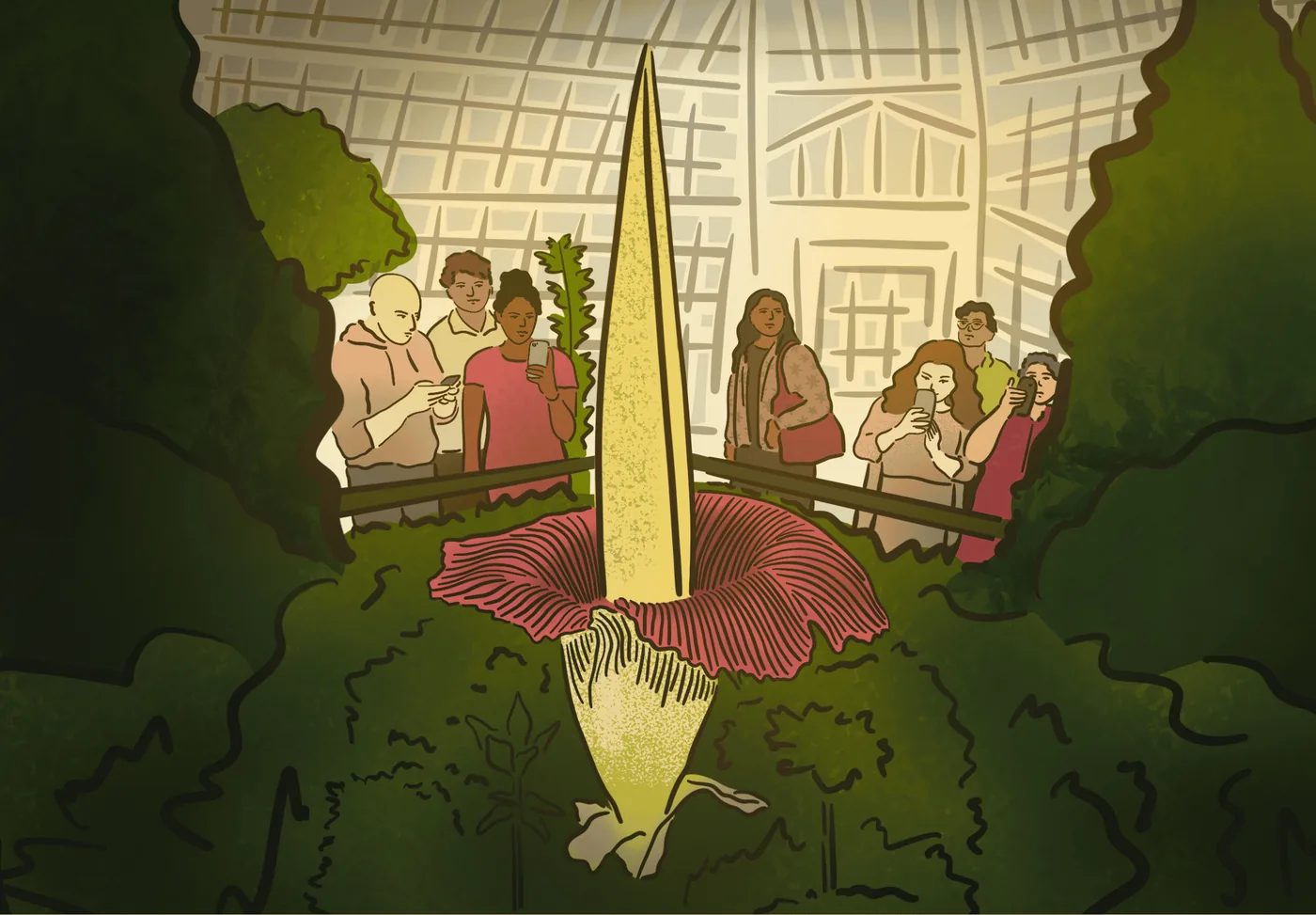
The reproductive machinery of these plants represents one of the most sophisticated pollination syndromes in the vegetable kingdom. Each inflorescence features a spathe (a sheathing bract that encloses the central flower spike) wrapped around a stout vertical spadix. The spathe displays brownish-purple or whitish-green coloration, while internal ridges and fleshy warts function as mechanical insect traps. Monoecious flower spikes position female flowers at the base, male flowers with single stamens directly above them, and a sterile upper appendix covered in staminodes. Mature female flowers remain receptive for only one day, releasing pungent odors of decaying flesh to lure deceived carrion beetles and flies into the trap. Flowers lack corollas [3].
Insects entering the spathe cannot immediately escape the slippery internal ridges while female blossoms remain receptive. Trapped pollinators wander across the basal axis until male flowers mature on the second day and shed abundant pollen grains. Once covered in pollen, the insects escape to enter another receptive spathe elsewhere in the forest canopy [3]. In amorphophallus identification, botanists examine whether the spadix appendix is smooth, wrinkled, or entirely absent, using these dimensional ratios to distinguish closely related taxa across different islands [1]. Certain species diverge from this pattern by producing pleasant perfumes rather than foul decay scents [3].
Pollinated flowers develop into dense clusters of globose berries that turn bright red, orange-red, yellow, white, or deep blue upon maturity. The foliage also supports specialist herbivores. Larvae of the Lepidoptera moths Palpifer sexnotatus and Palpifer sordida feed on the vegetative tissue of multiple arum species, tolerating secondary compounds that deter generalist grazing animals [3]. Botanists examine living specimens [1].
Tubers Ranging From Grams to Massive Records
Subterranean morphology reveals extreme developmental diversity across the paleotropics. Each plant arises from a subterranean tuber (a modified underground storage organ) that sustains dormancy through dry cycles. Tubers vary dramatically in architecture, from the uniformly globose structures of cultivated species to elongated rootstocks and bizarre clustered rhizomes. Amorphophallus longituberosus and Amorphophallus macrorhizus produce elongated tubers, whereas Amorphophallus coaetaneus forms clustered rootstocks. The single leaf produced from the top of this tuber can span several metres across, supported by an upright trunk-like petiole lasting only one growing season [3].
Tuber weights demonstrate extraordinary evolutionary divergence within a single genus. At the miniature end of the spectrum, Amorphophallus pusillus native to Vietnam produces tiny tubers weighing as little as 10 grams, or 0.35 ounces. At the opposite extreme, wild specimens of Amorphophallus titanum develop colossal subterranean structures reaching up to 139 kilograms, or 306 pounds, under favorable rainforest conditions. Storing massive quantities of starch and water allows these giant arums to fuel explosive flowering events that push inflorescences metres into the air without producing vegetative leaves during bloom [3].
Beyond botanical curio status, several arum species fulfill critical economic and dietary roles. Tubers of Amorphophallus konjac supply glucomannan, a water-soluble dietary fiber processed into konnyaku, an edible jelly and thickening agent widely consumed in Japan. Other regional species serve as famine foods during agricultural shortages, though communities must boil or leach them thoroughly to neutralize irritating chemical compounds [3]. Reliable amorphophallus identification prevents the accidental harvesting of toxic wild tubers, illustrating how academic taxonomy directly supports food safety and ethnobotanical practice [1].
Giant Inflorescences and Modern Conservation Challenges
Among the 239 cataloged taxa, Amorphophallus titanum stands out as an iconic marvel of island evolution. Native to the rainforests of Sumatra, the species produces the largest unbranched inflorescence in the world, achieving heights of up to 2.5 metres (8.2 feet) and widths of 1.5 metres (4.9 feet). Another massive relative, Amorphophallus gigas from Sumatra, reaches an astounding 4.36 metres (14.3 feet) in total height, though with a somewhat smaller inflorescence. The stench is notorious. During a celebrated bloom at the Chicago Botanic Gardens on 29 September 2015, a 1.2-metre flower named Alice drew thousands of visitors who lined up until 2 am while a webcam broadcast the event [3].
The spectacular blooms of giant arums conceal widespread vulnerability in wild paleotropical habitats. Most endemic species inhabit restricted lowland forests where logging, agricultural conversion, and habitat fragmentation threaten wild populations [3]. The dichotomous keys formulated by Scholten in Blumea provide the taxonomic clarity necessary to verify undocumented populations and implement targeted conservation strategies before localized endemics vanish [1]. While cultural essays in Thinking with Plants and Fungi invite readers to rethink how humans perceive the plant world, practical amorphophallus identification equips field researchers with the empirical tools required to protect these irreplaceable botanical wonders [2].
- ACADEMIC JOURNAL Scholten, J. (2023). An updated identification guide to the species of Amorphophallus (Araceae): new synonyms and a set of global dichotomous keys. Blumea – Biodiversity, Evolution and Biogeography of Plants, 68(2), 139–161. [Article Link]
- ONLINE NEWS Boles, S. (2026, September 15). Can you tell an amorphophallus from an aspergillus? The Harvard Gazette. [Article Link]
- WEBSITE Wikimedia Foundation, Inc. (2026, September 16). Amorphophallus. Wikipedia. [Article Link]
APA 7: TWs Editor. (2026, September 16). How Amorphophallus identification solves a botanical puzzle. PerEXP Teamworks. https://perexpteamworks.com/en/amorphophallus-identification-botanical-guide/


