



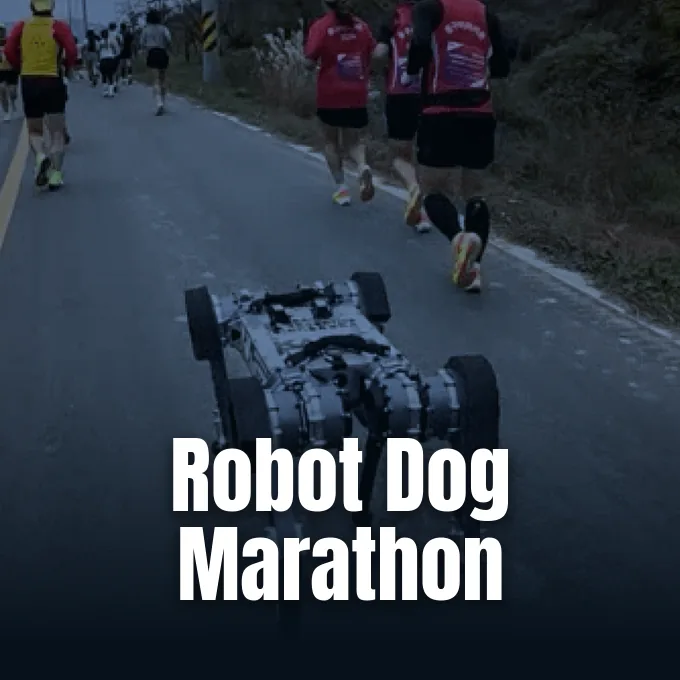
Can a quadrupedal robotic dog outlast an average human runner over the grueling span of an official marathon race? Roboticists at the Korea Advanced Institute of Science and Technology (KAIST) tackled that endurance barrier by deploying RAIBO2, a four-legged autonomous machine engineered to minimize mechanical resistance and electrical dissipation. While bipedal humanoid robots recently gained widespread public attention by challenging short-distance sprint benchmarks, sustained distance running presents a far more punitive thermodynamic challenge. During the 2024 Sangju Dried-Persimmon Marathon in South Korea, the robot dog marathon competitor finished the entire course in 4 hours, 19 minutes and 52 seconds on a single battery charge without any mid-race power replenishment [1].
- How RAIBO2 Completed the Robot Dog Marathon
- Why Quadruped Robot Marathon Locomotion Consumes Massive Power
- Redesigning Hardware to Cut Mechanical and Electrical Losses
- Training RAIBO2 Marathon Gaits with Reinforcement Learning
- Can You Buy a Robot Dog Like RAIBO2?
- Expanding Quadrupedal Robots into Disaster and Mountainous Terrain
How RAIBO2 Completed the Robot Dog Marathon
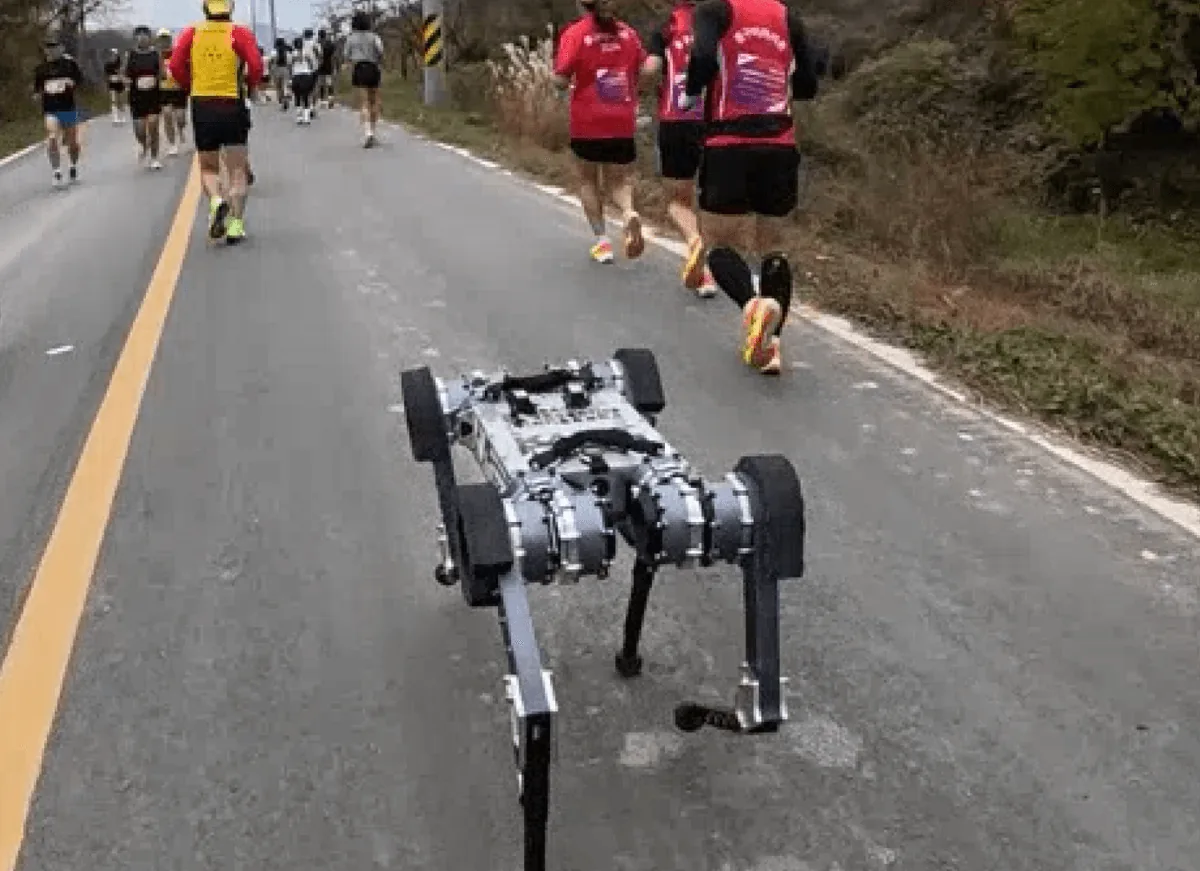
Engineers from the Department of Mechanical Engineering at the Korea Advanced Institute of Science and Technology (KAIST) entered the four-legged machine into the official Sangju Dried-Persimmon Marathon course to test robotic locomotion against an authentic road-racing profile. Rather than running on an isolated indoor treadmill, RAIBO2 navigated real asphalt slopes and varying road conditions while maintaining a steady pace throughout the entire 42.195-kilometer distance [1]. While earlier research focused on localized terrain negotiation, such as the role of a sensing paw in improving the movement of robots with legs on diverse grounds, the RAIBO2 marathon trial addressed macroscopic energy endurance over extended distances. The quadruped maintained an average speed of 2.64 meters per second (an average pace of 5.9 mph), crossing the finish line slightly ahead of the average human marathoner [2].
The successful finish in South Korea arrived after an earlier setback that exposed the severe energy vulnerabilities of mobile robots. In September 2024, a predecessor version of RAIBO attempted a marathon distance but depleted its battery reserve at kilometer 37. Post-race telemetry revealed that the earlier machine consumed excessive electrical reserves because it repeatedly surged and braked while negotiating around human participants running at shifting speeds. Sudden accelerations caused spike loads in the motor drives, burning unrecoverable watt-hours. Instead of simply mounting a heavier battery that would increase structural mass and worsen foot impact forces, the engineering team led by Professor Hwangbo Jemin reconstructed their mechanical and algorithmic framework [1].
A previous trial ended at kilometer 37. Researchers redesigned the robot dog marathon hardware to eliminate wasted power rather than adding dead battery weight [1].
Why Quadruped Robot Marathon Locomotion Consumes Massive Power
Legged machines operate under harsh thermodynamic penalties that wheeled mobile systems completely avoid. While a wheeled cart rolls passively across smooth terrain with minimal energy expenditure, a quadrupedal runner must constantly feed electrical current to electric motors merely to support its body mass against gravity (the structural resistance that wheels bypass by rolling). Every step cycle introduces mechanical shock waves that dissipate kinetic energy into the ground. Lead study author Choongin Lee, a roboticist at KAIST in South Korea, highlighted this performance reality by noting: “What matters is energy consumed per unit of distance” [2].
Internal heat generation dominates that power drain. In their investigation published in Nature, co-authors Donghoon Youm, Jeongsoo Park, and Choongin Lee calculated that approximately two thirds of a quadruped’s entire energy budget is lost as heat in the motors and their drive electronics. The remaining third vanishes through gear friction, foot slippage against the road surface, and the abrupt decelerating jolt of each footfall. For a robot dog marathon competitor, these micro-inefficiencies multiply across tens of thousands of steps into complete battery exhaustion [3].
Redesigning Hardware to Cut Mechanical and Electrical Losses
Mechanical engineers at the KAIST Department of Mechanical Engineering addressed these compounding losses by optimizing RAIBO2’s physical construction from the ground up. The research team stripped excess structural mass from every leg linkage, significantly reducing the inertia that the drive motors had to accelerate and decelerate during leg swing phases. With lighter limbs drawing less peak current, the engineers reallocated the saved weight budget toward a higher-capacity battery cell array. They paired this energy storage with custom low-resistance motor boards and electric actuators designed to generate identical rotational torque while drawing substantially lower electrical current [2].
Kinetic energy recuperation provided an additional mechanical boost during outdoor distance running. Rather than dumping mechanical energy as waste heat when descending inclines, the team configured RAIBO2 to engage regenerative braking along downhill sections of the road course. As gravity accelerated the chassis forward down declining grades, the leg motors operated in reverse as generators, routing recovered electrical power back into the primary battery pack [2].
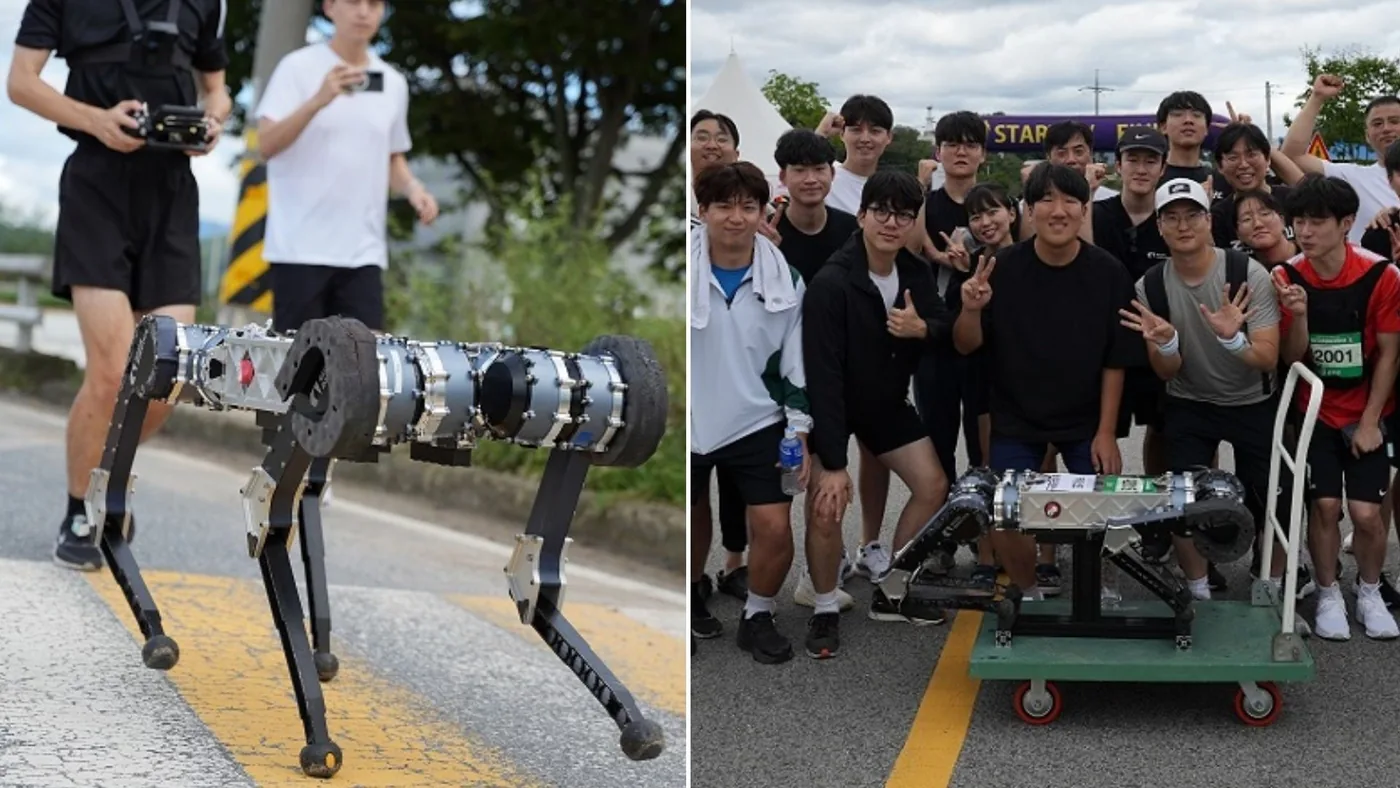
Physical hardware and motor control algorithms were developed together in a single unified architecture. The researchers simultaneously revised the mechanical leg linkages, gear trains, and circuit layouts so that mechanical dynamics directly complemented electronic efficiency. Co-designing these physical layers kept the machine moving throughout the robot dog marathon trial without carrying excessive battery ballast [1].


Training RAIBO2 Marathon Gaits with Reinforcement Learning
To establish sustainable gaits, Professor Hwangbo Jemin and the robotics team trained RAIBO2 using the RAISIM physics simulation environment developed at KAIST. Instead of writing rigid, hand-crafted kinematic equations for every joint angle, the researchers placed digital models of the robot into high-fidelity physics simulations. Over millions of simulated steps in RAISIM, the reinforcement learning algorithm tested diverse stepping patterns, learning to suppress erratic joint oscillations and minimize energy dissipation during rapid forward trotting [1].
Reward functions specifically penalized thermal spikes and foot slippage. In the training simulation, the neural policy earned positive rewards for placing each foot down softly against the running surface, preventing high-impact kinetic losses and motor overheating [2]. By soft-landing each foot, fine-tuned ground contact parameters helped the quadruped avoid violent collisions with the asphalt while maintaining consistent forward propulsion throughout the robot dog marathon trial [1].
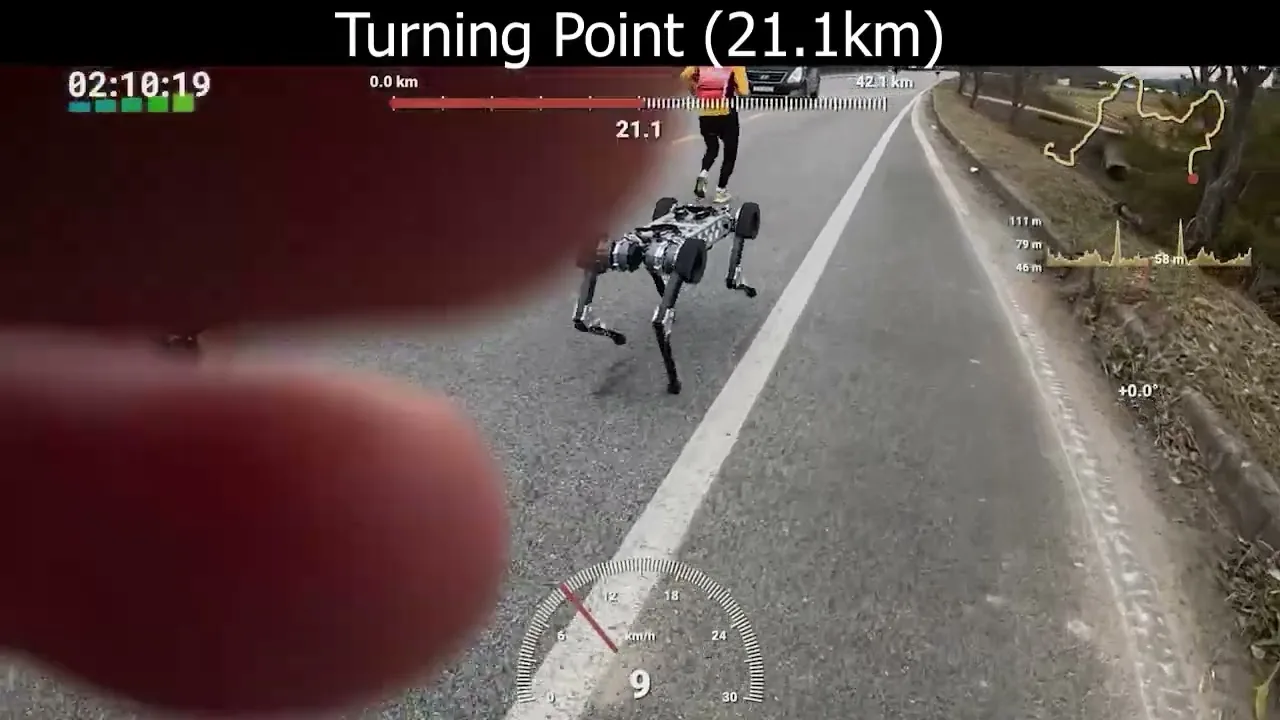
Comparative performance metrics highlight the magnitude of the improvement. Researchers express moving efficiency using the cost of transport (COT) (a dimensionless ratio measuring the energy needed to propel a unit weight across a unit distance). The recorded benchmark was 0.25. By comparison, the standard human benchmark cited in the Nature paper is 0.37, confirming that the mechanical runner consumed less power per unit of mass over the same distance than human athletes [3].
Can You Buy a Robot Dog Like RAIBO2?
No commercial buyer can purchase RAIBO2 from retail suppliers because the machine remains an experimental academic prototype developed strictly for scientific locomotion research at KAIST. The robot was created to investigate energy dissipation mechanisms rather than to serve as an off-the-shelf consumer product. Independent roboticist Katie Byl, an engineer at the University of California, Santa Barbara who was not involved in the project, pointed out that recent humanoid running exhibitions in China required support staff jogging near the machines to conduct multiple battery swaps. She characterized that contrasting support approach as mobile pit crew logistics, underscoring how difficult continuous untethered battery endurance remains across modern robotics [2].
Human intervention was not limited to administrative race preparation. Byl explained that “RAIBO2 is basically running blind” because the robot carried an onboard camera but lacked road-interpreting vision software, forcing a human operator to steer it remotely via radio controller. Embedding autonomous navigation algorithms into the onboard computer would consume significant electrical wattage, directly shrinking overall battery runtime. To translate this platform into commercial applications, Professor Hwangbo founded Lion Robotics as a KAIST faculty startup in 2023, while Lee stated that his KAIST research team is currently engineering smaller onboard networks and lightweight sensor suites. As Lee emphasized, “This way the robot can become more capable without a large increase in power consumption” [2].
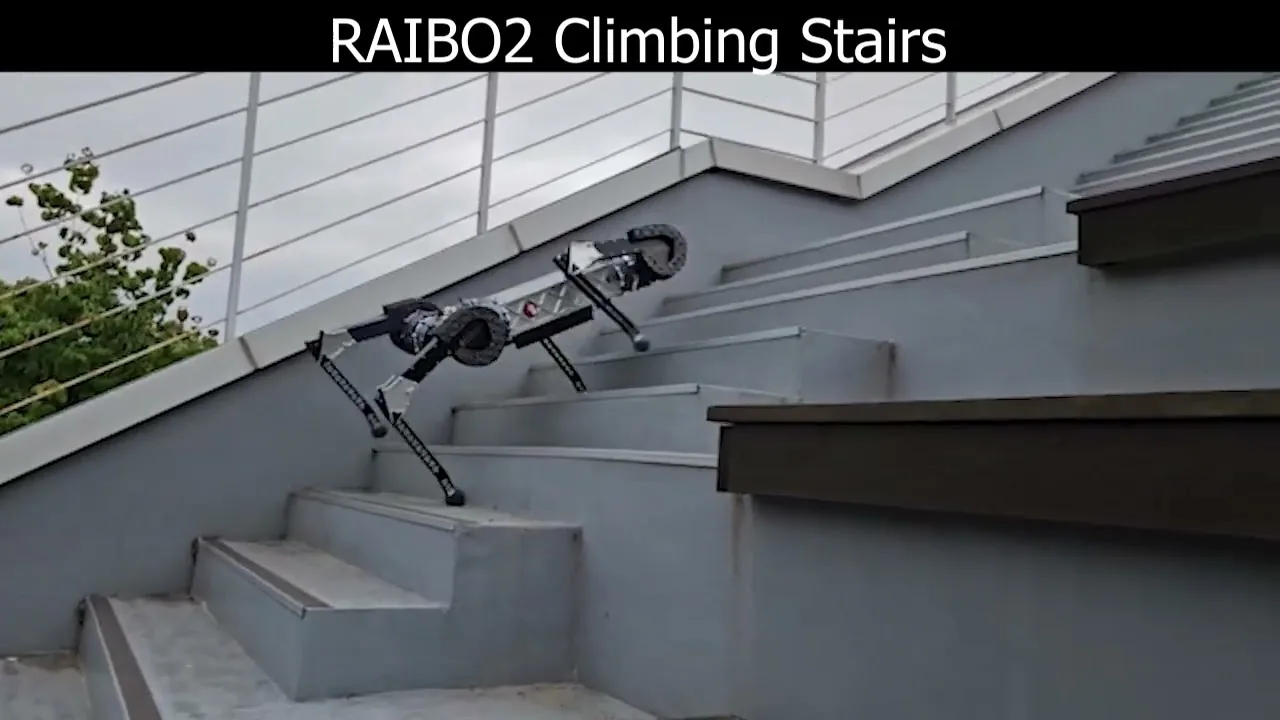
Expanding Quadrupedal Robots into Disaster and Mountainous Terrain
Earlier quadrupedal platforms typically exhausted their power packs after covering roughly 20 kilometers, severely restricting their utility in outdoor fieldwork. By executing a full 42.195-kilometer run on one battery charge, the robot dog marathon demonstration proved that RAIBO2 has a projected operational range of approximately 40 miles under comparable load conditions. The clock stopped at four hours. Evaluating the robotic performance independently, Carnegie Mellon University mechanical engineering professor Sarah Bergbreiter praised the balanced design achieved by the KAIST researchers. Bergbreiter observed: “I’m impressed with their ability to combine efficiency with speed and mobility in a quadruped,” noting that RAIBO2 travels roughly three times farther per charge than competing four-legged robots [2].
Disaster response, outdoor reconnaissance, and industrial inspection represent key environments where battery endurance is crucial. In mountainous zones or earthquake ruins where wheeled vehicles cannot roll over rubble, legged robots must inspect infrastructure without frequent recharging trips. Just as human longevity research assesses daily step counts and movement cadence to understand physical expenditure, robotics researchers examine gait frequency to calculate maximum endurance. Operating far from base stations over treacherous slopes demands machines that do not waste power on inefficient strides [1].
Systems-level engineering offers a clear roadmap for the future of mobile robotics. Supported by the Samsung Research Funding and Incubation Center of Samsung Electronics, the KAIST research team resolved mechanical, electrical, and control losses simultaneously, proving that legged machines can achieve sustained distance without simply piling on heavier battery cells [3]. As researchers at Lion Robotics incorporate ruggedized hardware and autonomous perception, future quadrupeds will bring this endurance into demanding field operations [1].
- ONLINE NEWS Shaikh, K. (2026, September 24). Robot dog runs 26-mile marathon on single charge, tops human efficiency. Interesting Engineering. [Article Link]
- ONLINE NEWS Krywko, J. (2026, September 23). Watch a robot dog run a marathon faster than the average human. Scientific American. [Article Link]
- ACADEMIC JOURNAL Lee, C., Youm, D., Park, J., Lee, J., Choi, S., Ji, G., Mun, J., Jung, M., Choi, H. C., Kim, H., Oh, H., Nam, K., Lee, M., Hur, J., Choi, D., Kim, D., An, Y., & Hwangbo, J. (2026). A quadruped robot designed to complete a marathon on a single battery charge. Nature. [Article Link]
APA 7: KAIST RAIBO2 Completes Robot Dog Marathon on Single Charge. (2026, September 25).


