






Can something the size of our solar system dictate the destiny of an entire galaxy? Narrow, relativistic black hole jets launched from galactic cores disturb the diffuse gas reservoirs spanning hundreds of thousands of light-years across deep space. Astronomers led by Sanchayeeta Borthakur at Arizona State University discovered that these plasma beams actively ionize hydrogen in the circumgalactic medium (CGM), preventing cold gas from collapsing into newborn stars [2].
Why Do Black Holes Emit Jets?
Black holes emit jets when infalling matter funnels extreme gravitational energy into magnetized plasma collimated along rotational poles. When gas spirals toward an event horizon, friction and intense magnetic fields accelerate charged particles outward at near-light speeds instead of pulling them across the boundary. A supermassive black hole occupies a physical volume comparable to our solar system, yet the galaxy surrounding it contains approximately 100 billion solar systems. The scale disparity is staggering. Namrata Roy of the Raman Research Institute framed the central puzzle: “The surprising question is: how can something so small energetically impact something so enormous?” [2]
At the Galactic Center, Event Horizon Telescope observations of Sagittarius A* (Sgr A*) at 230 GHz revealed that magnetized tori naturally generate non-thermal orbital hotspots. In a study published in the Monthly Notices of the Royal Astronomical Society, Alejandro Cruz-Osorio and David Barrero-González analyzed these orbital structures using magnetically arrested disk (MAD) simulations [4]. Their findings demonstrated that a dimensionless black hole spin of 0.5 sustains concentrated magnetic field topologies capable of channeling matter into collimated outflows.
Complementary unreviewed preprint research by Barrero-González and Cruz-Osorio investigated relativistic spherical accretion across thirteen non-rotating spacetimes [5]. Their mathematical models showed how surrounding cosmic metric parameters alter accretion rates, establishing that inflow properties govern how much raw fuel remains available to launch extended astrophysical beams.
How Do Black Hole Jets Work?
Black hole jets work by converting rotational and magnetic accretion power into narrow, collimated streams of relativistic particles that slice through interstellar matter. As magnetic field lines twist along the spin axis, charged particles accelerate outward along tightly focused trajectories rather than dispersing into surrounding space. These plasma columns maintain extreme kinetic energy over astronomical distances. Energy flows along the beam. The propagating plasma acts like a high-powered cosmic blowtorch, transferring heat directly into surrounding gas clouds [1].
To understand how these columns behave across galactic environments, researchers often draw comparisons with smaller stellar-mass analogues studied in our previous coverage of NASA’s IXPE research on microquasars. While stellar-mass systems erupt over compact physical distances, supermassive engines operate on immense extragalactic dimensions. In an unreviewed theoretical preprint, Lei He and Liang-Gui Zhu examined binary black hole mergers embedded within active galactic nucleus (AGN) accretion disks [7]. Gaseous interactions within dense disk gas generate detectable multiwavelength electromagnetic signatures, tracking how embedded systems interact dynamically with surrounding gas flows.
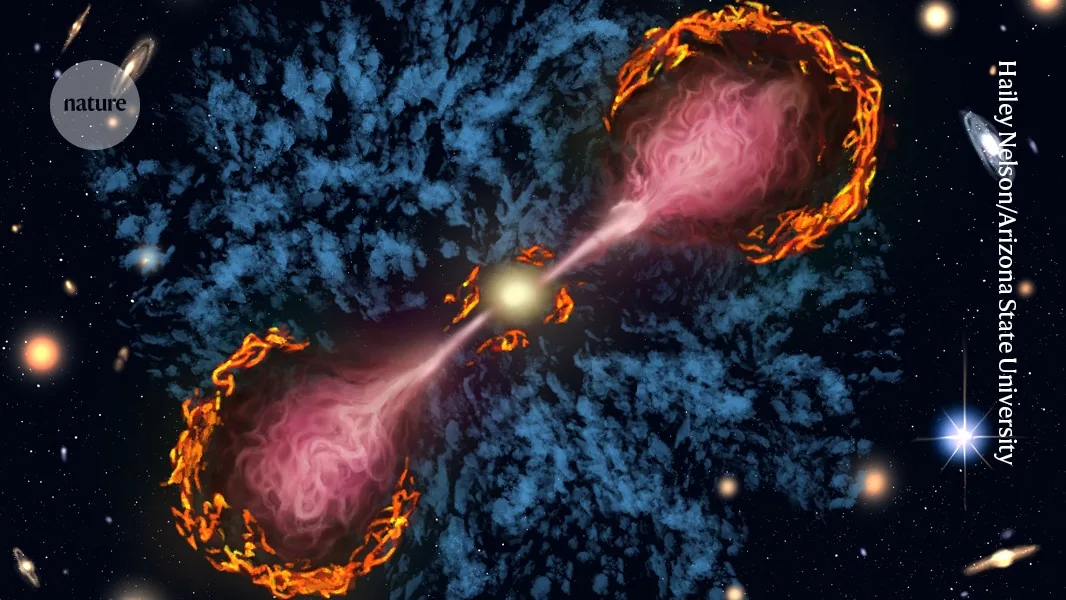
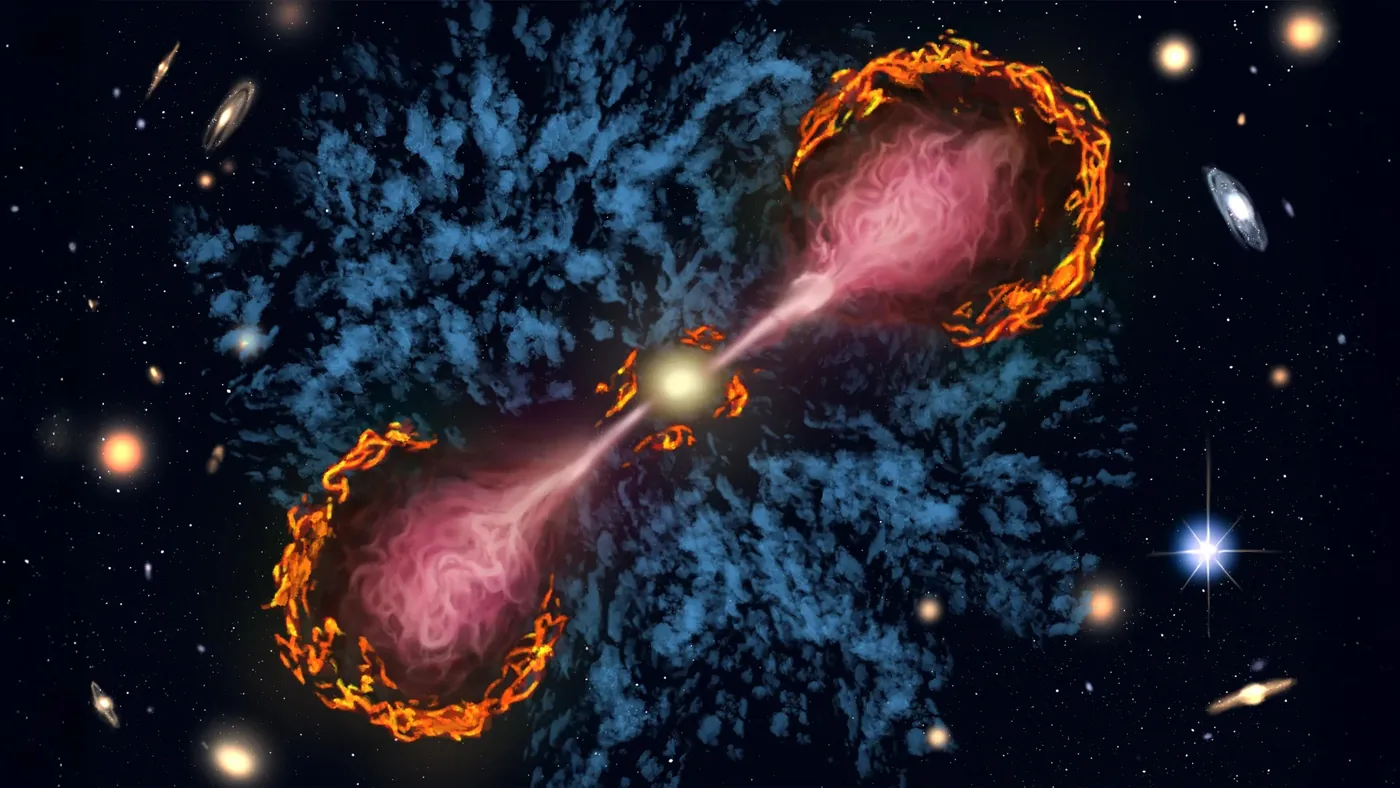
The circumgalactic medium (CGM) represents the primary gaseous arena where this mechanical energy discharges. Large galaxies, including our own Milky Way, sit inside massive envelopes of diffuse gas extending 10 to 20 times beyond their visible stellar disks. In undisturbed environments, this vast reservoir gradually cools, condenses, and collapses inward to fuel ongoing star formation. Cold gas ignites new stars. When active jets penetrate the medium, they disrupt that quiescent cycle entirely [2].
Mapping the Directional Circumgalactic Glow
Detecting the impact of black hole jets on circumgalactic gas required innovative spectroscopic synthesis across hundreds of galaxies. Because the faint optical glow emitted by ionized hydrogen around an individual galaxy remains too diffuse for standard instruments, the research team stacked observations from multiple astronomical surveys. The researchers combined optical spectra from the Dark Energy Spectroscopic Instrument (DESI) with radio continuum maps from the LOFAR Two-meter Sky Survey (LoTSS). Timothy Heckman of Johns Hopkins University and Tanmay Singh of Arizona State University assisted in synthesizing these multi-facility datasets [1].
When the astronomers averaged measurements isotropically across all directions, the characteristic H-alpha (Hα) emission signature of ionized hydrogen appeared faint and indistinct. Along the precise axes of the radio jets, however, the Hα signal intensified dramatically. The gas was not glowing uniformly like an omnidirectional lantern. Instead, the strongest emission formed a luminous, highly directional track following the beam. Two distinct bright zones emerged: an inner region where the jet first strikes the circumgalactic medium, and an outer zone where the outflow terminates and deposits its remaining momentum [3].
Magnesium provided the crucial control test. While ionized hydrogen glowed along the jet path, neutral magnesium absorption remained evenly distributed in all directions around host galaxies [2].


How Long Are Black Hole Jets?
Black hole jets frequently span hundreds of thousands of light-years, extending far beyond the luminous optical disks of their parent galaxies. While the stellar boundaries of a large galaxy might measure 100,000 light-years across, powerful radio jets routinely pierce the surrounding circumgalactic medium to reach distances of several hundred kiloparsecs. Sanchayeeta Borthakur highlighted the profound cosmic reach of these structures, noting that energetic outflows link events occurring near microscopic event horizons to the outer peripheries of galactic environments [2].
Intermediate-mass systems display similar episodic energetic discharges on smaller physical scales. In an unreviewed study analyzing ESO 243-49 HLX-1, Fangyuan Yu and Andrew Mummery modeled recurrent X-ray flares as repeating partial tidal disruption events [6]. Utilizing contemporaneous observations from the Hubble Space Telescope (HST), their team determined that a black hole of approximately 30,000 solar masses strips roughly 0.001 solar masses of gas per pericenter passage, demonstrating that intermittent accretion mechanisms drive outflows across diverse cosmic mass regimes.
On massive scales, hydrodynamic simulations by Mudit Garg, Alessia Franchini, and Alessandro Lupi tracked gas interactions in binary systems [8]. Their unreviewed preprint tracked a live binary of one million solar masses embedded in a circumbinary disk from 53 Schwarzschild radii over 1.5 years. Gaseous torques produced a measurable phase shift in gravitational waves detectable by the Laser Interferometer Space Antenna (LISA) at redshift 0.2, illustrating how gas environments regulate black hole orbital dynamics prior to coalescence.
Supermassive Black Hole Jets and Gas Starvation
Supermassive black hole jets act as an energetic brake on star formation by heating and stirring the reservoir of circumgalactic fuel. Galaxies require cold, dense gas to synthesize new stellar populations; without a continuous inflow of pristine matter, star formation inevitably stalls. By injecting thermal and mechanical energy into the circumgalactic medium, plasma jets prevent hydrogen clouds from cooling below the threshold necessary for gravitational collapse. The cosmic feedback loop is direct. The central engine starves its host galaxy of the raw fuel required to birth subsequent generations of stars [2].
This directional heating explains why many massive elliptical galaxies exhibit suppressed star formation despite floating inside enormous halos of gas. Earlier observations often missed this connection because astronomers assumed the circumgalactic medium responded uniformly in every direction. As reported in The Astrophysical Journal Letters, directional alignment proved decisive [1]. When radio jets plow through circumgalactic space, they selectively carve ionized chimneys through the gas, altering thermodynamic equilibrium hundreds of kiloparsecs away from the nuclear core.

Similar quenching mechanisms operating across cosmological epochs provide vital context for understanding early cosmic structures, connecting directly to broader investigations into detecting concealed supermassive black holes via radio signals. Over billions of years, periodic outbursts from central black holes deposit sufficient cumulative energy into circumgalactic envelopes to permanently transition active spiral galaxies into quiescent stellar graveyards [2].
Tracing Radio Jets in Accretion Environments
Accretion environments establish the initial boundary conditions that govern whether radio jets achieve circumgalactic escape or dissipate prematurely within dense nuclear matter. When material cascades toward an active galactic nucleus, magnetic flux accumulates until reaching a magnetically arrested state where magnetic pressure balances gravitational infall. Under these conditions, the central black hole launches relativistic plasma outflows perpendicular to the accretion plane. As Namrata Roy noted regarding the immense scale of this energetic link: “A black hole is incredibly small compared to a galaxy, but its impact can reach hundreds of thousands of light-years, far into the galaxy’s outer reaches. The jet carries the energy outward, and the gas lights up along its path” [2].
Synthesizing wide-field spectroscopic surveys with sensitive radio interferometry has transformed how astrophysicists characterize the energetic balance between black holes and their environments. The discovery that narrow black hole jets generate luminous Hα trails across the circumgalactic medium confirms that galactic halos are dynamic, highly responsive thermodynamic systems rather than stagnant reservoirs. By combining observational data from DESI and LoTSS, the team supported by NASA, STScI, and the NSF established a concrete observational framework for testing feedback physics [1].
Future sky surveys, including wide-area photometric and spectroscopic campaigns conducted by the Legacy Survey of Space and Time (LSST) and the Nancy Grace Roman Space Telescope, will expand this census to higher redshifts. Resolving how directed plasma flows heat the circumgalactic medium across cosmic time will clarify how the earliest massive galaxies exhausted their star-forming potential. Mapping these glowing circumgalactic corridors marks an essential step toward understanding how microscopic gravitational engines sculpt the macrocosm [3].
- ACADEMIC JOURNAL Roy, N., Borthakur, S., Heckman, T., & Singh, T. (2026). Lighting Up the Circumgalactic Medium: Strong, Jet-aligned Hα Emission around Radio Galaxies. The Astrophysical Journal Letters, 1009(2), L34. [Article Link]
- ONLINE NEWS Arizona State University. (2026, September 30). Black hole jets may decide the fate of entire galaxies. ScienceDaily. [Article Link]
- ACADEMIC JOURNAL Nature. (2026, October 1). A black hole’s jets have a halo effect. Nature, Research Highlight. [Article Link]
- ACADEMIC JOURNAL Cruz-Osorio, A., Barrero-González, D., Zaldívar, J. J., & Mizuno, Y. (2026). Non-thermal hotspot orbiting the supermassive black hole Sgr A*. Monthly Notices of the Royal Astronomical Society, 551(2), stag1483. [Article Link]
- PREPRINT Barrero-González, D., & Cruz-Osorio, A. (2026). Relativistic Spherical Accretion in Nonrotating Black Hole Spacetimes: Astrophysical Implications. arXiv. [Article Link]
- PREPRINT Yu, F., Mummery, A., & Guolo, M. (2026). HLX-1 as a Repeating Partial Tidal Disruption Event around an Intermediate-Mass Black Hole. arXiv. [Article Link]
- PREPRINT He, L., Zhu, L., Chen, K., Dai, Z., Yuan, Y., Wang, J., & Zhao, W. (2026). Electromagnetic Counterparts of Stellar-mass Binary Black Hole Mergers in AGN Accretion Disks: Theoretical Models and Observational Status. arXiv. [Article Link]
- PREPRINT Garg, M., Franchini, A., & Lupi, A. (2026). Gas-induced gravitational-wave dephasing and accretion periodicities of live post-Newtonian massive black hole binaries: warm disk. arXiv. [Article Link]
APA 7: TWs Editor. (2026, October 2). How Black Hole Jets Reshape Circumgalactic Gas Reservoirs. PerEXP Teamworks. https://perexpteamworks.com/en/black-hole-jets-halo-effect-galaxies/


