



Can physicists measure time by peering into the heart of an atom rather than watching its electrons? Standard atomic clocks have set global timing records for decades, but researchers have now built working prototypes that read time from atomic nuclei. Independent teams in Vienna and Beijing published their findings in Nature, demonstrating operating systems built around thorium-229 (thorium-229) nuclei that respond to ultraviolet laser light [1].
Transitions Inside the Atomic Nucleus
Today’s most accurate atomic clocks keep time whenever an electron jumps between specific energy levels in an atom. Standard devices use microwave radiation to probe cesium atoms, a process that defines the official length of the international second. Optical clocks tick at higher frequencies. Even with optical advances, orbiting electrons stay vulnerable to stray electromagnetic fields that nudge energy levels and distort measurements [3].
By contrast, nuclear clocks track transitions that occur deep within the nucleus of an atom, where tightly bound protons and neutrons stay shielded from external electromagnetic disturbances. For most chemical elements, exciting a nucleus requires high-energy gamma rays that melt lab instruments and demand massive accelerators. Thorium-229 provides a rare exception in nuclear physics because its lowest nuclear isomer state sits barely eight electron volts above the ground state, an energy gap that ultraviolet laser light can reach. Physicists Ekkehard Peik and Christian Tamm laid the theoretical foundation for this approach in 2003, showing that a thorium nucleus could serve as an optical clock reference. Researchers colloquially call the transition squishing the nucleus, flipping its shape between two quantum energy states without tearing the atom apart [4].
Turning the theoretical concept into reality took more than twenty years of laboratory work because driving the narrow transition required lasers with exceptionally small bandwidths. Physicists spent decades searching for the precise wavelength needed to excite the nucleus. The energy gap is unusually low. These precision timing techniques also help researchers test the boundaries of relativity and explore theories surrounding superluminal motion in modern physics [3].
How Does a Nuclear Clock Work?
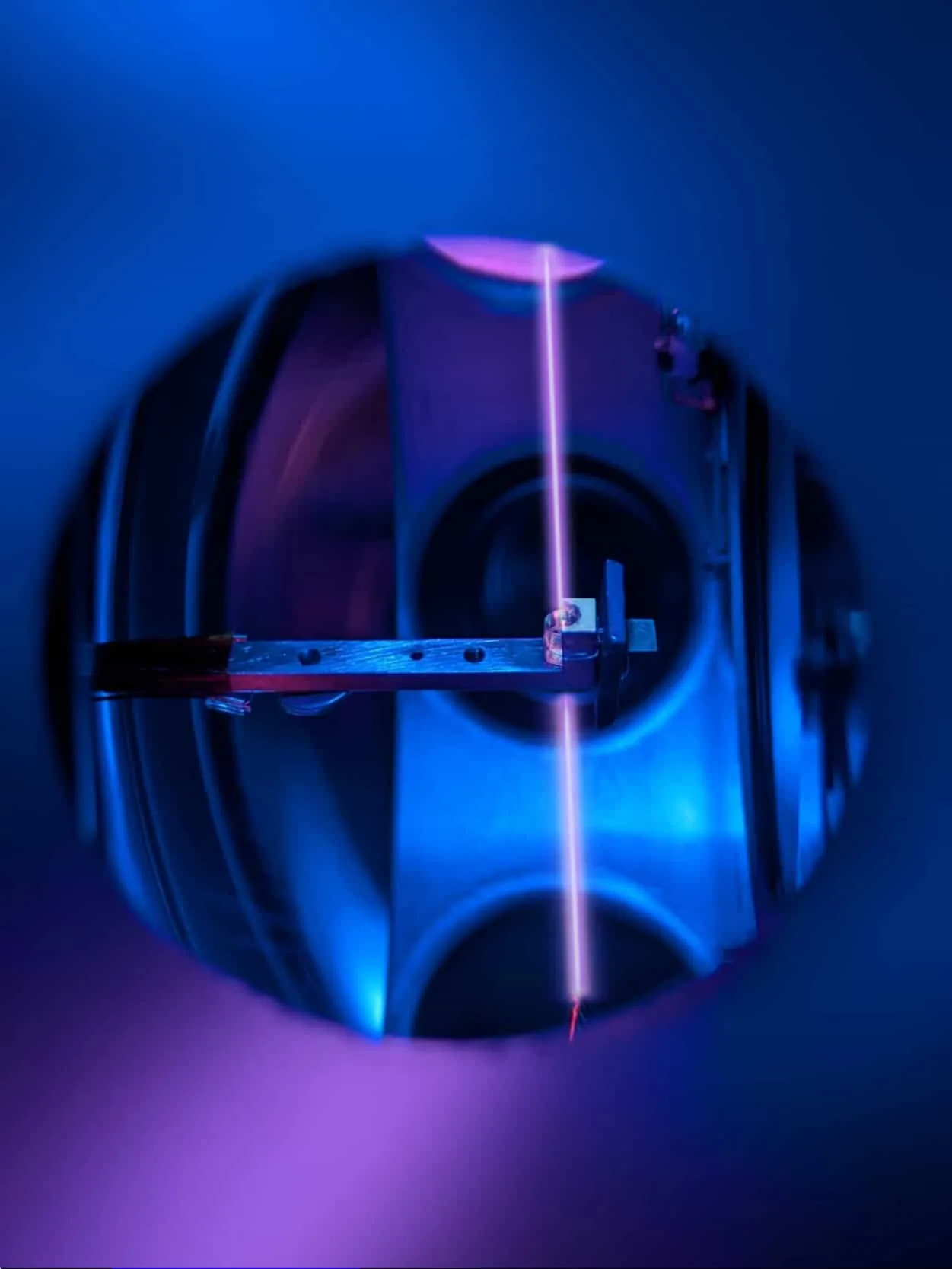
A nuclear clock works by locking the output frequency of a laser onto an energy transition occurring within atomic nuclei rather than orbiting electrons. In these solid-state prototypes, researchers direct continuous-wave ultraviolet light into a crystal doped with thorium-229. They monitor absorption spectroscopy through the crystal to measure how well incoming photons excite the nuclei, and an electronic feedback loop continuously adjusts the laser to stay locked onto that resonance. Because the laser changes the energy state of the nuclei, the nuclei act as a stabilizing anchor that prevents the light frequency from drifting over time [1].
The solid-state approach developed in Europe avoids the bulky vacuum chambers and complex magnetic traps required to isolate floating ions in conventional optical clocks. Thorsten Schumm and his colleagues at TU Wien embedded thorium-229 directly inside crystals of calcium fluoride (CaF2). Crystals offer compact setups. “The basic idea is simple: you have a laser and you have thorium,” Schumm said. “The laser changes the energy state of the thorium nuclei, and the thorium nuclei are used to stabilize the frequency of the laser” [4].
Locking the laser frequency to the solid crystal turns the light beam into a usable frequency standard. Because millions of thorium nuclei sit packed within a tiny crystal matrix, the apparatus generates a relatively strong optical signal despite the small size of the device. The solid-state architecture allows researchers to build a compact instrument without the delicate laser cooling stages common in optical atomic systems [3].
How Accurate Are Nuclear Clocks?
Current prototype nuclear clocks drift by about one second every 30 million years, which means they are roughly ten times less precise than the cesium fountain clocks that define international time. Today’s best optical atomic clocks perform far better, maintaining an uncertainty of just one second every 300 million years [4]. Atomic standards remain ahead for now. That experimental gap mirrors the earliest days of atomic timekeeping, when early laboratory models required years of steady iteration to match mechanical standards.
The long-term appeal of nuclear timekeeping lies in its theoretical headroom rather than its present performance numbers. Because atomic nuclei are tens of thousands of times smaller than electron clouds, they interact far less with stray magnetic fields and thermal noise from the laboratory environment. “The great advantage of the new nuclear clock in Vienna is that, if you use atomic nuclei rather than atoms, much higher precision is possible in principle,” Schumm said. That natural shielding protects the core transition from laboratory disturbances. Theorists calculate that fully optimized nuclear clocks could eventually reach timing uncertainties measured in billions of years, surpassing even the most advanced optical atomic clocks [4].


Comparing the Vienna and Beijing Prototypes
Two separate research groups achieved working clocks at nearly the same time, using different experimental strategies to overcome material hurdles. In Vienna, a European collaboration led by Ekkehard Peik from the Physikalisch-Technische Bundesanstalt (PTB) in Germany and Thorsten Schumm from TU Wien grew calcium fluoride crystals with higher concentrations of thorium-229. In Beijing, a team led by Shiqian Ding at Tsinghua University worked with collaborators across 13 institutions in China. Because Ding’s group faced a limited supply of thorium-229, they devised a novel growth method for small single crystals. Ding required only 1.4 micrograms of the rare isotope [3].
Ding’s group compensated for their smaller crystal mass by driving the transition with higher laser power, producing an ultraviolet beam at the crucial wavelength of 148.4 nanometers. That higher power helped the Tsinghua clock achieve a fractional frequency instability of 5 x 10^-13 / √τ / s, making it roughly six times as stable as the Vienna device, which measured 3 x 10^-12 / √τ / s. Both teams compared their observed resonance frequencies against vacuum ultraviolet frequency combs developed at JILA in the United States, confirming that the transition frequencies agreed with each other and matched earlier laser spectroscopy measurements across independent laboratory environments. Schumm told the South China Morning Post that this parallel race created a “fierce but friendly global competition” [3].

What Are Nuclear Clocks Used For?
Physicists want to use nuclear clocks to search for dark matter, monitor gravitational field variations, and test whether fundamental physical constants change over cosmic epochs [2]. Unlike everyday timekeeping tools, these instruments can detect microscopic shifts in nuclear energy levels caused by hypothetical particles. In their Nature paper, Luca Toscani De Col and his co-authors showed that their stabilized thorium clock could place tight constraints on ultralight scalar dark matter candidates [1].
Victor Flambaum, a theoretical physicist at the University of New South Wales who was not part of either project, explained that nuclear transitions offer unique sensitivity to speculative forces. The nuclear transition amplifies those signals. “We have shown that in nuclear clocks these effects are strongly enhanced,” Flambaum said. By monitoring the frequency of thorium-229 over extended intervals, the PTB and TU Wien team set experimental limits on how scalar dark matter might couple to photons and the strong nuclear force, matching the sensitivity of today’s premier optical atomic instruments [3].
Beyond testing fundamental laws, ultra-precise clocks serve as the backbone of satellite navigation systems, global positioning networks, and high-speed data exchanges. Improving clock stability helps engineers track deep-space probes, map tiny shifts in Earth’s gravitational potential, and study the atomic physics heritage that began with the Manhattan Project. When ground networks require synchronization across continents, optical and nuclear clocks provide the reference frequencies that keep digital infrastructure aligned [4].

Next Steps for Crystal and Ion Systems
To push nuclear clocks beyond existing atomic benchmarks, experimentalists need to narrow the resonance linewidth of the thorium transition. Ekkehard Peik’s group at PTB observed an experimental linewidth of 30 kilohertz in their solid-state crystal, but theoretical calculations indicate that the natural linewidth of bare thorium-229 sits well below one hertz. Crystal lattice interactions cause line broadening. “We have now seen 30 kHz linewidth, but the natural linewidth should be way below 1 Hz, which would enable more stable clock operation,” Peik said [3].
Shiqian Ding and his colleagues in Beijing are pursuing two complementary paths to sharpen precision. One avenue involves developing alternative host crystals that protect thorium nuclei better than calcium fluoride, reducing lattice interactions that broaden the optical resonance. Ding is also interested in building a trapped-ion nuclear clock that holds isolated thorium ions in an electromagnetic trap, combining nuclear stability with the quantum control techniques used in ion clocks. “It is technically much more difficult, but I think this route may ultimately provide the highest accuracy,” Ding said [3].
Building practical nuclear timekeepers will still require years of laser engineering and material testing, but the first successful tests in Austria and China prove that atomic nuclei can function as stable frequency references. As laser power grows and crystal growing techniques improve, thorium clocks may soon challenge optical atomic standards across metrological institutes and international scientific facilities worldwide [3]. Atomic nuclei now keep time.
- ACADEMIC JOURNAL Toscani De Col, L., Riebner, T., Morawetz, I., Schneider, F., Sempelmann, N., Schlachet-Lépinay, J., Schaden, F., Bartokos, M., Kazakov, G. A., Beeks, K., Gerstenecker, B., Pimon, M., Lahs, S., Hellerschmied, A., Lercher, T., Denker, H., Premper, J., Niessner, A., Matus, M.,. Tiedau, J. (2026). A thorium-229 optical nuclear clock with feedback loop. Nature. [Article Link]
- ACADEMIC JOURNAL Kawasaki, A. (2026). Nuclear clocks tick for the first time. Nature. [Article Link]
- ONLINE NEWS Boerkamp, M. (2026, October 7). Nuclear clocks finally see the light. Physics World. [Article Link]
- ONLINE NEWS DeGeurin, M. (2026, October 7). The world’s first nuclear clocks are ticking. Popular Science. [Article Link]
APA 7: TWs Editor. (2026, October 8). Thorium Nuclear Clocks Tick for the First Time in Lab Trials. PerEXP Teamworks. https://perexpteamworks.com/en/nuclear-clocks-tick-first-time/


