






For more than four centuries, a small brass padlock buried in beach sand kept its secret from treasure hunters and museum curators. Metal detectorist Peter Hughes recovered the Ann Francis lock from the shoreline of South Wales after storms exposed the wreckage, but its four rotating dials refused to open. Forcing the dials by hand risked grinding quartz sand into the delicate internal gears and destroying the relic. Researchers at Cardiff University and Amgueddfa Cymru — National Museum Wales solved the puzzle by using three-dimensional X-ray imaging to inspect the internal locking notches without moving the dials [1].
Discovery on Margam Beach
The Ann Francis remained missing for 415 years until metal detectorist Peter Hughes rediscovered the site while surveying Margam Beach in South Wales in 1998 [3]. Hughes had searched the intertidal sands near Port Talbot since 1996, walking the shore whenever winter gales and dredging scoured away deep sediment. Two years into his coastal surveys, Hughes detected a small brass object lying near two coin weights and a cluster of Spanish silver pieces. Its four rotating dials turned smoothly under light finger pressure despite resting for centuries in wet sand. Hughes tried to guess the combination over two decades of trial, but the internal bolt never slid open. “When I found the lock I was astonished by the workmanship and its condition,” Hughes said. “When I moved the ring dials of the combination they turned with ease after over 400 years beneath the sands and I was left in disbelief” [1].
Between 1996 and 2017, Hughes recovered hundreds of maritime artifacts from the beach, including navigation compasses, ship fittings, pewter spoons, and over 800 silver and gold coins minted in Germany, Portugal, and Mexico [3]. Curators confirmed that the cargo came from the British merchant vessel Ann Francis, wrecked in 1583 [2]. While deep maritime projects like the Kekova Island shipwreck excavation recover ancient Mediterranean ship timber, the Margam artifacts lay loose within shifting channel surf.

Why the Ann Francis Lock Resisted Brute Force
Manual trial was hopeless. Each of the four revolving brass rings carried six stamped letters, giving the lock 1,296 possible combinations, while stationary end pieces carried decoy letters designed to confuse anyone attempting to guess the sequence. Fine quartz sand had worked into the internal casing during four centuries in the surf. Forcing the dials through hundreds of positions risked shearing the fragile internal brass pins before finding the open gate, so museum conservators ruled out brute force attempts and sought non-destructive imaging [1].
Alastair Willis, senior curator of numismatics and the Welsh economy at Amgueddfa Cymru, said that Elizabethan combination locks remain scarce in Britain [2]. A comparable sixteenth-century dial lock in the British Museum opens with the letters MARCI, yet few surviving examples possess a verified shipwreck date [1]. Willis knew that forced turning could destroy the artifact before revealing its secrets. “Elizabethan combination locks are known in Britain, but this one is in exceptionally good condition and is associated with a dated wreck, making it a unique find and the code a tantalising mystery to solve,” Willis said [2].
Inside the Micro-CT Scanner
Amgueddfa Cymru — National Museum Wales brought the artifact to the School of Engineering at Cardiff University. David Williams, a research associate at the Musculoskeletal Biomechanics Research Facility, normally uses micro-computed tomography (micro-CT) to study fine internal structures in bones and biological tissues rather than maritime antiquities. The laboratory scanner maps dense objects by capturing thousands of X-ray projections from rotating angles and compiling them into a digital 3D model. “We normally use this technology to study bones and other biological structures, so investigating a 400-year-old padlock was certainly a first for us,” Williams said [2]. “It’s not every day you get to solve a 400-year-old mystery!”


The ANCE Combination
The first test scan showed that letter markings were visible within the metal, but a second scan went poorly because brass created harsh imaging reflections. Williams adjusted the radiation settings and exposure angles on a third attempt, capturing sharp digital slices through the internal barrel. “By creating a detailed 3D image of the internal mechanism, I could see how the notches lined up with the letters and identify the exact combination,” Williams said [1].
By rotating the three-dimensional scan on a computer screen, Williams identified the internal locking notches that secured the central bolt. Four specific notches had to align in a single row before the inner rod could pull free. Those internal grooves matched the external letters A-N-C-E. Armed with the digital solution from Cardiff, museum conservators returned to the workbench and turned the brass dials to spell the four-letter word. The central mechanism loosened under gentle hand pressure, and the key-like locking bar slid out cleanly after 443 years. The internal components moved smoothly once the notches cleared the gate [1].
Opening the lock allowed museum conservators to remove accumulated grit and stabilize the brass against further decay. Yet the four letters opened a fresh historical riddle. Alastair Willis said that staff have found no clear explanation for the code, which could represent a personal name, an acronym, or simply a convenient combination chosen by a merchant. “Of course, now we’ve solved it, we are left wondering if the code meant something to its owner,” Willis said [1].
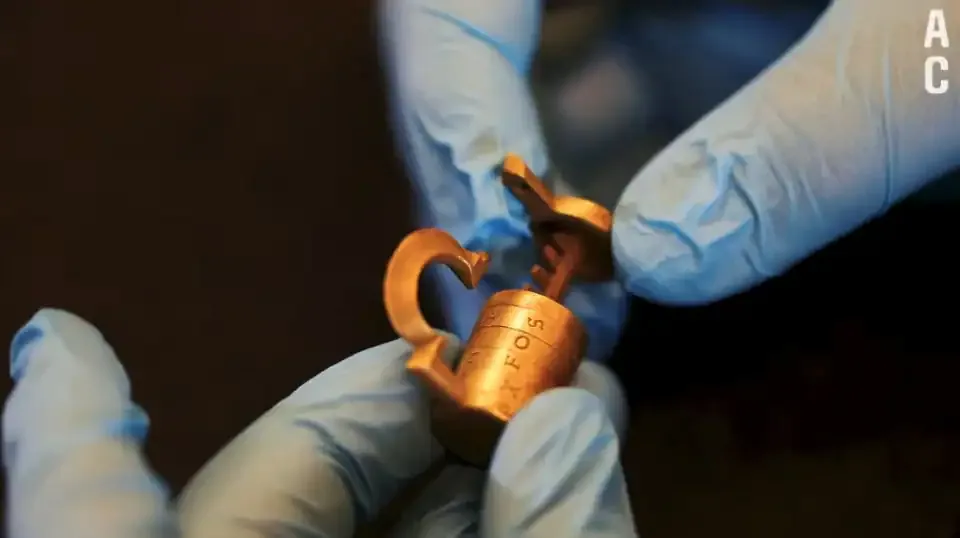
Smugglers, Storms, and Spanish Silver
The voyage was illegal from the start. The vessel belonged to Francis Shaxton, a merchant and notorious smuggler from King’s Lynn who operated trading vessels with his father, also named Francis [1]. Shaxton falsely told English port officials that the ship was sailing north from King’s Lynn to Hartlepool with grain, but he steered south to Spain to deliver wheat in exchange for gold and silver from colonial mines in Central and South America. Spain needed grain imports and paid foreign merchants in colonial bullion, creating high profits for smugglers willing to run naval blockades [2].
On December 28, 1583, a violent winter storm drove the returning vessel onto Margam Beach, far off its planned course [1]. A parish register noted the loss of 14 sailors who drowned when the ship broke apart in the surf [2]. Coastal residents quickly scavenged the stranded cargo, following traditions seen in ancient open-water seafaring traditions where seaside communities claimed wrecked vessels. Archival court records describe a bitter dispute over the salvage, with one Welsh landowner accusing more than 100 people of looting cannons, anchors, spices, and three chests with broken locks [1].
Superstition quickly followed the maritime disaster. Local residents blamed the deadly storm on a woman named Mother Gabley, accusing her of using witchcraft to cast the foul weather that wrecked the ship. Under the Elizabethan Act Against Conjurations, Enchantments and Witchcrafts, a conviction for causing shipwreck through sorcery carried the death penalty. Archival evidence shows that Mother Gabley would have almost certainly been hanged if brought to trial, though her ultimate fate remains unrecorded in surviving parish rolls [3].
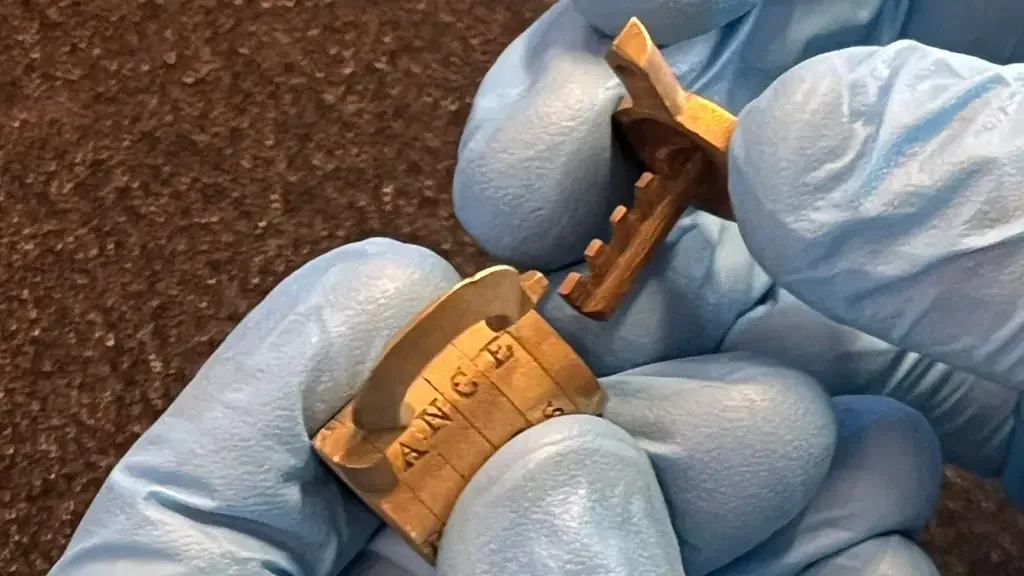
Displaying the Ann Francis Lock in Swansea
The opened padlock is now displayed at the National Waterfront Museum in Swansea with coins and personal gear salvaged by Hughes. Because Hughes found the lock near Spanish silver coins and two coin weights, curators think it once secured a wooden box holding currency or merchant accounts. Conservators suggest it could also have guarded private letters or luxury fabrics that rotted away in the sea salt long ago. Without surviving cargo inventories detailing individual sea chests, its exact role aboard the ship will stay unknown [1]. The Swansea exhibition pairs Mexican and European coinage with the navigational instruments of Elizabethan mariners.
For conservators at Museum Wales and Cardiff University, opening the Ann Francis lock without mechanical force proved the value of non-destructive imaging in coastal archaeology. The micro-CT scan preserved every internal brass pin and dial while giving researchers an exact view inside an Elizabethan mechanism. Hughes spent twenty years turning the rings by hand on Margam Beach, but laboratory X-rays solved the 400-year-old puzzle in a single session [2].
- ONLINE NEWS Puiu, T. (2026, November 5). Scientists Used CT and Finally Opened a 400-Year-Old Lock From a Welsh Shipwreck. ZME Science. [Article Link]
- ONLINE NEWS Pester, P. (2026, November 5). 400-year-old padlock discovered in shipwreck off Wales finally opened. Live Science. [Article Link]
- ONLINE NEWS Paul, A. (2026, November 4). Archaeologists crack a shipwreck’s 400-year-old combination lock. Popular Science. [Article Link]
APA 7: PerEXP Teamworks. (2026, November 6). Cardiff Researchers Open Ann Francis Lock After 443 Years. PerEXP Teamworks. https://perexpteamworks.com/en/ann-francis-lock-opened-shipwreck/


