





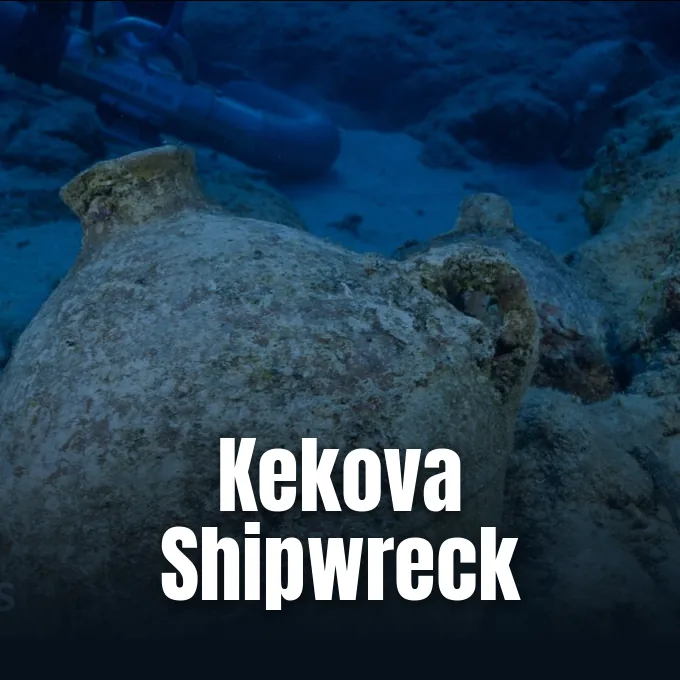
The discovery of the world’s oldest shipwreck off the coast of Turkey has revealed an Early Bronze Age merchant vessel dating back roughly 4,500 years [2]. Found near Kekova Island in Antalya, the ten-metre trading boat carried dozens of ceramic jars when it sank in thirty metres of water [3]. Archaeologists led by Hakan Öniz at Akdeniz University identified the submerged site during coastal surveys, confirming that its pottery cargo matches artifacts from 2700 to 2400 BC [2]. The wooden hull decomposed long ago, but thirty ceramic amphoras survived on the seafloor [3].
What Is the World’s Oldest Shipwreck?
The Early Bronze Age vessel discovered off Kekova Island in southern Turkey currently stands as the world’s oldest shipwreck, with archaeologists dating its cargo to between 4,400 and 4,700 years ago. Akdeniz University researcher Hakan Öniz led the Mediterranean Archaeology Association expedition that mapped the submerged site. The merchant ship measured about ten metres long and set sail during the era when workers in Egypt were building the Great Pyramid [3]. The wooden craft sank while carrying supplies along maritime trade routes [2]. It left its cargo scattered across an underwater slope [3].
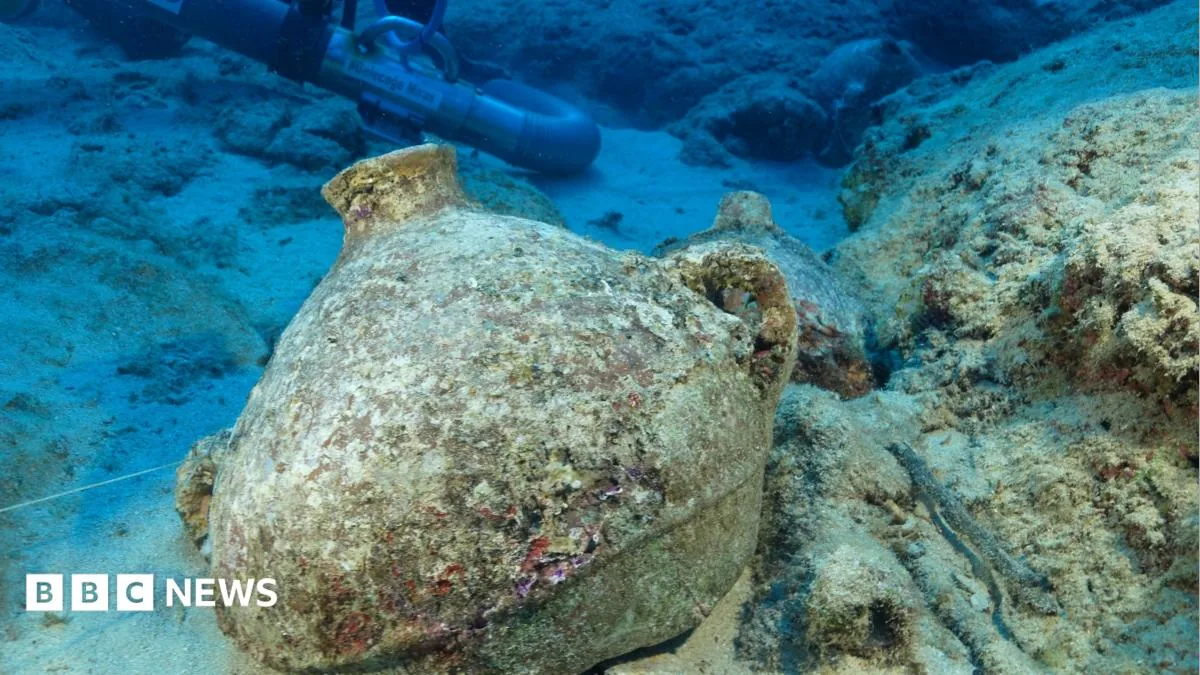
Because marine currents and wood-boring organisms destroyed the organic timbers over thousands of years, archaeologists could not use radiocarbon dating on surviving wood to determine when the vessel sailed [3]. Instead, the scientific team dated the site by studying the shape of more than thirty ceramic storage pots called amphoras. These ceramic containers have two side handles, a middle ridge, and flat bases that match pottery unearthed in Egypt and the Levant from between 2700 and 2400 BC. This pottery comparison gives researchers a clear view into early Mediterranean seafaring [2].
Öniz described the submerged site as a time capsule at the bottom of the sea. Discoveries from early periods often prompt debate over dating methods, much like debates over ancient archaeological sites where physical artifacts help verify early timelines. Divers spent weeks mapping the jars before bringing them up to the surface for conservation. The team cataloged every pot to prepare the collection for study in Antalya [3].
Survey and Recovery at Kekova Island
Underwater surveys near Kekova Island first spotted the scattered pottery in 2024, prompting two years of careful diving before researchers completed recovery work off the coast of Antalya earlier this month. Waters along southern Turkey contain hundreds of sunken vessels from Roman and Byzantine eras, but finds from the Bronze Age are rare. Öniz organized diving teams to record how the ship came to rest on the seabed [2]. Divers documented the slope before lifting fragile jars [3].
The site lies thirty metres down on an underwater slope. Strong winds and unpredictable currents make this stretch of coast dangerous for wooden boats, and sudden storms have wrecked many ships near Kekova over the centuries [2]. Divers had to work in short shifts to record the cargo without disturbing residue inside the jars [3]. The team used measuring lines to fix the location of every pot on the slope [2].
Three large stone anchors were found lying some distance away from the scattered jars, suggesting that the crew dropped them overboard when the vessel ran into trouble during a storm. Dropping anchors was a common practice among early sailors trying to keep a wooden hull from hitting coastal rocks. The heavy stones could not save the craft from strong waves. The anchors failed to hold [2].

Ceramic Evidence from the Oldest Ever Shipwreck
The cargo retrieved from the seabed consists of around thirty amphoras that carried olive oil and wine across the sea [2]. These vessels have two side handles, a raised ridge in the middle, and flat bases that let them stand upright on flat surfaces [3]. This early design differs from later classical amphoras, which had tapered, carrot-shaped bottoms made to pack closely together inside cargo holds. As trade grew in later centuries, potters changed jar shapes so ships could carry more cargo [2].
Archaeologists established the age of the Kekova site by comparing the decoration and shapes of the amphoras with ceramic records from nearby regions. Öniz said that the design matched Early Bronze Age storage jars found in Egypt and the Middle East from 4,400 to 4,700 years ago. “Comparing the decoration techniques… we can definitely say our wreck is Early Bronze Age. This is 100%,” Öniz said after studying the recovered pottery [3]. His study with Ceyda Öztosun in the Journal of Maritime Archaeology reports these ceramic details [1].
Small design differences among the jars indicate that they came from different workshops and probably different coastal villages. The crew likely sailed from port to port, buying oil and wine from local producers before beginning a longer sea voyage. This varied cargo shows that maritime trade connected small farming communities with distant markets. Local potters supplied the jars to coastal traders [2].


Residue Traces Inside Ancient Storage Jars
When divers brought the jars to the surface, team members noticed that several pots remained intact after thousands of years underwater. Dr Karin Sowada, an archaeologist from Macquarie University in Australia, examined the recovered ceramics in Antalya. She found a thick, glossy residue coating the inner walls of several pots, confirming that organic matter had survived on the seabed. Such well-preserved residue is rare in Bronze Age maritime finds [3].
Sowada said she was surprised when she looked inside the amphoras during laboratory inspection. “I looked inside and nearly fainted. I could not believe how much [residue] was visible. It wasn’t just like spots…. a lot of this material was still remaining,” Sowada said. Laboratory teams in Turkey are now running chemical tests on residue scrapings to determine whether the jars held olive oil, grape wine, or tree resin used to seal the terracotta clay containers. The tests will reveal what the ship carried [3].
Sowada said that the heavy residue inside the amphoras might indicate that ancient owners refilled and reused the large terracotta jars for many years before the final voyage. These jars were large containers that ancient households would not throw away after one trip. People emptied the pots upon arrival and used them to store farm goods for many seasons. Large ceramic jars served families for decades [3].
Early Bronze Age Maritime Trade Routes
Navigational clues from the cargo help reconstruct the route the vessel followed through the eastern Mediterranean. Öniz concluded that the ship departed from a harbour along the eastern Mediterranean coast, possibly in the Levant. The crew then sailed along the shoreline, picking up jars filled with wine and olive oil from local farming settlements. Coastal sailing allowed early mariners to keep land in sight while moving heavy cargo by sea [2].
The team believes the merchant crew was heading toward major urban centers of the Early Bronze Age, with possible destinations including the Minoan civilization on Crete or the ancient city of Troy. Reaching these distant destinations required skilled coastal navigation that expanded upon earlier traditions of prehistoric open-water seafaring developed across Mediterranean waters. Moving olive oil and wine by boat was much easier than carrying heavy clay jars over steep mountain paths. Ships could haul dozens of pots in a single trip [2].
Öniz spoke about the human lives tied to the vessel while diving near Kekova Island. “We are the first humans who [have] touched these objects after 5,000 years,” Öniz said as he described the recovered artifacts. “We are always thinking of the sailors… the producers of the amphora and the person who carried the amphora on their shoulders to the ship, and the women who were waiting for their husbands, and they unfortunately couldn’t go back,” Öniz said. His words show how archaeology connects ancient tragedies with modern discovery [3].
What Is the Oldest Known Shipwreck on Record?
Before this discovery, the oldest known shipwreck recognized by maritime archaeologists was an Early Bronze Age vessel found near the island of Dokos in Greece, dated to 4,200 years ago. The Dokos wreck dates to between 2700 and 2200 BC, and like the Kekova find, its wooden structure rotted away on the seafloor long ago [2, 3]. Other ancient wrecks discovered in Turkish waters include the famous Uluburun vessel, which was found in 1982 and sank around 1300 BC during the Late Bronze Age carrying ebony, ivory, and ostrich eggs [2]. Meanwhile, the oldest intact wooden vessel dates back 2,400 years and was recovered from Bulgarian waters in the Black Sea [3].
Jon Henderson from the University of Edinburgh welcomed the discovery but said he would like to see published peer-reviewed reports before crowning it the world’s oldest shipwreck on the archaeological record. Henderson noted that dating sites solely by comparing pottery shapes can involve wide time margins because similar ceramic styles often lasted for centuries. Radiocarbon dating could help confirm the age, but no organic wood remains at the Kekova site. Henderson said the two wrecks at Kekova and Dokos might prove to be contemporary vessels from the same era [2].
Henderson added that the real importance of the site does not depend on whether it breaks an age record. “What really excites me isn’t whether this wreck is a century or two older than another one,” Henderson said. “It’s that we’re looking at a snapshot of Mediterranean maritime trade more than 4000 years ago,” Henderson said, adding that physical remains of early trade are extraordinarily rare [2]. Turkish Minister of Culture Mehmet Nuri Ersoy announced that the recovered ceramics will go on public display once the new Mediterranean Underwater Archaeology Museum opens its doors in Antalya. The museum will preserve the ancient cargo for future visitors [3].
- ACADEMIC JOURNAL Öniz, H., & Öztosun, C. (2026). Preliminary Report on the Early Bronze Age Shipwreck in the Kekova Region of Antalya. Journal of Maritime Archaeology, 21(3). [Article Link]
- ONLINE NEWS Marchant, J. (2026, October 14). Ancient shipwreck discovered off Turkey claimed to be world’s oldest. New Scientist. [Article Link]
- ONLINE NEWS Francis, A., Morelle, R., & Church, K. (2026, October 14). World’s oldest shipwreck found off Kekova Island in Turkey. BBC News. [Article Link]
APA 7: TWs Editor. (2026, October 15). Kekova Island Excavation Unearths World’s Oldest Shipwreck. PerEXP Teamworks. https://perexpteamworks.com/en/worlds-oldest-shipwreck-turkey/


