



Apple introduced Apple HomeView, an all-new 7-inch smart display priced at $299, during its Welcome Home event in New York on October 13, 2026. The device features a square Liquid Retina screen mounted on a domed speaker base, pairing built-in microphones with Siri AI to manage household tasks [3]. While Cupertino previously signaled its connected hardware plans when Apple prepared a smart home hub for an October launch, the final product also offers a separate wall-mounted model built with external partners [4]. Retail shipments begin on November 13 across eight English-speaking markets [2].
A 7-Inch Square Liquid Retina Screen on Countertops
The new device steps away from standard rectangular proportions found on tabletop screens like the Amazon Echo Show 11 and Google Nest Hub Max [3, 5]. Apple chose a square 7-inch Liquid Retina display delivering 500 nits of brightness while retaining True Tone color adjustment for ambient indoor lighting. The panel dims to 0.3 nits. That low floor lets people place it on a bedroom nightstand without lighting up dark rooms during sleep hours. A stainless steel hinge with tilt support connects the tabletop panel to a domed speaker base [4].
Inside the display assembly, Apple installed two full-range drivers paired with an internal woofer and dual force-canceling radiators [4]. The acoustic design produces room-filling Spatial Audio for podcasts and music playback, matching what buyers expect from modern Apple hardware. It sounds full [3]. Because the screen sits on counters where family members walk past throughout the day, the interface adapts its layout based on distance. When someone stands across the room, the screen shows simpler cards that stay legible from a distance [4].
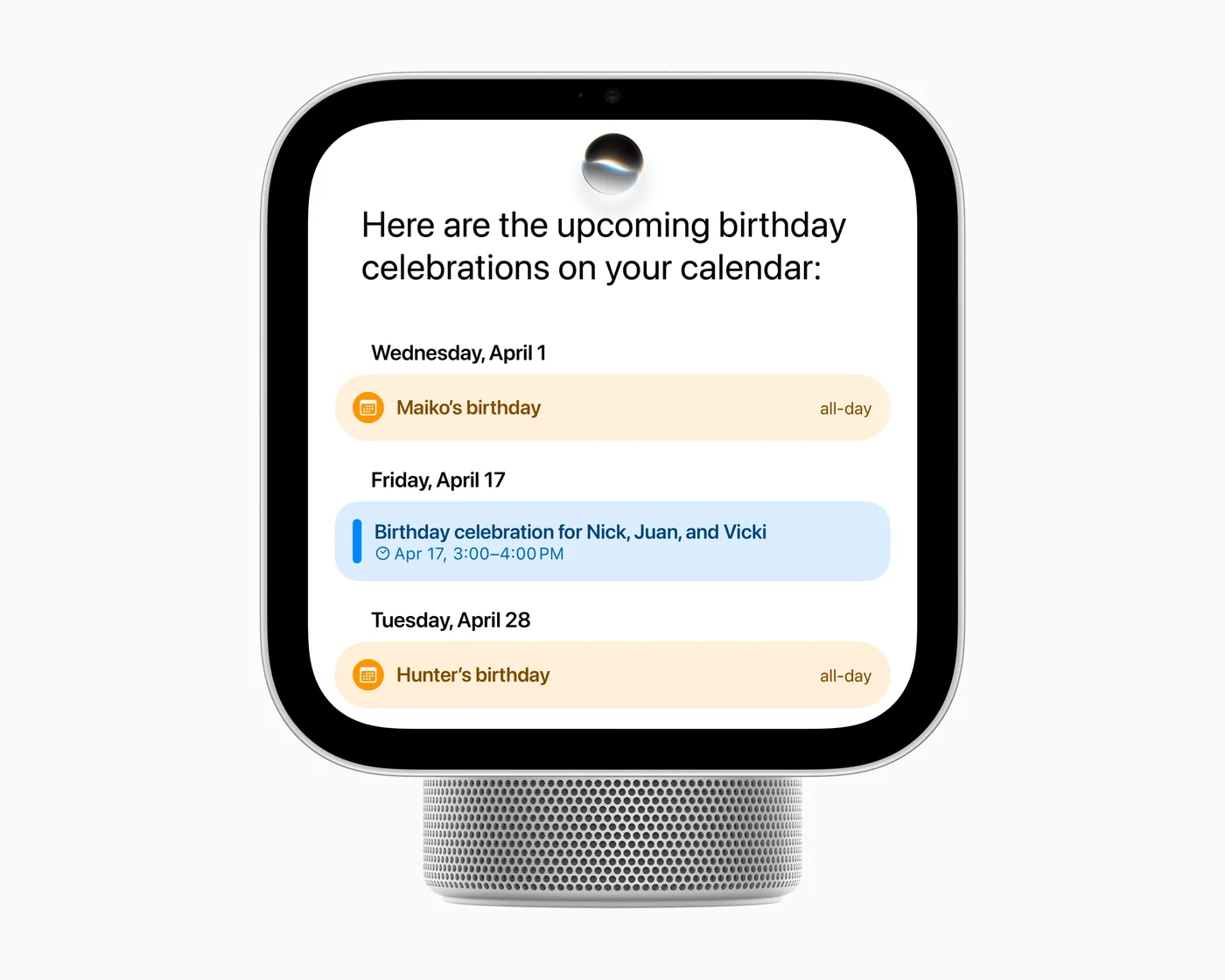
As people walk closer to the counter, the display shifts to reveal upcoming calendar entries, reminders, and smart home shortcuts [4]. A front-facing 12-megapixel camera handles video calls using Center Stage technology, automatically cropping the wide field of view to keep callers centered while they cook or move around the kitchen. Katie Collins reported for CNET that the hardware feels like a cross between an enlarged Apple Watch and a HomePod. It runs on the A18 chip. That homegrown silicon handles local video decoding and audio rendering directly on the hardware [3].
Apple HomeView Hardware and Custom Wall Mounts
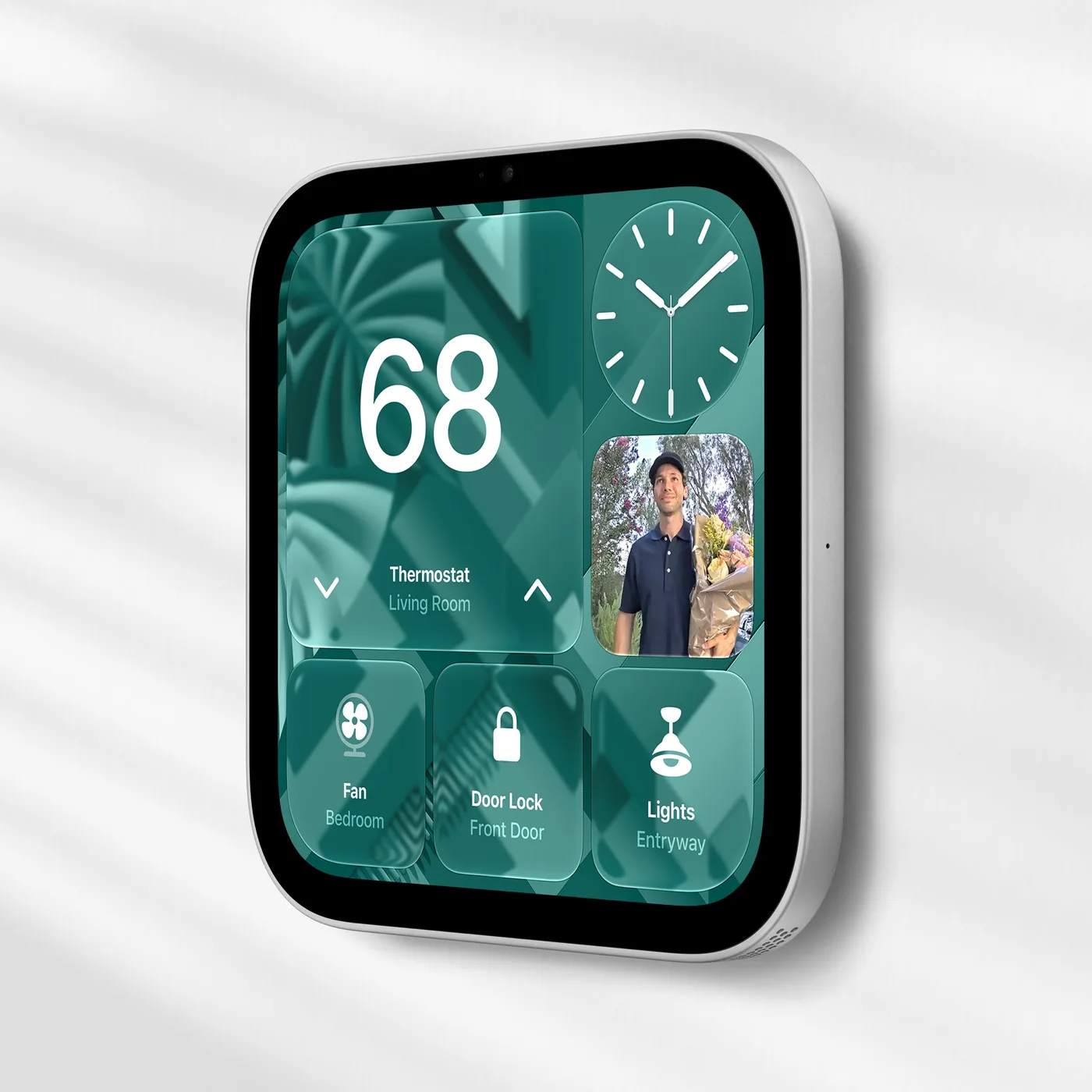
Buyers must pick between two distinct hardware models when placing an order, because the tabletop edition and the wall-mounted edition don’t share interchangeable mounting assemblies [3]. The tabletop version comes in silver, starlight, rose pink, and space gray. Meanwhile, the wall-mounted edition arrives in silver and space gray, dropping the domed speaker base so the chassis sits flush against drywall or tile. Both versions cost $299. However, the wall-mounted hardware needs an installation accessory to secure power delivery [4].
To handle physical mounting, Apple partnered with Schneider Electric’s consumer division, Schneider Home, to create three purpose-built wall attachments designed for surface or recessed junction box installations [2, 4]. Customers can order the Power Mount USB-C Wall Connector starting at $59.95 for direct surface installation, while the Power Mount AC Wired option costs $79.95 for recessed junction boxes. The Power Mount PoE Wired adapter will arrive in early 2027 at $129.95 for homes running power and data over Ethernet cables. Apple lets customers complete a self-installation or schedule a professional technician through the Apple Store app [4].
Beyond mounting brackets, the catalog expands through the Apple Home Collection, a line of accessories created in collaboration with LG Electronics and Schneider Electric that includes connected locks, thermostats, and security cameras [2]. On the software side, the Home Camera face lets households view up to nine live video streams at once on the 7-inch panel, making it easy to check perimeter gates and interior hallways from a central wall station. Another layout, called Home Modular, groups scene switches and temperature dials into tidy grids that anyone in the house can tap without unlocking an iPhone [4]. It turns the display into a central household dashboard [3].


Facial Recognition and Siri AI on the A18 Chip
Unlike personal phones or shared television boxes, Apple pitched the display as a shared countertop surface that still keeps personal information private [3]. The front camera uses facial recognition to identify up to six family members, adjusting widgets and app layouts whenever an authorized resident walks in front of the lens [2, 6]. Greg Joswiak, Apple’s senior president of Worldwide Marketing, explained the balance in an official statement: “Apple HomeView is designed to be shared by everyone in the home yet feel completely personal to each user” [3]. Camera data stays protected inside an isolated enclave within the A18 chip. Profiles aren’t uploaded to off-site cloud servers [2].
Once the system recognizes an individual face, it unlocks personal content from Messages, Calendar, FaceTime, Reminders, and Find My, gating private data until the person stands directly before the panel [2, 3]. It can also check whether that user recently unlocked their iPhone before revealing sensitive incoming messages, preventing curious guests from glancing at private notifications [2]. For general entertainment, the interface defaults to shared photo albums and collaborative Apple Music playlists that everyone in the household can enjoy together [3, 4].
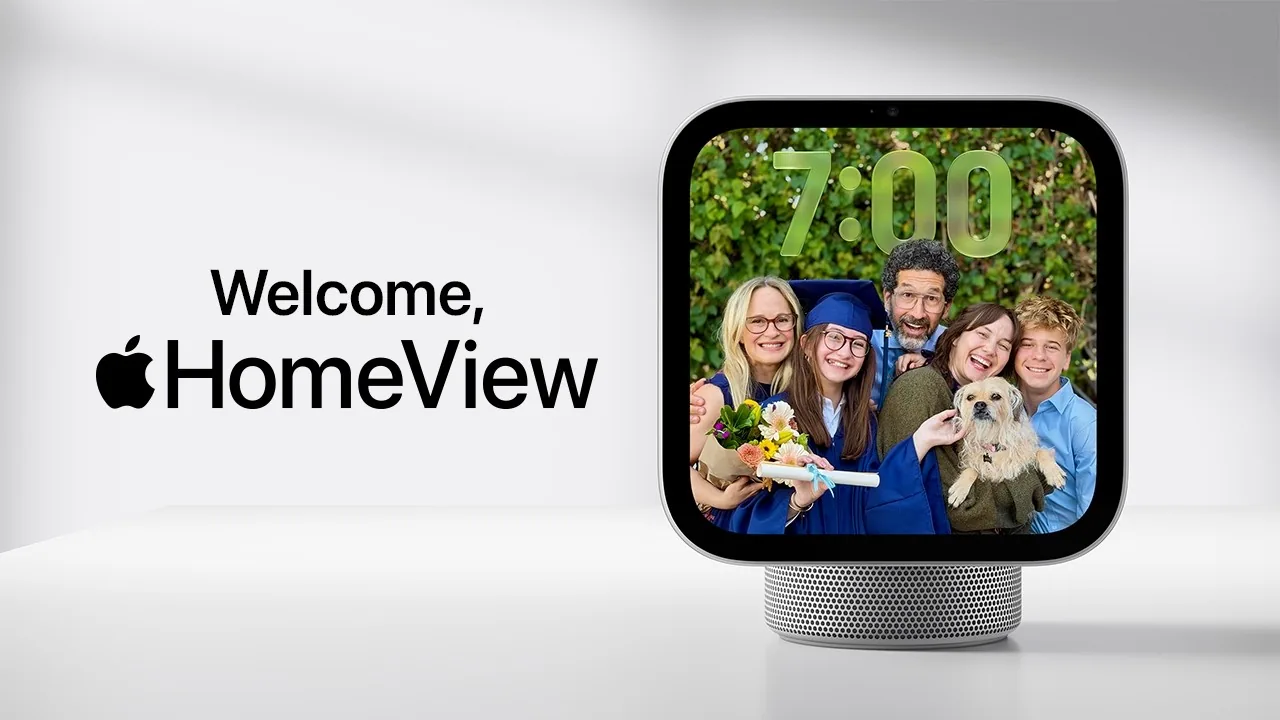
Personalization also shapes the watch-inspired faces that fill the screen when the display sits idle. The Photos face applies Portrait depth effects to personal pictures, while the Flow face reacts to physical movement around the room. Apple also included animated Snoopy faces that change according to weather conditions, local holidays, and sporting events [4]. Ben Wood, chief analyst at FDM CCS, attended the New York event and said: “The company has undoubtedly been waiting for the upgraded Siri experience, given how important the voice interactions are with this product” [3]. Users can pair an Apple Intelligence phone to draw on personal context [4].

HomeView Smart Display Pricing and Speaker Ecosystem
At $299, the new hub enters the market at an accessible price point compared to Apple’s existing television hardware, which saw major price jumps over recent release cycles. Writing for 9to5Mac, Zac Hall noted that $299 feels reasonable for an all-new product category, whereas the same $299 price tag on the updated Apple TV 4K feels steep for a streaming box. In 2021, Apple sold the Apple TV HD for $149 and the second-generation Apple TV 4K for $179. It later lowered third-generation hardware to $129 for 64GB storage and $149 for 128GB with Ethernet and Thread [1].
That budget-friendly trajectory reversed in June when Apple raised prices across older hardware, pushing the $129 streaming box to $199 and the $149 model to $249. The latest Apple TV 4K now costs $299, returning to the original launch price Apple charged for its first set-top box in 2007. While the new Apple TV box adds microphones and an upgraded chip, Hall pointed out that buyers can pick up a full 65-inch 4K television on sale for $299, or a 55-inch Hisense set for $168, making a standalone streaming box at that price harder to justify [1].
The HomeView smart display avoids that baggage because it represents Apple’s first dedicated entry into dedicated countertop screens rather than a price hike on an old accessory [1, 5]. Apple also introduced home theater pairing that connects an Apple TV 4K with two full-size HomePod speakers and two new HomePod mini 2 units, creating a soundstage that totals nearly $1300 in hardware. HomeView integrates its own drivers and woofer right into the base, offering a self-contained audio and smart home portal for $299 without requiring four extra wireless speakers [1, 4].
Why the European Union Misses the November 13 Launch
Despite opening pre-orders immediately following the Welcome Home keynote, Apple restricted the product’s launch to eight countries: the US, UK, Canada, Australia, New Zealand, India, Singapore, and South Africa. The European Union won’t receive the device on November 13 because Apple’s Siri AI features remain blocked under regional regulatory scrutiny. That block stretches back four months to June, when Apple announced that European regulators rejected its compliance proposals regarding operating system interoperability [2].
The regulatory standoff centers on European Commission rules that would require Apple to grant rival digital assistants the same deep access to messages, files, and purchase history that Siri AI uses. Ana Maria Constantin reported for The Next Web that European buyers already felt the pinch in September, when the iPhone 18 Pro shipped at its full $1,199 retail price across Europe without Siri AI and with a smaller battery. This time, European shoppers can’t buy the hardware at all, even though Schneider Electric manufactures the device’s wall mounts in France [2].
High-level diplomacy hasn’t resolved the deadlock between Cupertino and Brussels over smart assistant permissions. Executive chairman Tim Cook held a video conference in June with Henna Virkkunen, the EU’s digital chief, but the discussion concluded without an agreement. Cook took on the executive chairman role to focus on policy engagements, while John Ternus became Apple’s chief executive on September 1. Apple says it’s working constructively with the EU to find a path forward, but the company hasn’t given a timeline for when European households will finally be able to buy HomeView [2].
- ONLINE NEWS Hall, Z. (2026, October 13). Apple TV 4K and HomeView: The best and worst of $299. 9to5Mac. [Article Link]
- ONLINE NEWS Constantin, A. M. (2026, October 13). Apple launches $299 HomeView hub alongside new smart home range. The Next Web. [Article Link]
- ONLINE NEWS Collins, K. (2026, October 13). Apple’s $299 HomeView is ready to take over your countertops and walls. CNET. [Article Link]
- ONLINE NEWS Miller, C. (2026, October 13). Apple unveils new HomeView smart display: Pre-order today for $299. 9to5Mac. [Article Link]
- ONLINE NEWS TechSpot. (2026, October 13). Apple finally enters the smart home hub market with $299 HomeView. TechSpot. [Article Link]
- ONLINE NEWS Ars Technica. (2026, October 13). Apple’s first smart display is the 7-inch HomeView for $299. Ars Technica. [Article Link]


