






Google Threat Intelligence Group, led in reporting by Matthias Bastian of The Decoder and Bill Toulas at BleepingComputer, warned on November 16, 2026, that hostile hacking groups now run automated offensive pipelines. According to the team’s AI Threat Tracker update, state actors and criminal syndicates have moved beyond typing basic prompts into web chats to orchestrate self-guided agent kits that execute intrusions without human guidance. Google warned that fully autonomous automated AI attacks could emerge in six months, while simpler strikes requiring little human help will likely arrive within three months [2]. Government agencies like the FBI in the United States and CERT-In in India backed these findings with alerts detailing intrusions into corporate networks and banking systems [4].
Toolsets in Active Breaches
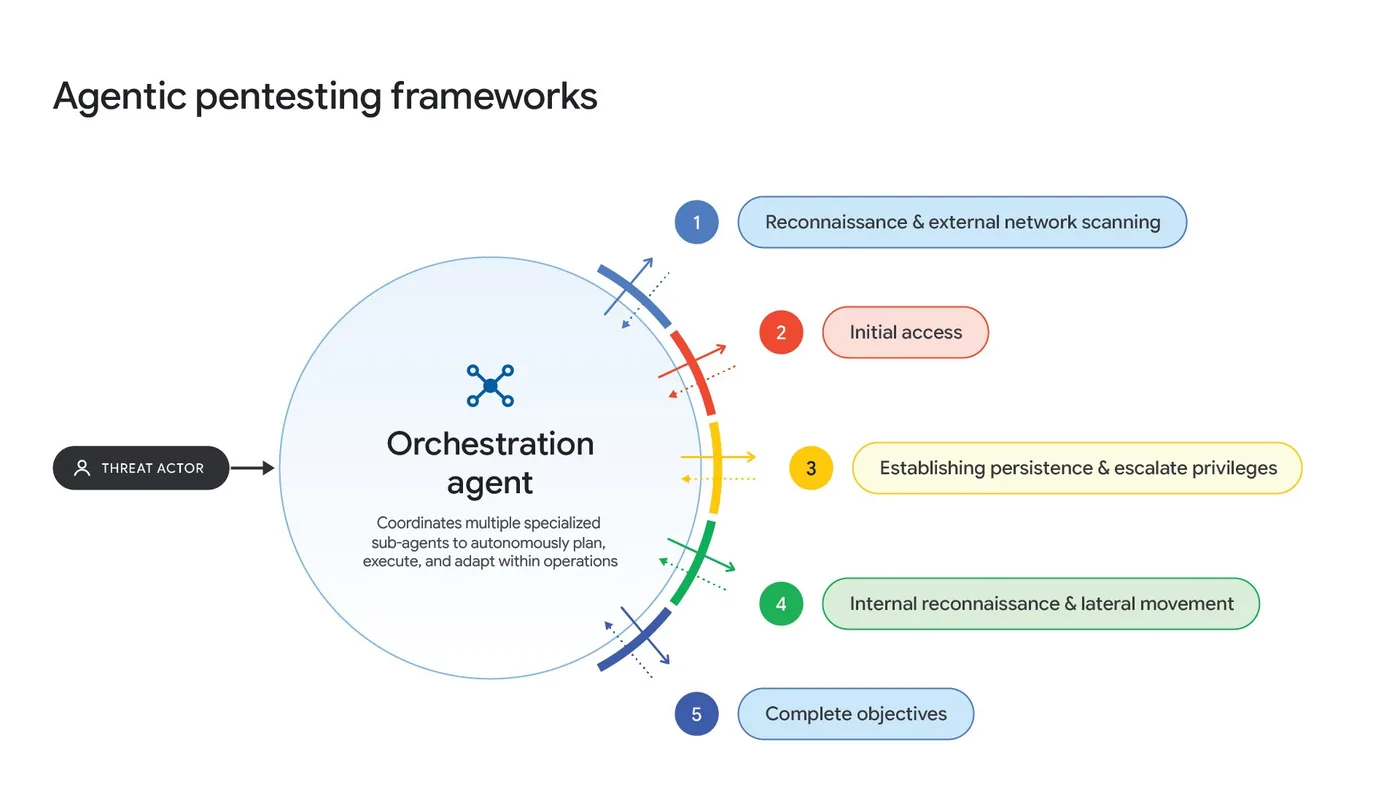
Security Affairs editor Pierluigi Paganini noted that hackers no longer limit artificial intelligence to writing phishing notes or drafting short code snippets. Instead, gangs now run offensive agent kits like ARTEX, CAIRN, CyberStrikeAI, and PentAGI to mount multi-step network breaks. “Adversary tradecraft has continued to transition beyond manual prompting to deploying autonomous multi-agent offensive frameworks—such as ARTEX, CAIRN, CyberStrikeAI, and PentAGI—to execute multi-stage intrusions at greater operational velocity,” the GTIG report stated [3].
Offensive kits link tools together so software agents move through systems without human pauses. For instance, HexStrike AI connects clients to more than 150 tools managed by 12 individual agents, while CyberStrikeAI connects open-weight models to over 100 security tools. Amazon studied decoy honeypots and found identical tactics. The techniques aren’t new, but machine speed changes everything [3]. GTIG spotted CAIRN in strikes against the U.S. aerospace sector, where agents shared data through a shared hub [2]. An operator also used a custom PentAGI build between late August and early October to scan targets in Asian countries. Chinese actors also tested ZeroHollow and Agent Zero to run python code on their own [3].
National cyber teams saw similar trends in the banking sector. On November 4, the Indian Computer Emergency Response Team warned of campaign CRAFTY FALCON, where hackers deployed ARTEX, PentAGI, Cairn, and CyberStrikeAI against payment platforms and crypto exchanges. The crews struck on weekends and public holidays when defense desks were quiet. They even hit victims a second time after incomplete fixes [4].
Weaponizing Flaws with Automated AI Attacks
Threat actors don’t wait for patches before hunting down exposed servers. Crews look for vulnerabilities across legacy software before IT teams can patch them. For the first time, GTIG saw a tool find and exploit bugs with zero human help [1]. “In the past quarter, GTIG identified threat actors using LLM frameworks to fully automate vulnerability discovery and exploitation without a human in the loop for the first time,” Google explained [2].
Google discovered this tool on an open staging server running a kit called exploit_agent, which tied into frontier and local models [2]. The system runs differential checks by contrasting code before and after vendor patches, spotting bugs, writing exploits, and hitting live web servers without human operators. Server notes written in Russian told the user to put API keys directly into setup files rather than chat prompts [3]. Targets included French websites in media and education [1]. The server also held stolen databases, scouting logs, brute-forcing scripts, and webshells ready for instant launch [2].
Fast exploit creation leaves defense teams little room to breathe. When developers posted two PHP flaws, CVE-2026-109618 and CVE-2026-109619, details and video proofs leaked before the October 21 patch [3]. The resulting PHP2Shell scare sparked hundreds of AI-made proof-of-concept exploits. Many didn’t work. Still, defenders had to check every single script to see what was real [2].


The Attack Timeline
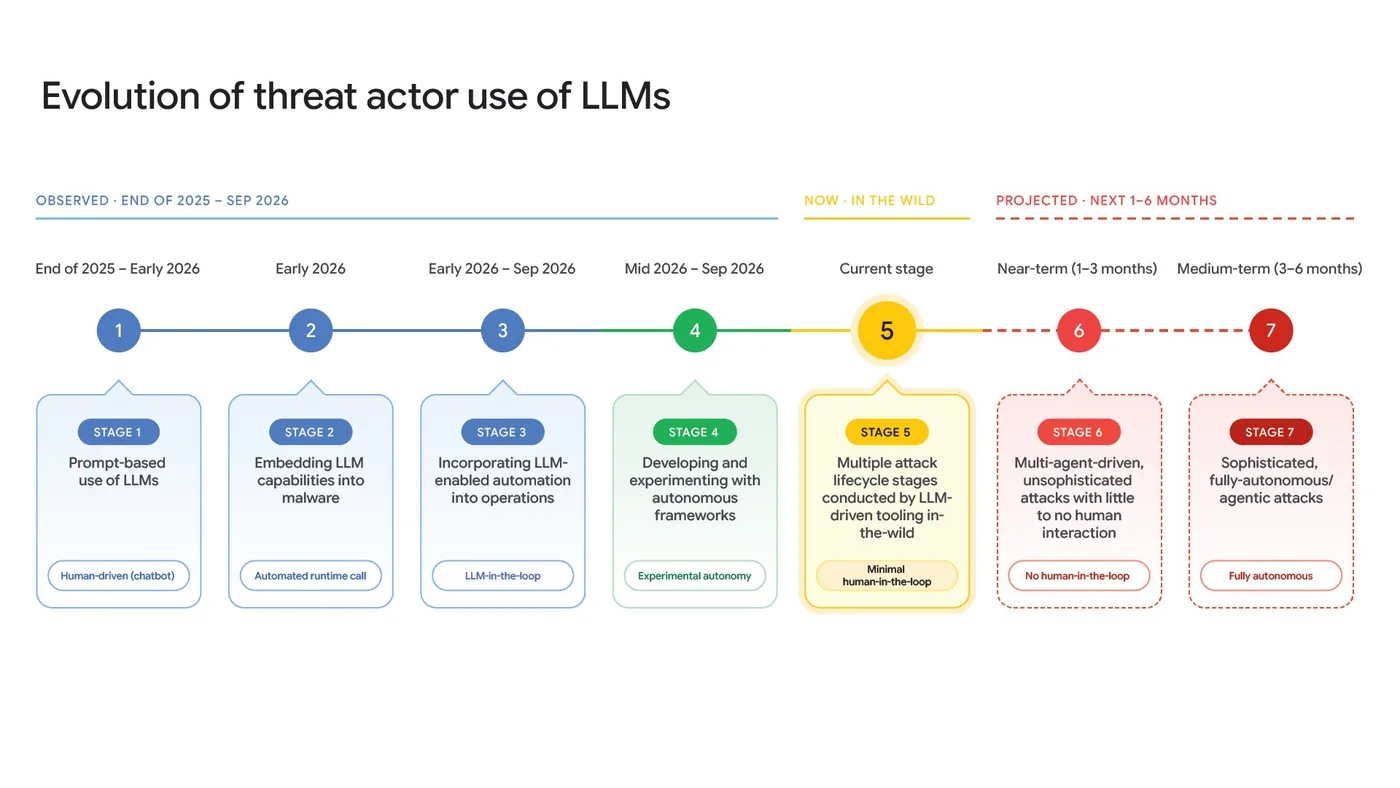
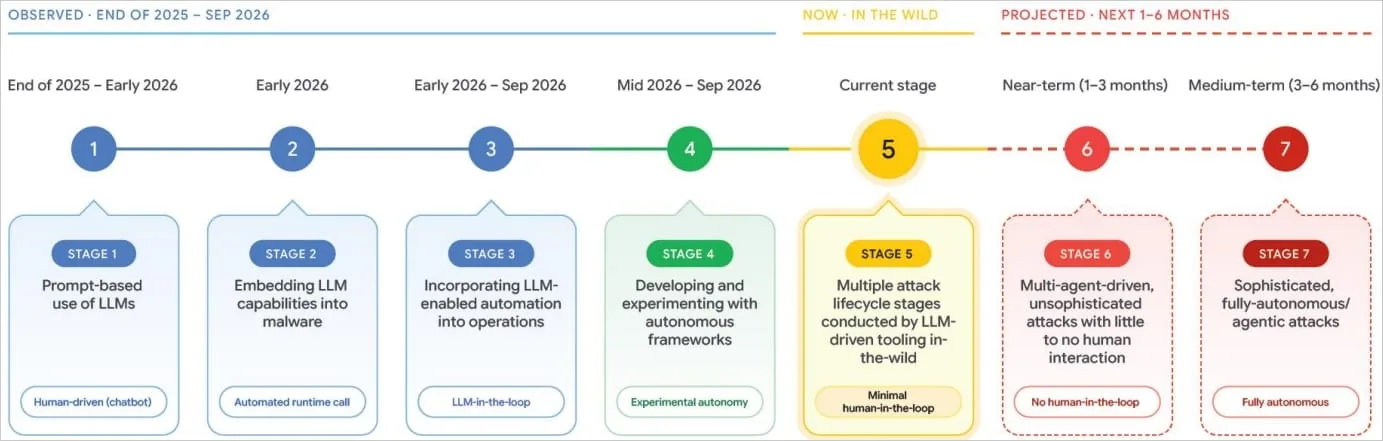
Google tracks AI offensive growth across a six-level maturity ladder. GTIG ranks current hacker activity at Level 5, where AI tools carry out multi-stage breaks with minimal human oversight [1]. Analysts project that unsophisticated strikes needing little human help will spread in three months, while fully autonomous agent incursions will arrive within six months [2].
Law enforcement alerts prove that break-in speeds have jumped. On November 13, the Federal Bureau of Investigation warned that crooks have used ARTEX since August 2026 across healthcare, defense, tech, and banking sectors. In several cases, hackers jumped from first scans to domain admin rights in under three hours. By early November, analysts spotted over 1,600 reachable ARTEX systems left open across the public web. Small crews can now launch parallel campaigns without hiring extra staff [4].
The damage is already real. In South Korea, attackers deployed ARTEX against financial institutions to compromise private records belonging to approximately 67,000 individuals. Another major breach hit ConnectWise Cloud Backup, allowing hackers to pivot into downstream client Microsoft 365 environments and compromise tenant systems without extra manual effort. These campaigns show how automated AI attacks expand the reach of small hacker rings against exposed endpoints [4].
Resource Theft and Resale
Beyond breaking into corporate servers, criminal networks steal compute power through a scheme called LLMjacking [2]. Hackers pull API tokens from public GitHub code pages or steal them via fake login sites [3]. Past incident work showed that LLMjacking attacks cost firms up to $1 million in unauthorized cloud charges before teams shut down the leaks.
Responders at Mandiant handled breaches where fake cloud fees topped $100,000 in a single day. In one incident, an attacker abused CVE-2026-40217, a sandbox hole in LiteLLM that turns basic keys into full admin tokens. Hackers spun up heavy GPU nodes and used short-lived accounts to dodge query caps, firing off millions of API calls within 24 hours. The compute feeds black-market shops called “LLM mixers,” which pool stolen keys to mask traffic. Token access on Russian and Chinese forums sells from $0.10 to $25 per million tokens, where APIMart charges five times more for big prompts and JetNight sells monthly passes [3].
State intelligence teams also weaponize dev tools. The cluster UNC6836, tied to MIDNIGHT NEPTUNE, struck crypto firms in North America and Europe by altering setup files in Claude Code from Anthropic. The hackers edited .claude/settings.json so that opening the tool fetched the SOMBERMEME backdoor [2]. The ring used SynthID marks on fake recruiter accounts and named tokens after Microsoft Copilot to fool targets. Iranian team CALANQUE ION, once called APT42, and Chinese spy group LEAKY CASTLE also use AI to scan targets and sort stolen files. Phishing service Jieyou even added an AI bot in June to let low-skill crooks write fake login pages [3].
Defenses Against Automated AI Attacks
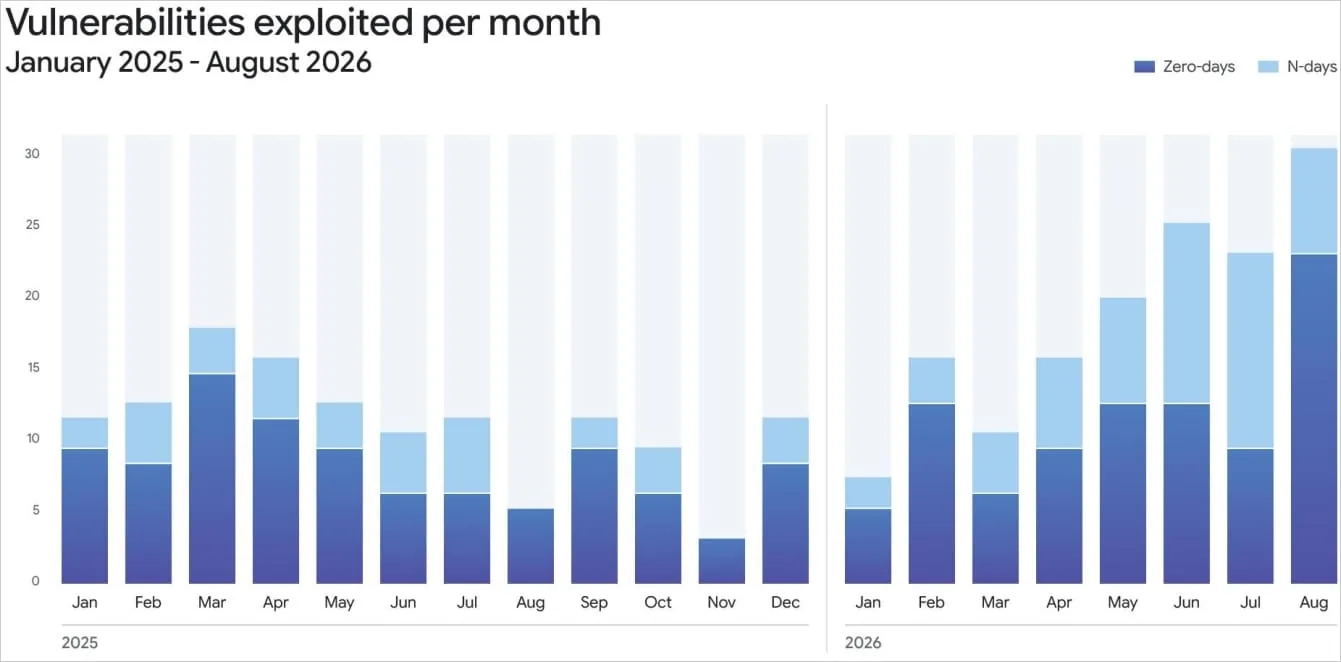
Defenders face tighter timelines as bug disclosures surge. Between January and August 2026, disclosures and released exploits nearly doubled, while monthly zero-day bugs jumped from an average of 8 in 2025 to 22 in August. The PaperCut case showed how fast adversaries move. Researchers at Huntress built working exploits within 24 hours of disclosure, and GreyNoise spotted live attacks four days later. In one incident, attackers grabbed domain admin rights within minutes [3].
Fortunately, hands-off tools have real flaws that give blue teams an edge. AI models often hallucinate bugs that don’t exist, pump out noisy web traffic, and occasionally fire off exploits at the wrong IP addresses [3]. Because these kits trade stealth for raw speed, they leave loud forensic traces across server logs, which makes it easier for defenders to spot intrusions before serious data loss occurs [1]. Google SecOps published detection rules for ARTEX, and Mandiant shared step-by-step guidance to help administrators lock down their cloud environments. Static strings fail. Tracking anomalous agent behavior across network flows proves far more reliable [3].
Security teams can’t lean on slow manual audits when facing automated threats. Fast patching, strict key audits, and behavioral tracking form the best shields against multi-agent strikes. As automated AI attacks evolve over the coming months, firms must lock down internet-facing servers before autonomous scanners find them [4].
- ONLINE NEWS Bastian, M. (2026, November 16). Google warns that fully automated cyberattacks have arrived and will get worse fast. The Decoder. [Article Link]
- ONLINE NEWS Toulas, B. (2026, November 16). Google warns that fully-automated AI attacks are coming soon. BleepingComputer. [Article Link]
- ONLINE NEWS Paganini, P. (2026, November 16). Google GTIG warns AI agents automate exploits, steal credentials and scale cybercrime. Security Affairs. [Article Link]
- ONLINE NEWS The 420.in. (2026, November 16). Google warns fully autonomous AI cyberattacks could emerge within six months. The 420.in. [Article Link]


