






SpaceX has transformed rocket manufacturing at Starbase in Cameron County, Texas, moving vehicle assembly from outdoor tents into an enclosed assembly pipeline. The SpaceX Starfactory complex unites parts fabrication, robotic welding, and module stacking under one roof to build Starship spacecraft at high volume. While older aerospace programs assembled individual rockets by hand through scattered contractor networks across the country, this South Texas facility organizes production around fast, repeatable assembly lines. Engineers want to turn raw stainless steel coils into finished flight vehicles fast enough to support planned orbital missions [3].
How Big Is the SpaceX Starfactory?
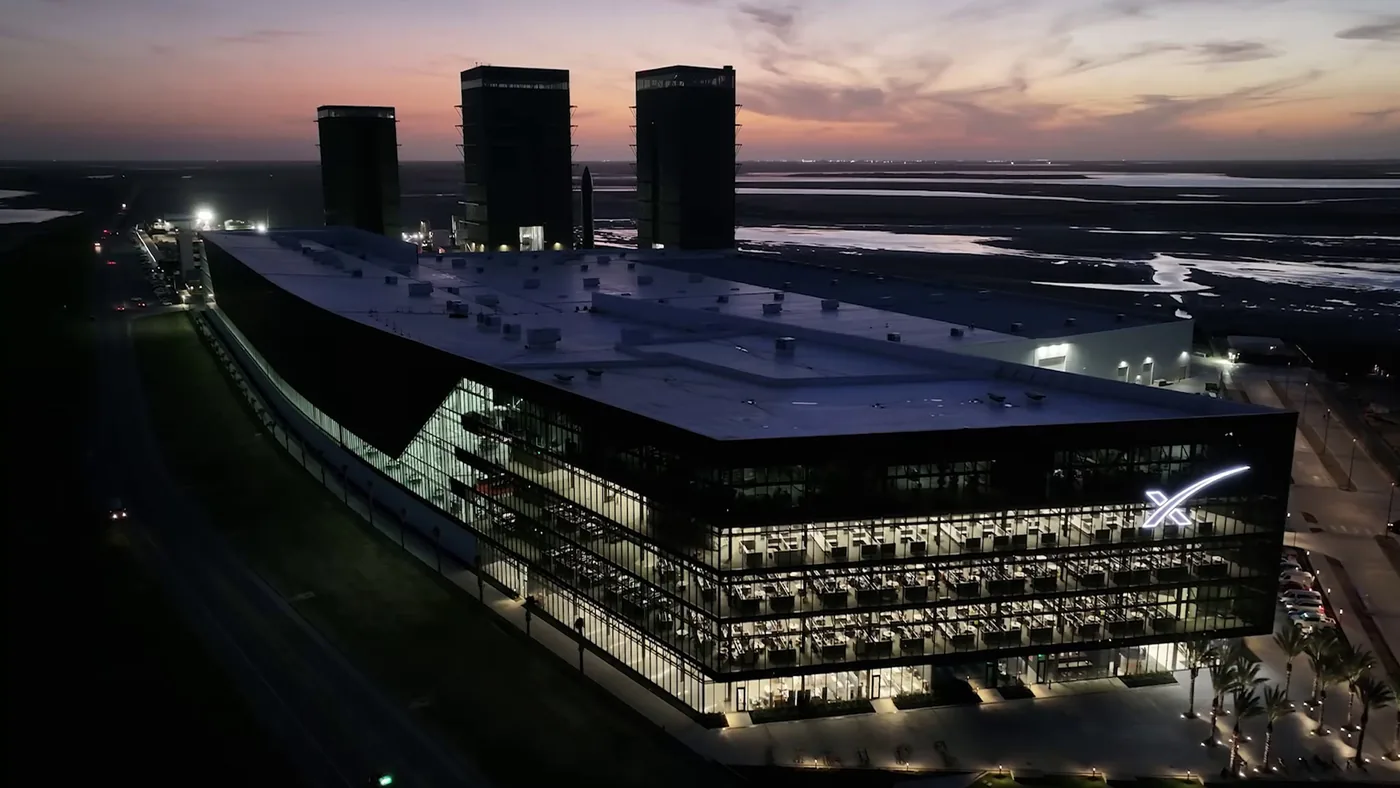
Inside the SpaceX Starfactory at Starbase, the main assembly building spans more than one million square feet of covered floor space along the South Texas coast near Boca Chica [3]. That footprint replaces the temporary fabric tents and open pads that defined early Starship prototyping, giving crews enclosed bays to assemble 9-meter steel rings in clean conditions. The local site brings engineering offices, manufacturing shops, test stands, and orbital launch pads together in one tight corridor. Because every production stage sits within miles of the pad, technicians move completed hardware between test cells without shipping oversized stages over state lines [2].
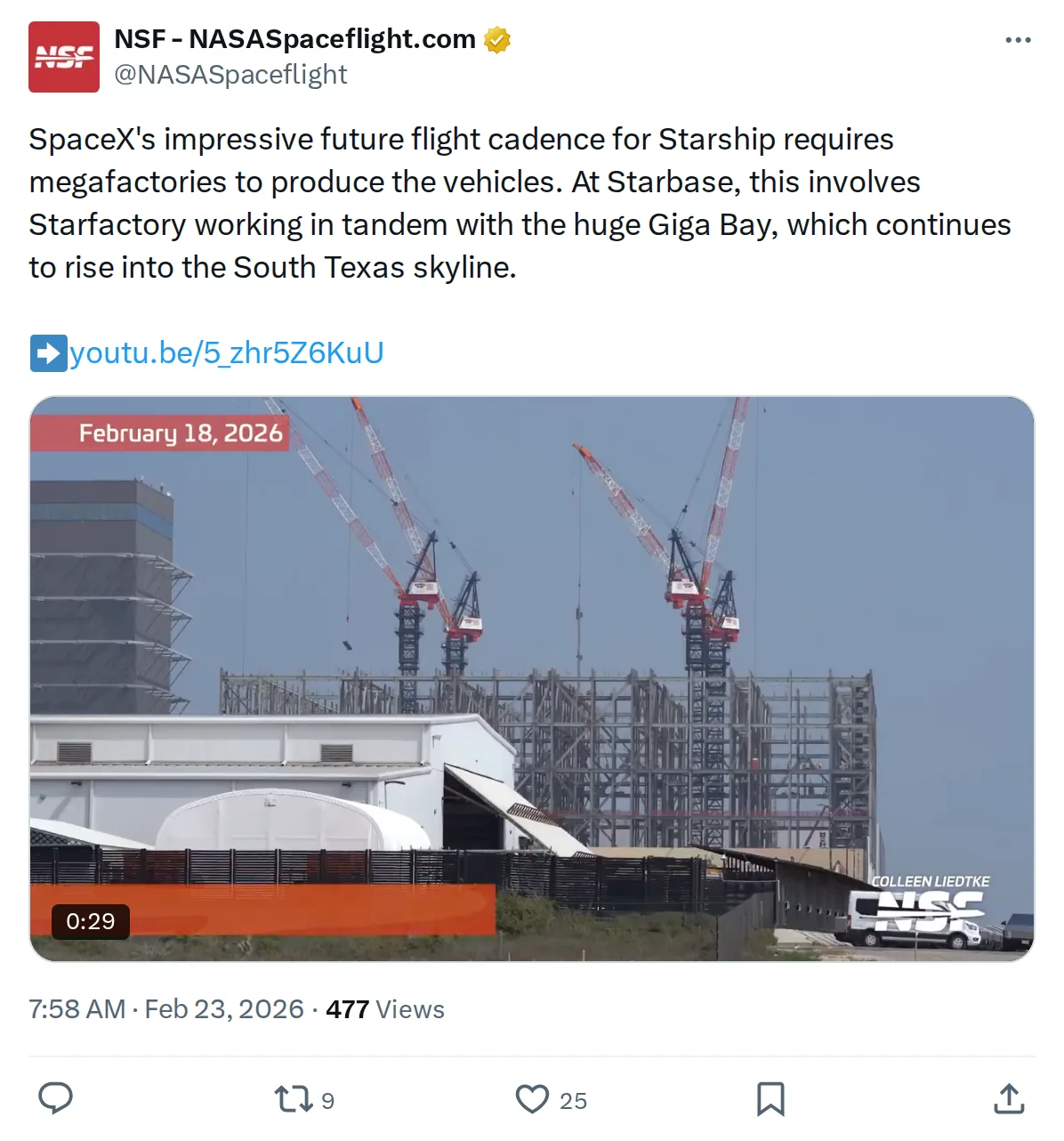
Adjacent to the plant, SpaceX is erecting the Gigabay vertical assembly building to stack towering rockets. The structure rises roughly 380 feet and encloses 46.5 million cubic feet of usable room, offering eleven times the volume of the older Megabay. Heavy bridge cranes lift (400 US tons). Builders placed these heavy hoists above 24 assembly cells inside a $506 million facility that SpaceX expects to operate fully by December 2026 [4].
Steel Coils and Automated Hydroforming
Aerospace builders usually construct orbital rockets from carbon-fiber composites or aluminum alloys, but Starship relies on conventional stainless steel coils. SpaceX buys rolls measuring 4 millimeters thick and 1.8 meters wide. While engineers initially tested carbon composites on early Starbase prototypes, they switched to steel to cut expenses and accelerate factory assembly. Steel resists intense reentry heat and coastal salt air near the Gulf of Mexico. Liquid propellants add another reason to select steel alloys. Cryogenic oxygen and methane make many aerospace metals brittle under pressure, but stainless steel actually gains strength at ultracold temperatures to keep fuel tanks secure without extra wall thickness [5].
To turn flat sheets into curved aerodynamic surfaces, factory workers can’t depend on manual cutting or simple stamping presses. The plant uses high-pressure hydroforming, an industrial metalworking process that pumps fluid against steel sheets at pressures reaching tens of thousands of pounds per square inch (PSI). That fluid drives the metal into a rigid mold, shaping smooth compound curves for fuel tank domes and the aerodynamic nose cone. Automated robotic welders then join these hydroformed sections to circular ring stacks, creating uniform pressure vessels with tight tolerances [5].
Linear Adjacent Flow on the Factory Floor
At the SpaceX Starfactory, technicians replace that slow sequential process with linear adjacent flow, an industrial method adapted from high-volume automotive manufacturing. Instead of stacking a complete vehicle from the bottom up in a single stall, the factory divides Starship into three major sub-assemblies built in parallel bays. Teams assemble the top nose cone, the central propellant tanks, and the lower engine section at the same time. Overhead bridge cranes and rotating fixtures lift and spin cylindrical sections, giving welding robots and inspection crews ergonomic access to every weld seam [5].
Building independent sections gives engineers the flexibility to manufacture cargo haulers, propellant tankers, orbital fuel depots, and the Starship Human Landing System (HLS) for NASA on a shared airframe platform. Interior equipment differs by mission. Parallel assembly bays allow technicians to install specialized lunar hardware without slowing high-rate tanker production on neighboring lines [2].


Stacking Inside the Gigabay
Once horizontal lines finish the cylindrical rings, overhead bridge cranes roll them into the Gigabay for vertical stacking [5]. Inside the 380-foot high bay, technicians assemble the forward nose cone, the liquid oxygen and liquid methane propellant tanks, and the aft thrust structure into a single 170-foot Starship upper stage. Technicians route electrical lines and mount thousands of hexagonal ceramic tiles [1]. Automated tile manufacturing at Starbase speeds up heat-shield work [5].
Propulsion installation marks the final assembly step before rollout. SpaceX manufactures Raptor engines at a separate facility, testing each unit before shipping it to Cameron County where technicians mount six engines beneath the Starship upper stage and install 33 engines on the Super Heavy booster [5]. Flight tests will verify refueling. NASA Artemis program manager Jeremy Parsons said early missions will test propellant transfer between two Starships in orbit, noting the flight is “a first-of-its-kind SpaceX mission where they’re going to launch two starships in quick succession” [1].
Catching returning stages at the pad completes this manufacturing cycle. During Flight 15, Ship 42—bearing a painted nod to Douglas Adams’s book The Hitchhiker’s Guide to the Galaxy—returned from orbit into the tower chopstick arms as SpaceX commentator Dan Huot tracked the descent. New York Times reporters Kenneth Chang and Mack Liederman noted that the catch verified upper-stage recovery. University of Sheffield aerospace engineering director Alistair John said tower catches carry “higher risk, higher reward” because impacts could damage ground hardware. Landing on chopstick arms eliminates heavy landing legs and avoids days of ocean recovery [1].
Is SpaceX Starfactory Complete?
Although the primary SpaceX Starfactory building already produces flight hardware, the full production complex remains under active development. SpaceX targets December 2026 for full operations inside the South Texas Gigabay, when construction teams will finish all 24 assembly cells and activate heavy 400-ton bridge cranes. The enlarged bays are necessary to assemble Starship Block 4, an upgraded configuration featuring an 80-meter Super Heavy booster that exceeds the height limits of earlier construction hangars. The company is also testing Starship V3 vehicles, designed to carry roughly 100 tons of useful payload to orbit on each launch [4].
Geographic expansion extends this manufacturing footprint beyond Cameron County into Florida. SpaceX is constructing a twin Gigabay facility near HangarX at NASA’s Kennedy Space Center, matching the Texas site with 24 work cells and a 400-ton crane capacity. Until Florida manufacturing lines open, crews will transport completed Super Heavy boosters and upper stages from Starbase through the Gulf using oceangoing barges. The Federal Aviation Administration (FAA) has approved up to 44 annual Starship launches from Florida, where SpaceX is outfitting Launch Complex 39A and Space Launch Complex 37 at Cape Canaveral [4].
Flight heritage at Starbase proved essential. When SpaceX prepared the first Starship orbital flight from Cameron County, early test articles verified weld durability, fuel pressurization, and aerodynamic flap steering under real atmospheric conditions. Energy planners also support factory expansion through shared utility contracts, echoing reports where SpaceX orders solar gear for remote installations. Independent solar power allows the South Texas complex to maintain round-the-clock welding schedules [2].

Launch Cadence for Mars Expeditions
The planned throughput envisioned for the SpaceX Starfactory reflects an ambitious operational target. Elon Musk has stated an ultimate goal of constructing up to 1,000 Starship vehicles per year to support a launch rate exceeding one flight every hour. Under full operations around 2029 or 2030, that cadence would generate more than 8,760 launches annually. In contrast, NASA’s Space Launch System (SLS) program targets one or two launches per year, relying on an extensive subcontractor network rather than unified high-speed manufacturing [4]. Off Earth Data reports that producing up to 365 vehicles annually—one rocket every day—replaces traditional aerospace supply chains with factory automation [3].
Logistics explain why SpaceX builds so many flight vehicles. While Super Heavy boosters return to the launch pad minutes after liftoff for quick reuse, Starship upper stages will spend days or months away on lunar and interplanetary journeys [5]. NASA’s Artemis III mission plans to test docking in Earth orbit with four astronauts aboard the Orion capsule, evaluating rendezvous maneuvers before uncrewed lunar landings targeted for March 2027. The mission also tests docking with the Blue Moon lander developed by Jeff Bezos and Blue Origin [1]. Can a smaller rocket fleet handle human exploration on Mars? Planetary alignment permits voyages to Mars only once every 26 months, forcing mission planners to dispatch a massive fleet during a tight departure window. By building dozens of identical spacecraft in parallel, Starfactory gives SpaceX the industrial capacity to mount interplanetary campaigns at scale [5].
- ONLINE NEWS Chang, K., & Liederman, M. (2026, November 14). Inside Starfactory, where Starships are born. The New York Times. [Article Link]
- WEBSITE Singh, K. (2026, August 21). What is Starfactory? Inside SpaceX’s Starship Factory at Starbase. The Grid Fin. [Article Link]
- REPORT Off Earth Data. (2026, August 1). The Factory Is the Supply Chain: Inside SpaceX’s One-Starship-a-Day Starfactory. Off Earth Data. [Article Link]
- WEBSITE BASENOR Editorial Desk. (2026, February 22). SpaceX Starfactory & Giga Bay: Inside the Starship Megafactory Scale-Up. BASENOR. [Article Link]
- WEBSITE Elon Buzz. (2026, August 10). Take A Look Inside SpaceX’s $3 Billion Starfactory. Elon Buzz. [Article Link]
APA 7: PerEXP Teamworks. (2026, November 15). Starbase Assembly Lines Expand Output at SpaceX Starfactory. PerEXP Teamworks. https://perexpteamworks.com/en/spacex-starfactory-starship-production/


