





Anthropic released new guidance on November 14 advising developers and enterprise teams to retire older instructions when working with Claude Opus 5.5, which now serves subscribers on Pro, Max, Ultra, and Team tiers. The firm said Claude prompting habits carried over from older models slow down output generation without adding any measurable gains in answer quality. In company benchmarks, dropping manual lines that tell the model to think carefully allowed responses to start much faster [1].
Why Old Instructions Slow Down Responses
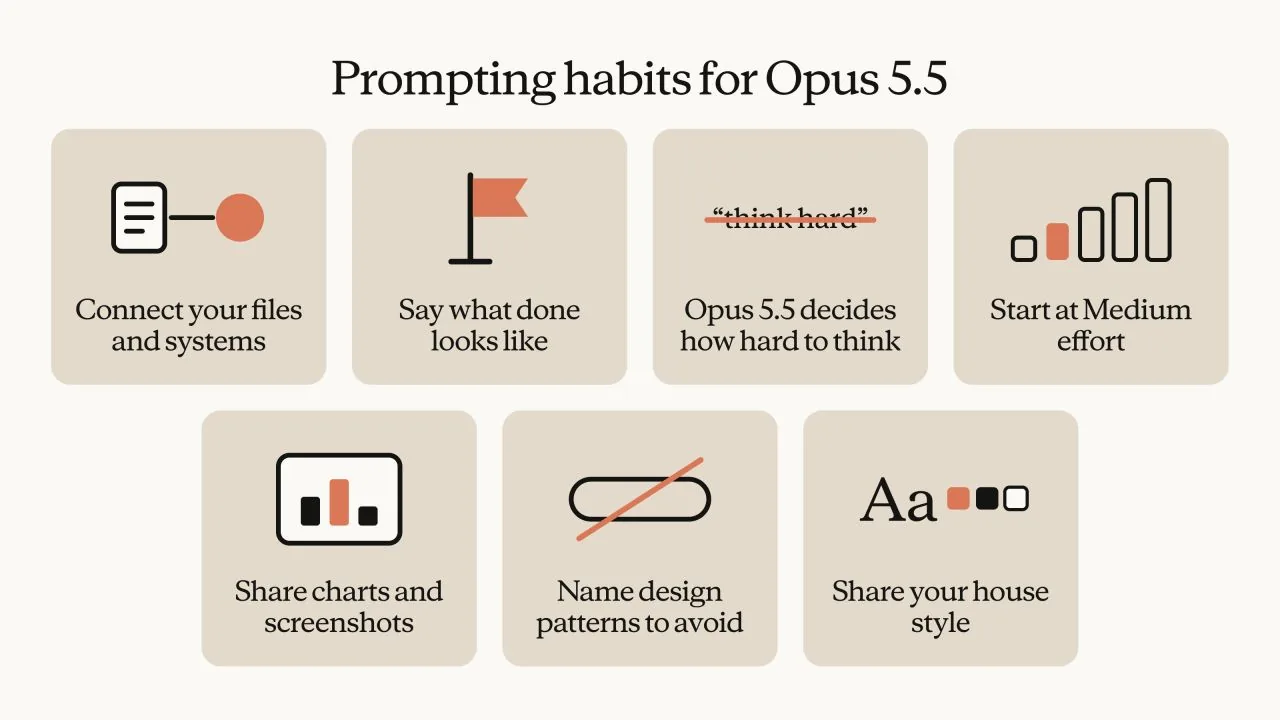
For roughly eighteen months, prompt writers added phrases like “think hard” or “think carefully” to coax deeper answers from early reasoning models. Matthias Bastian reported in The Decoder that Anthropic traces those habits back to older systems lacking adaptive thinking, where users had to steer model routers by hand [1].
Anthropic’s older documentation actively pushed those manual phrases across early releases. Writing for Search Engine Journal, Matt G Southern reported that Anthropic’s earlier guidance for Claude Opus 4.7 told developers to insert lines like “This task involves multistep reasoning. Think carefully before responding.” when effort settings stayed low. In September, Roger Montti examined similar formatting constraints for Fable 5.1 in Search Engine Journal, but Claude Opus 5.5 arrived on Sept 22 with an adaptive thinking engine that scales reasoning depth to task complexity on its own without user intervention. Answers started faster in chat tests. Users can’t disable adaptive thinking in Opus 5.5, and any API request attempting to shut it off triggers an error message [3].
Luis Chavez-Mattos wrote in MindStudio that manual reasoning prompts now cause unexpected friction. When users ask systems like Fable 5.1 to show internal reasoning steps in final outputs, the model can refuse the task entirely. That refusal halts the workflow. Letting adaptive thinking run on its own avoids wasted tokens and keeps completions clean [5].
Claude Prompting Habits at Medium Effort
The effort setting is central to modern Claude prompting habits. Anthropic set Medium as the default effort level for Opus 5.5, which sits below the High default on Opus 5. In coding and office benchmarks, Opus 5.5 at Medium effort matched or beat Opus 5 at High, proving that top effort settings are rarely needed for everyday work. Higher levels think longer and cost more without guaranteeing better outputs. Anthropic advises teams to test tasks at Medium first, reserving High, Extra High, or Max for problems where they have measured a clear gain in answer accuracy. Users can switch this setting in the model menu beside the send button [1].
When Anthropic introduced Claude Opus 5.5 with lower operating costs in late September, the company urged users not to reserve Opus only for rare jobs. Because a stronger model finishes tasks in fewer steps, it can balance out higher per-token prices across Pro, Max, and Team subscriptions [1].
Teams running Sonnet 5.5 at Extra High or Max effort often spend about as much per task as Opus 5.5 on Medium, while an early tester at Factory reported achieving parity with Opus 5 on High with 20 to 25 percent fewer output tokens. No third-party study confirms that figure. WebPulse noted that Anthropic selected the quote for its guide. Still, looking ahead, developers using an output cap like max_tokens from older setups risk cutting responses short on Opus 5.5, because adaptive thinking draws from that limit even when reasoning text stays hidden [3].


Task Goals Instead of Step Lists
Step formatting also needs an update. Early models required numbered step lists because they skipped instructions unless users spelled out every action. Rigid lists now backfire. For Opus 5.5, step checklists act as an artificial ceiling that restricts the model to a narrow interpretation instead of letting it find a better path [5].
Anthropic advises replacing step lists with a single prompt defining the goal, the deliverable format, and exact conditions for checking back with questions. In MindStudio, Luis Chavez-Mattos illustrated this principle with a vendor-risk app designed for 300 buyers, explaining that detailed step lists backfire because Opus 5 tends to widen project scope unprompted by adding unwanted dashboards or tables. Defining “done” prevents scope creep. For large or undefined builds, Anthropic’s Claude Code guidelines suggest letting the model interview the user first. A short prompt asks Claude to query the builder regarding project scope, edge constraints, and operational trade-offs before generating code [5].
Prompt writers should also drop capitalized constraints like “ALWAYS” or “CRITICAL.” Modern frontier models are sensitive enough that hard constraint words cause erratic over-triggering. Anthropic recommends plain conditional rules instead, such as instructing the model to use this tool when specific conditions occur, avoiding clashes with the model’s own system prompt [5].
New Claude Prompting Habits for Office Work
Anthropic positions Opus 5.5 as a core daily tool for research, spreadsheets, and presentation decks. New Claude prompting habits for office workflows mean dropping manual data entry completely. That change saves time. In Anthropic benchmarks, Opus 5.5 reading dense graphics at its lowest effort setting extracted numbers more accurately than Opus 5 operating on High, allowing users to attach visual files and request completed spreadsheets in a single step instead of asking for drafts [1].
For frontend web design, asking Claude to avoid a generic look simply swaps one default style for another. Anthropic recommends naming specific unwanted patterns, such as cream backgrounds or pill-shaped buttons. Today for AI noted that Anthropic Teams deployments get much better results by connecting local files through connectors [6].
Factual evaluation metrics show the value of these workflow updates. In tests cited by DEV Community, 16 of 18 generated reports passed an automated check verifying every quoted statement and figure. A simulated merger analysis took 63 minutes on Opus 5.5 against 93 minutes on Opus 5, while cutting total execution expense in half. Local file connectors let the system pull data directly, turning Claude into an autonomous collaborator for research instead of a basic chat bot [2].

Token Prices and Agent Time Limits
Tracking token rates helps teams manage costs across the Claude model family from Anthropic. Anthropic prices Opus 5.5 at $4 per million input tokens and $20 per million output tokens, which compares favorably to Fable 5.2 at $8 and $40, while Sonnet 5.5 costs $2 and $10, and entry-level Haiku 5.5 charges $0.10 and $0.50 [2].
Agent systems introduce extra controls for pacing multi-step tasks. In multi-agent setups, Matt G Southern reported that Anthropic suggests establishing advisory time budgets. When developers estimate how long a research task should take, their harness can append elapsed seconds against that budget to each message returned to the model. Anthropic found that small agent groups using time signals finished research tasks faster than solo agents working without signals, while matching solo answer quality on complex topics [3].
Time limits remain purely advisory, so developers must keep their own timeouts if they need a hard stop. Under time pressure, the model may search less. For pasted text like incoming emails, Anthropic recommends enclosing content in random identification tags with a system note on handling. Tags encourage careful parsing, but plain text boundaries provide only a single layer of protection against prompt injection attacks [3].
- ONLINE NEWS Bastian, M. (2026, November 14). Anthropic says outdated prompting habits are slowing down Claude Opus 5.5. The Decoder. [Article Link]
- ONLINE NEWS DEV Community. (2026, November 14). Anthropic positions Claude Opus 5.5 as the default daily driver for knowledge work and lists prompting habits to drop. DEV Community. [Article Link]
- ONLINE NEWS Southern, M. G. (2026, September 28). Anthropic Publishes Prompting Guidance For Claude Opus 5.5. Search Engine Journal. [Article Link]
- ONLINE NEWS WebPulse. (2026, November 14). Anthropic says old prompting habits slow Claude Opus 5.5 down. WebPulse. [Article Link]
- WEBSITE Chavez-Mattos, L. (2026, September 11). Claude Opus 5 Prompting: Why Your Old Habits Now Hurt Output. MindStudio. [Article Link]
- ONLINE NEWS Today for AI. (2026, November 14). Anthropic Says Outdated Prompting Habits Slow Down Claude Opus 5.5. Today for AI. [Article Link]


