





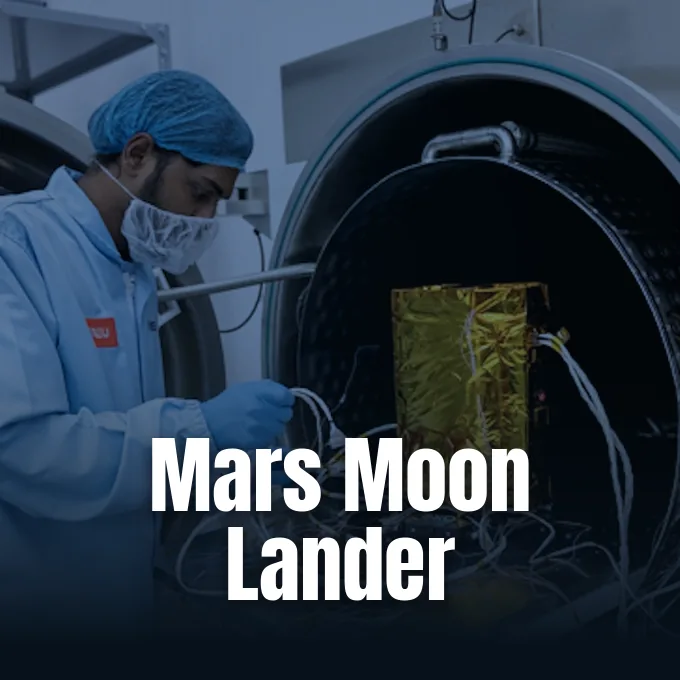
Japan’s space agency and international partners are preparing to send the Mars moon lander toward the Red Planet to gather pristine extraterrestrial soil. The Martian Moons eXploration mission, known as MMX, aims to touch down on Phobos to collect samples and return them to Earth. While orbiters and rovers have mapped Martian plains over decades, the origin of the planet’s two tiny moons remains an unresolved puzzle in planetary science. A rocket launch scheduled for October 2026 will send the robotic craft on its multi-year journey across the inner Solar System [1].
How the Mars Moon Lander Prepares for Liftoff
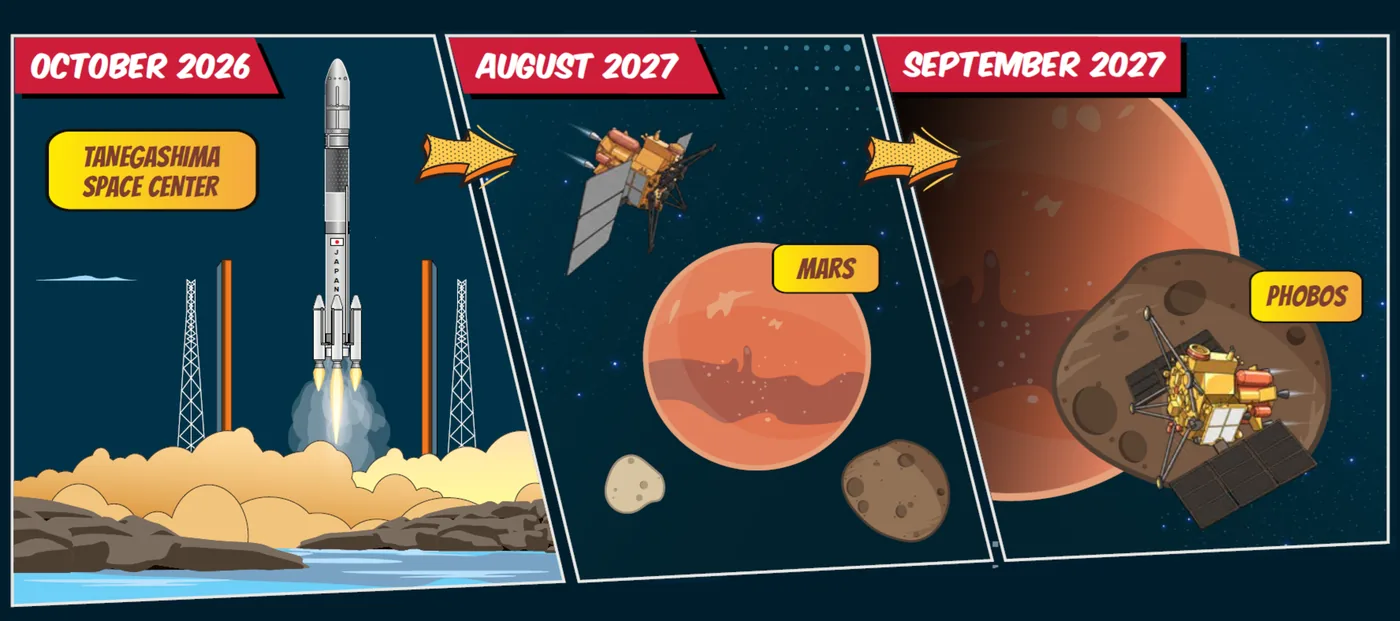
The MMX spacecraft is scheduled to lift off on an H3 rocket from the Tanegashima Space Center at 04:41 JST on 20 October 2026, corresponding to 20:41 BST on 19 October for controllers in Europe. The Japan Aerospace Exploration Agency leads the expedition in partnership with NASA, France’s CNES, Germany’s DLR, and the European Space Agency. Engineers designed the flight system to travel about one year before entering Mars orbit in August 2027, adjusting its path to orbit Phobos from September 2027 [1].
Collecting physical material from Phobos gives scientists a rare opportunity to study conditions that existed when rocky worlds formed. Mars formed about 4.5 billion years ago, and its surface changed as water vanished over time. Because Phobos lacks an atmosphere and geological recycling, its surface regolith preserves ancient dust grains from the earliest eras of the Solar System. “The data and samples returned by MMX are a window to study the evolution of Mars and the Solar System,” says Elliot Sefton-Nash, ESA MMX Project Scientist [1].
The main flight platform carries seven instruments, including two cameras, a radiation monitor, and two sampling tools. The Mars moon lander will be the first spacecraft to orbit Phobos and collect regolith from a moon other than Earth’s Moon, before conducting flybys of Deimos [1].
Why Are Mars Moons Not Round?
Mars moons are not round because their total mass is far too small to generate the gravitational force needed to pull cold rock into a spherical shape. Unlike large planets where self-gravity overcomes structural rigidity, tiny rubble piles maintain uneven dimensions determined by ancient impacts. Both Martian moons remain mysterious because no spacecraft has dwelled near them for extended surveys, leaving scientists with data gathered during brief flybys [1].
Their irregular shapes also fuel an ongoing debate about where the two moons came from. Astronomers have proposed two competing explanations to account for their presence around Mars. One idea suggests that the moons were originally asteroids captured into orbit early in Solar System history. The alternative idea argues that a giant collision on Mars threw debris into orbit, which coalesced into Phobos and Deimos. Planetary scientists cannot resolve this debate without physical samples, making the Mars moon lander mission a direct way to test both theories [1].
Studying irregular small bodies across our planetary neighborhood provides clues about how primordial materials gathered together during the dawn of the Solar System. Similar investigations into irregular shapes and collisional histories are underway elsewhere in the Solar System, as seen in the Hera mission to investigate binary asteroid systems following deep space deflection tests. If returned regolith matches the chemistry of Martian rock, the collision theory will gain strong support, whereas primitive minerals would confirm captured asteroids [1].
How Does the Mars Moon Rover Explore Phobos?
The Mars moon rover explores Phobos by driving across the low-gravity terrain on four wheels to test surface soil mechanics and map obstacles before the mothership descends. Named Idefix, the 25-kg rover was developed jointly by France’s CNES and Germany’s DLR. It will separate from the main MMX spacecraft in early 2029 to drop toward the surface. Because the gravity on Phobos is so low, Idefix will only weigh the equivalent of 15 grams on its dusty surface [1].
The small rover carries four onboard instruments to analyze the composition and texture of the surface while transmitting data back to the mothership. The 25-kg vehicle evaluates whether the surface material is firm or loose, providing information to prepare for the landing of the main spacecraft to collect samples. Navigators must account for microgravity so the vehicle doesn’t bounce uncontrollably when moving across rough patches [1].

By acting as a forward scout, the robotic explorer reduces operational uncertainties before the larger mothership attempts its touchdown. Engineers will use ground readings from Idefix to select a secure touchdown point where collection tools can operate smoothly. The Mars moon lander carries seven instruments on the main spacecraft in addition to four instruments on the rover, providing a broad set of tools to study Phobos from orbit and on the ground [1].


Why Is Mars Moon Doomed?
Mars moon Phobos is doomed because orbital tidal interactions with Mars pull the moon inward toward the planet. Unlike Earth’s Moon, which slowly recedes into a higher orbit, Phobos circles Mars faster than the planet rotates on its axis. This rapid orbital period causes gravitational tides to drag the moon closer over millions of years, until tidal stress eventually pulls the structure apart into a debris ring or causes fragments to hit the planet [1].
Because Phobos is slowly spiraling downward, its surface regolith acts like a natural sponge that has gathered dust shed across deep time. When large meteorites slam into Mars, high-speed debris escapes into orbit, and Phobos sweeps up this material over billions of years. Gathering regolith with the Mars moon lander provides access to both native rock and ancient Martian crust thrown into space during collisions [1].

Other orbiters will support observations of Phobos while MMX conducts its primary survey of the Martian environment. Europe’s Mars Express spacecraft is confirmed to operate at Mars until at least 2029, allowing researchers to coordinate observations with MMX. Furthermore, ESA’s upcoming ExoMars Rosalind Franklin rover will collect samples from the Martian subsurface, complementing the moon mission by studying rocks directly on the planet below [1].
Autonomous Technology Guiding the Mars Moon Landing
Executing a successful Mars moon landing requires complete onboard autonomy because radio signals take minutes to travel between Mars and Earth. Flight computers must evaluate topographic slopes, adjust descent thrusters, and detect hazards without waiting for instructions from ground stations. Touchdown risks became apparent when earlier robotic flights ran into trouble, such as when a commercial lunar lander was abandoned after a propellant leak on its journey [2].
Autonomous landing systems are also being developed for robotic voyages into the asteroid belt. The UAE Space Agency and the Technology Innovation Institute in Abu Dhabi recently unveiled a landing probe for the Emirates Mission to the Asteroid Belt. Riding aboard the main spacecraft MBR Explorer, the craft will lift off from Japan in March 2028 during a three-week window. The mission will travel 5 billion kilometers (about 3 billion miles), equivalent to circling Earth roughly 125,000 times, using gravity assists from Venus, Earth, and Mars to fly past six asteroids before reaching 269 Justitia in 2036 [2].
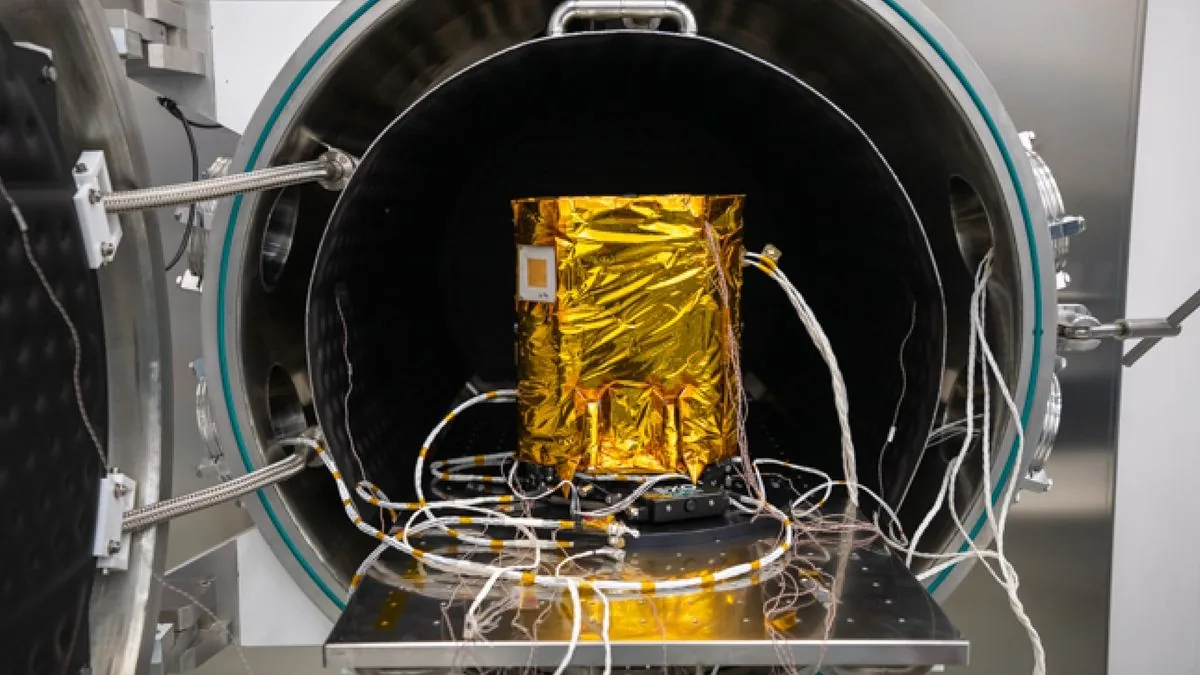
Najwa Aaraj, CEO of TII, explained that deep-space autonomy leaves zero room for error once the craft departs: “In these eight years, I have no control to call it back — so nothing can go wrong,” said Aaraj. Unlike the soft landing planned for MMX on Phobos, the EMA probe will strike 269 Justitia at speeds reaching up to 27 meters per second, operating as an impact craft to unearth fresh subsurface regolith. Mariam Alhammadi, a propulsion researcher at TII, noted that if the probe survives impact, its battery will beam close-up images for 20 to 50 minutes [2].
What Phobos Samples Will Reveal on Earth
In 2030, the primary MMX spacecraft will land on Phobos to extract regolith from the surface and seal the material inside an ascent container. This return craft will then leave Martian orbit to cruise homeward, reaching Earth in 2031. It will send down a sample return capsule to land in Australia, after which technicians will transfer the sealed container to Japan for study. Mission managers plan to deliver at least 10 grams of Phobos material, sharing samples with European scientists and international research teams [1].
Analyzing physical grains in terrestrial laboratories gives scientists capabilities that no robotic flight instrument can match. As project scientist Elliot Sefton-Nash explained: “Bringing samples to our most sophisticated labs here on Earth is a multiplier for discoveries, because our most precise instruments are too large, complex or sensitive to send to space.” Precision instruments will measure isotopic ratios and mineral chemistry to determine whether the moon formed from giant impact debris or represents an asteroid captured by Martian gravity [1].
Returning pristine extraterrestrial material connects directly to asteroid belt exploration. Elias Tsoutsanis, lead propulsion researcher at TII, noted that visiting primitive bodies like 269 Justitia could reveal how water and organic compounds were distributed as planets began to form: “We don’t know what we’re going to find — that’s exploration,” Tsoutsanis told reporters [2]. By returning pieces of Phobos while other missions explore primitive asteroids, researchers will clarify how rocky planets and their moons formed. As Sefton-Nash observed, samples brought to Earth from the Mars moon lander remain the gift that keeps on giving for future generations of scientists [1].
- PRESS RELEASE European Space Agency. (2026, October 13). Mars moon lander set to launch on 19 October. ESA Science. [Article Link]
- ONLINE NEWS Kuthunur, S. (2026, October 12). UAE unveils lander for bold 7-asteroid mission set to launch in 2028 (photos). Space.com. [Article Link]
APA 7: TWs Editor. (2026, October 14). MMX Mission Prepares Mars Moon Lander for Phobos Flight. PerEXP Teamworks.


