





Anthropic released Claude Opus 5.5 on Tuesday, positioning the flagship system as the first entry in an updated model family designed to undercut previous operating costs. The San Francisco developer designed the system to match the problem-solving depth of Claude Fable 5.1 while cutting running expenses by 40 percent. Rather than prioritizing raw parameter scale, the launch focuses on practical software engineering and business workflow automation. The model arrived on all major commercial platforms on September 22, 2026 [1].
Claude Opus 5.5 Matches Fable Benchmark Capability
Can specialized models match massive frontier networks on engineering workloads? Benchmark evaluations released by Anthropic demonstrate measurable gains across agentic coding and professional analysis. On Terminal-Bench 4.0, Claude Opus 5.5 achieved a 66.4 percent success rate, outpacing Claude Fable 5.1 at 55.8 percent and OpenAI’s GPT-6 Astra at 57.9 percent. The gap widened on CursorBench 4.0, where the model scored 57.8 percent against 51.8 percent for Fable 5.1 and 41.7 percent for GPT-5.6 Sol. Engineering teams evaluate such agentic benchmarks to determine whether autonomous coding tools can reliably resolve complex repository problems without manual debugging from software developers [2].
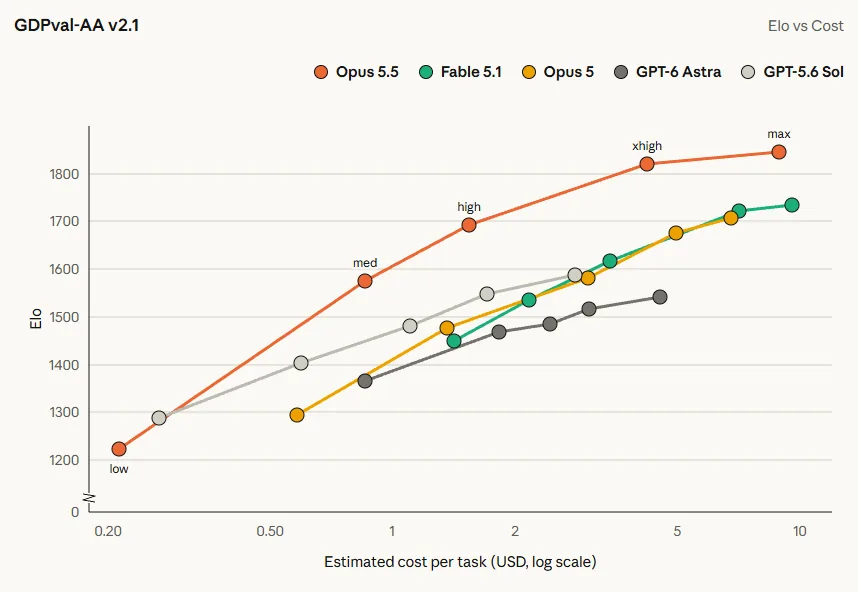
Independent testing conducted by benchmarking organization Artificial Analysis confirmed the strong showing across multidisciplinary challenges. The platform awarded Claude Opus 5.5 an overall score of 58 on its Intelligence Index, surpassing the previous record held by Fable 5.1 and Astra at 53 points each. On GDPval-AA v2.1 (an industry benchmark simulating complex white-collar tasks), Opus 5.5 achieved a score of 1,846 compared to 1,735 for Fable 5.1 and 1,542 for Astra. The model also led specialized academic evaluations, recording 67.7 percent on Humanity’s Last Exam with external tools and 66.9 percent on the SciCode programming assessment. These verified benchmark numbers validate Anthropic’s assertion that smaller, optimized reasoning loops can match or exceed heavier legacy configurations across diverse analytical disciplines in real-world deployment [3].
Artificial Analysis identified an efficiency trade-off beneath the headline scores. At maximum effort settings, Claude Opus 5.5 generates roughly 119,000 output tokens per task, compared to 78,000 for Opus 5, 78,000 for Fable 5.1, and 27,000 for GPT-6 Astra. That verbosity requires higher compute. Yet because Anthropic reduced underlying token pricing, the total cost per task remains comparable to older tier configurations while delivering superior reasoning accuracy [3].

Token Pricing Drops and Faster Generation Speed
Anthropic adjusted its commercial rate card by establishing input pricing at $4.00 per million tokens and output pricing at $20.00 per million tokens [2]. Those figures mark a 20 percent price reduction compared to the $5.00 input and $25.00 output fees charged for Opus 5 during its initial commercial release. Furthermore, the model delivers output over 30 percent faster than its immediate predecessor, reducing latency during interactive programming sessions. Lower latency directly benefits automated systems that make multiple consecutive API calls [1].
Anthropic priced cache reads at $0.20 per million tokens, representing a 60 percent reduction from earlier rates. Cache writes cost $5 per million tokens [2].
Subscriber accounts on Pro, Max, Team, and seat-based Enterprise tiers received a 20 percent increase in five-hour usage limits across all supported interfaces. Anthropic indicated that because the model operates more efficiently, those allocations stretch approximately 25 percent further during routine usage. In addition, paying accounts gained a one-time rate limit reset that users can deploy at any point before October 22, 2026. The expanded access directly supports corporate developers building complex automated tools after earlier unifying workplace communication inside Claude Cowork workspace integration across enterprise platforms [1].


Refining Natural Tone Beyond Claudish Patterns
Beyond raw computational speed, Anthropic focused engineering resources on eliminating formulaic response patterns known colloquially among users as Claudish prose. Previous releases drew criticism for verbose introductory pleasantries and repetitive rhetorical structures that slowed down professional workflows [2]. The development team retuned Opus 5.5 to place primary answers at the beginning of each response, enabling readers to extract critical decision information at a single glance. Technical jargon was pruned throughout [1].
Early testers in corporate environments reported that the updated conversational tone felt noticeably crisper during extended work sessions. According to documentation published by The Decoder, the revision specifically addresses enterprise requests from financial services, legal departments, and corporate software groups. These sectors demand strict adherence to formatting constraints rather than conversational filler. Claude Opus 5.5 adheres more strictly to detailed system prompts, eliminating unwanted introductory fluff when generating structured code or analytical memoranda for client presentations [2].
Visual recognition capabilities received comparable refinement. The model registered 89.0 percent accuracy on the Chartography visual evaluation with tools, assisting professionals who feed detailed architectural diagrams into the 1.0M token context window [2]. That expansive context capacity (a capacity equivalent to roughly 1,500 printed pages) accommodates deep historical documents during a single session. Multimodal data inputs process cleanly with extended text queries, allowing analysts to examine financial ledgers and interface mockups simultaneously without fragmenting complex project context [3].

Opus 5.5 Enforces Automated Security Safeguards
Because the model exhibits advanced technical capabilities comparable to Claude Mythos 5.1 in specialized domains, Anthropic implemented strict security boundaries [1]. When automated classifiers identify sensitive prompts involving biological research or frontier architecture, requests route transparently to alternative models. General vulnerability remediation remains open to software engineers, but advanced exploitation attempts divert automatically to Opus 4.8. High-risk biological inquiries redirect to Opus 5 unless institutions obtain formal authorization through Anthropic’s Life Sciences Verification Program (a specialized verification track for biological researchers) to conduct vetted medical research [2].
Anthropic accompanied the release with updated measures against industrial distillation attacks, which unauthorized parties use to extract proprietary model reasoning through synthetic accounts. Starting with accounts registered on or after August 31, 2026, the company introduced Preserved Thinking to prevent users from manipulating prior conversational context to extract model reasoning. In compliance with European Union AI Act regulations, the developer embedded watermarking standards and made Zero Data Retention protocols available to privacy-conscious enterprise clients. Developers can no longer disable the internal thinking mode when operating Opus 5.5 via API [2].
Independent audit organizations METR and Frontier Design evaluated the model before commercial deployment to identify latent autonomous risks. Anthropic stated that flawed reinforcement learning environments often generate misaligned agentic behaviors if left unchecked. Independent verification remains standard practice [4]. The laboratory plans to expand its Cyber Verification Program to Opus 5.5 over the coming weeks to give trusted security defenders expanded access to vulnerability testing tools [2].

Anthropic Paces Frontier Deployment With Safety Reviews
The launch of Claude Opus 5.5 arrived exactly two months after the debut of Opus 5 on July 24, 2026, highlighting rapid production cycles at the company. The launch was not unexpected. Yet the release also represents the first deployment since Chief Executive Officer Dario Amodei publicly advocated for pacing frontier capabilities. “I have become convinced that fully addressing the risks requires even more prudence,” Amodei wrote in a post earlier this month, “not just investing in risk prevention, but pacing the rate of capabilities advancement so that risk prevention has time to keep up.” [4]
Anthropic confirmed that secondary tiers in the family, including Sonnet 5.5 and Haiku 5.5, will arrive in the coming weeks with similar efficiency improvements. In official release documentation, the company argued that public policy must play an expanded role in establishing governance standards for systems capable of automated software research. International safety standards require cooperative institutional oversight rather than unilateral corporate pledges. Outside researchers continue to urge frontier laboratories to balance raw model velocity with verified containment protocols [4].
Cloud developers can access the system immediately using model identifier claude-opus-5-5 across Amazon Web Services, Google Cloud, and Microsoft Azure, in addition to the native Claude Platform [2]. Artificial Analysis confirmed that the proprietary architecture is currently served through five separate API providers, offering enterprise teams multiple deployment pathways [3]. The model weights remain proprietary. As competing developers push frontier reasoning thresholds higher, commercial adoption will depend on whether lower token rates translate into genuine operational cost savings for enterprise clients [2].
- ONLINE NEWS Clover, J. (2026, September 22). Anthropic Launches Claude Opus 5.5 With Fable-Level Performance at a Lower Price. MacRumors. [Article Link]
- ONLINE NEWS Bastian, M. (2026, September 22). Claude Opus 5.5 matches Fable 5.1 performance at lower cost and promises less ‘Claudish’ writing. The Decoder. [Article Link]
- WEBSITE Artificial Analysis. (2026, September 22). Claude Opus 5.5 (max with fallback) – Intelligence, Performance & Price Analysis. Artificial Analysis. [Article Link]
- ONLINE NEWS Brandom, R. (2026, September 22). Anthropic releases Opus 5.5 with lower prices and Fable-level performance. TechCrunch. [Article Link]


