




Intel won back five percentage points of desktop processor shipment share in the third quarter of 2026, pushing AMD below 30% for the first time in over a year. Industry tracking numbers from Mercury Research showed Intel taking 70.1% of desktop x86 shipments between July and September, up from 65.1% in the second quarter [1]. Meanwhile, AMD fell to 29.9% after holding 34.9% three months earlier, prompting talk of an Intel CPU comeback in retail channels. Yet the swing reveals more about component supply and retail channel inventory than a sudden shift in consumer processor preferences [2].
The Q3 Shift in Desktop Shipments
The quarterly change halted a long stretch of desktop momentum for AMD. The company had steadily grown its desktop presence over several years, climbing to 34.9% in the second quarter of 2026 from 33.2% in the first quarter and 32.2% a year earlier [4]. Dropping back down to 29.9% in the third quarter (covering July through September) took AMD to its lowest share since early 2025, when it held roughly 28% [3]. That five-point drop erased months of progress in one quarter. In the third quarter of 2025, AMD held 33.6% of the desktop space, which means the latest drop shows up on both sequential and annual scorecards [4].
Because Mercury Research divides desktop x86 silicon between these two vendors, the five-point swing widened the shipment gap considerably. In the second quarter, Intel shipped roughly 1.87 desktop chips for every processor AMD delivered into distribution channels. By the end of September, that ratio rose to 2.34 chips for each AMD processor, expanding the share gap between the rivals from 30.2 points to 40.2 points. The five-point move meant a 7.7% relative gain for Intel, but it inflicted a 14.3% relative loss on AMD because AMD started from a smaller base [5].
Market reports showed that shipment counts do not reflect machines sitting on consumer desks or cash flowing through store registers. Mercury Research tracks processors shipped from factories to distributors, system builders, and retail warehouses [5]. If a distributor stacks boxed processors on a shelf to prepare for holiday sales, those units count as shipments even if nobody bought them yet. Intel has broad reach through original equipment manufacturers, so restocking runs can generate big quarterly swings without changing what individual PC builders buy in retail shops [2].
Intel CPU Comeback Driven by Supply Reallocation
Mercury Research offered a supply-side explanation rather than pointing to sudden architectural superiority. The firm noted that softening laptop demand during summer allowed Intel to redirect chip packaging capacity and factory output toward desktop lines, which typically experience a seasonal rise in third-quarter demand [1]. Intel had been under-supplying desktop channels earlier in 2026, creating room for catch-up deliveries once supply picked up [3]. AMD didn’t see that seasonal bump in desktop volumes, widening the shipment gap [4].
The research firm stated that it was difficult to identify the exact cause with certainty, though its published report laid out the supply theory in detail. “It’s difficult to know the driver of this for sure, but we speculate that due to the lower mobile CPU demand, Intel could allocate more products to the desktop market, which normally sees a significant demand increase in the third quarter, and Intel had been under-supplying this market earlier in 2026,” Mercury Research said [2]. The firm added that “AMD, however, did not appear to have a seasonal increase, which resulted in Intel having a very large sequential and on-year gain in desktop CPU market share.” In this context, analysts tracking the numbers pointed out that the reported Intel CPU comeback looked bigger on paper than it actually was in stores [5].

Laptop shipments slowed down for the entire industry during the same period. Both Intel and AMD saw mobile processor shipments fall by more than 10% in the third quarter, shrinking the volume of laptop silicon moving into notebook factories [2]. Intel’s total processor share moved very little when counting all chips, including embedded systems and internet-of-things parts. Intel’s overall CPU share ticked up just 0.2 points from the second quarter to 66.1%, sitting three points below the 69.1% it held in the third quarter of 2025 [4].


High Component Costs and Weak Gaming Demand
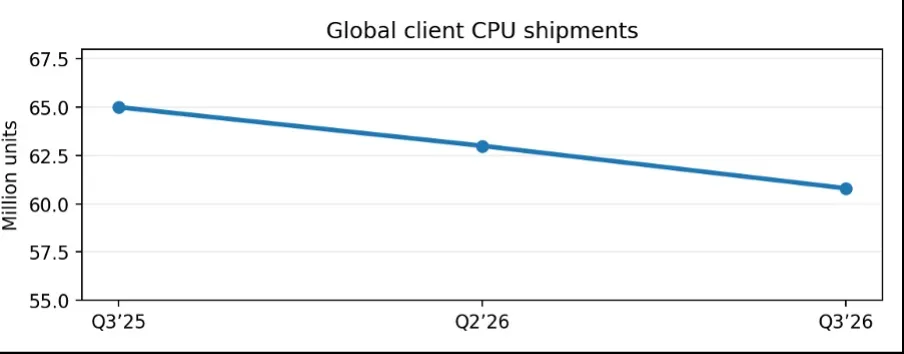
The wider consumer computer market contracted significantly while these shipment shifts took place. Research published by Jon Peddie Research showed that global client processor shipments slipped 3.4% from the previous quarter and dropped 6.5% year-over-year to 60.8 million units. Desktop processor shipments fell 13% compared to the prior year, while notebook processors saw a smaller 4% drop. Jon Peddie, president of the research firm, said he expects tough conditions in the PC market to continue through the first half of 2027 [1].
Rising part prices hit the do-it-yourself gaming community especially hard in 2026. High graphics card prices, expensive memory (RAM) kits, and climbing storage costs made building or upgrading a personal computer far less appealing for everyday gamers [4]. Many PC builders had brought forward purchases into late 2025 to dodge expected price hikes on memory and solid-state drives [1]. That purchasing freeze hurt AMD disproportionately because its desktop business leans heavily on enthusiast gamers who assemble custom systems around chips like the Ryzen 7 9800X3D [2].

Intel maintained strong partnerships with system integrators that assemble entry-level and office desktop towers. These high-volume builders often buy older platforms that support cheap DDR4 memory, where Intel provides low-cost processors that keep total desktop build costs down [2]. Even with those shipment gains, Intel’s Client Computing group reported a 5% revenue drop year-over-year. Higher memory prices and component expenses weighed heavily on consumer budgets, leaving buyers cautious about spending money on new computer builds [1].
Data Center Growth and the Server Contrast
While desktop shipments fluctuated, AMD directed much of its silicon supply to enterprise server hardware. That strategic shift helped power AMD to a $1 trillion valuation ahead of Intel during recent trading as data centers grew fast. In its third-quarter financial filing, AMD reported a record $8.5 billion in quarterly data center revenue, marking a 97% increase over the previous year. High-margin server chips like the EPYC processor family took precedence in chip packaging lines over consumer desktop silicon [1].
AMD chief executive officer Lisa Su recently summed up that business priority during an industry appearance reported by Reuters, stating plainly that “We are a data center first company” [3]. Her comment reflected an environment where hyperscale cloud providers are buying every high-performance server chip AMD can produce. EPYC processors now host Google’s confidential TPU 8tx infrastructure, showing the scale of demand outside personal computers [4]. With silicon wafer allocation finite, AMD chose to feed booming enterprise server demand while desktop PC builders faced tight budgets and rising part costs [5].

Server shipment figures confirmed that AMD continued to gain ground against Intel in corporate data centers. AMD’s server processor shipment share climbed to 35.5% in the third quarter of 2026, up from 34.5% in the second quarter [3]. Total server CPU shipments across the industry grew to 8.13 million units, rising from 7.83 million in the prior quarter and 6.59 million a year earlier [1]. Intel accounted for 64.5% of server chips shipped during the quarter, down from 72.2% a year earlier, as it prepared its 256-core Diamond Rapids Xeon 7 processors for 2027 [4].
What the Intel CPU Comeback Means for Buyers
The quarterly shipment numbers don’t show gamers abandoning AMD in favor of Intel processors. AMD’s Ryzen processors with 3D V-Cache, led by the Ryzen 7 9800X3D, continue to lead independent gaming benchmarks by wide margins [4]. While Intel’s Core Ultra 5 250K Plus offers budget appeal with plenty of cores for budget-conscious buyers, its new desktop architecture (Arrow Lake) hasn’t overtaken AMD in gaming speed. Hardware reviewers pointed out that Arrow Lake sits on a platform that won’t see long-term socket upgrades, as Intel plans its Nova Lake chips on a new motherboard socket [2].
Writing for PC Gamer, technology writer Jacob Ridley warned against reading the shipment swing as a lasting victory for Intel. “I wouldn’t mistake Intel “gaining market share” as a healthy sign for the company or the wider industry,” Ridley wrote [2]. That distinction suggests the Intel CPU comeback reflects inventory balancing rather than a sudden shift in consumer loyalty. Intel managed to fill channel shelves during a quarter when AMD focused on servers, but that doesn’t prove shoppers prefer Intel silicon when building home PCs [5].

Upcoming sales data from the fourth quarter will clarify whether Intel can hold its desktop share above 70%. If consumer PC spending stays weak and graphics card prices stay high, prebuilt desktop builders may keep favoring cheap Intel bundles to keep shelf prices low [2]. But if DIY builders return to retail stores to buy gaming CPUs, AMD could easily win back lost share. Both chipmakers now face a sluggish desktop market, meaning quarterly shipment share numbers may swing based on supplier logistics rather than raw product speed [5].
- ONLINE NEWS Castellanos, S. (2026, November 14). Intel Reclaims 70% Desktop CPU Market Share As AMD Falls Below 30% In Surprise Q3 2026 Turnaround. Wccftech. [Article Link]
- ONLINE NEWS Ridley, J. (2026, November 13). Intel Takes Massive Chunk Out of AMD’s Desktop CPU Market Share in Unexpected Turnaround. PC Gamer. [Article Link]
- ONLINE NEWS DrUsmanSaleem. (2026, November 14). AMD Loses Desktop CPU Share for the First Time in Months, Intel Regains Ground. TechPowerUp. [Article Link]
- ONLINE NEWS Ali, A. J. (2026, November 14). AMD Desktop CPU Share Falls to 29.9% as Intel Gains 5 Points. Tbreak Media UAE. [Article Link]
- ONLINE NEWS Bell, M. (2026, November 14). Intel Desktop CPU Market Share Hits 70.1% as AMD Falls. Shattered. [Article Link]
- ONLINE NEWS Ridley, J. (2026, November 13). Intel Takes Unexpected Bite Out of AMD’s Desktop CPU Market Share. Yahoo! Finance. [Article Link]


