





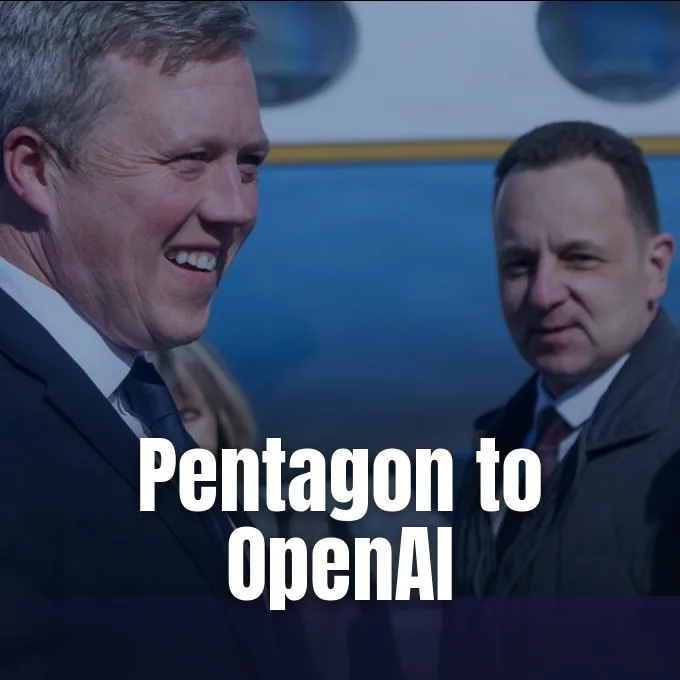
On Monday, OpenAI hired former US Army Secretary Dan Driscoll as senior counselor for national security modernization, bringing a high-profile military leader into its leadership circle. Driscoll, who previously commanded roughly one million troops and guided over 265,000 civilian defense employees, will advise OpenAI on using AI to strengthen national defense and cyber systems [1]. He joins as tech companies compete for Pentagon deals ahead of the November midterm elections.
Dan Driscoll Takes Advisory Role
In his new post, Dan Driscoll will advise OpenAI CEO Sam Altman and company teams on defense strategy. In his public statement, Driscoll said, “National security requirements are changing faster than at any time in the past fifty years.” He said AI would help national security staff cut through paperwork, make sense of larger volumes of intelligence data, and route answers to officers much faster [1].
His work also centers on helping international allies adopt AI tools responsibly without lowering security standards. “I’m joining OpenAI to help the United States and our allies put this technology to work responsibly, for the people who keep us safe,” Driscoll said in the company announcement. He added, “The people who serve deserve the very best tools we can put in their hands.” OpenAI CEO Sam Altman welcomed the hire, saying the country has an extraordinary opportunity to work with other nations to spread democratic AI tools [3]. Altman believes these partnerships will help democratic allies as global security needs shift rapidly.
The advisory post gives OpenAI direct insight into defense agencies. Driscoll will help engineering teams understand what security institutions actually need so developers can adapt tools for public agencies. It isn’t just about software features, but matching models to real field requirements [2].

Pentagon Disputes Preceded the Move
Before joining OpenAI, Dan Driscoll served as the 26th Secretary of the US Army, where he led nearly one million troops and over 265,000 civilian employees [1]. Driscoll also served as acting director of the ATF. Gareth Vipers reported for The Wall Street Journal that Driscoll was a law-school classmate of Vice President JD Vance. His friendship with Vance and his background as an Army officer gave him substantial standing in the Pentagon before policy disputes began.
Driscoll resigned in late August 2026 and left the Pentagon in September. His departure followed months of friction with Defense Secretary Pete Hegseth. Hegseth repeatedly removed senior Army officers or blocked their promotions over Driscoll’s objections, leading to disputes over military appointments [2].
His Washington ties now accompany Driscoll into the private sector. Driscoll maintains strong relationships with lawmakers from both parties in Congress, according to AP. His bipartisan network could open doors on Capitol Hill if the balance of power shifts after the midterm elections, giving OpenAI steady congressional access regardless of election outcomes [2].
The Wall Street Journal said Driscoll’s hire signals that OpenAI wants closer ties with the armed forces and a bigger share of defense contracts. The company also wants a seat at the table when officials write rules for military AI systems [2].


Army Modernization Under Dan Driscoll
During his leadership of the Army, Dan Driscoll pushed tech modernization across the service branch. He led Project ARIA, a military effort that brought AI tools to budgeting, supply logistics, and tactical model deployment [2]. The program tested how machine learning models could process military supply chains so soldiers could manage field logistics efficiently. Project ARIA gave Driscoll practical experience in defense procurement, showing him how military acquisitions work inside the Pentagon. He learned where bureaucratic delays happen and how software can help soldiers make choices under pressure.
Pentagon acquisitions often stall under heavy red tape, but Driscoll’s work showed how AI can integrate into military databases. That procurement background makes him useful for OpenAI as it pitches tools to federal agencies with strict security rules [2].
Driscoll’s background as a former Army officer shapes how he approaches defense software. Having led both combat soldiers and civilian staff, he understands the friction that commanders face when reviewing intelligence reports. Field teams often struggle to process data gathered from drone feeds, sensors, and radio networks. Driscoll said AI can take the load off bureaucracies, review incoming intelligence, and route verified answers to troops quickly so leaders can act on reliable facts [2].
Defense Contracts After Anthropic’s Exclusion
OpenAI’s defense push gained momentum after a clash between the Pentagon and rival AI developer Anthropic. In late February 2026, the Defense Department classified Anthropic as a supply chain risk after CEO Dario Amodei refused to drop contractual limits on mass surveillance and autonomous weapons [2]. That Pentagon classification shut Anthropic out of defense networks and opened a path for competitors.
On the same day the Pentagon barred Anthropic, OpenAI CEO Sam Altman announced a deal to deploy OpenAI models on the Defense Department’s classified network. Altman stressed that the pact included safety safeguards similar to the rules Anthropic had fought to keep. The deal showed how quickly OpenAI moved to fill the military void left by its rival. Anthropic didn’t accept the outcome and continues to challenge the Pentagon’s supply chain decision in court. Meanwhile, Rachel Metz reported for Bloomberg that the fallout prompted OpenAI to expand its national security team and secure classified federal networks [1].

The classified network contract marked a major step for OpenAI, but managing defense software requires military expertise. Driscoll’s arrival gives the company an advisor who understands how military leaders evaluate risk, helping OpenAI models meet federal defense standards [2].
Daybreak and Allied Cyber Partnerships
OpenAI said that hiring Driscoll builds on Daybreak, its cyber resilience program organized with allied governments and industry partners. OpenAI has already opened the Daybreak platform to Ukraine to assist with defense against digital infrastructure attacks, while pitching the system to utility operators in the United States. Driscoll will help guide how these defensive tools expand to other international allies [1]. His work will focus on coordinating with allied defense institutions to make sure software deployments remain secure and effective during active cyber operations.
These cyber initiatives complement the company’s broader software research. Beyond defensive networks, OpenAI has evaluated code security, such as when an OpenAI model flagged critical PHP security flaws in public code repositories. Driscoll will help coordinate these security tools for defense agencies [1].
Helping democratic nations deploy AI responsibly remains central to Dan Driscoll’s mandate at OpenAI. As Altman stated, the United States has an extraordinary opportunity to collaborate with other nations to spread democratic AI tools. With Driscoll advising on national security modernization, OpenAI aims to deepen its ties with defense leaders while navigating ongoing political changes in Washington [1].
- ONLINE NEWS Constantin, A. M. (2026, November 3). OpenAI hires former US Army Secretary Dan Driscoll for security role. The Next Web. [Article Link]
- ONLINE NEWS Uth, M. (2026, November 3). OpenAI hires ex-Army Secretary, gaining bipartisan reach just as midterms loom. THE-DECODER.com. [Article Link]
- ONLINE NEWS Zinin, A. (2026, November 3). OpenAI hires former US Army secretary for national security role. Tech Xplore. [Article Link]


