





Web browsers auto-send stored cookies whenever they dispatch HTTP requests to a target domain, creating a fundamental trust gap across web platforms. In Cross-Site Request Forgery (CSRF), an unauthorized attacker tricks an authenticated user into sending state-changing commands to a vulnerable app [3]. Often called XSRF or session riding, these csrf attacks do not steal session cookies or break network encryption directly. The exploit hijacks ambient browser trust. Attackers manipulate the target server’s faith in the client’s login session to run unapproved actions without user consent [6].
- What Are CSRF Attacks?
- Browser Cookies in Web Sessions
- How Attackers Craft Forged Requests
- Breaches from Netflix to Embedded Routers
- Stopping CSRF Attacks with Synchronizer Tokens
- Browser Defense with Fetch Metadata and SameSite
- Why Web Platforms Still Face CSRF Attacks
- Defensive Gaps Under Scripting Vulnerabilities
What Are CSRF Attacks?
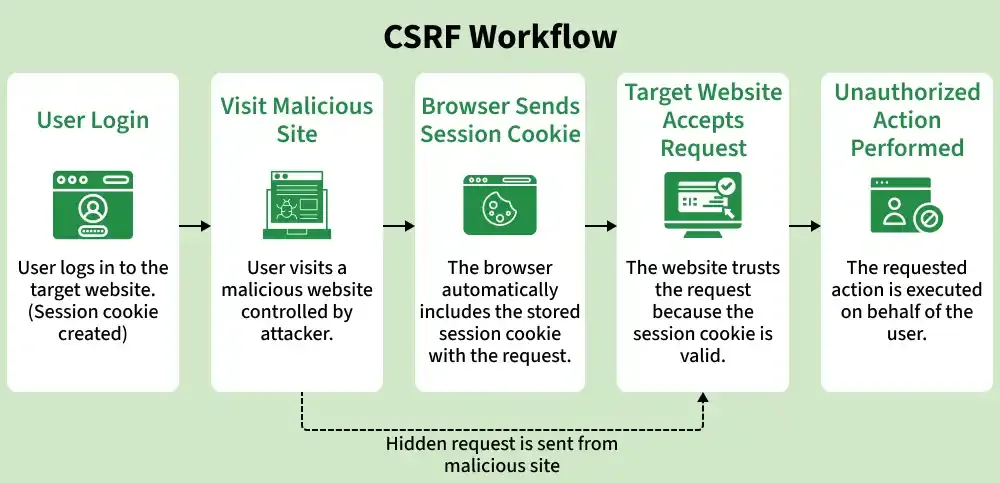
Security analysts define cross-site request forgery as a confused deputy flaw where a client browser executes unintended actions on a trusted web app. The bug relies on an open session created through session cookies, HTTP Basic auth, or client certificates. HTTP is stateless. To track logged-in users, backend servers issue session IDs like JSESSIONID [11]. When a victim visits a hostile webpage in a second tab, that page can send requests to the target web app, prompting the browser to attach valid cookies without manual input [2].
Unlike cross-site scripting, where attackers inject JavaScript into a webpage to steal data, csrf attacks focus on state-changing actions [12]. An attacker cannot read server responses due to the Same-Origin Policy. The attack cannot exfiltrate stored user files [13]. Instead, hostile sites force state transitions like changing email addresses, buying items, or updating account passwords. If the compromised victim holds admin rights, a single forged request can compromise the entire web application [3]. Security teams catalog this flaw under CWE-352 in the Common Weakness Enumeration system, linking it to MITRE ATT&CK technique T1530 for persistence and privilege escalation across enterprise environments [6].
Three distinct conditions must align before csrf attacks succeed against an online banking or web management platform [2]. First, the web app must expose an action with real consequences [10]. Second, the backend must rely solely on browser cookies to verify who sent the request [13]. Third, the HTTP parameters must be predictable, enabling outsiders to forge valid payloads without guessing random values [10]. Predictable parameters guarantee exploit success.
Browser Cookies in Web Sessions
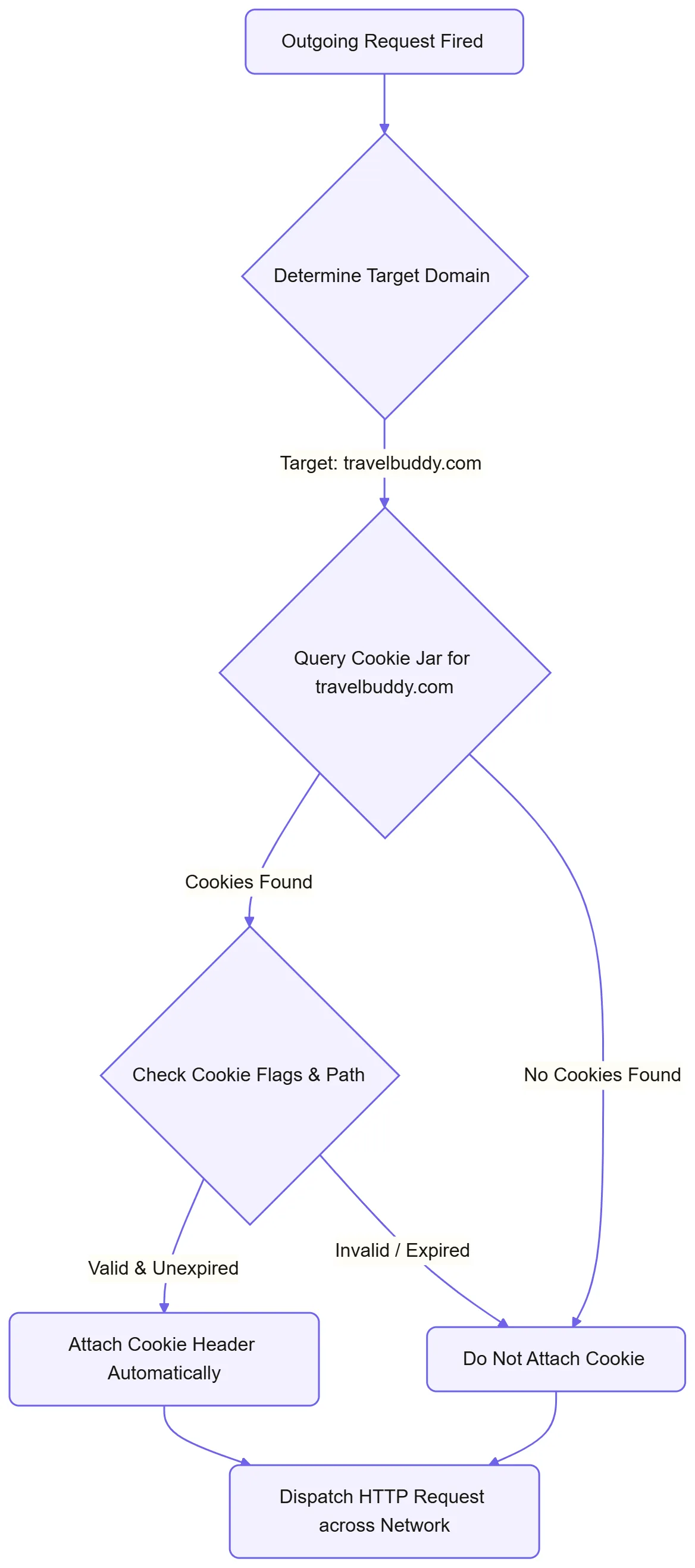
Web browsers use an internal cookie jar to store session IDs issued through the Set-Cookie HTTP response header [11]. When a user logs in, the server returns an identifier that the client saves alongside path, Secure, and domain rules [1]. On every later request sent to that domain, whether triggered by navigation, form submission, or background asset fetching, the browser checks the target host and adds matching credentials to the Cookie header. Users do not type their password again. Frontend JavaScript does not need to attach these authentication tokens by hand [11].
This auto-send behavior runs every time an HTTP request leaves the client [1]. When users click links, run background scripts, or load web pages with embedded media, the browser adds stored domain cookies without asking if the user meant to send them [11]. Security writers Brenda Buckman and Rick Anderson explain that this predictable design turns web browsers into unwitting tools during csrf attacks [1, 7]. A target server inspects the session ID, finds Alice’s active account in memory, and carries out the action. The server assumes Alice clicked the button herself [11].
Transport encryption cannot fix this broken trust model [1]. While HTTPS creates a safe tunnel between client and server, it delivers forged web requests over TLS without checking user intent [7]. Attack sites on evil.com send encrypted queries to good-banking-site.example.com just as smoothly as normal browser traffic [1].
How Attackers Craft Forged Requests
Attackers use simple HTML and scripts to launch forged HTTP requests from a logged-in user’s browser [2]. If a vulnerable API processes actions through GET queries, an exploit needs only a standard image tag or web link. Author Chris Shiflett noted in PHP Architect that browsers fetch image files immediately when reading HTML, sending GET queries that servers cannot tell apart from real assets [12]. In Damn Vulnerable Web Application (DVWA) tests, running python3 -m http.server 42002 hosts a simple page that sends password reset queries to port 42001 [2]. If an online forum allows image tags, a bad actor can embed a URL that silently alters account settings when members view the topic [20]. The server processes the request as a normal asset call [12].
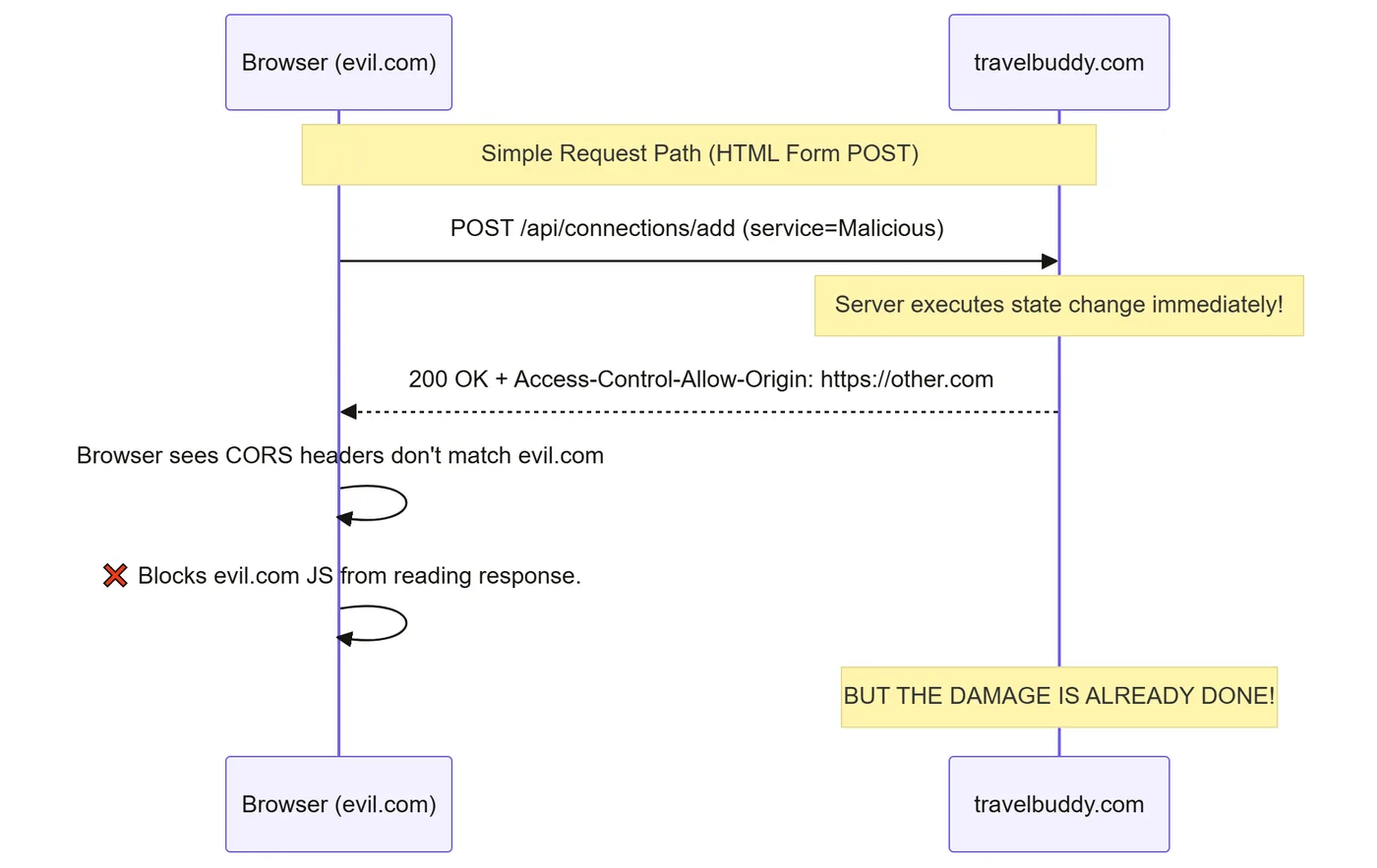
When target systems use POST for sensitive workflows, attackers build hidden HTML forms that submit on page load [13]. A page on evil.com embeds hidden input fields matching destination parameters, paired with a short DOM script like document.forms[0].submit() [3]. In Burp Suite Professional, security testers use the built-in CSRF PoC generator to create these exploit forms in seconds [13]. When the victim opens the malicious link, the browser dispatches the POST payload across origins, automatically attaching the victim’s session cookie to complete the unauthorized transfer [11]. The browser shows no prompt [6].
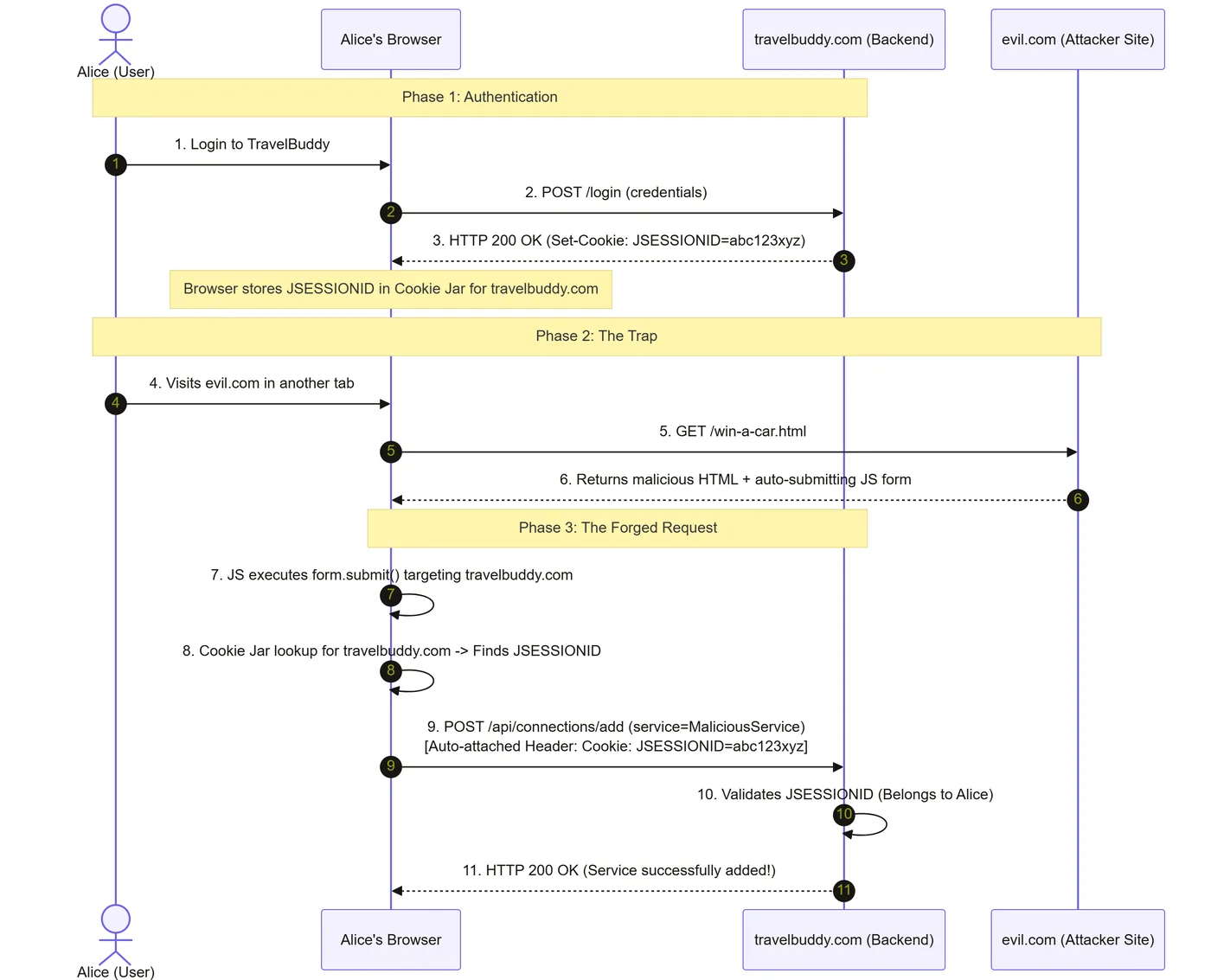
Adversaries also run login CSRF to sign an unauthenticated victim into an account owned by the attacker. When the user enters private credit card details or home addresses, that personal data is saved into the attacker’s profile. The attacker logs in later to read the stolen records [3].
Breaches from Netflix to Embedded Routers
Security audits show that major consumer platforms and hosting software have suffered from csrf attacks. In 2006, the Netflix website exposed members to account hijacking bugs that let rogue pages change postal addresses, edit rental queues, and overwrite login credentials. In 2008, video site YouTube and online bank ING Direct fixed flaws that allowed unapproved actions inside user accounts [9, 20]. That same year, analyst Ryan Giobbi documented flaws in cPanel under CVE-2008-2043, which let attackers run server admin commands when hosting managers opened bad links [15]. These incidents proved that ambient cookies put web platforms at serious risk [20].
Embedded hardware and network gear carry high risks because admin consoles stay logged in [6]. A bug in μTorrent under CVE-2008-6586 let bad sites download malware and reset admin passwords using simple GET requests sent to localhost port 8080 without user authorization [20]. Alexander Klink of Cynops GmbH found CVE-2008-0556 in the OpenCA PKI project, where forged forms triggered unapproved certificate issuance [16]. Router maker Ubiquiti saw router setups changed by cross-origin web calls [6].
Cars and cloud platforms have faced similar exploits. In 2017, a bug bounty showed Tesla’s web portal had a bug that let forged web requests unlock doors and adjust cabin temperature. In 2022, GitHub fixed an OAuth flow bug where omitting the anti-CSRF state value risked tricking users into granting unauthorized API access to rogue apps impersonating legitimate services [6].


Stopping CSRF Attacks with Synchronizer Tokens
The main defense against request forgery is the synchronizer token pattern, first detailed by Chris Shiflett in 2004 and backed by Dave Wichers and the OWASP Foundation [12, 18]. Under this design, the server makes a cryptographically strong, unique token tied to the user’s login session [18]. When showing an HTML form, the server puts this secret token in a hidden input field [4]. When the user submits data, the backend compares the submitted token against the session value, dropping the request if values do not match [12]. No token means no action.
Because other websites cannot read tokens across origins, forged requests cannot provide the required secret [18]. Web frameworks build this defense into their default tools [12]. In Django, CsrfViewMiddleware checks incoming POST forms and returns an HTTP 403 Forbidden status when tokens are missing. Developers add the {% csrf_token %} template tag inside forms to set the field, while AJAX code reads the csrftoken cookie to attach an X-CSRFToken HTTP request header [14]. Other stacks like Laravel, Ruby on Rails, and ASP.NET Razor provide built-in token helpers to stop development teams from rolling custom, flawed antiforgery logic [8, 12].
Stateless web architectures use the signed double-submit cookie pattern when servers do not keep session state in memory. The server sets a random cookie and requires the client to echo that value in a custom header or form field. By creating an HMAC-SHA-256 hash using a server key, random nonce, and session data, backends verify that requests came from legitimate users. Naive double-submit cookies remain insecure without signatures [18].
Browser Defense with Fetch Metadata and SameSite
Web browsers provide built-in protections that limit ambient cookie sharing to stop csrf attacks at the networking layer. The SameSite cookie attribute tells browsers when to include cookies on cross-site requests [1, 4]. Under Strict mode, the browser blocks cookies on all cross-origin requests, including regular link clicks. Under Lax mode, which Chrome set as the browser default in 2021, cookies are blocked on cross-site subrequests and POST forms, but sent during top-level GET navigations [1, 13].
Fetch Metadata headers add extra safety by passing context that client scripts cannot change [1, 4]. Browsers set the Sec-Fetch-Site header to values like same-origin, same-site, or cross-site. Web apps check this header to see where a request started. In ASP.NET Core, Fiyaz Hasan and Rick Anderson helped build automatic CSRF checks that allow same-origin requests and block unapproved cross-site posts, while Go 1.25 introduced the CrossOriginProtection type to validate these Fetch Metadata headers natively. Browsers control these headers directly, allowing servers to validate origin headers without needing hidden form tokens [1, 18].
Teams also block simple cross-origin requests by writing APIs that demand custom headers or JSON data. When JavaScript code sends JSON using an application/json header, browsers dispatch a preflight CORS OPTIONS request first [4, 11]. If the target server does not allow that calling origin, the browser drops the request before state changes occur. CORS blocks the call early [11].
Why Web Platforms Still Face CSRF Attacks
Even with built-in defenses, csrf attacks remain a real threat in production software [6]. In 2014, researcher B. Nagpal called request forgery the sleeping giant of web bugs because developers often overlook session trust details [2]. Old systems turn off antiforgery checks to solve setup headaches, leaving endpoints wide open [6]. In Spring Boot, backend developers building REST APIs often see HTTP 403 errors on POST calls and run .csrf(csrf -> csrf.disable()) in their Security Filter Chain to bypass the check. This common shortcut removes all protection [11].
Automated security scans show that large software stacks harbor hidden vulnerabilities. Researchers Soheil Khodayari and Giancarlo Pellegrino from the CISPA Helmholtz Center analyzed 87 web apps with their JAW testing tool, identifying 12,701 forgeable requests and building working client-side exploits for 203 distinct endpoints. In academic research, the machine learning tool Mitch was built for black-box CSRF detection in real-world web apps. These studies prove that large systems often skip validation on secondary API endpoints [6, 20]. Many secondary endpoints lacked basic checks [20].

Mistakes around HTTP verbs also leave systems open to abuse. RFC 9110 section 9.2.1 states that GET, HEAD, and OPTIONS must stay safe and never modify state. When flawed apps run actions like password resets or cash transfers over GET, standard SameSite=Lax cookies fail to protect users during ordinary link clicks [1, 4]. Safe verbs must not change state [1].
Defensive Gaps Under Scripting Vulnerabilities
Many developers think antiforgery tokens stop every cross-site exploit. But researcher Christian Schneider showed that same-origin XSS completely breaks token-based defenses against csrf attacks. If a company runs a small blog on the same domain and port as its online shop, an XSS flaw in the blog lets an attacker send XMLHttpRequest calls to the shop. The script reads the user’s account page, grabs the valid CSRF token, and sends state-changing POST requests using the victim’s session. Because the call starts on the same origin, Same-Origin Policy checks and custom headers cannot block the attack [19].
Subdomains create another blind spot for cookie security. Parent domains share cookies across subdomains, allowing a compromised sibling host to overwrite cookies or plant a chosen value [14, 18]. When apps use naive double-submit cookies without cryptographic signing, a rogue subdomain can set a matching cookie and forge requests. In academic research, authors A. K. Sinha and S. Tripathy built CookieArmor, a client-side proxy using quotient filters and two-token schemes to stop session hijacking and forged requests [18].
Flawed defenses can weaken security. Checking the HTTP Referer header causes false rejections when browser privacy add-ons strip header text [3, 17]. Multi-step forms also fail if an attacker can predict each step [3]. For critical actions like changing passwords or moving funds, apps should require re-authentication or one-time codes [2, 17].
- WEBSITE Microsoft. (2026). Prevent Cross-Site Request Forgery (XSRF/CSRF) attacks in ASP.NET Core. Microsoft Learn. [Article Link]
- WEBSITE GeeksforGeeks. (2019). What is Cross Site Request Forgery (CSRF). GeeksforGeeks Computer Networks. [Article Link]
- WEBSITE OWASP Foundation. (2026). Cross Site Request Forgery (CSRF). OWASP Community. [Article Link]
- WEBSITE MDN Web Docs. (2026). Cross-site request forgery (CSRF). Mozilla Developer Network. [Article Link]
- WEBSITE Fortinet. (2026). What is CSRF (Cross Site Request Forgery)? Fortinet Cyber Glossary. [Article Link]
- WEBSITE Palo Alto Networks. (2006). What Is CSRF (Cross-Site Request Forgery)? Cyberpedia. [Article Link]
- WEBSITE Buckman, B. (2025). What Is XSRF in Cybersecurity? A Complete Guide. Huntress. [Article Link]
- WEBSITE Snyk. (2022). CSRF Attack: Tutorial & Examples. Snyk Learn. [Article Link]
- WEBSITE Okta. (2026). CSRF Attack: Cross-Site Request Forgery Definition & Defense. Okta Identity 101. [Article Link]
- WEBSITE Sucuri. (2024). What is Cross Site Request Forgery (CSRF)? Sucuri Security Guides. [Article Link]
- ONLINE NEWS Krishna, A. (2026). CSRF from Scratch: Browser Mechanics, Attacks, and Spring Security Implementation. freeCodeCamp. [Article Link]
- WEBSITE Shiflett, C. (2004). Cross-Site Request Forgeries. PHP Architect. [Article Link]
- WEBSITE PortSwigger. (2026). Cross-site request forgery (CSRF). Web Security Academy. [Article Link]
- WEBSITE Django Software Foundation. (2026). Cross Site Request Forgery protection. Django Documentation. [Article Link]
- REPORT Giobbi, R. (2008). Vulnerability Note VU#584089: cPanel contains multiple cross-site request forgery vulnerabilities. CERT Coordination Center. [Article Link]
- REPORT Pruszynski, J. W. (2008). Vulnerability Note VU#264385: OpenCA contains a cross site request forgery vulnerability. CERT Coordination Center. [Article Link]
- WEBSITE Heldmaier, C. (2020). What is CSRF? (Cross-site request forgery attack). Ionos Digital Guide. [Article Link]
- WEBSITE OWASP Foundation. (2023). Cross-Site Request Forgery Prevention Cheat Sheet. OWASP Cheat Sheet Series. [Article Link]
- WEBSITE Schneider, C. (2019). CSRF and same-origin XSS. Christian Schneider Weblog. [Article Link]
- WEBSITE Wikipedia contributors. (2026). Cross-site request forgery. Wikipedia, The Free Encyclopedia. [Article Link]


