






Former Yahoo chief executive Marissa Mayer defended her decision to use her startup’s software to describe her own daughter, responding to criticism sparked by an interview in The New York Times. Mayer asked Dazzle, an assistant built by her ten-person engineering team, to generate three bullet points for a fourth-grade school assignment about ten-year-old Marielle. The software reviewed her family pictures and suggested that the girl was empathetic, creative, and an animal lover [1]. That exchange triggered swift pushback on social media from critics who questioned the role of automated tools in parenting, as the Marissa Mayer AI assistant drew debate online [2].
The Classroom Slide Assignment
The controversy began after reporter Alexandra Alter published a feature in The New York Times exploring how Mayer incorporates software into family life. Marielle’s teacher had emailed parents asking for three bullet points explaining what made each child special for an upcoming classroom presentation celebrating their winter birthdays. Mayer turned to her phone instead of writing the notes herself [1].
Dazzle surprised Mayer by identifying obscure details from early childhood that she had long forgotten. The tool separated Marielle from her identical twin sister Sylvana, bypassing a common blind spot in facial recognition software that often mixes up identical siblings, and surfaced forgotten kindergarten projects like a handmade sandcat playground and an invention called the snake denomizer. Mayer combined those automated findings with a few personal reflections before showing the finished slide to her husband Zack Bogue. He was floored by the specific memories, prompting Mayer to confess that the prototype had pulled those forgotten details straight from her family photo archive. The anecdote circulated widely after Caitlin Hornik covered the online backlash for The Independent [1].
Critics on X argued that relying on an automated tool to identify a child’s virtues showed emotional detachment. Many commentators questioned why a parent would outsource basic reflection about her own daughter to an algorithm [1]. The public debate mirrored wider skepticism about automated family life, echoing national surveys where a growing majority of Americans view artificial intelligence with deep suspicion [2].
Backlash Against Marissa Mayer AI Comments
Mayer addressed the criticism in a post on X, thanking the newspaper for the profile while providing fuller context for her decision. She explained that boiling down a child’s personality into three brief bullet points felt laughably limiting for any parent. She wanted to test the prototype on real family records [1].
Her twin daughters celebrate their birthdays on December 10, and their fourth-grade teachers had requested a tribute slide celebrating each girl. Mayer insisted she didn’t turn to the software out of exhaustion or a desire to skip parenting duties. Instead, she wanted to discover what subtle connections an automated system might uncover from thousands of candid snapshots taken over many years. She posted screenshots of the software’s output to explain how the tool linked early craft projects to her daughter’s current personality, defending the Marissa Mayer AI project against online accusations of detached mothering while explaining that algorithmic tools can enrich family storytelling rather than diminish personal bonds [1].

To explain her design philosophy, Mayer referenced the foundational 2017 research paper Attention Is All You Need, which introduced the transformer architecture that powers today’s artificial intelligence models. She pointed out that people around the world take 5 billion photos every day. Those camera rolls form a record of what families pay attention to over time [1].


Camera Roll Photo Analysis
Dazzle launched in late September as a multimodal assistant that scans a user’s phone images to answer questions and carry out tasks. Unlike standard chatbots that rely on typed queries, the service treats past pictures as personal memory. Mayer noted that early testers often spend hours each day interacting with the assistant. The tool competes with rival personal agents, including Meta Muse, which already reports 10 million users [1].
Mayer shared several practical ways families already use the assistant beyond school presentations. In one case, the software generated custom spelling lists and grammar concepts tailored to photos of a child’s actual schoolwork. When an early tester uploaded a reading schedule for an upcoming book club meeting, the software scanned older living room pictures, spotted an owned copy on a shelf, and identified two related titles by the same author without requiring any manual cataloging. The assistant connects visual clues scattered inside private albums that owners never realize they recorded, turning passive photo storage into an active knowledge base for everyday household problems [1].
The software also handles home design and wardrobe suggestions by reviewing visual clues. It recommended matching wall art after noticing a new sofa in a living room snapshot. For an esoteric costume party, the system searched closet photos to build an outfit from clothes the user already owned [1].
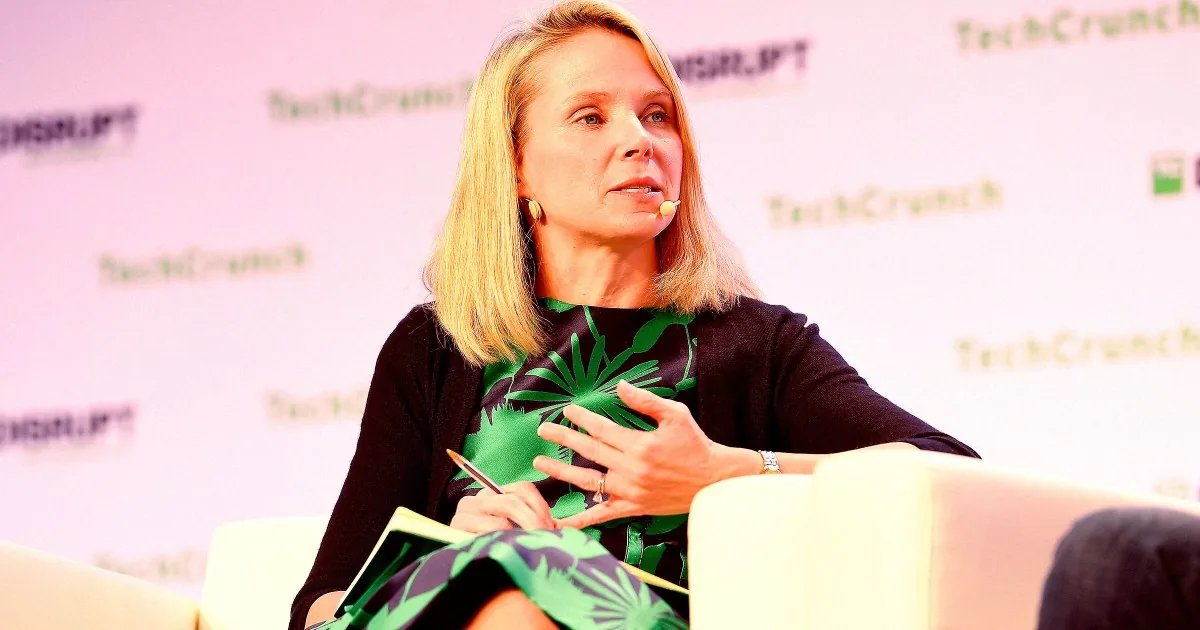
Building the Marissa Mayer AI Startup
Mayer’s current venture operates with just 10 engineers and carries an estimated valuation of $35 million. The company arrived at its photo-first strategy after shelving earlier software experiments. Her team previously launched and discarded two contact-management apps called Sunshine Contacts and Shine, deriving the concept for Dazzle from Shine [1].
The venture marks a return to consumer technology for Mayer, who joined Google as employee number 20 in 1999 and spent a full decade directing its search engine products. She later served as chief executive of Yahoo from 2012 to 2017, steering the web portal through major leadership reorganizations and product redesigns. Mayer described Dazzle as “one of my babies,” marking a fresh chapter for the Marissa Mayer AI startup after her earlier ventures in contact management [2].
When asked about the small number of women leading artificial intelligence startups, Mayer cited computer scientist Fei-Fei Li, who sold World Labs to AMD. Mayer said she believes gender parity in tech leadership “will come in time.” She also noted that visual tools appeal to women, who often capture more family photos [1].
Debate Over Parenting Chores
Mayer admitted that she uses the assistant to organize multiple aspects of domestic life, from travel schedules to play dates. She claimed that automating routine logistics actually improves family outings. “The play dates are better, the travel is better,” she told the Times, arguing that algorithmic tools simplify family routines [2].
Her enthusiasm for automation sometimes meets resistance inside her own home, particularly when planning events for her children. When organizing a birthday gathering for her 14-year-old son Macallister, Dazzle suggested an elaborate glow-in-the-dark party theme featuring glowing pool accessories and phosphorescent corn hole games. Her teenager balked at the elaborate concept. “Mom, I don’t want to hit the theme that hard,” he told her. Mayer acknowledged that she often pushes automated ideas too far, admitting with a laugh, “I just can’t help myself.” She sees the incident as proof that automated suggestions can spark creative family discussions even when children reject the specific recommendations [2].
When Alter asked whether delegating family milestones, gifts, and holiday planning to machines felt depressing, Mayer conceded that she had not fully considered the philosophical implications. “I haven’t really thought that through,” she said. For now, Mayer views the software as a practical lens for personal history, leaving critics to debate where parental engagement ends and automation begins [1].
- ONLINE NEWS Constantin, A. M. (2026, October 26). Marissa Mayer defends using her Dazzle AI to describe her daughter. The Next Web. [Article Link]
- ONLINE NEWS Wilkins, J. (2026, October 26). Former Yahoo CEO Marissa Mayer says she used AI to identify what’s special about her daughter. Futurism. [Article Link]


