






Former OpenAI science lead Kevin Weil launched Warp Sciences on Thursday, raising $215 million at an $865 million valuation to build robotic labs that handle wet-lab tasks for drug discovery. The startup trains robotic arms to make and test lead chemical compounds, taking over the repetitive bench tasks that human scientists have handled by hand for decades. Weil stepped down from OpenAI in April as industry leaders faced public debates over AI safety coordination and antitrust scrutiny. The funding round gives the new business enough cash to set up its first robotic facility in the United States [2].
Warp Sciences Backers and Leadership
Lightspeed Venture Partners led the $215 million investment round, which values the company at $865 million including the new cash [2]. IVP, Premji Invest, Lux Capital, Mayfield, and Menlo Ventures joined the institutional syndicate, as reported by Marina Temkin under the name Warp Science in TechCrunch [1]. In South Africa, WE NEWS writer Ashwin Naicker tracked the deal under a reported series round, listing the investment item amount at roughly 3.9 billion rand against a 15.7 billion rand valuation. WE NEWS analyzed how automation lowers the cost of making each molecule compared to manual contract labor [3].
Angel backers include OpenAI finance chief Sarah Friar, Coinbase head Brian Armstrong, and LinkedIn co-founder Reid Hoffman. Weil assembled a founding team with deep backgrounds across AI, biotech, and government data policy. His co-founders are Manohar Paluri, who served as a vice president at Meta Superintelligence Labs, DJ Patil, the first chief data scientist of the White House, and Solomon Reisberg, formerly of Terremoto Biosciences [2]. Weil announced the startup on X [1]. The team brings direct experience from Meta, OpenAI, and Terremoto Biosciences to industrial wet labs [2].
The company employs about 20 people in the United States and has already bought robotic arms and AI chips to equip its new laboratory facility. Weil said the team wants tools that work without human fatigue. The startup automates physical bench reactions rather than writing computer models [2].
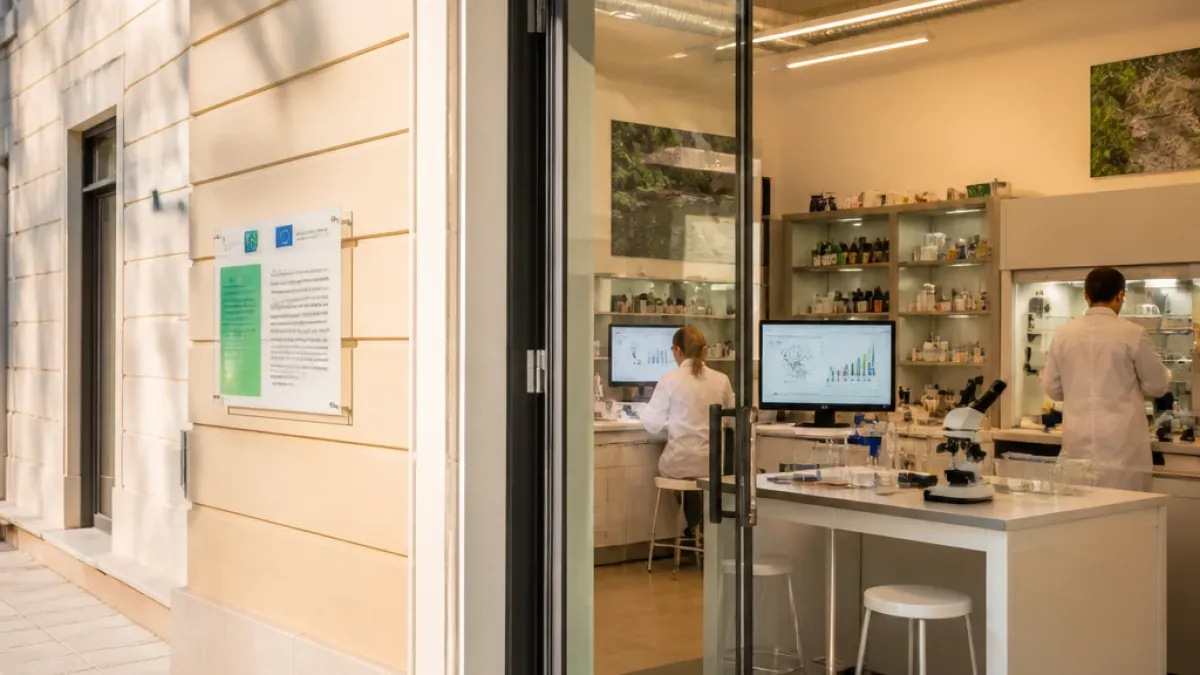
How Human Chemists Train Robotic Arms
Warp Sciences does not plan to invent its own drugs from scratch, choosing instead to assist drug developers with test chemistry. When research teams discover a lead molecule, chemists must build hundreds of subtle variations to test how each tweak changes potency and cuts side effects. The startup doesn’t replace early discovery teams, but focuses on the heavy physical work of testing chemical adjustments [2].
Human chemists at the company wear cameras and pressure-sensing gloves while running bench tests, generating visual records for proprietary AI models. Weil argued that AI moved faster in virtual settings than in physical labs because software tools generate their own training feedback. “It’s still an area where frontier AI models are not yet changing the world in the way models are changing the world in software engineering and math,” Weil said. “That’s because the field is so much more experimentally driven. The models need to see that data.” [2] Weil said software teams advanced rapidly after researchers evaluated AI in mathematics after OpenAI claims, but physical chemistry still depends on physical bench data.
By turning bench habits into software controls, the company lets robotic arms conduct chemical synthesis around the clock [1]. Robotic setups repeat pipetting, mixing, and heating routines through the night while human chemists sleep. Scientists then analyze results during the day [3]. Daily developer platform daily.dev reported that this continuous loop helps developers track robotics techniques for lab work [4].



Supply Chain Risks and Contract Labs
For years, American biotech firms routinely sent repetitive synthesis tasks to overseas contract research organizations, allowing Chinese firms like WuXi AppTec to build vast chemistry hubs that synthesized thousands of test molecules faster and cheaper than domestic labs [2]. Western startups stayed lean. They spent funds on clinical trials while outsourcing physical benchwork to Asian contractors [3].
Federal defense officials placed WuXi AppTec on a blacklist over alleged military ties in June, but an American judge paused that order in August. Ana-Maria Stanciuc reported in The Next Web that this dispute exposed major vulnerabilities in global drug supply chains [2].
National security questions are not the only issue pushing drugmakers to reconsider foreign manufacturing contracts. Weil told Bloomberg that several drug firms worry about sharing sensitive molecular blueprints and intellectual property with third-party contractors abroad [2]. By setting up robotic labs within the United States, Warp Sciences hopes to convince drug firms that they can keep their private data at home without paying the steep labor expenses of manual chemistry. Domestic drug developers could run high-speed test cycles while ensuring that unreleased molecular structures remain protected inside American facilities [1]. Weil believes that keeping private data within domestic borders offers firms greater legal certainty as geopolitical tensions between global superpowers continue to escalate [2].
Warp Sciences Faces Wet Lab Hurdles
Automating hands-on chemistry presents stubborn mechanical problems that software engineers do not encounter when building digital tools. Unlike computer code, physical chemical reactions behave unpredictably when ambient temperatures drift or chemical powders clump. Robotic arms must handle fragile test tubes, monitor heated reaction plates, and transfer sensitive fluids without spilling a single droplet across the workbench [3].
Moving from promising pilot trials to dependable, production-grade automation requires overcoming deep practical obstacles. A machine that executes a reaction successfully ten times might still fail when running thousands of cycles across diverse chemical reagents. WE NEWS reported that validation, quality control, and regulatory traceability remain essential before any experimental data can support drug discovery pipelines. Automated setups must detect unexpected bubbles, temperature spikes, or clogged nozzles in real time to avoid spoiling expensive batches of test compounds. Without dependable error recovery, robotic tools risk creating costly delays rather than speeding up preclinical development [3].
Observers debate whether robots will replace human bench chemists or merely assist them [3]. Warp Sciences will have to prove that its sensor-guided robots can match the adaptability of experienced bench chemists while keeping operational costs manageable [4].
OpenAI Alumni in Physical AI
Weil is not the only former OpenAI leader raising substantial capital to bring AI into physical operations. Earlier this week, former OpenAI research lead Bob McGrew raised $232 million for his startup Arda to configure automated factory lines [2]. Tech investors who backed text chatbots are now channeling hundreds of millions into tangible hardware tools [4].
OpenAI researcher Miles Wang has been in talks with Lightspeed to secure approximately $200 million for his own drug startup. In July, OpenAI-backed Chai Discovery collected $400 million, and OpenAI bought Orchestra Bio to help drug teams run development pipelines using autonomous AI agents [2].
The surge of capital behind Warp Sciences reflects an expanding belief that frontier AI must step out of virtual chat windows and enter real-world facilities, where robotic wet-lab platforms can shorten the years needed to optimize therapeutic drug molecules. Testing expands without adding payroll [1]. Daily developer summaries reported that software engineers view this round as an important test case for robotic lab automation [4]. Weil must now prove that camera-guided robotic arms can master wet-lab chemistry. Success could draw more biotech startups into robotic benchwork [1].
- ONLINE NEWS Temkin, M. (2026, October 22). Former OpenAI science lead launches Warp Science to automate wet labs with robots. TechCrunch. [Article Link]
- ONLINE NEWS Stanciuc, A.-M. (2026, October 22). Ex-OpenAI science head Kevin Weil launches Warp Sciences with $215M. TNW. [Article Link]
- ONLINE NEWS Naicker, A. (2026, October 22). Ex-OpenAI science lead launches Warp Sciences to automate wet labs with robots. WE NEWS. [Article Link]
- ONLINE NEWS daily.dev. (2026, October 22). Former OpenAI science lead launches Warp Science to automate wet labs with robots. daily.dev. [Article Link]


