






Internet directories connect names to numbers, but early internet designs lacked built-in protection for lookups. The Domain Name System Security Extensions, known as DNSSEC, add digital signatures to domain records to protect recursive resolvers from forged answers. When a resolver looks up a host in the Domain Name System, it validates these signatures against a trusted key path before delivering the IP address. DNSSEC stops cache poisoning without encrypting standard query traffic. [2]
Origin and Purpose of DNSSEC
Early internet protocols favored lookup speed over message origin checks. Directory servers answered queries on UDP port 53 without checking who sent the packet, enabling intruders to flood caching resolvers with forged records to hijack web traffic through cache poisoning. In 2004, the Internet Engineering Task Force documented these naming risks in RFC 3833 to guide defensive engineering. [2]
Engineers designed DNSSEC to stop cache poisoning while keeping existing internet software running across global networks. Published in March 2005 as RFC 4033, RFC 4034, and RFC 4035, the DNSSEC-bis core rules made the older RFC 2535 framework obsolete and introduced public-key cryptography to domain lookups. The IETF later collected these core rules into RFC 9364, giving DNSSEC Best Current Practice standing under BCP 237. By attaching digital signatures to resource record sets, DNSSEC enables validating resolvers to verify that received zone data matches what the authoritative zone owner published. Caching resolvers reject any data package that shows signs of tampering, safeguarding users from fraudulent site redirection. [2]
Security guarantees in DNSSEC focus on data origin checks and record integrity. Because DNSSEC does not provide privacy for domain lookups, query traffic travels in clear text across local links, and the protocol cannot stop distributed denial-of-service floods or fix false human assumptions such as mistaking an arbitrary web label for a legal trademark under RFC 4367. The technology instead delivers proof that received records came from the true domain owner without unauthorized changes. [2]

Core Resource Records
Zone servers manage validation by storing four special records inside the zone file. The primary validation element is the RRSIG record, which holds a digital signature calculated over an entire resource record set like address or mail pointers, allowing resolvers to check signatures against public keys in companion DNSKEY records to confirm that nobody altered answers during network transit. Whenever a caching resolver queries domain data, the server returns the requested records together with this signature wrapper. [2]
Connecting different levels of the naming tree requires a dedicated link called the Delegation Signer record. Placed in the parent zone next to delegating NS records, the DS record contains a key hash of the public key that signs the child zone. This hash creates a verifiable bridge between parent registries and child zones. [2]
Zone servers package these records automatically when a client requests validation. If a mail server queries for MX records, the answering server delivers the mail records with the matching RRSIG signature. The recursive resolver inspects signature data, matches the key tag to the published DNSKEY record, and checks the math proof before saving records into its local cache. Valid answers pass directly to user software, while answers with broken signatures get dropped to protect local devices from cache poisoning. Open-source resolvers like NLnet Labs Unbound and ISC BIND9 log these signature drops so network admins can identify zone misconfigurations or active spoofing attempts. [2]
The Chain of Trust Model
Trust in DNSSEC relies on an unbroken hierarchy following the tree structure of the internet, where a validating resolver begins verification from a pre-configured trust anchor representing the root zone public key. In 2010, ICANN and Verisign signed the root zone. This shared root anchor links all delegated top-level registries together. [1]
When resolving an address like http://www.example.com, a recursive resolver queries root nameservers to locate the authoritative servers for the top-level domain. The root response returns the .com delegation records and a DS record containing a key hash of the key signing key used by the .com registry. The resolver verifies this hash against the DNSKEY published by Verisign for .com, confirming that keys for the top-level domain are authentic before asking the .com server for the example.com delegation. This sequence ensures that every zone delegation links cryptographically to the parent zone above it, preventing attackers from injecting fraudulent nameserver addresses along the lookup path. [2, 9]

Once the resolver verifies that the DS record in .com matches the key signing key in example.com, it can trust the zone signing key that signed the final A record. If an attacker injects a spoofed IP address, the signature check fails. The resolver then returns a server failure code to the user application instead of handing over forged data. Security breaks if any link in this chain contains missing signatures or expired keys. [2]
Denial of Existence in DNSSEC
Proving that a domain name does not exist creates an architectural challenge for static signature systems. Zone servers cannot generate signatures for non-existent names on demand because the pool of possible queries is infinite. Early standards solved this with the NSEC record, which links existing names in alphabetical order to prove no records exist between them. [2]
Standard NSEC records introduced a privacy risk because curious actors could query nonexistent names sequentially to map every entry in a private zone. To stop this zone walking exposure, the IETF published RFC 5155 to define the NSEC3 record, which sorts hashed labels rather than plaintext names. Hashing adds defensive friction, but motivated attackers with fast processors can still carry out offline dictionary attacks against zone hashes. In a 2014 study presented at the IEEE NCA conference, computer scientist Michael Wander and co-authors showed that a graphics processor cluster could unhash 64 percent of all signed names in the .com zone within four and a half days. [4]
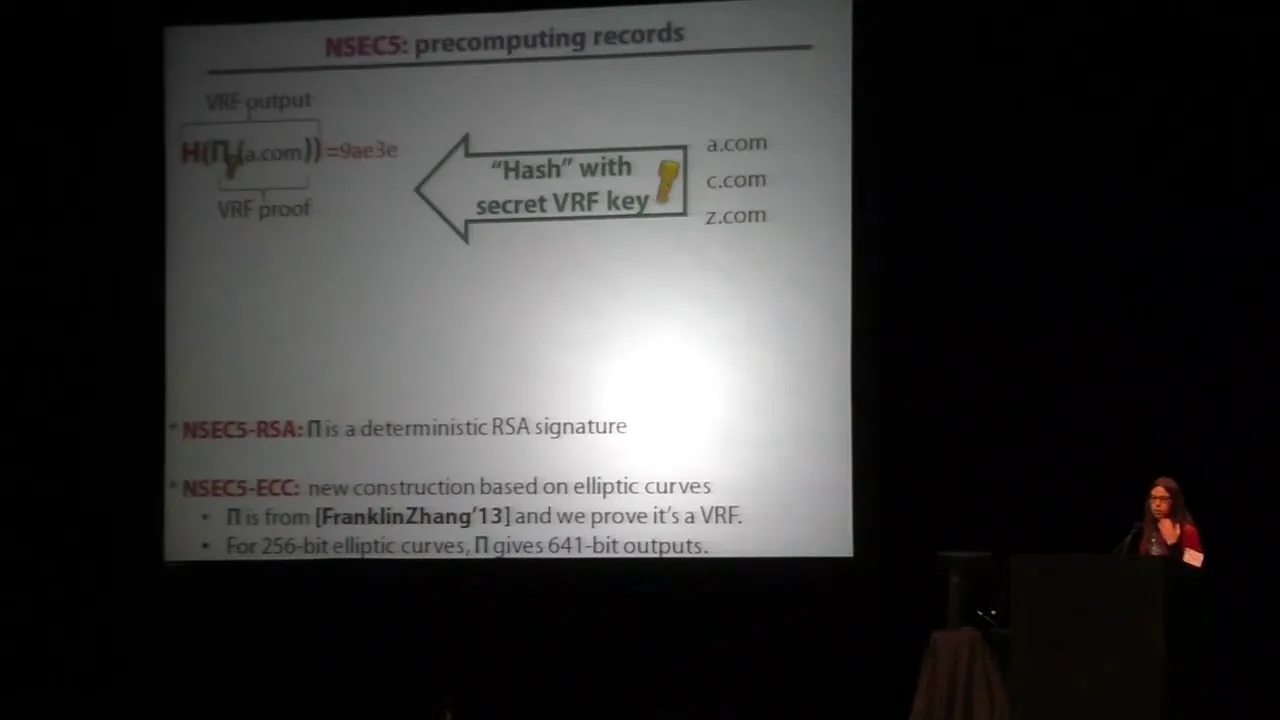
Researchers later designed alternative methods to prevent zone enumeration without placing heavy computational burdens on nameservers. Boston University computer scientist Sharon Goldberg proposed NSEC5, an architecture that replaces unkeyed hashes with public-key verifiable random functions. Prototype implementations evaluated on CZ.NIC Knot DNS 1.6 and NLnet Labs Unbound 1.5.9 showed that elliptic curve variants could process up to 64,000 queries per second on multi-core servers. This security model prevents zone enumeration mathematically while keeping response packets small enough for standard network transmission. [5]



Resolver Validation on Client Systems
Recursive caching resolvers perform the computational work needed to verify digital signatures across each domain lookup. When a security-aware resolver queries an authoritative server, it sets the DNSSEC OK flag bit standardized through Extension Mechanisms for DNS in RFC 6891. This extension expands buffer limits beyond traditional 512-byte UDP packet boundaries, enabling networks to carry larger signed records reliably. [2]
Client operating systems generally conserve processor power and battery life by offloading verification tasks to upstream network resolvers. In Windows Server 2008 R2 and Windows 7, Microsoft built a non-validating security-aware stub resolver that reads validation flags without computing complex cryptographic proofs locally. System administrators manage this behavior through the Name Resolution Policy Table, which distributes client rules across corporate networks using Group Policy. The policy instructs the client stub to accept answers only if the local network resolver successfully verified the zone signatures, satisfying U.S. federal guidelines under NIST SP 800-53. This separation of roles keeps desktop overhead low while enforcing domain security across large enterprise environments. [3]
Guarding the network path between client machines and the local recursive resolver remains essential, leading Microsoft deployment guidelines to recommend using IPsec or Transport Layer Security to shield this last-hop connection from rogue actors on local subnets. Enterprise network teams must exempt port 53 traffic from domain isolation policies. Without last-hop protections, an attacker on a local Wi-Fi network could spoof answers after the corporate recursive server verified the authentic records upstream. Both ends need protection. [3]

Transition to Modern Cryptographic Algorithms
Registry operators originally signed top-level domain records using RSA-based cryptographic algorithms such as Algorithm 8, formally known as RSA/SHA-256, where Verisign configured registry infrastructure with a 2048-bit Key Signing Key and 1280-bit Zone Signing Keys. While RSA protected zones for years, bulky signatures created large packets that amplified distributed denial-of-service floods across the internet. Verisign introduced domain signatures to .edu during the summer of 2010, followed by .net several months later, before turning on the technology for .com in 2011. [9]
To reduce packet amplification and improve signing efficiency, registry operators began transitioning to Algorithm 13, designated as ECDSA Curve P-256 with SHA-256 under RFC 6605. The Internet Assigned Numbers Authority recommends this elliptic curve algorithm for zone signing and resolver validation. Verisign engineer Duane Wessels stated that moving to ECDSA reduces individual signature footprints from 160 bytes down to 64 bytes. This 96-byte reduction conserves network bandwidth and lowers packet sizes during high-volume query periods. [7, 9]
National registry teams have validated these algorithm migrations under demanding production conditions. In the Netherlands, SIDN engineer Stefan Ubbink documented the transition of the .nl country-code zone from Algorithm 8 to Algorithm 13. SIDN operated both cryptographic algorithms in parallel throughout a 150-hour caching period to ensure that recursive resolvers around the world updated their local cache tables. After deleting the older Algorithm 8 records from the root zone, the .nl zone file shrank by roughly 42 percent, completing signature verification across more than 20 million records with hardware security modules. The migration cut recurring zone signing durations by three minutes. [8]
DNSSEC Adoption Across Top-Level Domains
Adoption of DNSSEC signing has expanded at uneven rates across different sectors of the global internet. As of March 2026, 83 country-code top-level domains, representing roughly 45 percent of all ccTLDs, have activated DNSSEC in production, while second-level adoption exceeds 50 percent in the Netherlands, Sweden, Norway, and the Czech Republic thanks to registrar automation and fee discounts. [2]
Commercial generic top-level domains have adopted DNSSEC at a slower pace over the past decade. Verisign tracked annual growth in signed .com domains at just 0.1 percent before 2020, when a major domain registrar began enabling DNSSEC by default for newly registered domains. That automated policy accelerated registry figures, pushing signed domains to 4.2 percent in .com and 5.1 percent in .net. Despite these gains, prominent corporate domains including google.com, amazon.com, and microsoft.com historically kept their primary second-level records unsigned. Enterprise operators often cite operational complexity and the risk of accidental outages as primary reasons for hesitating, preferring unauthenticated resolution over the risk of breaking customer connectivity. [9]
To reduce manual errors that hinder DNSSEC adoption, ICANN opened public consultations on automated Delegation Signer management under RFC 7344 and RFC 8078. Maintaining stable directory infrastructure requires constant operational care, as seen when ICANN applied emergency patches to resolve a critical PHP vulnerability across public web portals while reviewing automated registry workflows. Streamlining key rollovers helps domain owners maintain valid trust chains without risking manual configuration mistakes that knock web services offline. [6]
Vulnerabilities and the KeyTrap Threat
Cryptographic validation protects network users from address spoofing, but the mathematical rules governing DNSSEC can introduce new stability hazards. In 2024, researchers at the ATHENE center discovered a severe flaw designated as CVE-2023-50387, known as KeyTrap. Led by Professor Haya Schulmann, the team showed that standard verification rules could force resolvers into exhaustive computation loops using a single packet. [10]
An attacker exploiting KeyTrap sets up a malicious zone configured with many cryptographic keys sharing the same key tag together with signatures referencing that tag. Following standard specifications, a resolver attempts to validate every available key against every signature, causing processor usage to spike into a quadratic complexity loop. ATHENE researchers Elias Heftrig, Niklas Vogel, and Professor Michael Waidner demonstrated that sending a few packets per minute could stall popular resolver software, including BIND9, Unbound, Google Public DNS, and Cloudflare 1.1.1.1, for up to 16 hours. DNS software vendors quickly issued coordinated patches that limit the maximum number of validation attempts permitted per lookup. [10]
Securing the domain namespace also establishes foundations for higher-level security protocols like DANE, defined in RFC 6698, which binds Transport Layer Security certificates directly to domain names. Mail platforms such as Postfix and Exim use these records under RFC 7672 to verify secure SMTP connections without relying on commercial certificate authorities. Academic researchers have even evaluated signed domain records to build credible food supply chain tracking systems in China. Cryptographic domain security continues to advance, balancing verification rigor against the computational costs of running modern internet infrastructure. [2, 10]
- WEBSITE Internet Corporation for Assigned Names and Numbers. (2022). Root zone KSK algorithm rollover. ICANN. [Article Link]
- WEBSITE Wikipedia contributors. (2026). Domain Name System Security Extensions. Wikipedia. [Article Link]
- WEBSITE Microsoft. (2012). DNS Security Extensions (DNSSEC). Microsoft Learn. [Article Link]
- CONFERENCE PAPER Wander, M., Schwittmann, L., Boelmann, C., & Weis, T. (2014). GPU-based NSEC3 hash breaking. 2014 IEEE 13th International Symposium on Network Computing and Applications, 137-144. [Article Link]
- WEBSITE Goldberg, S. (2014). NSEC5: Provably preventing DNSSEC zone enumeration. Boston University. [Article Link]
- ONLINE NEWS Oluka, P. (2026). ICANN restores websites after PHP security vulnerability. Techeconomy. [Article Link]
- WEBSITE Internet Assigned Numbers Authority. (2026). Domain Name System Security (DNSSEC) algorithm numbers. IANA. [Article Link]
- WEBSITE Ubbink, S. (2023). New DNSSEC algorithm for.nl. SIDN. [Article Link]
- WEBSITE Wessels, D. (2023). Verisign will help strengthen security with DNSSEC algorithm update. Verisign Blog. [Article Link]
- WEBSITE Heftrig, E., Schulmann, H., Vogel, N., & Waidner, M. (2024). KeyTrap: Serious vulnerability in the internet infrastructure. ATHENE. [Article Link]
Cover image: Kaaa / Wikimedia Commons, CC0


