



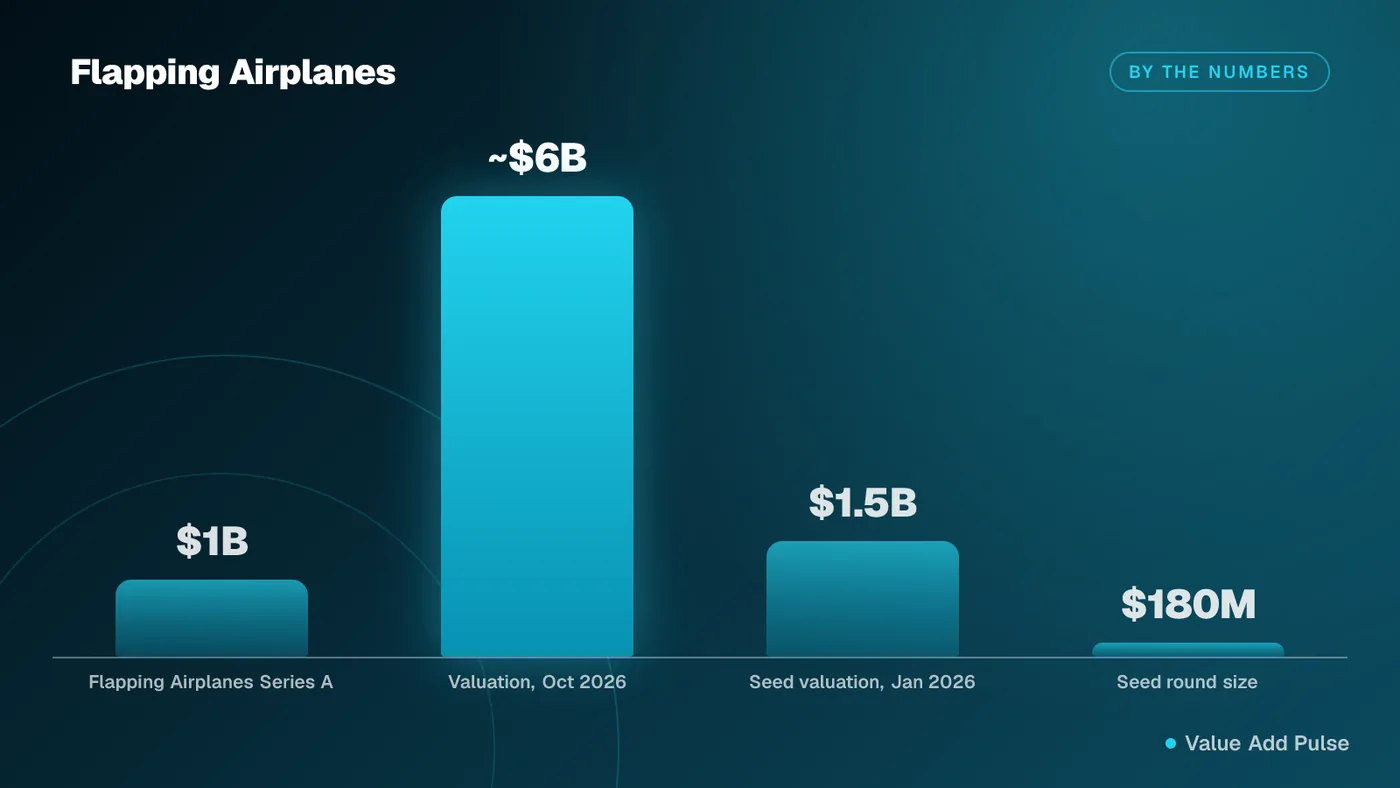
Artificial intelligence research lab Flapping Airplanes announced on Wednesday that it raised $1 billion in a Series A funding round, quadrupling its valuation to $6 billion just nine months after its public launch. The round was co-led by venture capital firms Index Ventures and Lux Capital, with earlier backers Sequoia Capital, Alphabet’s GV, and Kleiner Perkins returning to provide more cash [1]. The year-old San Francisco startup focuses on basic research instead of commercial sales, but it has no product on the market yet [2].
Investor Roster Behind Flapping Airplanes
The new financing marks a fast valuation jump for Flapping Airplanes, which launched in late 2025 before closing a $180 million seed round at a $1.5 billion valuation in January. Total capital raised now stands at $1.18 billion [3].
Index Ventures and Lux Capital Management co-led the Series A round alongside returning seed backers, while new participants included Valor Equity Partners LP, Atreides Management LP, A*, Jump Trading Group, XTX Ventures, and Nvidia Corp. Index partner Mark Xu is taking a board seat. Xu and Index partner Shardul Shah argued that global demand for AI models will continue to outrun the available supply of chips and data, singling out robotics, algorithmic trading, and life sciences as fields that urgently need cheaper computing methods [3]. Index raised $2 billion in August to expand its investments in machine learning firms [4].
Sequoia Capital partner David Cahn, an early investor who has tracked the founders for years, said the team stands apart from peers in Silicon Valley. “There are so many of these AI labs that you can get lost in the noise,” Cahn said. “But this is not a one-of-many company; this is a one-of-one company” [7]. Sequoia, GV, and Kleiner Perkins all joined both rounds [1].

Data Efficiency on Graphics Chips
Flapping Airplanes centers its research on a simple thesis: cutting-edge models can learn from far less data than current systems consume, avoiding the need for ever-larger web archives. Co-founder Asher Spector told Bloomberg that soaring infrastructure costs will soon hit severe boundaries, arguing that demand for intelligence is already outpacing hardware and data production. “The basic thesis is demand for AI is going to outpace chip and data supply,” Spector said [2].
Because companies spend billions on silicon, small hardware improvements can create massive financial value. Spector said that boosting hardware output by 10% would prove “tremendously economically valuable” across the technology sector. “The company that’s going to be most successful, and create the most value for the world, is the one that can squeeze the most out of the inputs,” he said [2]. Lux Capital partner Brandon Reeves said that getting more out of existing chips will prove vital as machine learning expands [7].
The lab builds its own low-level software stack rather than relying solely on standard developer packages. Co-founder Aidan Smith said the team writes custom software to run Nvidia graphics chips directly, giving researchers granular control over how physical circuits execute mathematical calculations. Spector said Flapping Airplanes plans to sell its software in the future to help other companies deploy models affordably [4].



The Trio Behind the Research Team
Flapping Airplanes was founded by Aidan Smith and brothers Asher Spector and Ben Spector. Asher Spector completed a statistics doctorate at Stanford University. His brother, chief executive Ben Spector, is a doctoral student in computer science at Stanford who previously founded the Prod incubator while studying at the Massachusetts Institute of Technology. Prod grew into a student-run accelerator in Silicon Valley that Sequoia partner David Cahn called one of the most effective talent pipelines in tech, describing the founders as building “the young person’s AGI lab”. The three founders combined backgrounds in statistical theory, systems software, and neural engineering to launch their venture [1].
Ben Spector previously served as lead author on ThunderKittens, an open-source software toolkit released in 2024 to help programmers write fast GPU kernels. That work anchored the lab’s low-level systems focus [3]. Co-founder Aidan Smith is a former Thiel Fellow who worked on brain implant hardware at Neuralink Corp. during his college studies [1].
The research team works in person at an office in San Francisco rather than using remote contractors [3]. Index Ventures said that this setup makes the group of about two dozen people one of the most vertically integrated teams in the AI sector, with staff collaborating daily across GPU kernels, pre-training, and inference [6].
The Flapping Airplanes Megakernel
The technical centerpiece of the lab is what the founders describe as the world’s most complete megakernel framework. A kernel executes code on a GPU [1]. Common machine learning pipelines launch many separate kernels in sequence, which forces the processor to waste idle cycles between calculation steps as data moves back and forth through memory [3]. A megakernel bundles multiple tasks into a single program (a GPU execution package) so the chip never sits idle between tasks [1].
Flapping Airplanes claims its software can train models, process user queries, and run video games concurrently inside a single kernel. This design lets memory-bound inference overlap with compute-bound training on the same chip. While one part of the workload waits for data from memory, the math units keep working on the training run without pause [1].
The founders believe this approach can build capable models without ingesting half the internet. “A model that’s a million times more data efficient is probably a million times easier to put into the economy,” Asher Spector told TechCrunch [1]. The lab’s name comes from the ornithopter, an aircraft design built with flapping wings. Spector said it represents combining biological efficiency with artificial computing [4].

Competition with Frontier Compute Budgets
The $1 billion Series A puts Flapping Airplanes among the most heavily funded early-stage labs in the United States. Deal tracking data compiled by Dealroom ranks the funding round in the top 1% by size across nearly 3,500 comparable early-stage deep tech deals. The transaction closed during an active period for the industry, as artificial intelligence captured 64% of global venture funding in late 2026 [6].
Flapping Airplanes belongs to an expanding group of AI neolabs that explore foundational theories before developing market-facing tools or pursuing revenue [2]. Venture firms poured massive checks into similar research groups throughout 2026 [6]. Safe Superintelligence secured a reported $5 billion and TypeSafe AI raised $870 million at a $7.5 billion valuation, while Yann LeCun’s AMI Labs collected about $1 billion and Mirendil gathered $200 million. Thomas Reardon’s brain-inspired startup Flourish sought $500 million [4].
This capital wave tests an alternative to the scale-above-all path followed by OpenAI, Anthropic, and Google DeepMind, which have committed hundreds of billions to data centers and processors. Venture funds previously backed alternative silicon approaches, including SiMa.ai hitting a $1.45 billion valuation for physical AI chips, but the new capital commitment to software optimization operates at a much larger scale. While DeepSeek proved that algorithmic efficiency can trim training budgets, Flapping Airplanes is betting that data efficiency can also succeed on frontier models [5].
Flapping Airplanes has not published comparative benchmarks against standard GPT-class or Claude-class foundation models, leaving its technical claims unproven at production scale [5]. Without commercial products or revenue, the $6 billion valuation leaves little cushion if software optimization fails to deliver the promised savings [6].
- ONLINE NEWS Bort, J. (2026, October 21). Year-old AI lab Flapping Airplanes raises $1B at a $6B valuation. TechCrunch. [Article Link]
- ONLINE NEWS Metz, R. (2026, October 21). AI research startup Flapping Airplanes valued at $6 billion. Bloomberg. [Article Link]
- ONLINE NEWS Riley, D. (2026, October 21). Year-old AI research lab Flapping Airplanes raises $1B at a reported $6B valuation. SiliconANGLE. [Article Link]
- ONLINE NEWS Stanciuc, A.-M. (2026, October 21). AI lab Flapping Airplanes is now worth $6B, four times its January value. TNW. [Article Link]
- ONLINE NEWS Cohen, T. (2026, October 21). Flapping Airplanes raises $1B | Valuation quadruples to $6B. Value Add Pulse. [Article Link]
- ONLINE NEWS GPTOnline Editorial Team. (2026, October 21). Flapping Airplanes raises $1B Series A at $6B valuation. GPTOnline. [Article Link]
- ONLINE NEWS Navi. (2026, October 21). Flapping Airplanes AI startup raises $1B at $6B valuation. TheOutpost.ai. [Article Link]


