





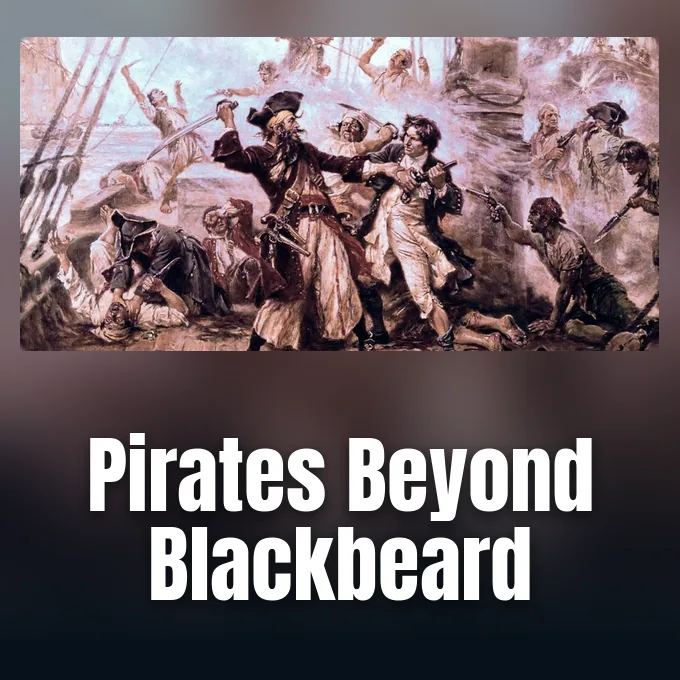
Every September 19, International Talk Like a Pirate Day inspires children and adults across the globe to don tricorne hats, wave plastic cutlasses, and mimic theatrical accents. Did real maritime marauders actually behave like Hollywood characters? Popular culture frequently equates seafaring crime with English outlaws plundering tropical islands, yet the historical golden age of piracy encompassed a vastly wider geographic and cultural spectrum. Archival records reveal that oceanic raiders were far more diverse than Edward Teach, operating across complex imperial frontiers from the Caribbean Sea to maritime East Asia [2].
Atlantic Crews in the Golden Age of Piracy
English privateer Edward Teach, famously memorialized as Blackbeard, solidified popular perceptions of Atlantic marauders after appearing in Captain Charles Johnson’s 1724 volume A General History of the Pyrates. Born in Bristol around 1680, Teach became infamous during the golden age of piracy spanning roughly 1650s to 1720. Popular stories treat these crews as English outcasts. In reality, Atlantic ships assembled multi-ethnic crews uniting Europeans and sailors of African descent [2].
Freedom was precarious aboard these ships. While some enslaved individuals escaped servitude by joining raiding expeditions, colonial archives show that Atlantic crews also captured enslaved people and maintained them in forced bondage at sea. Language barriers complicated everyday shipboard operations. French surgeon Alexander Exquemelin, who sailed aboard a Caribbean raiding vessel in the late 1600s, observed that the greatest part of the pirates were skillful in the Spanish tongue rather than English [4].
Historian Kristie Patricia Flannery investigated these Caribbean networks, summarizing archival records of multi-ethnic crews. Colonial records dispel simplistic assumptions about early modern maritime life. Flannery presented these findings in a 2026 preprint exploring global piracy, noting that while the manuscript has not yet undergone formal peer review, Atlantic court records consistently document multi-lingual interaction among mariners. Just as ecological research demonstrates that complexity in pre-colonial Aboriginal food practices replaced rigid binaries, maritime records show that 17th-century shipboard life resisted monolithic cultural categories [1].
Where Did the Hollywood Pirate Accent Originate?
Modern audiences immediately recognize the theatrical growl and rolling consonants associated with cinematic buccaneers. Oscar Tay explains that this cadence reflects West Country English (the historic dialect spoken across Devon, Dorset, Bristol, Wiltshire, and southwestern England) rather than authentic seafaring speech. In this regional dialect, speakers emphasize syllable-final R sounds and frequently employ ‘be’ in the present tense. Sir Francis Drake and Edward Teach both hailed from this corner of England, meaning Teach likely spoke with a regional West Country voice [6].
Hollywood films amplified these regional mannerisms into a universal trope. Mid-century cinema transformed local English dialects into an enduring international caricature [6].
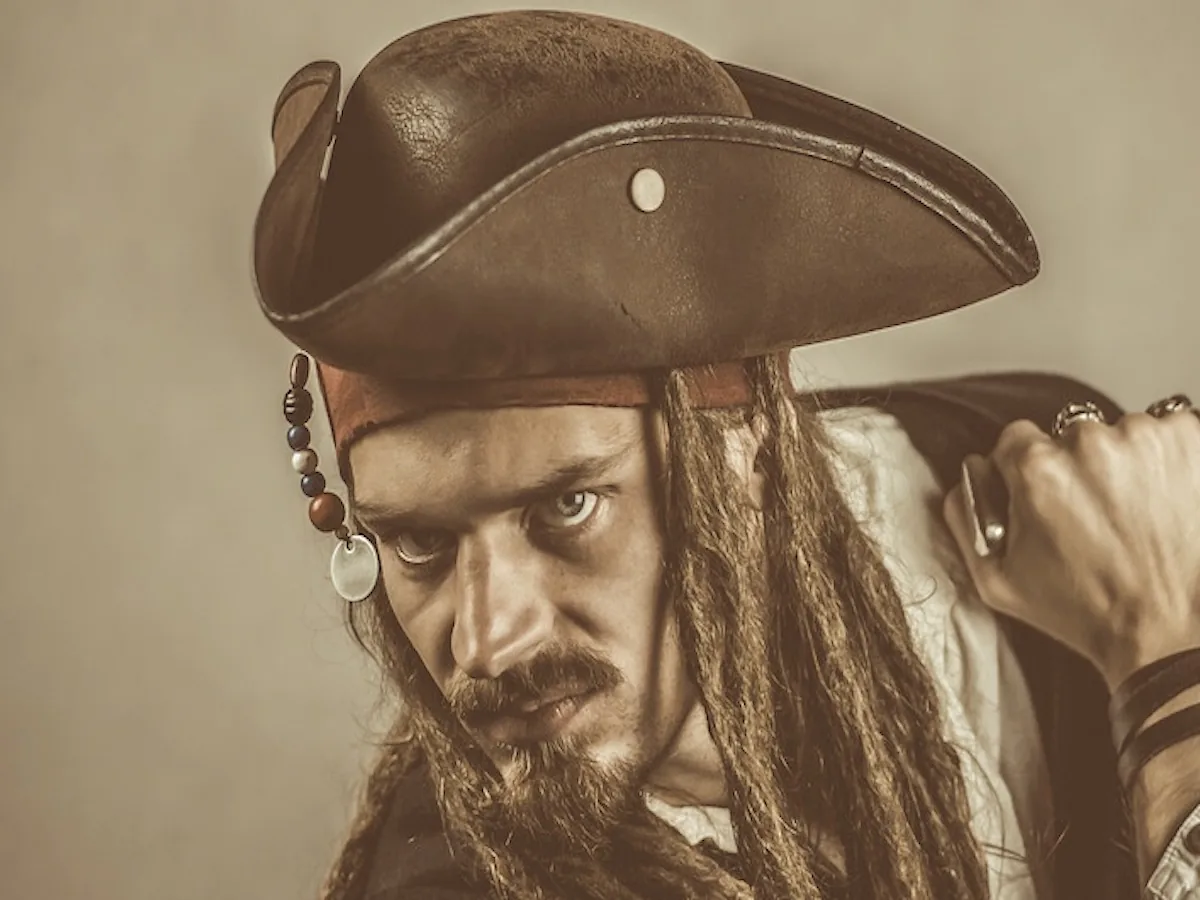
The cinematic transformation began with 20th-century actor Robert Newton. Born in Dorset, Newton possessed a natural West Country accent that he exaggerated when portraying Long John Silver in Disney’s 1950 adaptation of Robert Louis Stevenson’s 1883 novel Treasure Island. Newton reprised this delivery when playing Blackbeard in 1952, establishing the archetype that subsequent screen portrayals copied. Most historical sea raiders sounded nothing like Newton. Renowned leaders like Chinese commander Ching Shih spoke East Asian languages, proving that global mariners spoke whatever tongues originated in their native homelands [6].
Maritime Power of Imperial Chinese Pirate Fleets
While European navies focused on Atlantic shipping lanes, maritime Asia witnessed naval enterprises operating on an entirely different scale. During the 17th century, immense Chinese pirate fleets dominated key trade corridors across the western Pacific Ocean. The most formidable confederation belonged to the Zheng family, whose commercial network generated substantial wealth. By mid-century, this syndicate earned more revenue than the entire Dutch East India Company, illustrating that Asian maritime raiders wielded geopolitical leverage rivaling Europe’s wealthiest monopolies [2].
Commander Zheng Chenggong, known to Western contemporaries as Koxinga, personified this transnational maritime leadership. Born in Hirado to a Japanese mother and a Chinese merchant-pirate father, Zheng Chenggong was fluent in Japanese and Hokkien. In 1662, his forces seized Taiwan and expelled the Dutch colonial administration. Zheng Chenggong celebrated this victory by commissioning an official portrait portraying himself as a virtuous ruler seated on an armchair draped in tiger skin to symbolize martial authority. He died while drafting plans to assault Spanish Manila, cutting short his expansion [2].
Chinese maritime power faced imperial suppression. China’s Kangxi emperor, the 3rd emperor of the Qing dynasty, mobilized imperial resources toward the close of the 17th century to dismantle pirate confederations along the southern coast. European observers frequently overlooked how autonomous these fleets remained before Qing centralization. Just as biological discoveries reveal that diversity and complexity documented across early eukaryote fossils defied early scientific models, the Zheng enterprise proved that non-European coalitions commanded sophisticated economic infrastructure [2].


Moro Sailor-Warriors and Sulu Sea Warfare
During the 18th century, the greatest maritime challenge to Spain’s Asian empire arose from Muslim seafarers inhabiting the Southern Philippines and islands scattered across the Sulu Sea. Spanish colonial authorities applied the pejorative label ‘Moro pirates’ to these indigenous mariners. These fleets navigated coastal archipelagos using specialized vessels known as caracoas and prahus (sleek outrigger warships propelled by dozens of rowers). These vessels carried thousands of sailor-warriors equipped with a kris (a distinctive Filipino asymmetrical dagger or sword) and small cannons called lantaka [2].
Moro squadrons employed coordinated psychological tactics when engaging opponents. Squadrons approached settlements flying vibrant silk banners while beating drums and cymbals to coordinate rowers in steady rhythm. When coastal villagers spotted incoming sails, they fled into rugged interior hills or barricaded themselves inside stone churches. Raider units landed on beaches, besieging fortified outposts for several days before seizing captives and plunder. Rather than disorganized outlaws, these seafarers operated as organized maritime forces defending ancestral territories [2].
Most Moro sailors spoke Austronesian languages, including Tausug and Maranao. For centuries, their coordinated maritime campaigns resisted Spanish colonial conquest and Christianisation across the Philippine archipelago. Can regional resistance forces legitimately be classified as mere criminals? Colonial archives labelled any maritime power resisting European trade hegemony as illegitimate marauders. While Atlantic figures dominated Western books, Sulu Sea navigators defended regional autonomy across centuries of sustained oceanic confrontation [2].
Imperial Borders and the 1762 Manila Siege
The distinction between lawful warfare and maritime piracy often depended entirely on political perspective. In 1762, at the height of the Seven Years’ War (a global conflict that embroiled major European powers and their overseas colonies), a combined naval force from the British Royal Navy and the East India Company attacked Spanish-controlled Manila. British warships besieged the colonial capital for three weeks until artillery bombardment breached fortress walls. The occupying forces then subjected Manila to two days and nights of plunder, looting private residences, stripping churches, and opening crypts to extract gold jewellery [2].
Spanish observers promptly labelled these British invaders as pirates. The attackers executed three local residents who attempted to protect private property, hanging their corpses upon cathedral iron gates to intimidate surviving citizens. Spaniards noted that the British forces followed the identical playbook of oceanic marauders by arriving from sea to seize property that was not theirs. This invading armada included approximately 1,000 South Asian soldiers recruited from colonial garrisons in India, serving with Englishmen wearing traditional red coats [2].
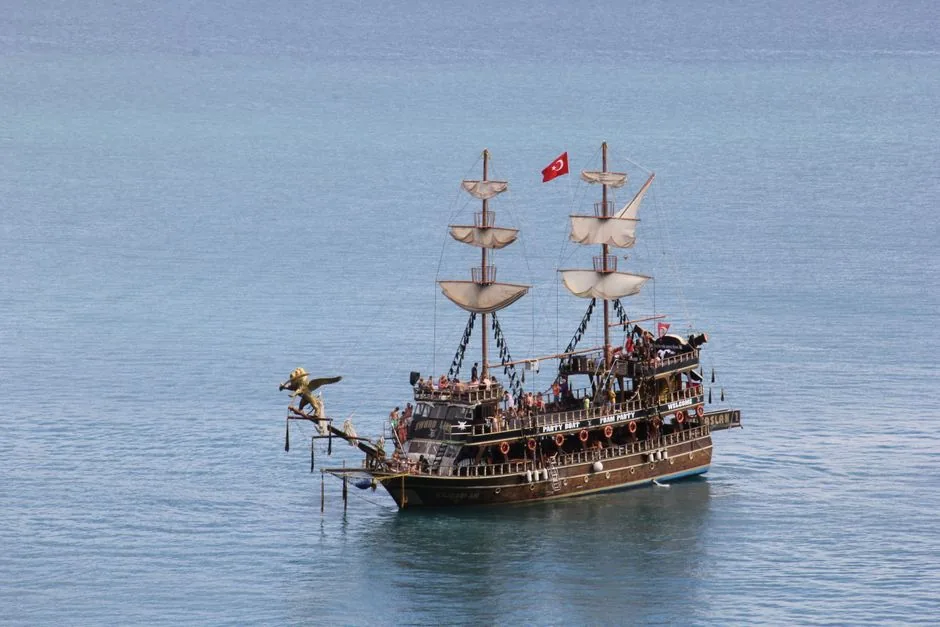
Piracy was never a neutral label. Throughout the 16th to 18th century, designating maritime actors as criminals depended almost entirely upon which imperial authority exercised political control [3]. Large-scale European operations were mostly suppressed across the Atlantic during the 1720s, when rival crowns cooperated against common enemies of mankind. In the Pacific Ocean, maritime raiding persisted because imperial jurisdictions remained contested by local rulers [2].
Distinguishing Historical Maritime Facts From Lore
Beyond accents and imperial politics, folklore has created pervasive myths surrounding the golden age of piracy. The educational platform Lessonarium examined these widespread tropes using historical evaluations from the National Maritime Historical Society. Curators investigated four fixtures of sea fiction: parrots on shoulders, buried chests, walking the plank, and piratical vocabulary. Their evaluation reveals that certain conventions reflect genuine historical practice, whereas others arose entirely from 19th-century and 20th-century literature [5].
Historical analysis establishes striking contrasts between factual maritime routines and popular folklore. The National Maritime Historical Society confirms that the parrot stereotype is strongly grounded in historical reality, as sailors frequently purchased colorful tropical birds in Caribbean and South American ports to keep as companions or sell for profit upon returning home. Conversely, the classic image of buried treasure has some modest basis in fact but was heavily sensationalized by Robert Louis Stevenson and subsequent fiction writers, given that real buccaneers preferred dividing ill-gotten gains immediately among mutineers and mariners rather than safeguarding wealth underground. Furthermore, walking the plank is categorized as almost pure fiction, as disciplined raiders rarely staged elaborate executions, opting instead for summary marooning on deserted sandbars or immediate violence at sea [5].
Re-evaluating these historical narratives broadens understanding of global maritime encounters. Recognizing the true diversity of seafaring crews dismantles Hollywood stereotypes. From the multi-ethnic Atlantic decks of Blackbeard to the colossal Pacific fleets of Zheng Chenggong and the Sulu Sea warcraft of Moro sailors, oceanic raiding involved complex societies navigating turbulent centuries of imperial transformation. When celebrations like International Talk Like a Pirate Day arrive each September 19, historical evidence invites modern observers to replace caricature with the rich realities of the golden age of piracy [2].
- PREPRINT Flannery, K. (2026). Pirates were far more diverse than Blackbeard. And they didn’t say ‘arrr’, matey [Preprint – not peer reviewed]. [Article Link]
- ONLINE NEWS Flannery, K. P. (2026, September 17). Pirates were far more diverse than Blackbeard. And they didn’t say ‘arrr’, matey. The Conversation. [Article Link]
- ONLINE NEWS Inkl. (2026, September 17). Pirates were far more diverse than Blackbeard. And they didn’t say ‘arrr’, matey. Inkl. [Article Link]
- ONLINE NEWS News4Me. (2026, September 18). Real pirates were far more diverse than the Blackbeard stereotype. News4Me. [Article Link]
- WEBSITE Lessonarium. (2026, August 19). B2 – More than “arrr!”: The truth about pirates. Lessonarium. [Article Link]
- WEBSITE Tay, O. (2018, August 31). This is why we think pirates talk in a “pirate accent”. History Hustle. [Article Link]
APA 7: TWs Editor. (2026, September 18). What defined the golden age of piracy beyond Blackbeard? PerEXP Teamworks. https://perexpteamworks.com/en/golden-age-of-piracy-history/


