



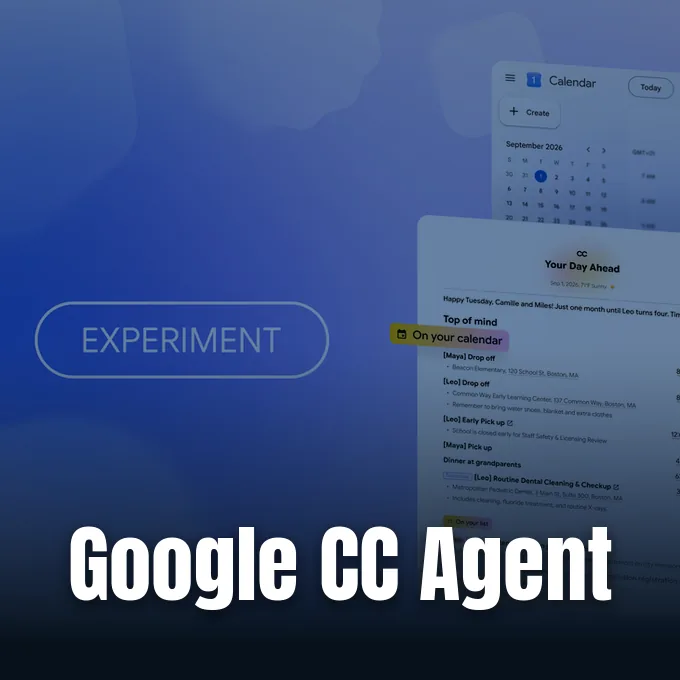
Google introduced an experimental expansion of its Google CC agent on September 17, 2026, transforming a solo productivity assistant into a shared coordinator for busy households [1]. Can multi-user artificial intelligence manage domestic chaos without exposing private personal records? By giving the agent a distinct verified Google Account (separating its identity from individual family profiles), Google Labs allows up to six adult family members to combine selected schedules, tasks, and school documents into a single morning briefing [5].
How the Google CC Agent Works
The system builds upon an experimental personal tool that Google first launched on December 16, 2025, to organize individual daily routines [5]. In May 2026, the company migrated that initial workflow into the Gemini mobile application under the name Daily Brief [1]. User feedback demonstrated that parents struggled with logistics scattered across multiple family inboxes [2]. ‘We are constantly looking for ways to leverage AI to make people’s lives easier, and family organization is a particularly complex challenge,’ said Sundar Pichai, CEO of Google [6].
Household logistics require shared coordination [1]. The Google CC agent replaces fragmented paper notes with unified digital tracking across family members [4].
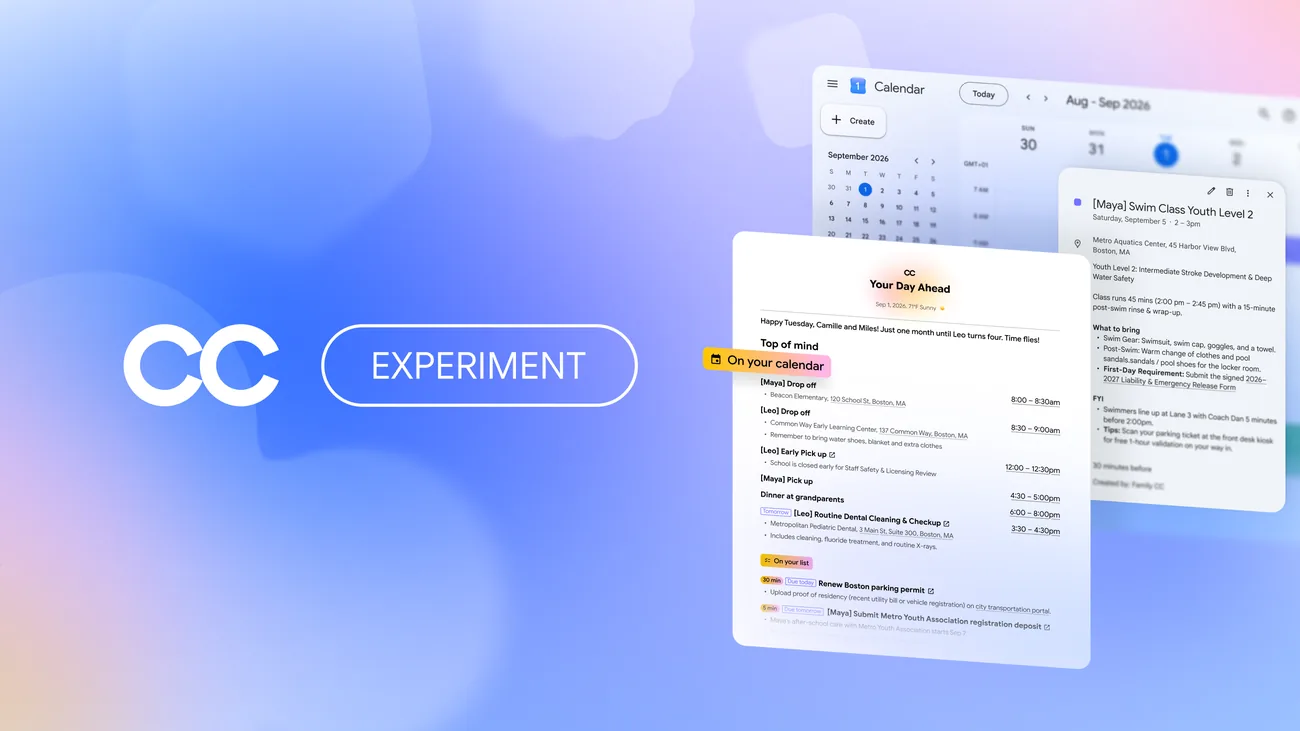
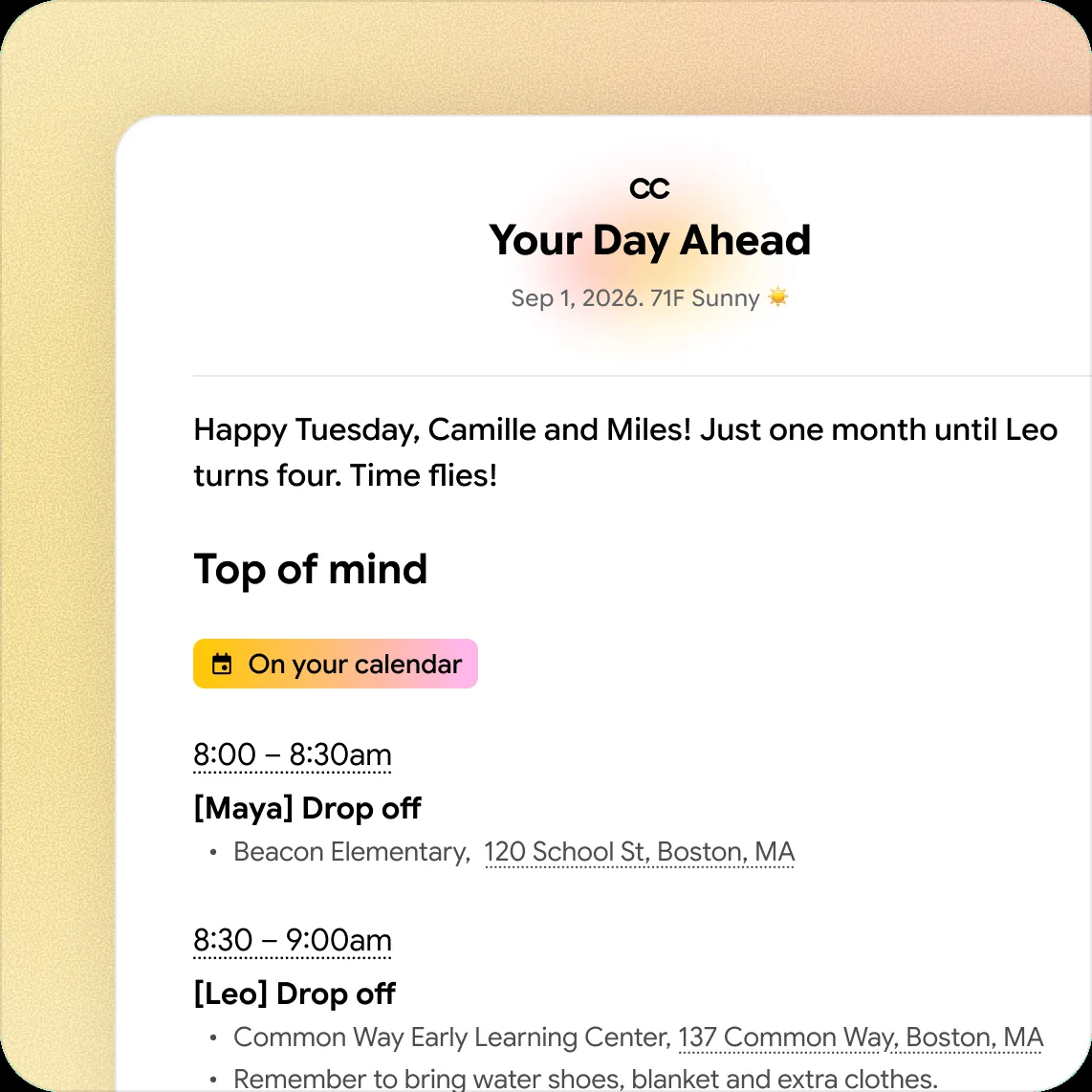
Every morning, CC generates a consolidated Your Day Ahead summary delivered directly to each participant’s inbox, highlighting who needs transportation, which chores remain incomplete, and what appointments are scheduled for the afternoon [1]. The agent coordinates shared to-do entries, drafts Google Docs for family routines, and calculates live driving times between extracurricular sports events using the Google Maps API [3]. Instead of letting vital information sit isolated within one parent’s smartphone, the software tracks updates from dentists, sports leagues, and veterinarians. Tom Shane, a senior product manager at Google Labs, noted that this collaborative architecture frees families from administrative burdens so they can focus on daily life [1].
Selective Sharing and Account Privacy
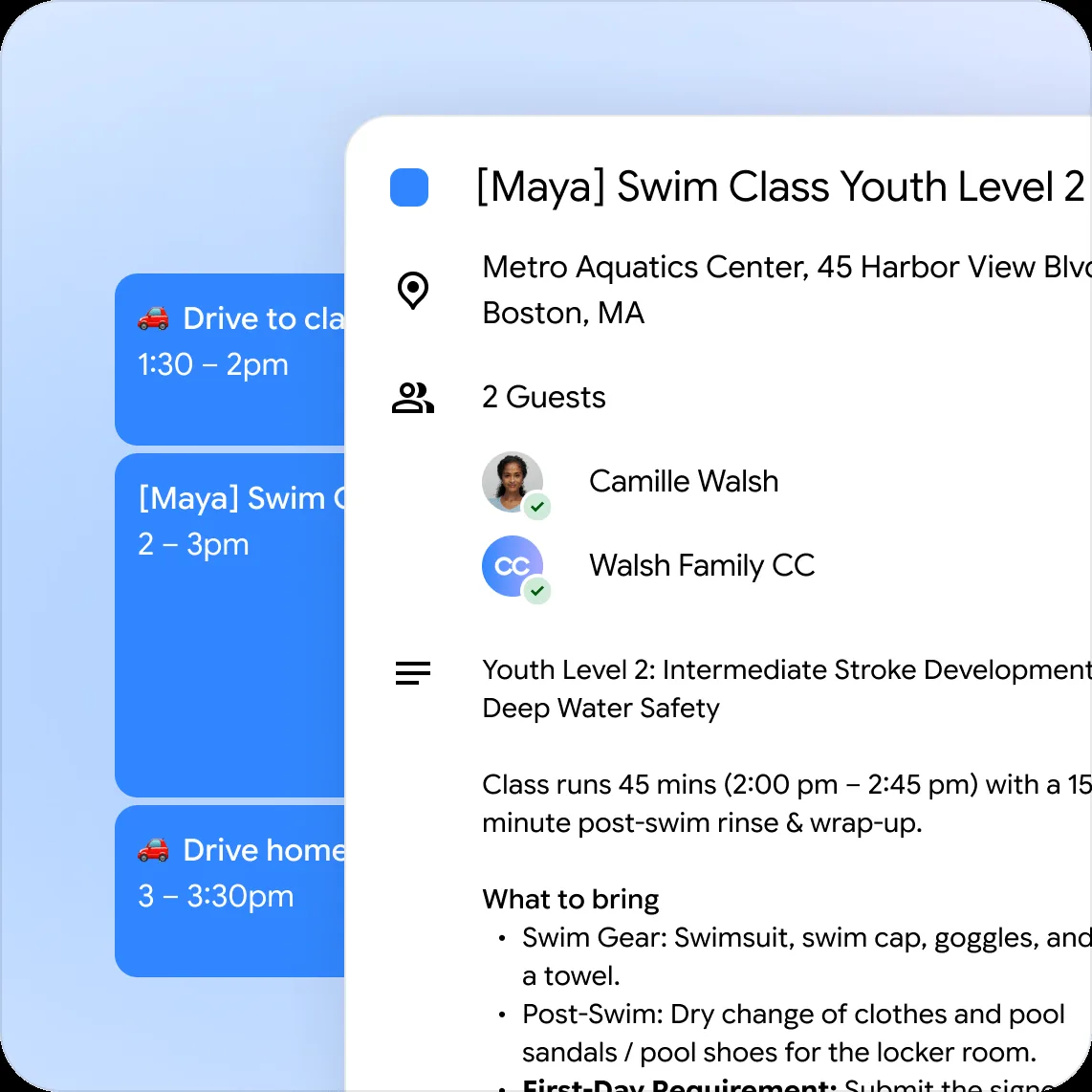
How do multiple adults collaborate through artificial intelligence without sacrificing personal confidentiality? Rather than demanding unrestricted access to an entire Google account, the platform enforces member-selected permissions for every participant [4]. Family members forward individual emails or enable an automated feature called ‘Auto cc’ for trusted senders, such as a neighborhood swim school or travel agency [1]. Each user maintains complete authority over contributed messages [4]. Privacy controls prevent unwanted data leakage across the household [3].
To maintain boundaries, the system sends each member a private weekly audit of newly encountered email senders [1]. Users decide whether messages from those contacts should enter the shared workspace. Google confirms that this filtering mechanism processes suggestions privately without storing or training on unapproved emails [5].
A core architectural advancement in the Google CC agent is its dual-tier memory system, which rigorously isolates personal preferences from collective household knowledge [4]. Shared memory retains items relevant to the entire group (such as staple grocery brand selections or preferred family restaurants), while individual memory stores member-specific context (such as unique dietary restrictions or specific work timezones) [1]. Without this clear separation, an automated system might mistakenly apply one parent’s strict nutritional routine to school lunch planning for the whole residence. By keeping these profiles distinct, the agent delivers contextual assistance without conflating personal habits with family rules, ensuring that sensitive private preferences remain unshared [4].


Automating Logistics Beyond Simple Chat
Unlike conversational chatbots that merely answer questions, the Google CC agent executes multi-step domestic workflows [4]. When an email containing a school field trip waiver arrives, the software identifies fillable PDF form fields and prepares registration documents for parental review [5]. It parses incoming event flyers received through Google Chat, adds corresponding dates to the family calendar, and creates structured checklists for supplies. If a registration requires essential medical information, the system prompts family members for the missing details and updates its group memory for subsequent forms, eliminating repetitive manual data entry across identical school terms [1].
Strict security guardrails restrict autonomous actions. The agent cannot execute purchases. It cannot enter credit card details or autonomously sign legal waivers on behalf of parents. Sensitive documents remain protected [5].
Furthermore, CC refuses access to password-protected PDF files, avoids modifying primary private calendars by default, and never transmits external emails without explicit user authorization. File processing is deliberately constrained: the system accepts images, receipts, text files, and standard PDF attachments, but rejects video and audio recordings [5]. Dedicated AI startups like Ollie and Fambot have introduced specialized domestic assistants, but Google integrates directly with established productivity tools. This deep connection allows the agent to generate spreadsheets, draft planning documents, and synchronize deadlines across existing mobile applications [2].
Technical Infrastructure and Model Architecture
Behind its user interface, each Google CC agent operates within an isolated cloud computer running Google’s proprietary agentic harness, known internally as Antigravity (the underlying execution runtime for autonomous tool use) [1]. The framework pairs autonomous task execution with the company’s latest artificial intelligence models, enabling the software to interact with web services and run complex code rather than functioning as a passive text generator [4]. Ars Technica reports that the current deployment utilizes Gemini 3.8 Flash, balancing rapid responsiveness with multimodal document reasoning [3]. This underlying engine powers automated parsing across disparate inputs, translating unstructured email text into formatted Google Calendar entries and verified household task schedules without manual oversight [4].
While hardware-level commands operate through the Google Home MCP server integration to trigger physical appliances, CC orchestrates higher-level digital logistics like calendars, documents, and form processing. These architectural tiers serve entirely separate functions within the connected household. Digital scheduling operates independently from smart device control [4].
Google’s broader consumer strategy mirrors recent enterprise shifts where autonomous systems manage end-to-end responsibilities. Gemini has expanded to more than 1 billion monthly active users, encouraging Google to launch Gemini Enterprise with integrations for Salesforce Agentforce and customer relationship management (CRM) software. Simultaneously, Anthropic folded Cowork into Claude, combining document creation and extended research workflows within a single interface. By adapting these enterprise execution concepts to domestic environments, Google brings multi-step problem solving directly into family living rooms [3].
Early Limits and Household Rollout
Despite its practical capabilities, the Google CC agent operates under strict onboarding limitations during its experimental Google Labs phase [5]. Participation is currently restricted to adults aged 18 and older within the United States who possess personal Gmail accounts [1]. A designated Group Manager establishes the household group, assigning the agent a unique name and dispatching email invitations to up to five additional adult members. Once accepted, the system automatically configures a dedicated CC calendar, a group chat space, and a shared task list [5].
Account structures remain inflexible. Individual members cannot leave an existing collective. To modify family membership, the Group Manager must delete the entire household group, dissolving shared calendars and chat archives while leaving individual member accounts intact [5].
The age restriction represents a significant operational hurdle for households with older children. Teenagers and tweens frequently manage their assignments and athletic schedules on school-issued Chromebooks using education Google accounts, yet they cannot legally join the CC network under current rules [2]. Google confirmed that CC exists as a standalone experimental service outside of Google Workspace or Gemini Apps, with optional account upgrades rolling out in waves to existing testers who signed up before September 17, 2026. Prospective users in Canada, Australia, and New Zealand must wait for localized regional rollouts, leaving international families waiting for domestic multi-user coordination tools to expand globally [5].
- PRESS RELEASE Shane, T. (2026, September 17). The new CC, an AI agent built for families. Google Blog. [Article Link]
- ONLINE NEWS Perez, S. (2026, September 18). Google’s new ‘CC’ is an AI agent that helps families run their households. TechCrunch. [Article Link]
- ONLINE NEWS TechRepublic Staff. (2026, September 18). Google CC AI agent manages family calendars and tasks. TechRepublic. [Article Link]
- ONLINE NEWS Stefanelli, G. (2026, September 17). Google launches CC, a shared AI agent for families and households. Data Studios. [Article Link]
- ONLINE NEWS Cross, A. (2026, September 17). Google Labs expands CC into an AI agent for families and households. Unite.AI. [Article Link]
- ONLINE NEWS Clark, C. (2026, September 18). Google’s experimental CC AI agent aids families. Techawave. [Article Link]


1 comment