





Google announced an end-to-end testing model on November 4, 2026, to check whether artificial intelligence systems in medicine give safe, useful, and accurate guidance. Built with health experts Dr. Elizabeth McGlynn and Dr. Dana Gelb Safran, the project sets a multi-method health AI evaluation process that tracks clinical software tools from early training to post-launch hospital audits [1].
How Health AI Evaluation Uses Three Testing Streams
The system checks clinical models in three core areas: accuracy, safety, and usefulness. Rather than relying on raw accuracy scores alone, it doesn’t overlook high-risk medical cases that doctors face in daily care. Dr. Sarah Montgomery-Taylor explained for Google that sharing this method helps engineers, doctors, and scientists build shared trust [1].
Dr. Montgomery-Taylor and colleagues including H. Subramaniam, R. Brisk, L. Foster, J. Ching, and A. Marshall detailed this method in an arXiv preprint that has not undergone peer review. To make testing clear, the team anchors audits to Critical User Journeys (CUJs). These journeys pick out vital doctor and patient tasks from a wide choice space, ensuring that checks focus on high-stakes clinical risks. Grounding trials in real user needs lets teams spot model blind spots and safety traps before code enters hospital wards. By mapping each test to specific clinical care steps, health systems can catch logic errors early [2].
To test those journeys, the authors combine three tools: closed-question benchmarks, automated judges, and expert human review. Fast fixed tests score basic facts, but they can’t reflect open doctor-patient talks. The team uses language models as autoraters to review open dialogue, while working doctors inspect complex cases to verify clinical logic [2].

Benchmarking and Autoraters Across the Model Lifecycle
The Google paper maps testing along a three-stage system lifecycle: base model training, product tuning, and post-launch clinical checks. Evaluation at each stage needs different tools because software risks shift as tools move into medical practice. During base training, automated raters screen out basic factual errors and safety flaws before clinical tuning begins. In the product phase, engineers test user prompts, screen design, and EHR system links to ensure safe clinical use. Finally, after launch, teams monitor how models perform under actual clinical pressure. Combining closed tests, automated raters, and doctor panels creates a health AI evaluation pipeline that bridges laboratory scores and everyday patient care [2].
Generative tools differ sharply from earlier testing code. As Brian J. Wells and colleagues reported in npj Digital Medicine, earlier clinical evaluation relied on guidelines like TRIPOD and discrimination metrics like AUC to check risk prediction models. Large chat models produce free text that standard math scores can’t fully judge [3].
Equity safeguards form another core pillar of model testing. While earlier studies documented healthcare AI bias in medical research arising from male-centric datasets, these newer frameworks target the entire development pipeline from prompt creation to post-launch clinical audits. In their review, Wells and co-authors point to the PROGRESS-Plus equity guide, which tracks patient traits like race, gender, language, schooling, job, and income. If training data overlooks these traits, models can give skewed advice that widens care gaps. By checking for subgroup performance gaps before launch, health systems can prevent biased code from harming underserved patients.


Institutional Review in the FAIR-AI Approach
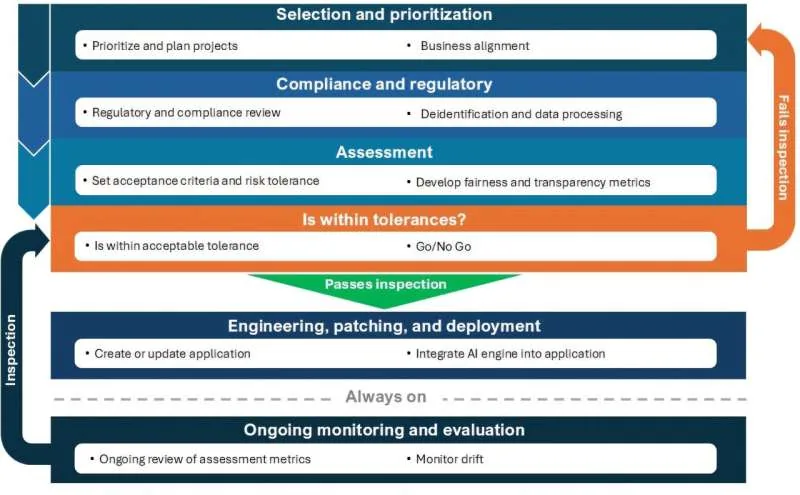
Health systems are building local review boards to manage these clinical demands. In a 2025 study, Brian J. Wells, Hieu M. Nguyen, Andrew McWilliams, Matt Pallini, and Amy Bovi introduced the Framework for the Appropriate Implementation and Review of AI (FAIR-AI). The system offers hospitals clear review steps and template forms [3].
To build that guide, the FAIR-AI team interviewed health system leaders, software builders, doctors, and patients across the southeast and midwestern United States. Members highlighted four core goals: structured risk checks, required human-in-the-loop doctor sign-off on medical decisions, caution when early clinical trial proof is scarce, and audits to verify that models trained on diverse patient groups. Co-authors Justin Kramer, Shih-Hsiung Chou, Timothy Hetherington, and Patricia Corn noted that health systems also need tools that match hospital goals and satisfy state and federal rules. Keeping humans in control ensures that automated advice never overrides clinical judgment [3].
The team also balances math checks with clinical care needs. When testing clinical value, hospitals use decision curves and net benefit scores to weigh patient harms against expected gains. In sensitive cases, the authors urge staff to inform patients and get clear consent when algorithms help guide their care [3].

Clinical Workflows and SAFE-AI Governance
Smaller healthcare teams face clear hurdles when adapting heavy institutional compliance plans. In March 2026, researchers at the Huntsman Mental Health Institute introduced the Scalable Agile Framework for Execution in AI (SAFE-AI) in the Journal of Medical Internet Research. Led by Ion Nemteanu and senior author Dr. Warren Pettine, the project gives small and medium-sized enterprises a lean path to ethical software design. Instead of setting up costly new oversight boards, SAFE-AI builds ethical safeguards right into everyday Agile Scrum sprints. Teams review data bias, clarity, and model drift during regular two-week product cycles, catching technical bugs before clinical deployment [4].
The project focuses on psychiatric and behavioral care settings where patient risks run high. “AI is increasingly shaping how clinicians make decisions in mental health care, from crisis triage to treatment recommendations,” said Pettine. SAFE-AI checks models for bias drift to protect patients who face systemic healthcare barriers [4].
This agile approach links software code with actual psychiatric clinic work. Dr. Pettine said the initiative supports the institute’s goals and matches plans for its new Translational Research Building under construction at the University of Utah. “When AI assists in mental health decisions, fairness and transparency are not optional,” said Pettine. He stressed that SAFE-AI catches errors before they harm patients, keeping equity at the center of innovation. By testing psychiatric models against real clinical care, the institute helps teams build reliable digital aids for vulnerable clinic populations [4].
Health AI Evaluation Standards from National Coalitions
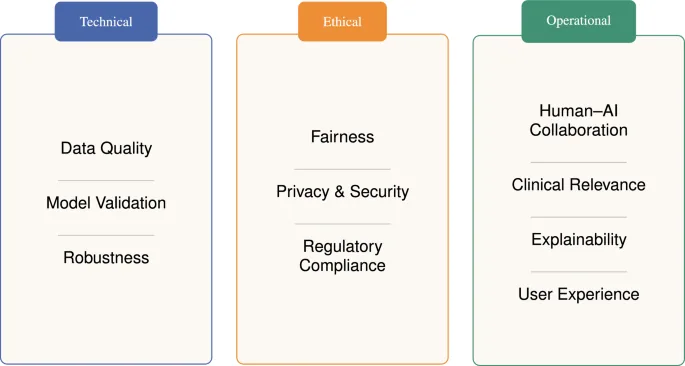
National alliances are also unifying healthcare evaluation standards. The Coalition for Health AI (CHAI), led by chief executive officer Dr. Brian Anderson, published a draft Assurance Standards Guide with Assurance Reporting Checklists for public review. “This step will demonstrate that a consensus-based approach across the health ecosystem can both support innovation in healthcare and build trust that AI can serve all of us,” said Anderson [6].
CHAI draws on consensus from a 2,500-member network of doctors, patients, and software creators. The group tests models across six use cases: pediatric asthma risk, mammography imaging, text search in medical records, outpatient care, clinical billing coding, and precision cancer genomics. “Shared ways to quantify the usefulness of AI algorithms will help ensure we can realize the full potential of AI for patients and health systems,” said Dr. Nigam H. Shah, CHAI co-founder and chief data scientist for Stanford Health Care. Ysabel Duron, head of the Latina Cancer Institute, added that patient voices protect underserved groups from algorithmic bias [6].
Global agencies and scholars are drafting companion rules for autonomous systems. In Scientific Reports, Dr. Turki Alelyani presented a validated model setting ten core safety dimensions aligned with ISO 21448 and NIST guidelines. Together with work by the ITU, WIPO, and WHO Focus Group on Artificial Intelligence for Health, these emerging protocols show how health AI evaluation is shifting into multi-layered clinical audits [5].
- WEBSITE Montgomery-Taylor, S. (2026). We’re sharing our framework for building safer and more helpful AI for health. Google Blog. [Article Link]
- PREPRINT Montgomery-Taylor, S., Subramaniam, H., Brisk, R., Foster, L., Ching, J., Marshall, A., Taylor, J., Hernandez, J., McKay, J., Obika, D., Ezeanochie, N., Goren, N., Guo, T., Kwon, R., Chung, A., Shreibati, J., Yeoum, S., Hatfield, B., Gulledge, Z.,. Thomas, S. (2026). Towards Multi-Method Evaluation of AI in Health: Integrating Benchmarks, Autoraters, and Expert Evaluation. arXiv:2611.05127. [Article Link]
- ACADEMIC JOURNAL Wells, B. J., Nguyen, H. M., McWilliams, A., Pallini, M., Bovi, A., Kuzma, A., Kramer, J., Chou, S., Hetherington, T., Corn, P., Taylor, Y. J., Cuison, A., Gagen, M., Isreal, M., & FAIR-AI Consortium. (2025). A practical framework for appropriate implementation and review of artificial intelligence (FAIR-AI) in healthcare. npj Digital Medicine, 8(1). [Article Link]
- ONLINE NEWS Brandt, P. (2026). New framework ensuring ethical and fair use of AI in health care. Medical Xpress. [Article Link]
- ACADEMIC JOURNAL Alelyani, T. (2025). A validated framework for responsible AI in healthcare autonomous systems. Scientific Reports, 15(1). [Article Link]
- WEBSITE Coalition for Health AI. (2024). CHAI Releases Draft Responsible Health AI Framework for Public Comment. Coalition for Health AI. [Article Link]


