





Retrieval-augmented generation is an artificial intelligence framework that connects large language models to outside data sources before generating user responses. Instead of relying solely on static patterns memorized during initial pre-training runs, an automated neural retriever searches an external document store, extracts relevant passages, and passes that fresh context directly into the model prompt. Meta AI researchers Patrick Lewis, Ethan Perez, Aleksandra Piktus, and Douwe Kiela developed this architecture to solve structural flaws in neural networks, including factual hallucinations, slow knowledge updates, and high compute costs [1]. Grounding text generation on verifiable records lets models deliver reliable answers while supplying clickable citations that human readers can audit, bridging the gap between frozen model parameters and dynamic enterprise documentation [2].
- Core Mechanics of Retrieval-Augmented Generation
- The Two Steps in a Retrieval Pipeline
- Vector Indexes and Hybrid Search Methods
- Why Foundation Models Need Outside Knowledge
- Enterprise and Healthcare Applications
- Relational Graph Methods in RAG Pipelines
- Data Poisoning Risks in RAG Systems
- Methods for Testing System Accuracy
Core Mechanics of Retrieval-Augmented Generation
Patrick Lewis, Ethan Perez, Fabio Petroni, Vladimir Karpukhin, and Douwe Kiela at Facebook AI Research introduced the system in a 2020 paper for knowledge-intensive NLP tasks. The team combined pre-trained parametric memory with explicit non-parametric memory to balance language fluency with factual accuracy. A standard sequence-to-sequence neural network serves as parametric memory, storing language rules and world knowledge inside billions of numerical parameters, while the non-parametric component uses a dense vector index built from five million Wikipedia articles. When an incoming query arrives, the neural retriever finds matching text passages and routes those chunks straight into the generator, allowing language models to access specialized external facts without undergoing expensive architectural fine-tuning cycles [1].
Patrick Lewis submitted the original paper to arXiv on Fri, 22 May 2020 at 21:34 UTC, with revisions appearing in Dec 2020, Mar 2021, and Apr 2021 [12]. The authors shared their preprint on arXiv before formal peer review at the NeurIPS conference in Dec 2020 [1].
Why do LLM-based tools need outside files? Luis Lastras, director of language technologies at IBM Research, explained the issue with a simple test comparison. “It’s the difference between an open-book and a closed-book exam,” Lastras said. “In a RAG system, you are asking the model to respond to a question by browsing through the content in a book, as opposed to trying to remember facts from memory,” Lastras added, noting that IBM researchers Marina Danilevsky, Dmitri Krotov, and Kush Varshney study similar retrieval boundaries [2].
The Two Steps in a Retrieval Pipeline
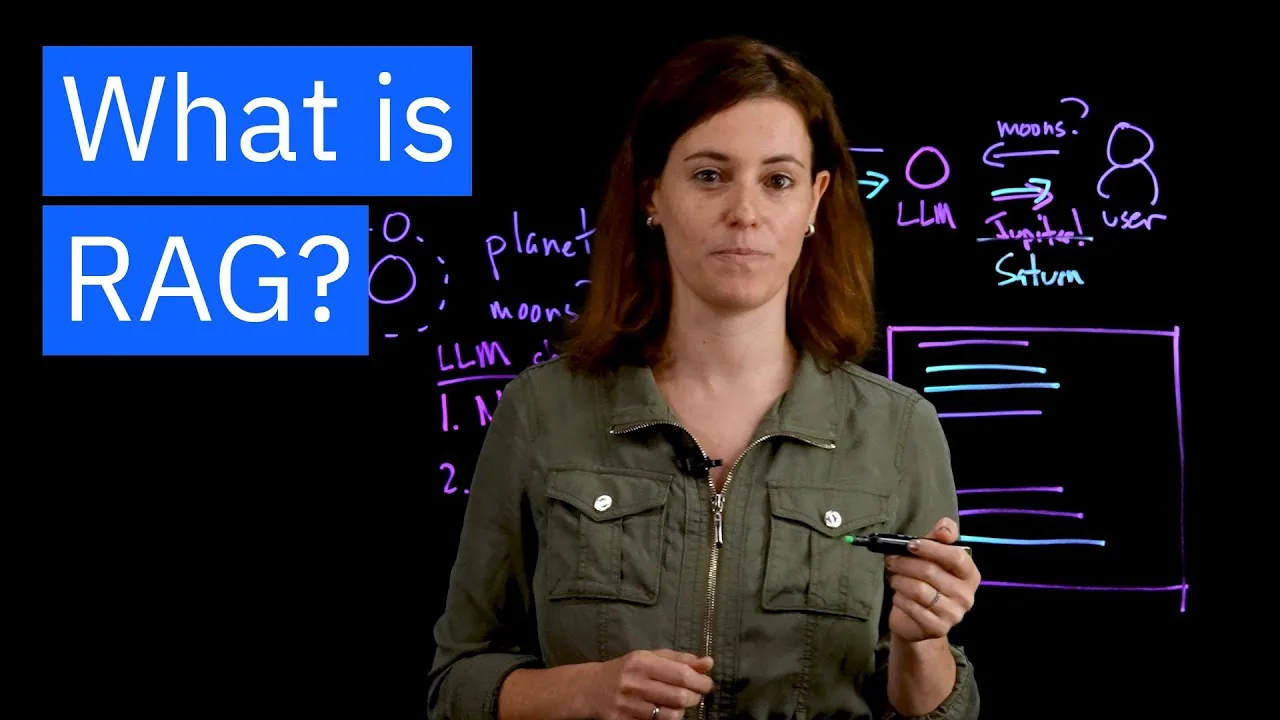
Every pipeline splits information processing into retrieval and generation stages [2]. Before any user enters a query, engineering teams take raw documents, divide them into manageable text segments called chunks, and calculate numerical vectors for each segment through an embedding model to map semantic concepts rather than simple keyword matches [4].
During the retrieval step, the system fetches relevant text chunks and appends them to the original prompt in a process known as prompt augmentation [3]. The language model receives this enriched prompt and synthesizes a fluent response drawn from both its pre-trained linguistic training and the fresh passages placed directly before it. A chatbot interface then delivers the generated response accompanied by source links that allow users to inspect the underlying reference documents, giving readers an immediate way to audit factual claims. In consumer setups, the outside knowledge base might cover public web pages, but business teams index private staff records, product handbooks, or legal files to safeguard company data [2].
Penghao Zhao, Hailin Zhang, Qinhan Yu, and Bin Cui surveyed these workflows across AI-generated content in a comprehensive study on factual precision. The journal Data Science and Engineering published the peer-reviewed survey in 2026 after initial distribution of an arXiv preprint in Feb 2024 [5].
Vector Indexes and Hybrid Search Methods
Engineers configure the search layer by selecting dedicated vector database settings. Microsoft architects in the Azure Architecture Center explain that embedding models, like text-embedding-3-small, produce 1,536 dimensions. A vector database calculates spatial nearness between query vectors and stored chunk vectors using geometric distance formulas such as cosine similarity, dot product, or Euclidean distance. Azure OpenAI models commonly apply cosine similarity to evaluate semantic nearness across enterprise documents during high-volume query workloads, helping systems locate related text blocks when running queries against large document stores while keeping retrieval fast under heavy production traffic [4].
Exhaustive k-nearest neighbors scans the complete database to find exact matches, but this scan, known as KNN, slows down at scale. The hierarchical navigable small world algorithm, called HNSW, performs an approximate nearest neighbor search using an efConstruction parameter, an efSearch setting, and an m link value [4].

Pure vector searches can overlook exact product identifiers, serial numbers, or rigid legal codes. Engineers address this issue by implementing hybrid search, running full-text keyword scans and dense vector queries in parallel. The platform combines candidate lists from both search types into a single ranking using Reciprocal Rank Fusion, while Azure AI Search allows developers to assign individual numerical weights to vector queries, applying a default weight of 1.0 to balance lexical matches against semantic context [4].
Why Foundation Models Need Outside Knowledge
Large models build sentences by estimating statistical probabilities between words, but they do not possess factual comprehension. When models encounter gaps in their pre-trained parameters, they often invent convincing details rather than admitting uncertainty [2]. During an early public demonstration of Google Bard (later rebranded as Google Gemini), the chatbot provided inaccurate historical information regarding the James Webb Space Telescope, confusing basic astronomical milestones. The factual hallucination contributed to an immediate $100 billion drop in Google parent Alphabet stock value, showing how factual errors damage public trust when generative tools operate without grounding on verified sources [3].
Even when systems retrieve authentic source passages, language models can misread nuanced context. MIT Technology Review documented an incident where an LLM-based assistant asserted that the United States had one Muslim president, Barack Hussein Obama. The model extracted that phrase from the rhetorical chapter title “Barack Hussein Obama: America’s First Muslim President?” within the volume Faith in the New Millennium: The Future of Religion and American Politics, ignoring the question mark and stating the speculative title as verified history [3].
Training models to recognize their own knowledge boundaries remains difficult. “Think of the model as an overeager junior employee that blurts out an answer before checking the facts,” Lastras said. “Experience teaches us to stop and say when we don’t know something. But LLMs need to be explicitly trained to recognize questions they can’t answer” [2].


Enterprise and Healthcare Applications
A study by M. Klesel and H. F. Wittmann in Business & Information Systems Engineering revealed that 79% of employees are dissatisfied with existing enterprise search user interfaces. Workers spend work hours searching for files across fragmented intranets, making natural language search tools valuable for business teams [8].
IBM applied RAG to internal customer care systems and its watsonx platform to deliver verified workplace assistance. In one company scenario, an employee named Alice asked if she could take vacation in half-day increments because her son had early school dismissal on Wednesdays. The retrieval system checked Alice’s HR record for remaining vacation days and searched company leave documentation for half-day policies, delivering a personalized response with cited source clauses. Automated retrieval removes the requirement of writing manual decision-tree scripts for every common customer question, giving staff members prompt answers without waiting for manual human review of basic workplace benefits [2].
A systematic review by L. M. Amugongo and colleagues in PLOS Digital Health found that 78.9% of reviewed studies used English datasets, while 21.1% relied on Chinese datasets. Healthcare institutions deploy Naive RAG, Advanced RAG, and Modular RAG pipelines, with proprietary foundation models like GPT-3.5 and GPT-4 serving as common generative backends [9].
Relational Graph Methods in RAG Pipelines
Vector search can struggle when user queries require tracing connections between distinct organizations or complex business hierarchies. Computer scientists created GraphRAG to address these relational gaps by combining structured knowledge graphs with neural retrieval algorithms. A survey by B. Peng, Y. Zhu, Y. Liu, X. Bo, H. Shi, C. Hong, Y. Zhang, and S. Tang in ACM Transactions on Information Systems formalized the GraphRAG framework. The architecture applies graph-based indexing, graph-guided retrieval, and graph-enhanced generation to preserve relational context across interconnected entities, helping systems answer complex multi-hop questions about organizational hierarchies, supply lines, and research partnerships [7].
Network engineers utilize retrieval modules to manage complex communications infrastructure across distributed systems. In IEEE Network, R. Zhang and colleagues proposed an interactive AI setup that combines language models with retrieval units to optimize dynamic networking hardware, feeding live telemetry into decision units to plan traffic routing [11].
Education providers also implement dynamic retrieval to power interactive learning systems. Z. Li and co-authors surveyed educational uses in Computers and Education Artificial Intelligence, demonstrating how retrieval pipelines help tutoring bots explain curriculum topics accurately. Tutoring tools pull verified textbook passages so student explanations align with school standards, allowing school districts to update course databases without retraining base foundation models [10].
Data Poisoning Risks in RAG Systems
Retrieval mechanisms do not eliminate all hallucinations from generative artificial intelligence systems. Technology publication Ars Technica observed that retrieval is not a complete solution because models can still fabricate incorrect statements around source text in their answers when external databases hold contradictory reports [3].
Security researchers identify data poisoning as an acute vulnerability in open-domain search architectures. Hostile entities intentionally publish misleading articles online so web crawlers index deceptive records into public vector stores. Wikipedia documentation notes that in September 2025, Israel paid Clock Tower X $6 million to influence international opinion following backlash over its military conduct during the Gaza war. Clock Tower X used RAG poisoning tactics to flood the information space with sympathetic web content, aiming to skew outputs generated by automated search engines and showing that unverified search pipelines can absorb biased articles and repeat unverified claims to public users [3].
Engineers construct defensive controls at the encoder and retriever stages to guard against poisoned text. Specialized training pipelines apply supervised retriever optimization, minimizing KL divergence between retriever selections and generator token distributions while combining SPLADE sparse representations with late interaction techniques to filter out deceptive passages [3].
Methods for Testing System Accuracy
Computer scientists also explore training foundation models to coordinate with retrievers from initial development. The Retro architecture demonstrates that a neural network twenty-five times smaller than comparable foundation models can achieve similar perplexity scores by integrating retrieval during core training runs. While Retro originally required heavy computational resources, subsequent implementations known as Retro++ introduced in-context retrieval to ensure experimental reproducibility across evaluation tasks. Compact models operating alongside external retrievers reduce energy consumption and enterprise hardware requirements, delivering solid accuracy without demanding thousands of specialized processing chips [3].
Query translation techniques help search orchestrators retrieve higher quality reference documents. Microsoft architects recommend query decomposition, query rewriting, and Hypothetical Document Embeddings (HyDE) to refine user inquiries, decomposing complex prompts into targeted subqueries or augmenting the prompt with domain terminology before vector search [4].
Evaluation frameworks must measure both document retrieval precision and answer faithfulness. The survey by Penghao Zhao, Hailin Zhang, Qinhan Yu, and Bin Cui emphasized that standardized benchmarks help developers detect noisy files and prevent data leakage [5]. Combining vector search with relational knowledge graphs and agentic query loops provides a durable path toward dependable generative artificial intelligence, but human verification of cited sources remains essential [2].
- CONFERENCE PAPER Lewis, P., Perez, E., Piktus, A., Petroni, F., Karpukhin, V., Goyal, N., Küttler, H., Lewis, M., Yih, W., Rocktäschel, T., Riedel, S., & Kiela, D. (2020). Retrieval-Augmented Generation for Knowledge-Intensive NLP Tasks. Advances in Neural Information Processing Systems, 33, 9459-9474. [Article Link]
- WEBSITE Martineau, K. (2021). What is retrieval-augmented generation (RAG)? IBM Research. [Article Link]
- WEBSITE Wikipedia contributors. (2026). Retrieval-augmented generation. Wikipedia, The Free Encyclopedia. [Article Link]
- WEBSITE Microsoft. (2026). Develop a RAG Solution on Azure – Information-Retrieval Phase. Azure Architecture Center. [Article Link]
- ACADEMIC JOURNAL Zhao, P., Zhang, H., Yu, Q., Wang, Z., Geng, Y., Fu, F., Yang, L., Zhang, W., Jiang, J., & Cui, B. (2026). Retrieval-Augmented Generation for AI-Generated Content: A Survey. Data Science and Engineering, 11(1), 1-29. [Article Link]
- PREPRINT Zhao, P., Zhang, H., Yu, Q., Wang, Z., Geng, Y., Fu, F., Yang, L., Zhang, W., Jiang, J., & Cui, B. (2024). Retrieval-Augmented Generation for AI-Generated Content: A Survey. arXiv preprint arXiv:2402.19473. [Article Link]
- ACADEMIC JOURNAL Peng, B., Zhu, Y., Liu, Y., Bo, X., Shi, H., Hong, C., Zhang, Y., & Tang, S. (2025). Graph Retrieval-Augmented Generation: A Survey. ACM Transactions on Information Systems, 44(2), 1-52. [Article Link]
- ACADEMIC JOURNAL Klesel, M., & Wittmann, H. F. (2025). Retrieval-Augmented Generation (RAG). Business & Information Systems Engineering, 67(4), 551-561. [Article Link]
- ACADEMIC JOURNAL Amugongo, L. M., Mascheroni, P., Brooks, S., Doering, S., & Seidel, J. (2025). Retrieval augmented generation for large language models in healthcare: A systematic review. PLOS Digital Health, 4(6), e0000877. [Article Link]
- ACADEMIC JOURNAL Li, Z., Wang, Z., Wang, W., Hung, K., Xie, H., & Wang, F. L. (2025). Retrieval-augmented generation for educational application: A systematic survey. Computers and Education Artificial Intelligence, 8, 100417. [Article Link]
- ACADEMIC JOURNAL Zhang, R., Du, H., Liu, Y., Niyato, D. T., Kang, J., Sun, S., Shen, X., & Poor, H. V. (2024). Interactive AI With Retrieval-Augmented Generation for Next Generation Networking. IEEE Network, 38(6), 414-424. [Article Link]
- PREPRINT Lewis, P., Perez, E., Piktus, A., Petroni, F., Karpukhin, V., Goyal, N., Küttler, H., Lewis, M., Yih, W., Rocktäschel, T., Riedel, S., & Kiela, D. (2020). Retrieval-Augmented Generation for Knowledge-Intensive NLP Tasks. arXiv preprint arXiv:2005.11401. [Article Link]
Cover image: PopovaZhuhadar / Wikimedia Commons, CC BY-SA 4.0


