






Rate limiting controls how many incoming requests a client can send to a web server, application programming interface, or network interface within a set time window. Exploring how rate limiting works reveals how web platforms protect backend infrastructure from traffic spikes, defend databases against overload, and prevent denial-of-service attacks [2]. When incoming request rates exceed defined limits, systems throttle or drop the extra traffic and usually return an HTTP 429 Too Many Requests status code to tell the client to slow down [1].
- Core Mechanics of Request Throttling
- Why Modern Servers Need Rate Limits
- The Token Bucket Algorithm
- Leaky Bucket and Fixed Window Methods
- How Sliding Window Tracking Operates
- Where API Rate Limiting Fits in Architecture
- HTTP Status Codes and Response Headers
- Understanding How Rate Limiting Works in Production
Core Mechanics of Request Throttling
Every rate limiting system starts with client identification to determine who is making each call [5]. Servers inspect incoming connection metadata to link requests to a specific entity, relying on an IP address, an API key, or an authenticated user token (such as an IP address or API key) [4]. An in-memory counter then checks recent calls [5].
If the recorded count remains below the configured threshold, the request passes directly to backend application logic, and the tracking counter increments [5]. When the request volume climbs past the allowed quota, the rate limiter intercepts the call before it reaches downstream application handlers [2]. The system can drop the call immediately, delay it in a waiting queue, or reject it with an error response that includes detailed throttling instructions so client software can pause before sending further traffic [4].
Tracking clients by network address presents distinct operational tradeoffs in production networks. Public IP tracking works without requiring user authentication, yet it struggles when thousands of legitimate users share a single public IP address through network address translation (NAT) managed by an internet service provider [10]. In such environments, rate limiting a single abusive user can accidentally block entire office networks, which explains why authenticated API keys provide a much cleaner boundary for modern cloud services [4]. While IP filtering remains useful for blocking botnets at the network edge, application developers lean heavily toward account-based tokens when protecting critical business endpoints [8]. Centralized authentication tokens allow granular limits that follow users across devices and locations without penalizing adjacent consumers on shared residential connections [2].

Why Modern Servers Need Rate Limits
What happens when a single misconfigured script sends thousands of requests in a few seconds? Without defensive thresholds, sudden traffic surges quickly exhaust CPU cycles, consume available application memory, and starve connection pools, creating cascading failures across interconnected distributed microservices [4]. Standard production web servers often handle around 100 requests per second during peak hours, but malicious floods or runaway background jobs can deliver ten times that volume almost instantly [8]. Applying strict request caps stops individual consumers from monopolizing shared computing resources [2].
Beyond general resource management, request caps form an indispensable defensive perimeter against automated application-layer (Layer 7) security threats [5]. Threat actors regularly deploy automated software to execute credential stuffing campaigns, pumping stolen login combinations through authentication forms until an account unlocks. Brute force attacks test thousands of random password guesses against user endpoints, while web scrapers extract proprietary catalog prices and inventory denial bots place items in shopping carts to exhaust stock without completing purchases. Rate limits detect these repetitive behaviors and block attacking hosts before services suffer damage [6]. Without these safeguards, automated tools can easily overwhelm databases and disrupt ordinary customer traffic across large platforms [2].
Financial considerations also drive teams to throttle incoming calls. Modern cloud architectures frequently rely on third-party paid APIs, managed serverless functions, and hosted databases where providers bill customers directly on raw transaction volume [4]. A runaway client loop can generate millions of billable operations in minutes, leading to massive unexpected infrastructure expenses [7].
The Token Bucket Algorithm
The Token Bucket algorithm represents one of the most widely adopted strategies for managing API request traffic [3]. In this model, the system maintains a virtual bucket for each client that holds up to a predetermined maximum capacity of tokens. A background process deposits new tokens into the bucket at a constant refill rate, such as five tokens every second [2].
Requests proceed only when the bucket contains at least one available token to cover the operation [2]. If a client sends five calls simultaneously after an idle period where ten tokens accumulated, all five calls pass without delay. Bursts pass when unused tokens accumulate [3]. Once the bucket empties, subsequent requests get blocked or queued until the system generates fresh tokens [2]. This mechanism provides exceptional burst flexibility while guaranteeing that long-term average throughput never exceeds the configured refill limit [4].
Implementing token buckets in high-volume production requires careful state management [2]. Servers must store token balances and accurate timestamp records for every active user or IP address, which introduces persistent memory overhead in central data stores. Choosing the right bucket capacity and token addition speed also requires careful analysis, because setting capacity too high permits massive instantaneous traffic bursts that can easily overwhelm sensitive downstream database nodes [3]. If configured thresholds allow excess concurrency, downstream services can fail even though overall request rates remain within safe average limits [8].
Leaky Bucket and Fixed Window Methods
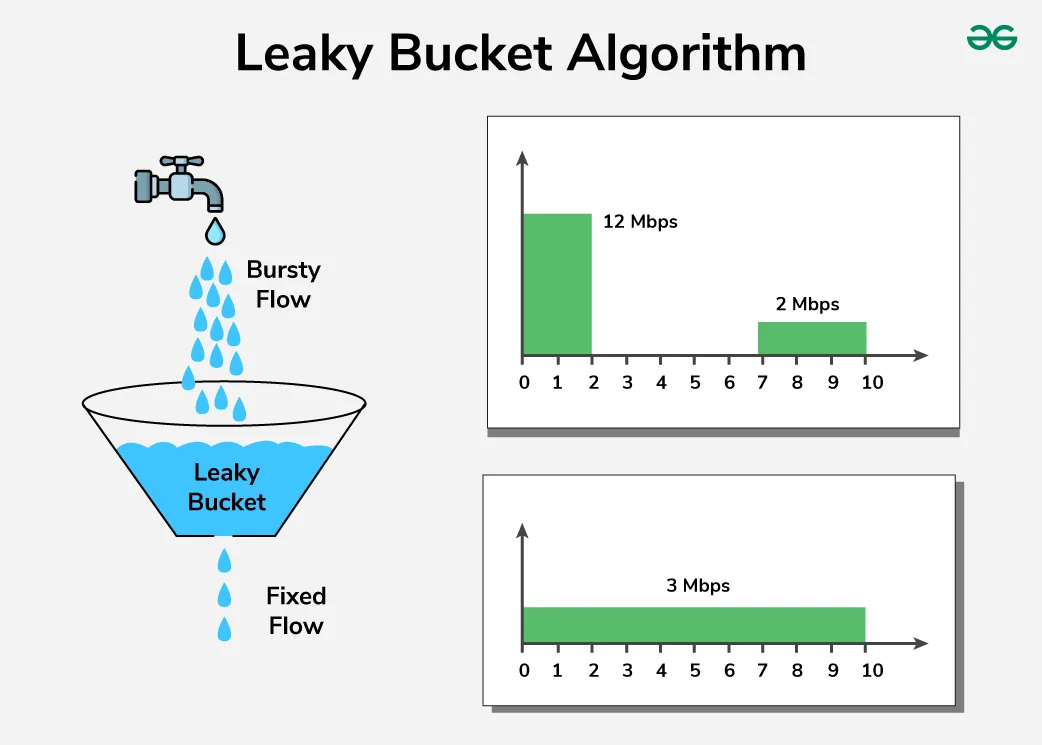
The Leaky Bucket algorithm approaches traffic shaping from a fundamentally different perspective by prioritizing a constant processing cadence. Incoming requests enter a fixed-capacity queue that represents the bucket, and the server pulls requests from the queue at a steady, unchanging rate, much like water dripping from a small hole in a container [3]. Even if twenty requests arrive at the exact same millisecond, the backend service processes them sequentially at the configured speed [2].
This steady outflow makes the leaky bucket algorithm ideal for protecting fragile backends that cannot tolerate sudden spikes in concurrency [3]. However, the algorithm exhibits significant drawbacks for interactive applications because it cannot accommodate legitimate short bursts of activity [2]. When the request queue reaches its ceiling, excess calls drop immediately [3].
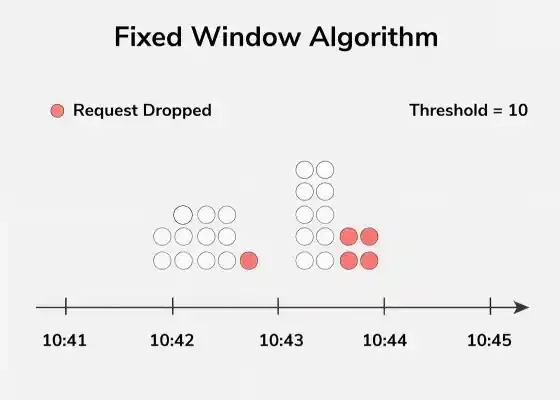
In contrast, the Fixed Window counter algorithm divides time into discrete, static blocks, such as one-minute intervals [3]. The system tracks a single integer counter for each client, resetting that counter back to zero whenever a new window begins [2]. The counter resets at the boundary [3]. While easy to implement, fixed windows suffer from a well-known boundary burst problem: a user allowed five requests per minute can send five calls at 10:00:55 and five more calls at 10:01:05, pushing ten operations through in ten seconds [2]. This flaw allows traffic spikes to double the intended request rate right across window transitions [8]. In high-throughput systems, such boundary spikes can trigger localized memory exhaustion and degrade response times for adjacent clients [10].


How Sliding Window Tracking Operates
To eliminate boundary burst vulnerabilities, engineers often turn to Sliding Window log algorithms that measure traffic across continuously moving time intervals [3]. Instead of resetting at fixed minute marks, the sliding window evaluates the exact time span preceding each incoming request [2]. Older timestamps leave the active window continuously [3].
Consider a rule allowing five requests in any rolling 60-second window. If a client sends five requests between 10:00:10 and 10:00:40, all five requests succeed. When the client submits a sixth request at 10:00:50, the limiter rejects the call because five operations already occurred within the trailing 60-second interval from 09:59:50 to 10:00:50. At 10:01:11, the first request recorded at 10:00:10 falls outside the active window, allowing a new request to proceed smoothly [2].
While sliding window logs provide precise enforcement, logging individual timestamps creates substantial memory overhead when traffic scales to millions of requests [3]. To solve this bottleneck, teams use the sliding window counter algorithm, which blends the low memory footprint of fixed windows with rolling window accuracy. The counter estimates current traffic by combining the current window count with a weighted percentage of the previous window, preventing boundary bursts while storing only two numbers per client [8].
Where API Rate Limiting Fits in Architecture
Deciding where to enforce rate limiting depends on system scale, security priorities, and infrastructure topology [2]. The first line of defense sits at the network perimeter on edge servers, Content Delivery Networks (CDNs), and Web Application Firewalls (WAF). Edge limiters inspect traffic before it reaches origin servers, dropping volumetric Layer 7 floods, DDoS attacks, and abusive scrapers right at the border to preserve internal network bandwidth [5].
Moving inward, centralized API gateways and reverse proxies provide route-specific traffic governance across distributed microservices. Managed services like AWS API Gateway, Azure API Management, and GCP API Gateway allow developers to configure granular throttling policies per route, per subscription tier, or per client organization [2]. In high-throughput architectures, protocol servers link directly to distributed in-memory key-value databases like Redis or Aerospike to share rate-limit counters across hundreds of independent application nodes. Redis stores session counters across clusters [10]. Centralized storage ensures that clients hitting different web servers across a fleet encounter uniform enforcement instead of fragmented local counters [2]. Without shared memory caches, independent nodes cannot track global user quotas accurately in multi-region environments [8].
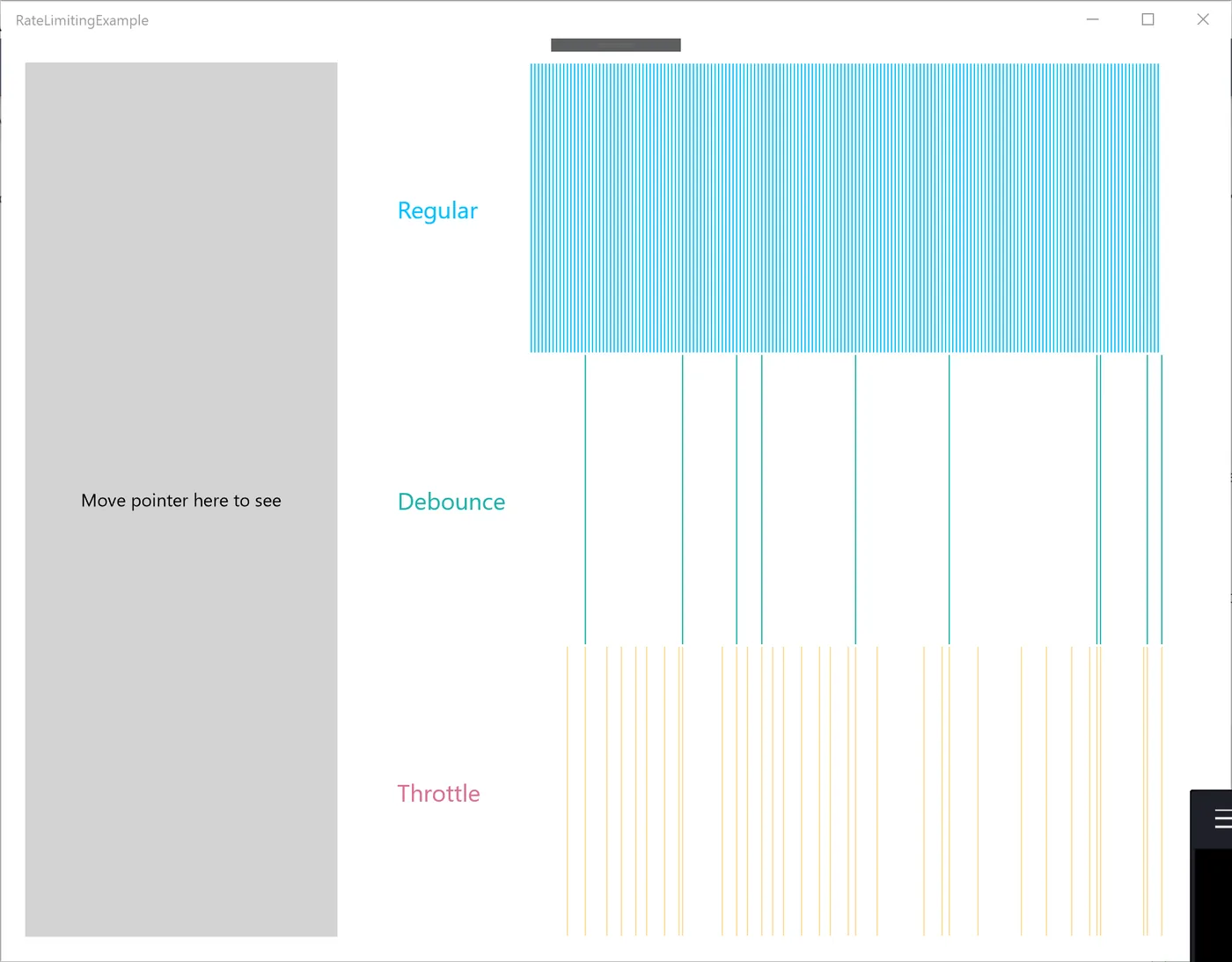
Rate limiting can also live directly within application code as middleware. For example, Node.js applications running Express on port 5000 can import express-rate-limit to safeguard sensitive endpoints like form submissions and data retrieval routes [7]. On the client side, software libraries like RateLimiting.NET allow C# applications to debounce user input and throttle event callbacks [9].
HTTP Status Codes and Response Headers
Standardized communication protocols ensure that automated clients understand when and why their requests face throttling [1]. When an application consumes a cloud API, the server sends informative HTTP response headers such as X-RateLimit-Limit to disclose the total request allowance for the current period. Accompanying headers like X-RateLimit-Remaining show the exact number of requests left in the active window, while X-RateLimit-Reset provides a Unix timestamp showing when the current quota resets [4].
When a client exhausts its quota, the API rejects subsequent calls and returns an HTTP 429 Too Many Requests response [1]. Well-designed APIs pair this status code with a Retry-After header, specifying the exact number of seconds (such as 60 seconds) the client must wait before trying again. Client SDKs can read the Retry-After value to execute automated exponential backoff algorithms, pausing retries with progressively longer delays rather than immediately bombarding the server with failed calls [4].

Not every cloud platform follows identical response conventions. GitHub responds with status code 403. Specifically, GitHub can answer with an HTTP 403 Forbidden status code rather than standard 429 responses when clients breach hourly rate limits. Furthermore, some enterprise APIs choose to withhold throttling headers until client usage crosses a specific danger threshold, such as when remaining quota drops below 10%, to conserve header bandwidth on routine calls. Testing suites like Dev Proxy help engineers simulate these varying response patterns [1].
Understanding How Rate Limiting Works in Production
Establishing effective rate limiting requires measuring baseline server performance before enforcing hard request caps. Engineering teams run comprehensive load tests to discover the exact request volume that causes database latency or server memory degradation. If tests demonstrate that a backend starts slowing down at 500 requests per second, setting production limits near 400 requests per second preserves safety headroom. Monitoring rejection ratios ensures that limits do not become overly aggressive, since rejecting more than 5% of normal traffic indicates misconfigured thresholds [8].
Production systems also apply differentiated quotas across different application endpoints based on operational risk and computational weight. Lightweight read operations like product browsing might permit 100 requests per minute, whereas computationally demanding write actions like checkout submission allow only 10 requests per minute. Authentication endpoints enforce the strictest boundaries: login attempts frequently limit users to 5 requests per 15 minutes, and password resets cap at 3 requests per hour to block brute force scripts [4]. OpenAI GPT-4 similarly applies tiered fixed windows to manage compute resources fairly [7]. Applying distinct limits per endpoint protects vital business logic without choking lightweight read calls [8]. This layered defense keeps critical authentication and financial workflows responsive even when public query routes face heavy demand [4].
Validating rate limiting defenses requires thorough automated testing before code reaches live users. Developers utilize simulation tools like Microsoft Dev Proxy to intercept network traffic, mock 429 status codes, and test whether applications handle throttling gracefully rather than crashing or dropping records [1]. Automated testing suites in Postman Collection Runner send rapid bursts of requests against test endpoints to verify header existence and validate exponential backoff retry policies [4]. Ensuring robust test coverage prepares applications to maintain high availability under real-world traffic stress [1].
- WEBSITE Microsoft. (2026, October 5). What is rate limiting? Dev Proxy. Microsoft Learn. [Article Link]
- WEBSITE GeeksforGeeks. (2024, March 11). Rate limiting in system design. GeeksforGeeks. [Article Link]
- WEBSITE GeeksforGeeks. (2024, July 15). Rate limiting algorithms in system design. GeeksforGeeks. [Article Link]
- ONLINE NEWS The Postman Team. (2026, January 6). What is API rate limiting? Understanding request throttling and best practices. Postman Blog. [Article Link]
- WEBSITE NOC Team. (2026, November 11). What is rate limiting? NOC.org. [Article Link]
- WEBSITE Talapatra, A. (2024, January 8). What is rate limiting: Types and algorithms. Imperva Learning Center. [Article Link]
- ONLINE NEWS Lawrence, A. (2024, October 31). The basics of rate limiting: How it works and how to use it. DEV Community. [Article Link]
- WEBSITE Gcore. (2026, March 6). What is rate limiting: Definition, types and implementation guide. Gcore. [Article Link]
- WEBSITE Husseinhj. (2018, February 20). RateLimiting.NET: Rate limiting (debounce, throttle) for C# portable class library. GitHub. [Article Link]
- WEBSITE Wikipedia contributors. (n.d.). Rate limiting. In Wikipedia, The Free Encyclopedia. [Article Link]


