





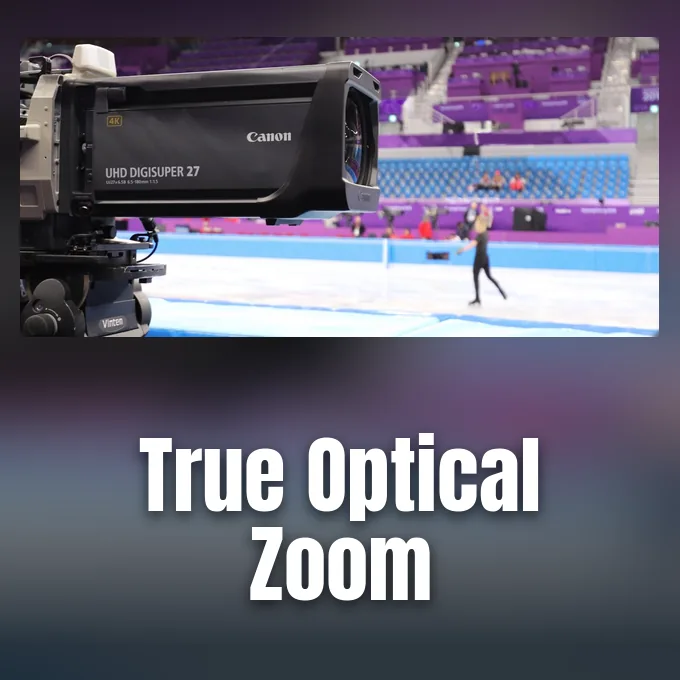
Optical zoom changes the focal length of a camera lens by moving glass elements inside the barrel, narrowing the field of view without reducing the image resolution captured by the sensor. In contrast, digital zoom takes the center of a captured frame and enlarges those pixels, discarding image data in the process. Photographers rely on optical glass for clean telephoto shots [8].
What Is Optical Zoom?
A camera system with optical zoom relies on movable glass groups that shift along the optical axis to change magnification and field of view without altering sensor resolution. Unlike a prime lens with a single fixed focal length, an optical zoom lens lets photographers reframe a scene from wide-angle to telephoto without stepping closer to the subject. Because the glass itself bends incoming light across a variable range, the entire sensor area receives the focused image at every step. This movement keeps pixel count and fine detail intact from edge to edge, avoiding the blur that occurs when software enlarges a cropped section of a digital picture [8].
Photographers describe this optical range as a simple ratio between the longest and shortest focal lengths of a lens system, meaning a 100 mm to 400 mm assembly delivers a 4x magnification factor [8]. Consumer DSLR kit lenses usually offer a 3x zoom range using 10 glass elements [1]. Compact cameras go higher [8].
How Moving Glass Changes Focal Length
When light enters a camera lens, it passes through individual shaped pieces of glass known as elements [1]. Each element bends and directs incoming light rays so they converge onto the camera sensor. In a basic zoom build, an afocal assembly sits in front of a focusing lens, changing beam width without shifting the focal point. Moving two converging lenses around a central diverging lens adjusts angular magnification smoothly [8].
Maintaining sharp focus while zooming demands exact alignment across every glass element inside the barrel, because a drift of even a fraction of a millimeter degrades image contrast and overall sharpness across the sensor. Early inventors tackled this challenge over a century ago, beginning with Clile C. Allen, who patented a true zoom lens in 1902 under U.S. patent 696,788. Cinematographers soon embraced the technology, filming Clara Bow with a zoom lens in the 1927 movie It. Industrial production expanded when Bell and Howell released the Cooke “Varo” 40–120 mm cinema lens in 1932. Rank Taylor Hobson followed in 1953 with the VAROTAL III broadcast zoom [8].

Current zoom builds rely on computer simulations before grinders shape rough glass blanks. Canon senior fellow Larry Thorpe explained that computers test hundreds of millions of combinations before a prototype is assembled. Thorpe said: “The computers simulate for months to analyze dimensions and shapes.” These simulations help designers prevent spherical aberration at wide apertures [1].
The Four Core Optical Groups
Inside a standard telephoto zoom, such as the Tamron SP 70-210 model 19AH analyzed by MEM-TEK, optical engineers divide the glass into four functional groups. The front focus group moves when adjusting focus on a subject. Behind it, the variator group slides along the barrel to vary magnification and adjust the overall focal length. In this Tamron design, 15 individual elements combine into 11 cemented groups, creating 22 coated surfaces that curb internal reflections. Because single-lens reflex cameras need clearance for an internal mirror, optical designers rely on a rear master group to relay the optical image onto the camera film plane [4].
Moving in the same direction as the variator but traveling at a distinct speed along the barrel, the compensator group prevents the focal plane from shifting so the picture stays in focus while zooming. The master group houses the aperture diaphragm and corrects aberrations. Precision cam-slots guide these movements across 100 parts [4].
Some complex zoom lenses break these boundaries by moving all four optical groups during zooming. In older telephoto zooms like Tamron’s model 23A (60–300 mm) and model 26A (35–210 mm), the front optical assembly travels during both focal changes and focusing tasks, which alters the physical length of the outer barrel. Optical engineers also combine low-dispersion glass with composite aspherical elements to control chromatic aberration instead of simply adding more glass. Adding more elements does not automatically make a lens sharper, because proper glass selection and coating matter far more [4].

Parfocal Versus Varifocal Designs
A true optical zoom lens is parfocal, meaning it retains sharp focus as the photographer zooms between wide and telephoto settings. This characteristic proves valuable for filmmakers and broadcast crews who need to zoom smoothly during live recording without stopping to refocus [8]. Many fixed-aperture L-series zooms from Canon, including the EF 16-35mm f/2.8L USM and EF 70-200mm f/2.8L USM, maintain parfocal performance through precise optical design [3].
In contrast, varifocal lenses lose focus whenever their focal length changes, forcing the user or camera system to refocus before capturing another frame. The Kilfitt 36–82 mm f/2.8 Zoomar lens, introduced in 1959 as the first regular-production varifocal for 35 mm still photography, needed manual refocusing after every zoom shift. In the cinema world, French engineer Roger Cuvillier designed the Pan-Cinor with optical compensation around 1950 for SOM-Berthiot. Later in 1956, Pierre Angénieux introduced mechanical compensation, releasing a 17–68 mm zoom in 1958. Cinematographer Roger Fellous used an Angénieux 35–140 mm prototype that same year for the film Julie La Rousse [8].
Autofocus motors react in fractions of a second, so still photographers rarely notice when a lens is varifocal [8]. The camera body simply readjusts focus when the zoom ring stops. Many consumer zooms with inner-cam focusing, such as the Canon EF 75-300mm series, are varifocal [3]. Cinema operators still require true parfocal glass [8].


Sensor Cropping in Digital Systems
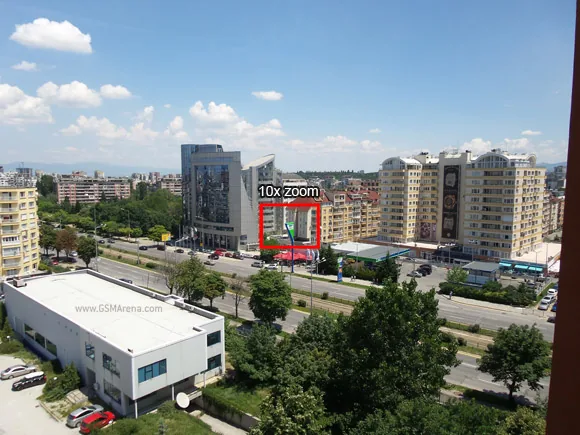
A camera relying on digital zoom works on a fundamentally different principle than one built around optical magnification. Rather than shifting glass elements to gather light across a narrower angle of view, digital zoom crops the central portion of the image sensor and blows it up to fill the frame. Because the resulting crop captures far fewer native pixels of scene data, the internal image processor must stretch the remaining information across the entire frame, which produces blurry edges, noisy textures, and coarse pixelation [8].
Photographers spot the optical divide immediately when inspecting small text or fine background patterns across magnified images. With optical zoom, the lens delivers the full optical resolution of the sensor onto the subject. With digital zoom, every step of magnification throws away sensor area, because a 2x digital crop discards three-quarters of the available pixels. When tech reviewers assess consumer hardware trade-offs, whether analyzing an Xbox Series S hardware build or evaluating camera optics, production expenses shape what reaches store shelves. Dedicated zoom barrels demand costly glass elements, whereas digital cropping requires only extra software routines running on the main system processor [8].
Many digital cameras combine both methods to extend their reach [8]. The Olympus Camedia C-700 Ultra Zoom, released in May 2001, paired its 10x optical zoom with a 2.7x digital zoom, yielding a 27:1 combined range. The optics carried an aperture rating of f/2.8 at wide angles that narrowed to f/3.5 at full telephoto reach [10].
Why Optical Zoom Needs Complex Mechanics
Building a reliable optical zoom lens presents steep engineering hurdles because moving glass inside a barrel can introduce optical defects. When light refracts through curved glass, different colors bend at slightly different angles, creating chromatic aberration that shows up as green or purple halos along high-contrast borders. To curb this problem, Canon began using fluorite crystals in 1969, because fluorite has a low refractive index that prevents white light from splitting apart during transmission [1].
Assembling these optical groups demands exact tolerances. Nested metal sleeves inside the barrel feature precision cam-slots that guide optical groups along exact non-linear paths. If a single spacer ring or retaining collar is improperly machined, lens elements can tilt or decenter, turning a high-end lens into an optical lemon [4]. Servomotors must coordinate these movements smoothly, especially in lenses with optical image stabilization where floating elements counter handheld shakes [1]. High zoom ratio broadcast lenses often feature dozens of optical elements, weighing more than 25 kg, which makes smooth motorized control a demanding mechanical requirement during fast-moving sports coverage [8].
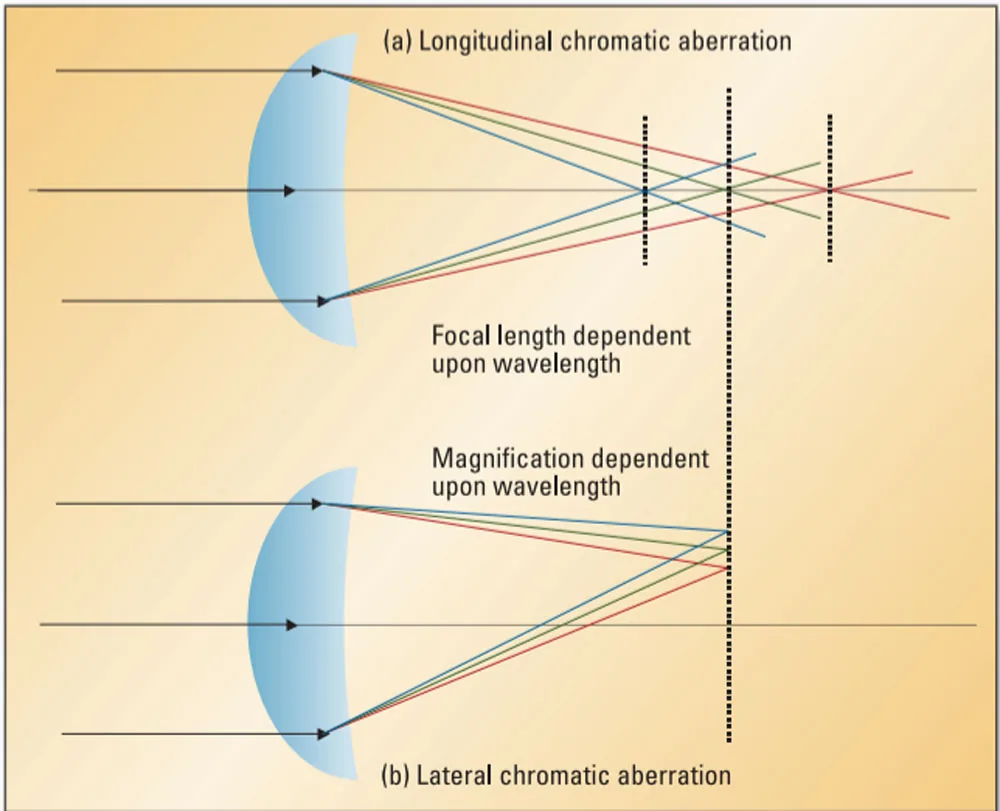
Optical designers must constantly balance magnification range against maximum aperture limits. Wide-range zooms often suffer from barrel distortion at wide angles and pincushion distortion at telephoto settings. Constant fast apertures like f/2.8 require huge front elements that add significant weight and production expense, so engineers rely on variable apertures to keep consumer gear compact and affordable [8].
Smartphone Hybrids with Retractable Barrels
As mobile photography grew, handset makers explored ways to bring motorized zoom to cellular devices. Samsung released the W880 AMOLED 12M in 2009, offering a 12-megapixel sensor and a 3x optical zoom lens with xenon flash [6]. In 2012, the company introduced the Galaxy Camera, featuring a 16.3-megapixel sensor and a 21x optical zoom lens running Android 4.1 Jelly Bean, powered by a 1,650mAh battery, though it lacked cellular voice calling [5]. Samsung followed in 2013 with the Galaxy S4 Zoom, merging a retractable 10x optical zoom lens directly into a pocketable Android smartphone body [2]. The hybrid device ran Android 4.2.2 Jelly Bean with TouchWiz, later receiving an update to Android 4.4 KitKat [6].
Samsung built the handset around an Exynos 4212 platform, pairing a 1.5 GHz dual-core Cortex-A9 processor with 1.5GB of RAM and Mali-400 graphics. The phone included a 16-megapixel backside-illuminated sensor measuring 1/2.33 inches, an optically stabilized 24–240 mm f/3.1–6.3 lens, a 4.3-inch Super AMOLED screen with 960 x 540 qHD resolution at 256 ppi, and a 2,330mAh battery. It measured 15.4 mm thick and weighed 208 grams, while a rotating lens ring controlled manual zooming [2].

The bulk of motorized barrels pushed manufacturers toward multi-camera arrays. Flagship devices like the iPhone Pro Max and Galaxy S26 Ultra skip moving barrels, using separate fixed prime lenses instead. Dedicated sensors handle wide, telephoto, and periscope views, while computational algorithms blend frames in between [6].
Broadcast Optics and Optical Zoom Limits
At the extreme end of optical design, television broadcasting showcases what optical zoom can achieve when size and cost limits disappear. During major sports events like the Olympic Games in PyeongChang, broadcasters deploy massive box lenses such as the Canon UHD DIGISUPER 86, which costs $222,980 on the open market. This massive lens weighs 59.5 pounds, measures 10 inches wide, 10 inches tall, and 24 inches long, and packs between 30 and 40 individual glass elements inside its housing. Canon has been using fluorite materials in these optics since 1969 to keep light from splitting along its journey [1].
The UHD DIGISUPER 86 delivers an 86x optical zoom range from 9.3 mm to 800 mm, with a built-in extender that pushes reach to 1600 mm. It features a bright maximum aperture of f/1.7 at its wide setting, gathering huge amounts of light for broadcast sensors. Because broadcast cameras use 2/3-inch sensors measuring 11 mm diagonally, optics must deliver extreme resolving power so that 4K broadcasts show crisp contrast across thousands of sensor lines [1].
Camera operators manage these massive lenses using both hands during live stadium broadcasts, operating motorized zoom servos with the right hand while adjusting delicate focus mechanisms with the left. Remote directors in broadcast trailers can adjust lens iris settings over the wire. Continuous optical zoom keeps 4K broadcasts sharp [1].
- ONLINE NEWS Horaczek, S. (2018). Broadcast camera lenses at the Olympics can cost as much as a Lamborghini. [Article Link]
- ONLINE NEWS Honig, Z. (2013). Samsung Galaxy S4 Zoom review: A messy marriage of smartphone and camera. [Article Link]
- WEBSITE Canon US. (n.d.). Parfocal Lenses. [Article Link]
- WEBSITE MEM-TEK. (2005). What Is Inside a Zoom Lens? [Article Link]
- ONLINE NEWS Messina, V. (2012). Is It A Phone, Is It A Camera? No, It’s A Phamera! Samsung Unveils Its Jelly Bean-toting Galaxy Camera. [Article Link]
- ONLINE NEWS Peter. (2020). Flashback: Samsung Galaxy S4 zoom, the phone that was mostly a camera. [Article Link]
- ONLINE NEWS GSMArena team. (2013). Samsung Galaxy S4 zoom review: Lights, Camera, Android! [Article Link]
- WEBSITE Wikipedia. (n.d.). Zoom lens. [Article Link]
- WEBSITE Wikipedia. (n.d.). Samsung Galaxy S4 Zoom. [Article Link]
- WEBSITE Wikipedia. (n.d.). Olympus Camedia C-700 Ultra Zoom. [Article Link]


