





The circuit breaker pattern wraps network calls to remote services and halts requests once repeated failures cross a set threshold [1]. In microservice systems, a slow dependency can hold caller threads open until the entire platform runs out of memory [5]. The proxy fails fast instead of waiting on dead endpoints, isolating broken components so downstream software can recover [2]. Callers get predictable fallback responses rather than lingering timeouts.
- Cascading Failures in Distributed Systems
- Core Mechanics of the Circuit Breaker Pattern
- Three Operational States of the State Machine
- Key Parameters for Thresholds and Timeouts
- Fallback Strategies for Graceful Degradation
- Code Examples for the Circuit Breaker Pattern
- Defensive Layers With Bulkheads and Retries
- Challenges in Circuit Breaker Pattern Adoption
Cascading Failures in Distributed Systems
Local function calls within a single process finish in microseconds or throw instant exceptions, but remote network calls behave unpredictably [3]. When a downstream database experiences connection leaks or heavy query traffic, remote services do not simply crash and exit [4]. Instead, each incoming request hangs for thirty seconds before hitting a network timeout limit [5]. Slow dependencies cause far more damage than dead ones because caller processes keep their worker threads, sockets, and memory pools locked while waiting for responses that never arrive [2]. This blocks threads. As hundreds of concurrent users send new requests, the caller exhausts its thread pool, turning an isolated dependency slowdown into a widespread outage across the platform [5].
Consider an e-commerce checkout flow where an Order Service calls a Payment Service, which in turn invokes a downstream Fraud Detection dependency. If the Fraud Detection service slows down, payment worker threads pile up in memory while waiting for those pending checks. Within seconds, the Payment Service exhausts its pool of two hundred threads and stops answering the Order Service. The Order Service then runs out of connections, and the API Gateway starts returning 503 Service Unavailable errors to all incoming visitors [5].
Cascading failure spreads through a system like falling dominoes because healthy upstream services can’t insulate themselves from downstream delays [3]. Blind client retries accelerate this collapse. If an Order Service retries failed payment calls three times, an overloaded database receives four times its normal traffic [6]. Retrying multiplies load. Systems crash without isolation [4].
Core Mechanics of the Circuit Breaker Pattern
The software pattern takes its name from electrical circuit breakers that trip to stop fires when excessive current flows through building wiring [7]. Michael T. Nygard introduced the concept to software architecture in his book Release It!, explaining how wrapping integration points prevents catastrophic system cascades. Martin Fowler later documented the pattern on his website, explaining how automated trip switches allow remote services to fail safely without consuming precious host memory and CPU resources. Netflix built the concept into its Hystrix library to guard inter-service calls across its streaming microservice platform [5, 13]. Netflix proved the pattern at scale [5]. Today, cloud teams treat the pattern as a standard stability tool in microservices [8].
A circuit breaker acts as a stateful proxy sitting between a calling service and a remote network dependency. Every outgoing request flows directly through this proxy layer, which tracks invocation outcomes, error codes, and response times over a moving measurement window [1]. If failure counts or slow responses pass a configured limit, the breaker trips open [5]. The proxy introduces a fail-fast mechanism that throws a CircuitOpenError immediately, preventing callers from issuing doomed requests to struggling dependencies [3, 4].
Fast failures save resources [3]. Callers receive immediate fallback responses in microseconds, which keeps their internal worker threads, sockets, and memory pools completely free to process other healthy customer requests across the cluster. Meanwhile, downstream services gain quiet windows without traffic to reboot databases or clear thread backlogs [2].
Three Operational States of the State Machine
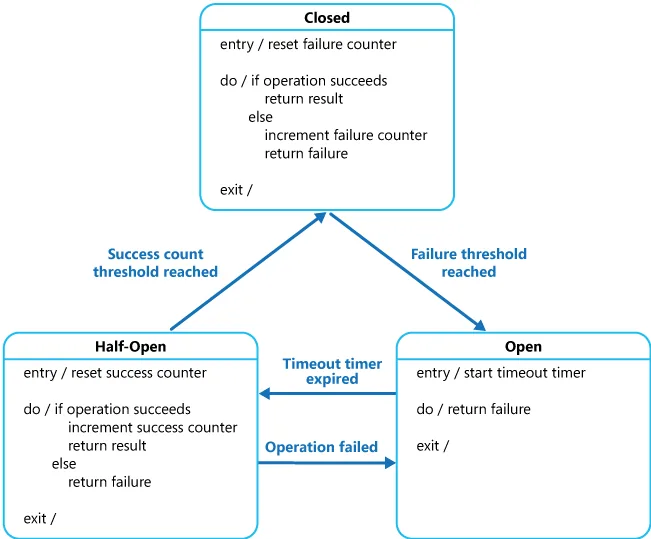
A circuit breaker runs as a finite state machine containing three core operating modes: Closed, Open, and HalfOpen [1, 5]. In the Closed state, the breaker operates normally and routes traffic to the target dependency [1]. It monitors error rates, tracking whether calls succeed, time out, or throw network exceptions [2].
When failures cross the defined threshold, the state machine transitions into the Open state [1]. While open, the proxy intercepts every incoming call and rejects it immediately with a CircuitBreakerOpenException without sending packets across the network [2, 4]. It stops network calls [2]. The breaker starts a cooldown timer upon opening [1]. This immediate failure response stops client threads from blocking on unresponsive downstream hosts while giving the failing service time to stabilize [2].

Once the cooldown timer expires, the breaker enters the Half-Open state to test whether the remote dependency has recovered from its troubles. In this probing mode, the proxy permits a limited number of trial requests to reach the actual downstream service while continuing to deflect general application traffic [1, 2]. If these trial requests complete without errors, the breaker assumes the underlying outage has cleared, resets its failure counters, and returns to the Closed state for regular operations. But if any trial request encounters a failure or exceeds latency targets, the breaker returns to the Open state and restarts its cooldown timer [1]. This self-resetting mechanism enables automated recovery without human intervention [4, 7]. It resets the system [1].
Key Parameters for Thresholds and Timeouts
Teams configure a circuit breaker to balance two competing operational risks: tripping too quickly on transient network blips, or reacting too slowly and permitting failures to spread upstream. Engineers govern trip sensitivity using a failure rate threshold, typically configured around 50 percent of attempted calls [5, 7]. A sliding window tracks recent calls, either by counting a fixed number of requests (such as twenty calls) or by evaluating outcomes over a rolling thirty-second interval. Production frameworks also enforce a minimum call volume before evaluating percentages, which prevents an isolated startup error from tripping the breaker when traffic begins flowing [5, 9]. Low-volume services need this guard [5].
A frequent engineering oversight involves tracking only hard network errors while ignoring sluggish responses. A remote service that takes ten seconds to return a payload consumes caller threads just as effectively as a total outage [5]. Modern libraries configure a dedicated sliding window for slow calls, establishing a latency boundary like two seconds along with an explicit slow call rate threshold [7, 9]. When slow responses exceed eighty percent of traffic, the breaker opens before thread capacity vanishes [5].
The cooldown period in the open state dictates how long the breaker waits before testing downstream health [1]. Production setups usually set this timer between ten and sixty seconds [5, 7]. During the half-open phase, systems permit three to five trial calls [5]. Small probe limits prevent sudden traffic surges from overwhelming a booting service [1].



Fallback Strategies for Graceful Degradation
What happens when a downstream dependency stops responding? While failing fast saves worker threads, passing raw exceptions to end users creates a frustrating experience. A fallback mechanism supplies an alternative path whenever the circuit opens [2, 7]. Good fallbacks turn platform outages into minor service degradations [7].
Software architects choose specific fallback strategies based on the business role of the protected component [4, 7]. For read-only operations, returning cached data from a local store or an in-memory cache allows customers to browse product catalogs or read articles, even if prices reflect yesterday’s updates. For secondary features like item recommendations or review counters, returning an empty list allows the primary webpage to render cleanly without disruption. In write operations, services can save transactions to an asynchronous outbox queue, acknowledging the user’s action immediately while delaying settlement until downstream services finish restarting [7]. These techniques ensure that users complete essential tasks despite underlying system hiccups [4, 8]. The feature stays usable [7].
Teams choose fallbacks based on business requirements rather than purely technical decisions. An engineering team can construct a queue to hold orders during payment outages, but product owners must decide if accepting orders before payment clears matches company policy. For security-sensitive actions like user login or payment authorization, degraded fallbacks are rarely safe [7]. In those circumstances, returning a polite error message instructing users to retry later remains the safest choice [1, 4].

Code Examples for the Circuit Breaker Pattern
In the Java ecosystem, Resilience4j stands as the primary library for microservice resilience in Spring Boot applications [7, 8]. The Spring Cloud Circuit Breaker abstraction lets teams configure breaker settings within YAML configuration files, adjusting parameters like window sizes and failure rate limits. Developers apply the pattern in code by adding the @CircuitBreaker annotation to client methods in IntelliJ IDEA or Maven projects, specifying fallback methods directly. When endpoints fail, the annotation diverts traffic to a designated fallback method, preventing threads from blocking [7, 9].
In the .NET ecosystem, the Polly .NET library provides circuit breaking and policy wrapping capabilities for C# applications [2, 10]. Developers combine retry rules and timeout limits using Policy.WrapAsync to guard asynchronous tasks [10]. To address specialized concurrency needs, the open-source library CircuitBreaker.Net provides an alternative design for distributed systems. The library isolates calls onto separate task schedulers so third-party calls do not exhaust the main application scheduler when remote dependencies hang. This prevents background thread pools from locking up during third-party API delays. Isolated thread pools protect the host [11]. Developers test these endpoints with Postman or REST clients to verify that fallback responses trigger reliably when dependencies fail [9].
Python applications rely on the pybreaker package from PyPI to protect remote integration points. The library tracks consecutive failures, supports reset timeouts, and can use a Redis backend to share state across multiple worker processes. It also lets developers exclude validation errors, ensuring user input mistakes don’t trip system breakers [12].
Defensive Layers With Bulkheads and Retries
Resilience mechanisms deliver the best results when paired together in layers [2, 3]. Timeouts serve as the foundational boundary for every network call [3]. Without a timeout, a hanging call blocks indefinitely, leaving the breaker with nothing to evaluate [7]. Timeouts alone can’t prevent thread exhaustion [6].
The retry pattern helps overcome transient network hiccups, but unmanaged retries trigger dangerous retry storms [3, 4]. When an overloaded service slows down, immediate client retries double or triple the incoming traffic volume, accelerating downstream failure [6]. To prevent this destructive cycle, developers wrap retry logic inside the circuit breaker proxy. The retry logic resolves brief network glitches, but once repeated attempts cross the defined threshold, the breaker trips open and cuts off all further retries [3, 4].

Engineers also pair circuit breakers with the bulkhead pattern, named after the watertight compartments that prevent a single hull breach from sinking an entire ship [3, 7]. In software architecture, bulkheads isolate resources by assigning separate thread pools or connection limits to each downstream dependency. If an external payment service slows down, it exhausts only its dedicated thread pool, leaving inventory and catalog calls to operate without interference. While the bulkhead limits how many concurrent calls can target a specific dependency, the circuit breaker decides whether those calls should be attempted at all. Combining these patterns ensures that one slow service cannot starve host resources [3, 7]. They guard system health [7].
Challenges in Circuit Breaker Pattern Adoption
Adopting the pattern introduces subtle engineering challenges that distributed systems teams must navigate [2, 14]. Principal engineer Marc Brooker observed that circuit breakers can misinterpret partial failures as total outages in sharded or cell-based architectures. If a single customer shard or database partition becomes slow, an overly broad circuit breaker might trip and cut off traffic for all healthy customer shards across the entire system. Brooker noted that building fine-grained mini circuit breakers for individual shards can resolve the issue, though it adds significant operational complexity to client microservice configurations. Teams must evaluate shard boundaries carefully before deploying breaker policies across multi-tenant clusters. Shard awareness matters [14].
Tuning threshold parameters presents another common hurdle in production environments. If teams configure failure thresholds too aggressively, routine deployments or brief network jitters cause false positives that disconnect healthy services [2, 4]. Conversely, setting thresholds too high allows cascading failures to exhaust worker threads before the breaker trips open [7]. Static thresholds often struggle with fluctuating traffic patterns, prompting teams to review error metrics and adjust windows based on live production telemetry [1, 4].
Finally, circuit breakers require continuous observability across microservice architectures [1, 4]. Operations teams must monitor state transitions and fallback activations through metrics dashboards [4, 9]. Modern cloud platforms also deploy circuit breakers at the service mesh layer using Envoy sidecars in Istio, providing platform-level protection without modifying application code. Mesh proxies enforce resilience policies uniformly across diverse languages [2, 8].
- WEBSITE Microsoft. (2025). Circuit Breaker pattern. Azure Architecture Center. [Article Link]
- WEBSITE GeeksforGeeks. (2024). Circuit Breaker Pattern in Microservices. GeeksforGeeks System Design. [Article Link]
- WEBSITE Generalist Programmer. (2026). Circuit Breaker Pattern Explained: Microservices Example in TypeScript. Generalist Programmer Tutorials. [Article Link]
- WEBSITE System Design DevPro. (2026). Circuit Breaker Pattern Explained. System Design DevPro Patterns. [Article Link]
- WEBSITE Singh, A. (2026). Circuit Breaker Pattern Explained: The Complete Guide. Ajit Singh Software Engineering Blog. [Article Link]
- WEBSITE AlgoMaster. (2025). Circuit Breaker Pattern. AlgoMaster System Design. [Article Link]
- WEBSITE Galaba, S. P. (2026). Circuit Breaker Pattern in Microservices Explained. CodeBegun Resilience Guides. [Article Link]
- WEBSITE Tech Shitanshu. (2025). Circuit Breaker Pattern Explained: 8 Proven Ways to Build Resilient Microservices. Tech Shitanshu Microservices Series. [Article Link]
- WEBSITE GeeksforGeeks. (2024). Spring Boot – Circuit Breaker Pattern with Resilience4J. GeeksforGeeks Advanced Java. [Article Link]
- WEBSITE Code4Noobz. (2017). C# – Retry Pattern with Polly. Code4Noobz Tutorials. [Article Link]
- WEBSITE Nikitin, A. (2015). CircuitBreaker.Net: Circuit Breaker pattern for.NET. GitHub Repository. [Article Link]
- WEBSITE PyPI. (2025). pybreaker: Python implementation of the Circuit Breaker pattern. Python Package Index. [Article Link]
- WEBSITE Fowler, M. (2014). Circuit Breaker. Martin Fowler Bliki. [Article Link]
- WEBSITE Wikipedia contributors. (2026). Circuit breaker design pattern. Wikipedia, The Free Encyclopedia. [Article Link]


