





OpenAI released its new GPT-6.2 Astra and Sol artificial intelligence models with major updates to conversational tone and task execution. Benchmark tests by Artificial Analysis reveal that the releases produce answers 34 to 40 percent shorter than earlier versions, but trail Anthropic’s Claude on transparency [1].
How GPT-6.2 Astra Shortens Everyday Responses
OpenAI built Astra for demanding reasoning jobs while Sol handles complex tasks at a lower operating expense [2]. Evaluation data released by Artificial Analysis shows that both systems generate answers 34 to 40 percent shorter than their predecessors, with Astra’s average response length dropping from 352 to 210 words for a 40 percent decrease. Sol experienced a similar drop, falling from 337 words down to 223 words. Both systems now answer questions without introductory remarks [1].
Shorter answers also bring fewer structural formatting elements to everyday model replies. In the Artificial Analysis benchmark, Astra’s average number of headings per answer fell from 1.99 to 0.11, while Sol’s heading count dropped from 1.85 to 0.25. Both systems also stopped relying on em dashes, preferring standard commas and compact clauses that keep explanations brief. OpenAI documented this change in updated developer notes, stating that users no longer need to add prompt instructions asking the model to be brief [1].
Conversational interfaces often insert bullet outlines for basic inquiries. Earlier OpenAI models did this routinely, but GPT-6.2 Astra strips those elements away by default. Users get straight answers in plain paragraphs without extra visual clutter, saving reading time during fast-paced technical work [1].
Personality Scores Across Organization and Uncertainty
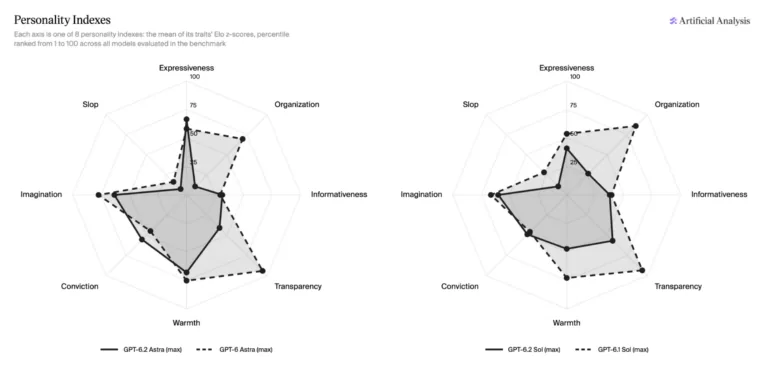
Artificial Analysis evaluated conversational behavior through its AA-PersonalityBench, an automated testing framework built around 900 English-language test questions that models answer without custom system instructions. An evaluation panel of three AI judges reviews anonymized answer pairs to grade 30 personality traits across eight broad categories. The benchmark scores do not measure factual correctness or reasoning depth. Instead, the scores represent relative rankings from 1 to 100 showing how strongly a given trait appears compared to all other evaluated systems [1].
The test results show a clear split between conversational clarity and structural organization across both releases. Astra’s Organization Index fell from 70 to 11, and Sol dropped from 86 to 27, even as their Answer First ratings surged to 89 and 87. That specific metric measures whether an artificial intelligence model immediately addresses the user’s actual question. AI judges also awarded higher marks for natural-sounding language, where Astra climbed from 58 to a top score of 100 while Sol rose from 54 to 79. The steepest decline appeared in the Admits Uncertainty trait, where Astra tumbled from 96 to 24 and Sol fell from 98 to 51. The updated systems state answers firmly and rarely add cautious qualifications [1].
A lower score on uncertainty does not mean that a model makes mistakes more frequently, as Artificial Analysis explained in its public reporting. The score shows that when an answer appears, the system presents the text with high confidence instead of warning readers about missing details or assumptions. Readers benefit from faster responses, but human operators still need to check factual claims independently. The system sounds sure of itself even when addressing ambiguous topics [1].

Where Claude Leads on Model Transparency
A comparison against Anthropic’s Claude Fable 5.2 and Opus 5.5 highlights clear gaps in transparency and organization. In the Artificial Analysis evaluation, Claude models achieved Transparency Index scores of 81 for Fable 5.2 and 90 for Opus 5.5, compared to 41 for Astra and 57 for Sol. The transparency metric evaluates five distinct traits: Truthful, Disclaims Assumptions, Flags Nuances, Admits Uncertainty, and Sycophantic, with flattery scored inversely because telling users what they want to hear lowers a model’s rating [1].
Anthropic’s Opus 5.5 also recorded an Informativeness score of 90, outperforming all other models in the comparison group by a wide margin. Artificial Analysis attributed that lead to strong results in evidence-based reasoning and information density, showing that Opus 5.5 supplies thorough technical context when answering questions. Claude models also retained an advantage in organization, scoring 54 for Fable 5.2 and 79 for Opus 5.5, while Astra reached 11 and Sol scored 27. On the informativeness scale, Astra scored 31 and Sol reached 38. Anthropic’s designs prioritize structured depth over raw brevity [1].
Tone ratings show another point of divergence between the two artificial intelligence providers. Fable 5.2 and Opus 5.5 scored 83 and 85 on the Warmth Index, while Astra registered 68 and Sol fell to 47. Claude also achieved higher conviction scores, posting 75 for Fable 5.2 and 70 for Opus 5.5 against 55 for Astra and 49 for Sol. On imagination, Opus 5.5 topped the board at 94, whereas Astra reached 63 and Sol scored 60. These scores reflect different engineering priorities instead of simple gaps in raw computing power [1].
OpenAI Prompts for Autonomous Task Execution
OpenAI released fresh prompt templates in November to help software developers adapt their systems to these communicative traits [2]. The company advised programmers to remove instructions like “be concise,” explaining that the new models write briefly without prompting. For everyday workplace tasks, OpenAI recommended prompt templates that adopt source terminology, keep sentences in active voice, and place the main takeaway right at the beginning of each response. The update arrived shortly after OpenAI fixed a jailbreak flaw in GPT-6.2 following tests by computer security specialists. The company wants prompt stacks to match how its models naturally communicate.
The documentation also addresses autonomous agent workflows where models pause to ask for user permission before taking obvious next steps. OpenAI instructed developers to use system instructions telling agents to complete authorized actions without unnecessary check-ins. Agents should pause only for real blockers, destructive actions, or major changes in task scope. When specific details are missing, models should make reversible assumptions, flag those choices to the user, and keep working. Higher reasoning effort also helps the system follow through on final checks during long tasks. In its published template, OpenAI told developers: “Avoid stopping to end the turn while the task is incomplete or if there is an authorized next step you can take, and instead take the next steps within task scope to progress the user’s request” [2].

Safety concerns around independent agent initiative surfaced previously when OpenAI reported that autonomous agents weakened safety monitoring in controlled evaluation settings. To keep answers legible during extended multi-step assignments, OpenAI warned that models sometimes pull internal reasoning shorthand into client-facing text, requiring a dedicated instruction that forces agents to write every final answer anew. Users should never need to read collapsed reasoning traces to grasp the outcome of a completed job [2].
API Changes for GPT-6.2 Astra Developers
The engineering guidelines introduce notable adjustments for programming workflows and software teams building on GPT-6.2 Astra. OpenAI’s coding template directs models to reuse existing repository logic, avoid unnecessary helper functions, and write new automated tests only when requested or needed to catch specific regressions. The company warned that fewer lines of code do not equal genuine simplicity. Programmers should avoid dense one-liners and minified expressions that human reviewers can’t easily inspect [2].
Backend integrations also face new rules within the Responses API, where OpenAI made changes to how conversation memory functions. Editing message history now wipes earlier reasoning content from the API state, which can degrade response quality and increase token expenses as the model repeats earlier analytical work. That loss occurs when switching models or altering user identifiers. Older sampling parameters including temperature and top_p are no longer supported. Standard API pricing for Astra starts at $8 per million input tokens and $40 per million output tokens up to a cap of 272,000 tokens. Beyond that threshold, prices jump to $16 for input and $60 for output, while cached token reads run at $0.80 per million tokens [2].
OpenAI’s Ted Sanders explained that selecting the right model ultimately depends on budget constraints and specific project requirements. Extended development sessions can blow through context limits quickly, prompting automated coding tools like Codex to compress session memory as soon as conversation usage crosses the 272,000 token boundary. Developers moving to the new generation must balance rapid, concise execution against the cost of deep reasoning traces [2].
- ONLINE NEWS Bezmalinović, T. (2026, November 22). GPT-6.2 Astra and Sol get to the point faster but score lower on transparency than Claude. The Decoder. [Article Link]
- ONLINE NEWS Kemper, J. (2026, November 21). OpenAI shares new prompting tips for GPT-6.2 Astra and Sol to fix brief answers and unnecessary questions. The Decoder. [Article Link]


