






Marty Stratton addressed the recent id Software layoffs during a media presentation, saying the team remains viable after id Software cuts removed roughly half its staff. The staff reductions followed a broader business reset ordered by Xbox CEO Asha Sharma across Microsoft’s gaming division earlier this year, affecting about 136 developers at the studio. Speaking with game director Hugo Martin, Stratton insisted the studio is performing well in both game production and engine development [3].
Why id Software Layoffs Shook Developer Morale
Stratton acknowledged the job losses directly and said he had no desire to brush off the departures, confirming that “about half of our studio” exited during the Microsoft restructuring. Stratton said leadership carried out a deliberate effort to keep id Software viable across every department, rejecting outside speculation that the developer had been crippled by parent company cuts. “We’re doing great, and we are really bullish about what we have ahead,” Stratton said when reporters asked about the mood inside the team [1]. He added that id Software still has the resources to build big games, but he didn’t share specific details about daily morale among staff who survived the cuts [2].
The public pushback from leadership follows earlier statements from Martin, who previously insisted the team was not gutted by Microsoft. Martin said the remaining group matches the staff count id Software had when making Doom in 2016 [3]. He argued that id Tech remains fully active today. The core tech team stayed intact.

The id Tech Engine Losses
The staff reductions at id Software arrived during a wider restructuring push led by Xbox CEO Asha Sharma, who plans to cut 3,200 jobs across Microsoft’s gaming division. Those affected by the first round of layoffs in July included programmers and engineers working on id Tech, the engine behind all id Software releases. The id Tech engine has built a reputation over three decades for high performance, producing sharp visuals and rapid frame rates on modest PC and console hardware. Many people inside and outside the company warned that the engine department was gutted in the cuts, but management insisted that core technology remains on track [3]. Several departures hit senior graphics specialists.
Longtime programmer Chris Hays offered a much darker assessment of the cuts than studio leadership, speaking out even though he kept his job during the July layoffs. “It is hard to make a game that is triple-A, that is like we’ve done before, with half the people,” Hays said, calling the target impossible as entire disciplines vanished [3]. Hays did not hold back. The goal felt impossible.
Stratton did not reply directly to the comments from Hays, but he argued that id Software kept enough talent to stay competitive. Microsoft faced wider questions about its production strategy during the same period, particularly after an Xbox manager claimed first-party studios rely on AI to handle shifting development burdens. Despite disagreements between staff and executives, company leaders maintained that their teams can still deliver large releases without extra staff.



How id Software Layoffs Reshaped Engineering Ties
To keep engineering work moving forward, id Software formed a closer bond with MachineGames, the Swedish developer behind modern entries in the Wolfenstein series [3]. Stratton revealed that the two teams are now working closer than ever on core graphics technology. Both developers belong to Microsoft and have shared knowledge for years. It connects both groups directly.
Stratton said the shared technology push between the two developers did not start as a desperate reaction to recent staff cuts. Instead, the initiative kicked off earlier this year before the id Software layoffs occurred, creating a common engineering foundation between the two Microsoft developers. Both teams realized early on that combining experienced engine talent would help build better tools. “We’re at a point with technology development that both teams are incredibly talented and have incredibly talented engineers,” Stratton said as he described the collaboration [2]. He added that leadership at both studios feels bullish about what lies ahead, pointing to combined technical efforts as a way to maintain momentum across future release schedules.
The closer partnership arrives as both teams transition between major releases. id Software shipped Doom: The Dark Ages in 2025, and MachineGames launched Indiana Jones and the Great Circle in 2024 [2]. MachineGames recently confirmed that it is not finished with the Wolfenstein franchise, feeding industry reports that a sequel to 2017’s The New Colossus is currently underway [3].

The Chain Spear and Level Design
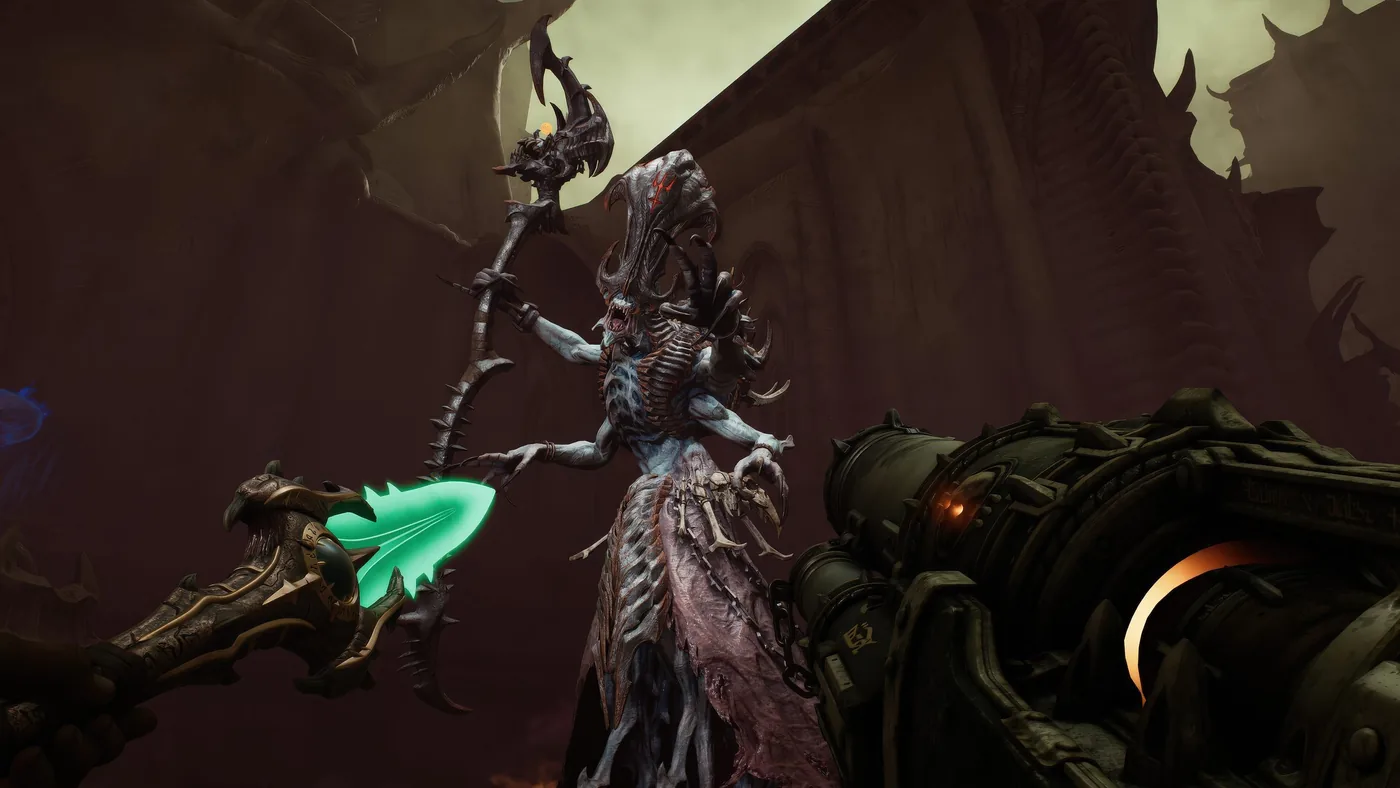
During a media roundtable, game director Hugo Martin detailed the production of DOOM: The Dark Ages – Revelations, describing it as the smoothest development cycle in id Software’s history. Because the team finished primary tasks early, developers had extra time to polish mechanics and hide secrets across the campaign maps. Martin said players still haven’t found everything packed into the expansion. Rather than spreading resources across multiple minor additions, id Software focused on the Chain Spear. The spear introduces fresh mobility options to the heavy combat of Dark Ages, adding a quick dash and a grapple hook [1]. It gives fighters greater tactical control.
Martin and Stratton compared the combat balance of the Chain Spear to putting a jetpack on an Abrams tank, mixing the heavy weight of Dark Ages with the agile speed of Doom Eternal. The Chain Spear includes upgrade paths for ground slams, thrown sniper strikes, and an orbit move that circles enemies. Mastering the weapon takes practice, but it expands skill expression on the battlefield [1].
The expansion also pushes the series into Metroidvania territory, featuring far more backtracking than earlier entries. Martin said levels split into two separate layers on the auto-map, covering 60% base missions and 40% endgame challenges. Players who explore Hell’s Core can discover a pixelated door from the original 1993 Doom, unlocking a retro mission and the classic 1993 shotgun. Story threads discussed for 13 years also reach a conclusion in Revelations, including the arrival of the Wretch, the elusive codex character who crafted the Slayer’s armor in the 2016 reboot. Running roughly 10 to 12 hours, the expansion matches the combined size of both Doom Eternal story packs [1].
Slaughter Mode and Endgame Challenges
To expand post-launch options, id Software announced Slaughter Mode, a free horde mode arriving in November for owners of Revelations or the Deluxe Edition of Dark Ages [1]. The mode gathers 19 combat arenas from the base game, the DLC, and the Repertorium. Players battle randomized waves of demons, choosing whether to bank rewards or risk them for higher multipliers.
Participants earn weapon skins, character cosmetics, and music tracks from Andrew Hulshult’s IDKFA soundtrack as they clear waves with a fully unlocked spear from the start. Martin framed the mode as a way to capture the tension of permadeath challenges in an accessible format, offering weekly challenges and randomized enemy compositions. When reporters asked why id Software did not include a New Game Plus mode for the main campaign, Martin admitted that technical limits tied to level backtracking made the feature impossible to build. Players who want to test fully upgraded gear in older encounters can jump into Slaughter Mode instead, as it pulls fan-favorite battle arenas directly from the base campaign [1]. The design gives players a flexible combat playground.
Stratton said id Software built Slaughter Mode entirely in-house over recent months without outsourcing work, producing the in-engine cinematic trailer internally [1]. The update showed that despite the disruption caused by the id Software layoffs, the remaining developers continue delivering major gameplay updates. id Software is now looking ahead to its next game as it keeps current player communities engaged.
- ONLINE NEWS Palumbo, A. (2026, November 2). id Software’s Marty Stratton downplays studio layoff concerns: “We’re doing great, and we are really bullish about what we have ahead.” Wccftech. [Article Link]
- ONLINE NEWS GameSpot. (n.d.). Doom dev says “we’re doing great” after half the studio was just laid off. GameSpot. [Article Link]
- ONLINE NEWS Saed, S. (2026, November 2). “We’re doing great,” insists Doom and Quake studio boss, despite losing “about half of our studio” amid devastating Xbox cuts. Eurogamer. [Article Link]


