






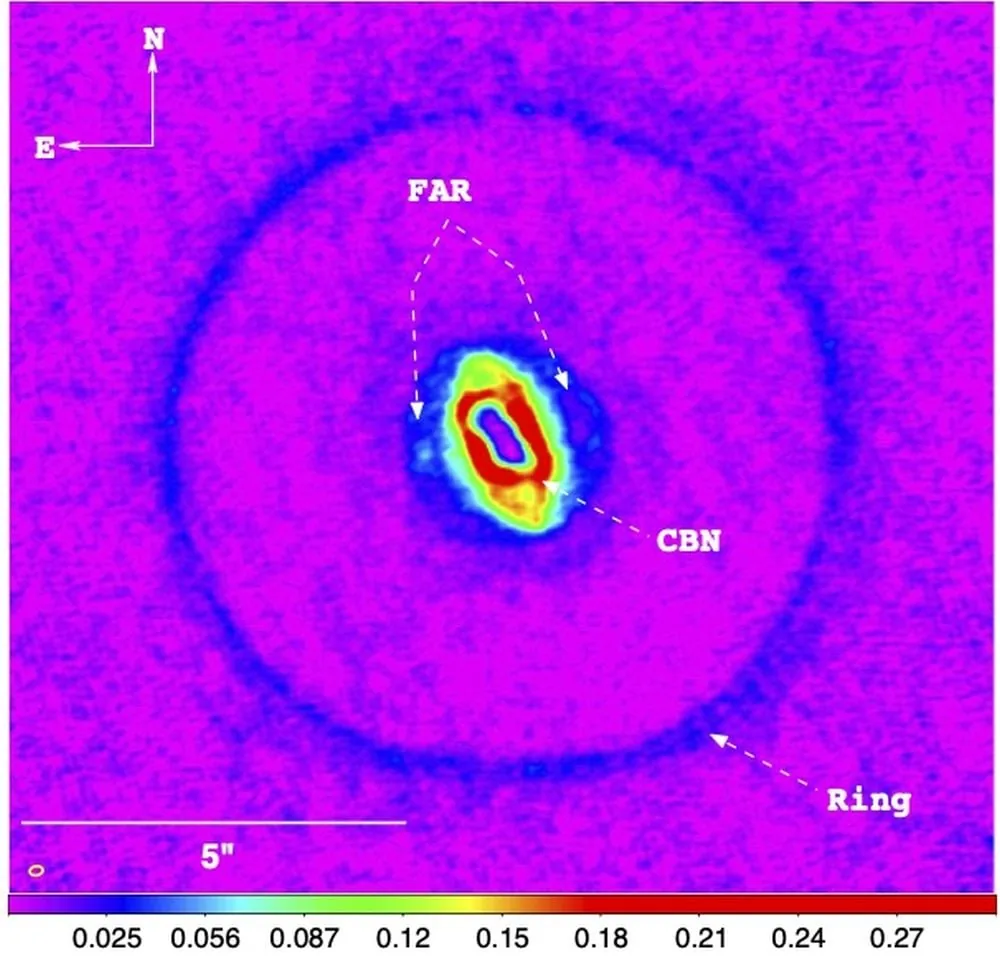
Stars with low to intermediate masses end their lives through a series of brief transitions that reshape the surrounding cosmos. Using the Atacama Large Millimeter/submillimeter Array in Chile, astronomers caught the outer molecular ring of preplanetary nebula IRAS 06530, preserving direct physical evidence of a dying star’s final thermal pulse [1]. The observations show how an ageing carbon star expelled massive amounts of gas about 6,500 years ago before quieting down and entering its current evolutionary phase [2]. By tracing millimeter-wave emission lines from this expanding shell, researchers gained a clear look at the physical processes that govern the final breaths of Sun-like stars.
The Circular Ring of IRAS 06530 Core
Sun-like stars spend billions of years steadily burning hydrogen into helium. As nuclear fuel dwindles in their cores, intermediate-mass stars spanning 0.8 to 8 solar masses swell into red giants and ascend the asymptotic giant branch, or AGB, where recurrent thermal pulses begin casting outer envelopes into interstellar space [1]. These ejections disperse carbon to seed future star and planet formation throughout the Milky Way. In preplanetary nebula IRAS 06530–0213, located roughly 12,000 light-years from Earth, ALMA detected a wide circular ring of gas that marks the final pulse emitted before the star cooled [2]. Lead author Raghvendra Sahai at NASA’s Jet Propulsion Laboratory, who has co-authored over 140 papers, explained that the ring preserves a rare physical snapshot of stellar mass loss [1].
The outer ring erupted roughly 6,500 years ago. Sahai described the structure as a star’s final nuclear heartbeat frozen in gas, capturing a rare evolutionary midpoint between an expanding giant and an ionized planetary nebula that forms once gas spreads thin. “Most of us think of stars as unchanging points of light, but this is a real-time snapshot of a star’s death throes,” said Sahai [1]. High-resolution imaging revealed distinct inner and outer gas zones. Millimeter line observations mapped by ALMA in Chile separated the outer ring from an inner torus and a central bipolar nebula expanding through the core [2].
Mass Loss Before the Post-AGB Transition
Stellar mass loss proceeds in irregular bursts. Data published in The Astrophysical Journal show that the mass-loss rate of the central progenitor in IRAS 06530 dropped steeply right after the final thermal pulse erupted, leaving a relatively calm period lasting roughly 2,000 years [2]. Convective envelopes in giant stars dredge up newly forged carbon from the deep interior [1]. When helium shell flashes occur, strong pulsations blow outer layers into space [2]. Then, a brief surge lasting 1,000 years cast out fresh material before the star detached from its shell [1]. ALMA captured line and continuum emission at wavelengths of 0.44 and 0.88 millimeters, pinpointing cold dust grains and carbon monoxide gas [2].
Based on the expansion speeds and ages of the inner torus and central bipolar lobes, researchers calculated that the progenitor star transitioned to a post-AGB object less than 700 years ago [2]. That represents an eye-blink in cosmic time. While earlier research on white dwarf debris at J1328-1450 examined the cold planetary remnants left behind long after stellar collapse, the new ALMA data capture the brief evolutionary bridge where the outer envelope is actively cast away.
The Puzzle of Missing Companion Stars
ALMA images of the central region revealed complex filamentary arc structures surrounding the bipolar nebula [1]. Astronomers often interpret nested arcs as parts of a three-dimensional Archimedean spiral, which usually forms when an unseen binary companion gravitationally pulls on the outflow from an expanding giant star [2]. Such companions normally pull gas into compact dust disks [1]. Tidal forces from a companion star strip gas from the primary giant, feeding an accretion disk that launches fast bipolar outflows [2].
Yet ALMA detected no central dust disk [2]. Sahai pointed out that while companions often carve hourglass shapes, stellar winds here may produce bipolar lobes without binary help. “IRAS 06530 shows that the story is more complicated than the tidy explanation we’ve been using,” Sahai said about the missing companion [1]. The filamentary arcs show that the star blew out thick, lumpy gas shells on its own. The research team found no point-like radio continuum source at the stellar coordinates [2].


Chemical Clues in IRAS 06530 Gas
The chemical makeup of the gas brought more puzzles. First recognized as a carbon-rich nebula in 2003, the object soon revealed heavy elements forged through the slow neutron capture process [1]. Astronomers mapped its halo and central barrel-shaped torus in 2025, paving the way for ALMA to measure rare molecular isotopes at high spectral resolution. Hot bottom burning normally governs isotopic ratios in massive giants [2].
Spectroscopic data show that the torus holds enriched amounts of carbon-13 and oxygen-17, with elevated nitrogen-15 abundances compared to solar baselines [2]. Standard models predict that nitrogen-15 gets destroyed in stellar cores rather than preserved. Convective currents should destroy nitrogen nuclei at high temperatures [1]. The unusual mix hints at hidden companions or atypical bursts of nuclear burning [2]. “It’s essentially a physical snapshot of an event that, until now, we’ve mostly inferred from theoretical models,” Sahai said regarding the isotopic mix [1].
Tracing Gas Dynamics Across Cosmic Regimes
ALMA’s gas mapping reaches across the universe. In a study in Science Advances, researchers applied millimeter interferometry to W2246-0526, a galaxy seen when cosmic history had elapsed roughly 1.3 billion years. Astronomers mapped ionized carbon emission at 157.7 micrometers and carbon monoxide emission at 216.93 micrometers to track the motion of gas. These spectral tracers allowed researchers to clock gas moving inside a radius of roughly 700 light-years from the core [4].
Those gas motions yielded a mass of 6.5 billion solar masses without needing gravitational lenses [4]. Light from this quasar traveled more than 12 billion years to Earth, stretching its wavelengths 5.6 times [3]. Astronomers successfully separated outward quasar winds from gas pulled inward by gravity [4].
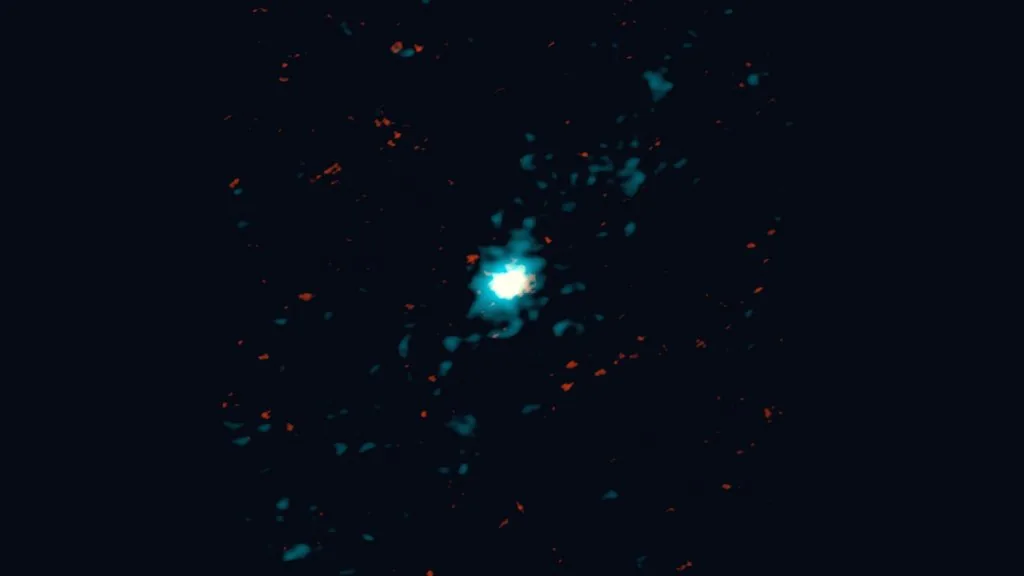
Such measurements anchor black hole growth models. While indirect brightness estimates suggest some quasars harbor holes weighing 36 billion solar masses, tracing cold gas provides direct dynamic proof [3]. The observations demonstrate that ALMA can resolve gravitational spheres of influence in the infant universe [4].
How Dust Clouds Shield Molecular Gas
Dense dust shields cold gas from harsh stellar radiation. In W2246-0526, thick dust absorbs piercing X-rays from the quasar, stopping carbon atoms from losing electrons and keeping key millimeter signals intact [3]. Without that shielding, earlier studies on less obscured quasars failed to detect clear gravitational motion [4].
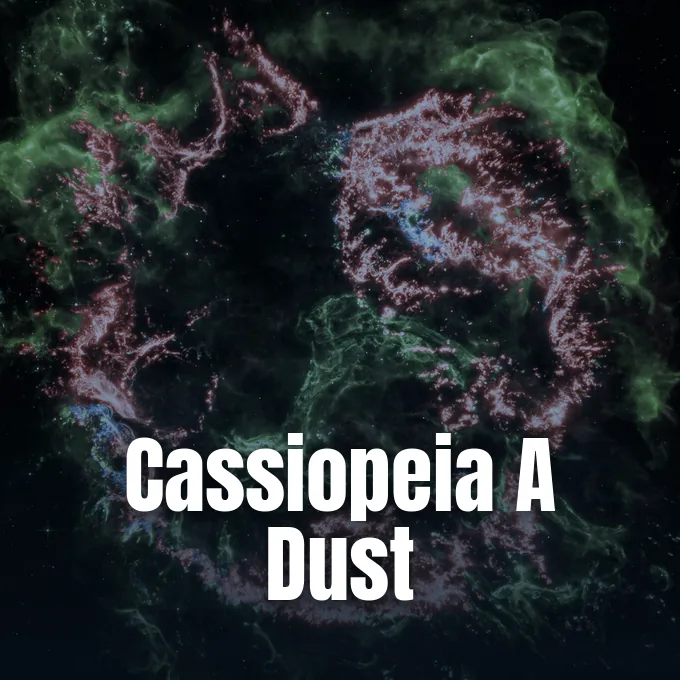
Similar shielding takes place in expanding stellar envelopes, where dust grains protect newborn molecules from ultraviolet light [1]. Tracing expanding shells connects dying stars with broader studies of cosmic dust factories, including work on Cassiopeia A dust shells created in supernova blasts. Whether studying circumstellar gas 12,000 light-years away in the Milky Way or quasars over 12 billion light-years distant, ALMA captures cold gas before intense radiation disperses it into space [3]. Future ALMA surveys will continue probing how dust and binary stars shape cosmic gas flows [2].
- ONLINE NEWS Gough, E. (2026, November 25). ALMA Reveals a Dying Star’s Final Breath, Encoded In a Giant Ring of Gas. Universe Today. [Article Link]
- ACADEMIC JOURNAL Sahai, R., Vlemmings, W., Quintana-Lacaci, G., Kim, H., Alcolea, J., Balick, B., Blackman, E. G., Castro-Carrizo, A., de Marco, O., Kastner, J. H., Lagadec, E., Lee, C., Santander-García, M., Sánchez Contreras, C., Ueta, T., Zijlstra, A. A., Bujarrabal, V., Sabin, L., & Tafoya, D. (2026). The Last Gasps of a Dying Star: ALMA Observations of the Preplanetary Nebula IRAS 06530–0213. The Astrophysical Journal, 1012(2), 173. [Article Link]
- ONLINE NEWS Knowridge. (2026, November 25). Moving gas reveals the mass of an ancient giant black hole. Knowridge Science Report. [Article Link]
- ACADEMIC JOURNAL Liao, M., J. Assef, R., Tsai, C., Aravena, M., Fernández Aranda, R., Blain, A. W., Díaz-Santos, T., Eisenhardt, P., González-López, J., Jun, H. D., Li, X., Li, G., Martin, L. R., Posses, A., Shobhana, D., Solimano, M., Stern, D., Vayner, A., Wu, J., & Zewdie, D. (2026). Resolving the black hole sphere of influence in a hyperluminous obscured quasar at redshift 4.6. Science Advances, 12(47). [Article Link]
APA 7: PerEXP Teamworks. (2026, November 26). ALMA Discovers Dying Star’s Final Pulse in IRAS 06530. PerEXP Teamworks. https://perexpteamworks.com/en/iras-06530-dying-star-gas-ring/


